
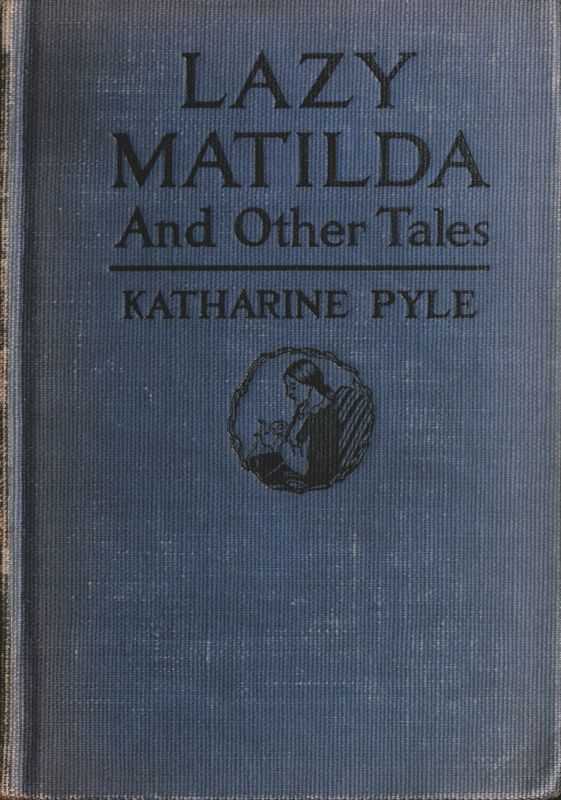
The Project Gutenberg eBook of Lazy Matilda, and Other Tales
This ebook is for the use of anyone anywhere in the United States and
most other parts of the world at no cost and with almost no restrictions
whatsoever. You may copy it, give it away or re-use it under the terms
of the Project Gutenberg License included with this ebook or online
at www.gutenberg.org. If you are not located in the United States,
you will have to check the laws of the country where you are located
before using this eBook.
Title: Lazy Matilda, and Other Tales
Author: Katharine Pyle
Release date: November 4, 2014 [eBook #47283]
Most recently updated: October 24, 2024
Language: English
Credits: Produced by Chris Curnow, Emmy and the Online Distributed
Proofreading Team at http://www.pgdp.net (This file was
produced from images generously made available by The
Internet Archive)
*** START OF THE PROJECT GUTENBERG EBOOK LAZY MATILDA, AND OTHER TALES ***
LAZY MATILDA
and OTHER TALES
and OTHER TALES
“Oh, grandmamma, I’m reading now,”
The lazy Annie said,
“I do not want to leave my book,
Mayn’t Mary go instead?”
LAZY MATILDA
and OTHER TALES
BY
NEW YORK
E. P. DUTTON & CO., INC.
COPYRIGHT, 1921,
BY E. P. DUTTON & COMPANY
All Rights Reserved
Printed in the United States of America
BY E. P. DUTTON & COMPANY
All Rights Reserved
| First printing | September, 1921 |
| Second printing | September, 1925 |
| Third printing | March, 1926 |
| Fourth printing | July, 1930 |
Printed in the United States of America
CONTENTS
| PAGE | |
| Lazy Matilda | 9 |
| The Witch and the Truant Boys | 27 |
| The Visitor | 37 |
| Daddy Crane | 49 |
| Envious Eliza | 63 |
| The Nixie | 75 |
| Stephen’s Lesson | 89 |
| The Caterpillar | 99 |
| Mischievous Jane | 113 |
| The Sweet Tooth | 125 |
| Vain Little Lucy | 139 |
| The Magic Man | 161 |
LAZY MATILDA
Matilda’s kind to pussy cat,
It shows her gratitude for that.
“I FEEL ashamed Matilda
To see you such a shirk!
I really think you’d run a mile
To get away from work.”
So spoke Matilda’s mother
Reprovingly one day,
But Mattie only shrugged and sulked
Soon mother left her then alone,
The door was open wide.
On tip-toes Mattie crossed the floor,
And gaily ran outside.
She left her room undusted,
She left her bed unmade,
Indeed she really was a shirk
I’m very much afraid.
With joy she gaily scampered
Across the meadows wide,
And chased the pretty butterflies
That flew from side to side.
And on and on she wandered
Until she reached a wood,
And there, deep in the shadows
A little grey house stood.
A dwarf was in the doorway,
The door stood open wide,
A lean and hungry-looking cat
Was mewing just inside.
The old dwarf grinned and beckoned,
“Come in, come in,” cried he;
“I need a little servant maid,
And you will do for me.”
“I have no wish to serve you,”
Matilda quickly cried.
But still the old dwarf beckoned her
And made her step inside.
He made her cook the dinner,
He made her work all day.
He watched her close, and left no chance
For her to run away.
The pussy rubbed about her,
“Meow, meow,” said she.
“I’ve been so starved, please look about
And find some scraps for me.”
“Whatever I may have to eat
I’ll always share with you,”
Matilda cried, “for I can see
That you’re unhappy, too.”One day the dwarf sat smoking
Outside the open door,
While Mattie worked about inside
And scrubbed and swept the floor.
“Matilda,” whispers pussy,
“You’ve served me well each day,
And now the dwarf is safe outside
I’ll help you run away.
“The kitchen door is open,
So now be off,” says she.
“Yes,” Mattie whispers, “but suppose
The dwarf should call to me.”
“You needn’t be afraid of that,”
The clever pussy said,
“For even if by chance he calls
I’ll answer in your stead.”
Now little Mattie’s scarcely gone
Before the old dwarf cries,
“Are you at work?” “I’m kneading bread,”
The pussy cat replies.
The old dwarf smoked and nodded,
But soon again he said,
“Are you at work?” “Oh, yes,” cried puss;
“I’m shaking up the bed.”
Again the old dwarf calls her,
“Now what are you about?”
“I’m waiting here to catch a mouse
If only he’ll come out.”
“What’s that?” the old dwarf bellows.
He bounces from his chair,
He rushes in and quickly sees
That only puss is there.
At once he knows the trick they’ve played.
He catches up the broom,
And chases poor old pussy cat
Around and around the room.
“Good-bye to you,” says pussy,
“Indeed, I’ve had my fill,”
And up she bounds and out she goes
Across the window sill.
“Come back! I will not beat you!
Come back, come back!” cries he.
“If I must lose both maid and cat
What will become of me?”
But pussy does not heed him.
Indeed, she’s far away.
She’s followed little Mattie home
And there she means to stay.
Matilda’s now a useful child,
She never tries to shirk,
But helps, with ready cheerfulness,
At any kind of work.
THE WITCH AND THE TRUANT BOYS
John is cleverer than the old witch
And he has her in a trap.
PETER and John, against the rule,
Are playing truant from their school.
With eager steps away they goTo seek a fishing pool they know.
But see a witch is hiding there—
She’ll catch them if they don’t take care.Oh boys! make haste and hurry past!
No—she has caught them tight and fast.And now away with them she hies,
In spite of all their kicks and cries.
She hurries home and shuts the doorAnd then she drops them on the floor.
“These boys are plump and soft,” says she,
“A fine fat meal they’ll make for me.I’ll fill my very biggest pot,
And cook them when the water’s hot.”But while her pot she’s getting out,
The frightened Peter looks about.
He sees the bread trough open wide,And into it he jumps to hide;
Then with a bump he shuts the lid.
And there he lies all safely hid.But the old witch has heard the sound.
And quick she turns herself around.She peers about with blinking eyes,
“Where is that other boy?” she cries.
“He can’t have run away so quick.He must be hiding for a trick.”
“You haven’t treated me so well
That you can think I want to tell,
But if you look outside,” says John,“Maybe you’ll see which way he’s gone.”
The old witch throws the window wide
And leans to look about outside.
But while she’s peering all aroundJohn creeps up close without a sound,
And shuts the window on her tight,
And holds it down with all his might.’Tis vain for her to kick and bawl,
John does not heed her cries at all.“Quick, Peter! Bring me from the shelf
Hammer and nails. Bestir yourself.”
Out from the dough-trough Peter springs;
Quickly he fetches John the things.
“Here they are, brother!” Now, tap-tap!
John drives the nails with many a rap.
He has the window nailed at lastSo tight ’twill hold the old witch fast.
No matter how she squirms and cries,
She can’t get loose howe’er she tries.
But now the little boys are freeTo run on home, as you may see.
I’m sure it will be many a day
Before again from school they stay.As for the witch, if she’s stuck tight
Until this day it serves her right.THE VISITOR
Children should never eat like this,
Although for pigs ’tis not amiss.
JOHN’S manners at the table
Were very sad to see.
You’d scarce believe a child could act
In such a way as he.
He smacked his lips and gobbled,
His nose down in his plate.
You might have thought that he was starved,
So greedily he ate.
He’d snatch for what he wanted,
And never once say “please,”
Or, elbows on the table,
He’d sit and take his ease.
In vain papa reproved him;
In vain mamma would say,
“You really ought to be ashamed
To eat in such a way.”
One day when lunch was ready,
And John came in from play,
His mother said, “A friend has come
To eat with you to-day.”
“A friend of mine?” cried Johnny,
“Whoever can it be?”
“He’s at the table,” mother said,
“You’d better come and see.”
Into the dining-room he ran.
A little pig was there.
It had a napkin round its neck,
And sat up in a chair.
“This is your friend,” his father cried,
“He’s just a pig, it’s true,
But he might really be your twin,
He acts so much like you.”
“Indeed he’s not my friend,” cried John,
With red and angry face.
“If he sits there beside my chair
I’m going to change my place.”
“No, no,” his father quickly cried,
“Indeed that will not do.
Sit down at once where you belong,
He’s come to visit you.”
Now how ashamed was little John;
But there he had to sit,
And see the piggy served with food,
And watch him gobble it.
“John,” said mamma, “I think your friend
Would like a piece of bread.”
“And pass him the potatoes, too,”
Papa politely said.
The other children laughed at this,
But father shook his head.
“Be still, or leave the room at once;
It’s not a joke,” he said.
“Oh, mother, send the pig away,”
With tears cried little John.
“I’ll never eat that way again
If only he’ll be gone.”
“Why,” said mamma, “since that’s the case,
And you your ways will mend,
Perhaps we’d better let him go.
Perhaps he’s not your friend.”
Now John has learned his lesson,
For ever since that day
He’s lost his piggish manners,
And eats the proper way.
And his papa, and mother too,
Are both rejoiced to see
How mannerly and how polite
Their little John can be.
DADDY CRANE
Each child should be content to do
Some useful thing each day,
And not be thinking all the time
Of pleasure or of play.
DADDY CRANE
NED was so fond of swimming
No punishment nor rule
That mother made could keep him long
Out of the swimming pool.
One morning she had set him
To clear a flower bed,
“And do not stop till every weed
Is out of it,” she said.
But oh, that naughty Edward!
She scarce had turned away
When up he rose, and off he ran;
He did not stop nor stay.Soon, naked as a little frog,
With many a joyous shout,
He jumped into the swimming pool,
And kicked and swam about.
But while he played so gaily
Old Daddy Crane, unseen,
Stood watching him, and grinning,
Among the rushes green.
“I’ll wait until that funny thing
Has dressed, and then,” says he,
“I’ll catch him by the trousers seat
And take him home with me.”
Soon, cooled and freshened by his swim,
Young Ned comes splashing out.
In haste he gets into his clothes
And never looks about.
Now Daddy stretches out his neck!
“Oh! Oh,” poor Edward cries,
For Daddy has him in his beak,
And off with him he flies.
Far, far off by a river,
Where no one comes to see,
Old Daddy lives among the reeds,
He and his children three.
’Tis there he carries Edward.
“Look children! Look!” cries he.
“I’ve brought you such a funny thing.
It swims, as you shall see.”
And now with cackling laughter
He throws poor little Ned
Far, far out in the river,
Ker-splash! heels over head.
Then how the young ones clap their wings,
And laugh and dance about,
As, blowing water from his nose,
Poor Ned comes scrabbling out.
“Quick, Daddy, throw him in again,”
The youngsters cry with glee.
“There never was a froggy thing
As comical as he.”
In vain poor Edward struggles.
His cries are all in vain.
No sooner does he get on shore
Than splash! he’s in again.
“Oh dear!” he cries, while water
Is mingled with his tears,
“I’ve had enough of swimming
To last for years and years.”