
- A
- Abbots, 202
- Abeyance, 136
- Actions of debt, 40
- — on the case, 40, 310
- — personal, 301, 315
- — real, 314, 366
- — mixed, 315
- — possessory and petitory, 292
- — to be tried by the judges itinerant, 298
- — of waste, 315
- — of ejectment, ibid.
- Acts of State. See proclamations
- Admiralty jurisdiction, 331
- — court of, 362
- Advowsons of Bishoprics, 78
- — right of nomination, in whom lodged, 79
- — presentative, 81
- — collative, 82
- — donative, ibid.
- — now subsisting in England, 84
- — how forfeited, 85
- Ætius, 46
- Agistment when due to the Clergy, 94
- Aids and subsidies, 174
- Alias writ of, 357
- Alans, 43
- Alarick, 44, 45
- Alexander III., 322
- Alexander Severus, 21
- Alfred makes a law for the payment of tithes, 90
- — his boast of the liberty he transmitted to England, 180
- — divided England into counties, hundreds, and tithings, 198, 245
- Alienation, 66
- — of lands, 80, 81, 146, 147, 148, 149, 150, 153, 157, 161, 384
- — in mortmain, 387
- Allodial. See estates allodial
- Allodians attach themselves to their neighbouring Lords, 114
- Amalfi, a copy of the civil law found there, 180
- Amerciaments, how settled by Magna Charta, 346
- Appeals, where properly to be brought, 301
- Appeal for murder, 186
- Arabs, erect academies for the study of their laws, 8
- Armigeri, 206
- Arresting by mittimus, 369
- — persons not authorised by warrant, 370
- Assemblies, general. The share they held in the government in the 13th century, 33
- — manner of admitting members therein, 34
- — crimes cognizable thereby, ibid.
- Assessors in Germany, 96
- Assize, trial by, 250
- — of novel disseisin, 291
- — writ of, 292
- Athenians, their multiplicity of laws, 4
- Ataulphus, 45
- Athol, Duke of, 193
- Attainder of felony, 348
- Attornment, 119
- Attorney-General, 318
- B
- Bail, superior power in the Court of King’s Bench to take it, 301
- Baron of England, its original import, 187
- — quantum of revenue to qualify for attendance in parliament, 188
- Barons, oppose the arbitrary measures of King John, 339
- — of the Exchequer, 318
- Barones majores & minores, 189
- — their rules of descent, 193
- — minores privileges obtained by writ of election to parliament, 192
- Baronets, by whom first created, 209
- Baronies by tenure, 188
- — long since worn out among the laity, 190
- Barristers at law, 313
- Bastards, 23
- Becket, Thomas a, 322, 327
- Beauchamp, John, the first peer created by patent, 193
- Benefices, or grants of land, wherefore so called, 49
- — improper, 68
- — incorporeal, 78
- Beneficiary law, 23
- — estates, 113
- Berytus, its famous academy, 7
- Bishops, how chosen in the infancy of Christianity, 78
- — their ancient revenue, 80
- — allocate the tithes in aid of the glebe, 81
- — retain the general cure of souls, ibid.
- — their seats in parliament, whence derived, 202, 203
- Bishop’s court, originally joined to the Sheriff’s, 247
- Bishops of Rome, their artful conduct; to obtain the supremacy, 83
- — dismember bishoprics, ibid.
- — attempt to over-rule general councils, ibid.
- — practise upon sovereign Princes, 83
- — encourages of the civil law, 181
- — their bull ineffectual to silence the people of England, when incensed against Richard II., 182, 183
- — assume a dispensing power, 186
- — their views respecting England, 272
- — lord it over the Kings of Europe, 320
- — compel King John to surrender his crown, 338
- — dispose of the English benefices by provisorship, 344
- Blackstone (Judge), 8, 9
- Bodies corporate, 211
- Bracton, 130, 180, 225, 293, 299, 314, 349
- Brevia testata, 60
- Britain, Great. Whence its multiplied laws, 5, 6
- — its peculiar advantages, 6
- Britton, 180, 349
- Brothers, not the heirs one of another, 140
- Brunechild, 111
- Burghers. See Citizens
- Burgundians, 4, 43, 46
- Butlerage of England, 72
- Bye-Laws, 211
- C
- Canon law, 13, 180, 203, 345
- Capias, writ of, 357
- — for a fine, 379
- Capitula itineris, 298
- Castleguard, 50
- Castration, 252
- Celtiberians. See Spaniards, 22
- Census, a tax among the Franks, 47
- Chancellor of England, 249
- — his ancient office, 305
- — derivation of his name, ibid.
- — of the Exchequer, 318
- Chancery, court of, 249, 300
- — ordinary, 304, 310
- — extraordinary, 364, 366
- Chapters, their origin, 80
- Charles I. his claim of ship-money, 172
- — his conduct to the Earl of Bristol, 190
- — raises money by Knights fines, 208
- Charles II. purchases the right of prisage of wines, 73
- — abolishes the feudal system, 68, 134, 150
- Charles the Bald, 114
- Charlemagne, 80, 88
- Charters, 211, 281
- Church benefices stiled improper feuds, 68
- — lands not secured by living evidence, 60
- — secured by brevia testata, ibid.
- — revenue of, how antiently distributed, 80
- Churchmen. See Clergy
- Circuits established by Henry II., 294, 298
- Citizens of London, anciently stiled Barons, 187
- — their original state, 209
- — antiently no part of the body politic, 210
- — admitted to vote along with Knights of the Shires, 211
- Civil law, 12, 13, 170
- — attempted to be introduced by the Princes of Europe, 180
- — and by the Pope, 181
- — became blended with the feudal, ibid.
- — destructive of freedom, ibid.
- — opposed by the English parliament, ibid.
- — openly countenanced by Richard II., 181
- — obligations of a freeman to his patron thereby, 234
- Claudian, 46
- Clergy, their wealth and importance, 52
- — their practice of redeeming slaves, 53
- — divested of their possessions by Martel, 54
- — supported by the voluntary contributions of the people, 78
- — their temporalities how derived, 80
- — feudal tenants to the bishop of their precinct, 81
- — rendered serviceable to the views of the Pope, 83
- — secular, depressed under the Norman Kings, 90
- — the only lawyers in the reign of William II., 91, 273
- — banished the temporal courts, 91
- — celibacy of the, 283
- — the only people that could read and writ, 273
- — dignified, their share in the legislation, 267
- — in France, make one distinct state, 202
- Clothair II., 111
- Clovis, 28, 48, 51, 52
- Coats of arms, 206
- — became hereditary, 290
- Coiff of a Serjeant at law, conjecture about its origin, 274
- Cojudge, 96
- Coke, Lord, 16, 72, 162, 190, 198, 217, 224, 233, 254, 257, 303, 340, 350, 353, 356, 365, 367, 371, 373, 375, 376, 378, 380, 384, 388
- Collation to a living, 82
- Colleges, 86
- Commons, house of, 206, 319
- — its present constitution compared with the feudal principles, 211
- — its advance in privilege and powers, 214
- — whether most inclined to popular or oligarchical influence, 214, 217
- Common Pleas, court of, 300, 312, 316
- Commentaries on the Laws, how multiplied by the Romans at the time of Justinian, 4
- Commoner, his right of excepting against the Sheriffs return of a Jury, 204
- Commerce, its effect in multiplying laws, 3
- — foreign, 153
- — regarded by Magna Charta, 380
- Commune Concilium, further the designs of William the Conqueror, 264
- Commissioners of Customs, 317
- — of Excise, 317
- — Appeals, ibid.
- Companions of the King or Prince, 30
- Constitutions of Clarendon, 203, 275, 325
- Coutumier of Normandy, 271
- Convocation of the Clergy, 276
- Conrad Emperor, 23
- Constable, High, of England, 73
- Constantine Porphyrogenetus, 22, 45
- Convivæ Regis, a title on whom conferred, 51
- Copyhold tenants, 324
- Corvinus, 77
- Cork, kingdom of, 201
- Covassals. See Pares curiæ
- Councils general, 83
- Counts, their origin and employments, 51
- — obtain grants of estates for life, 57, 187
- Counts. See Earldoms
- County court, 104, 247, 248, 296
- Counties their origin, 51
- — Palatine, 199
- Court of wards, 133, 317
- — record, the King’s, its cognizance of covenants to alienate, 149
- — merchant, 156
- — of the constable, 181
- — admiralty, ibid.
- — Tourn, 247, 271
- — Sheriffs. See Sheriff
- — of the hundred, 247
- — Leet, 247, 271
- — Baron, 271
- Courts of Westminster-Hall, 10
- — Ecclesiastical and temporal, their rights settled, 275
- — Martial, 363
- — of Record, what are such, 271
- — not of Record, what are such, ibid.
- Craig, 25
- Cranmer, 92
- Creation money, 199
- Crimes public, what among the Franks, 40
- — how punished, 252
- Cross, sign of it used in the first written instruments, 60
- Curia Regis, judges in that court, 249
- — how appointed by William the Conqueror, 270
- — the foundation of the Lords judicature in parliament, 249
- — their pleadings entered in the Norman language, 270
- — divided into four courts, 300
- Customs paid on merchandize, 173
- — local; origin of several, 297, 273
- D
- Danegelt, 285
- Decretals of the Pope, 320, 321
- Deed poll, 100
- Demesnes, 50
- Demurrer, what, 306
- Derby, Earl of, 193
- Descents by feudal law, to whom, 135
- — law of, 141
- Dioceses, how subdivided into parishes, 79
- Dispensing power, a prerogative claimed by the Stuarts, 186
- — distinct from a power of pardoning, ibid.
- — opposed by the early lawyers, 314
- Distress, what, 65, 100, 101
- — introduced instead of actual forfeiture, 97
- — severity of English Lords in levying it restrained, 101
- — how and where to be levied, 102
- — restrictions in levying it, ibid.
- Duelling, the practice whence derived, 39
- Dukes, 187
- Dyer’s reports, 39
- E
- Earldoms of England, quantum of Knight’s fees assigned thereto, 163
- — how antiently held, 197
- — wherein differing from Barons, ibid.
- — when created, 198
- Earls, 187
- — their authority restricted in the County court, 198
- — Palatine, 187
- — the first created, 199
- Ecclesiastical Courts, 271
- — how separated from the temporal, 275
- — their right of recognizance of suits for benefices annulled by the temporal courts, 276
- — screen their members from the rigour of the law, 276, 322
- — their power of excommunication, 360
- Edgar King, severity of the law enacted by him for payment of tithes, 90
- — division of the Sheriff’s and Bishop’s court in his reign, 247
- Edmundsbury, meeting of the Barons there, 339
- Edward I. his dispute concerning grand serjeanty grants, 70
- — gives in parliament a new confirmation of Magna Charta, 71
- — renounces the taking of talliage, ibid.
- — his action against the Bishop of Exeter respecting homage, 117
- — motives for his conduct, 121
- — the Confessor, his laws, 180
- Egypt, antient method of studying the laws there, 7
- — tithes first introduced there, 87
- Elegit, writ of, 156
- Elizabeth Queen, causes her proclamation to carry the force of laws, 184
- — why submitted to by the people, ibid.
- — her false policy in encouraging monopolies in trade, 185
- — discontinued the granting of protections, 379
- Emma Queen, 40
- Enfranchisement, express, 234
- — implied, 235
- England, how divided by the Saxons, 245
- — divided into circuits by Henry II., 298
- Escheat, 98, 140
- — of the King, 298, 382
- Escuage, 97, 289
- Esquires, their rank, 207
- Estates, allodial, 51, 52, 56, 106, 144, 254
- — of continuance, 57
- — tail, 99, 121, 160
- — beneficiary, 114
- — feudal, not liable to the debts of the feudatory, 146
- Ethelwolf, establishes tithes by law in England, 90
- Evidence, the kind admissible among the Franks before the use of letters, 60
- Exchequer court of, 300, 313, 315
- — ordinary, 317
- — extraordinary, ibid.
- — chamber, 318
- Extent, 155
- Eyre or circuit, omissions of places in first and second, 298
- F
- Fealty, the oath of, 61
- — its obligations, ibid.
- — why not required of the Lords, 64
- Fee simple, 99
- — tail, 99, 121
- Females, their dowry among the Franks, 35
- — the part they bore in the State, ibid.
- — excluded from descent by the feudal law, 135
- — under what limitations admitted, ibid.
- Feud, whence adopted into common language, 118
- Feudal law. See Law
- Feuds improper, 68, &c.
- — advowsons, 78
- — tithes, 86
- — feminine, 142
- Feudum de cavena, 75
- — camera, ibid.
- — soldatæ, 77
- — habitationis, ibid.
- — guardiæ, ibid.
- — gastaldiæ, 78
- — mercedis, ibid.
- Fiefs, 21, 36, 55
- — feminine, 163
- Fine levied on entailed lands, 167
- Fines honorary, 107
- — established as a fruit of tenure, 118
- — abolished at the restoration, ibid.
- — for licence to plead in the King’s court, 250
- First fruits and tenths, 84
- Fictions of law, 304, 315
- Fish weires, 351
- Fleta, 180, 349
- Forest laws, whence derived, 37
- Formedon, writ of three kinds, 161
- Fortescue, 180, 234
- Frank pledge, 247
- Franks, 4, 23, 24, 31, 35, 37, 38, 41, 42, 46, 48, 55
- Freemen, among the Germans, the nature of the allegiance required from them to their Princes, 31
- Free alms, 202
- Furnivall, William, 72
- G
- Gallway, county palatine of, 201
- Gascoigne, Judge, 368
- Gavel-kind, 135, 255
- Gauls, 22, 51, 111
- Gentry, who so called, 206
- — their peculiar privileges, ibid.
- — cause of their military disposition subsiding, 207
- Gentilis homo, its ancient and modern acceptation, 52
- Geoffry of Monmouth, 22
- Germans, their method of deciding disputes by single combat, 39
- — Murder not punished with death among them, 41
- Germany, its condition at the time of the Franks, 32
- — its ancient constitution nearly resembling that of England, 33
- Gilbert, Judge, his opinion concerning the division of courts, 309
- Glanville, 109, 130, 148, 180, 288, 290, 330
- Glebe-land, how obtained by the clergy, 80
- Gold and silver, their use unknown to the Franks, 35
- Goths, 4, 43, 44, 46, 47
- Grand assize, for what purpose invented, 40
- Grandsons, 108, 139, 140
- Grants, the first feudal ones, 50
- — temporary, 56
- — beneficiary, ibid.
- — for life, how obtained, 57
- — improper, 68
- — to women, 74
- — of things not corporeal, ibid.
- — to indefinite generations, 112
- — laws tending to establish them, 114
- — of William the Conqueror to his followers, 163
- — of Knight’s fees, ibid.
- Gregory, Pope, demands homage and Peter’s pence from William the Conqueror, 274
- Gratian, 321
- Guardianship. See Wardship
- H
- Habeas Corpus, 301, 370
- Hale, Sir Matthew, 14, 213, 296
- Heptarchy, 252
- Heriots, 254, 257
- Hearth-money, 134
- Heir in tail, 160
- Heirs of landed inheritance, 136
- Hengist, 179
- Henry I. his charter in favour of the Saxon laws, 281
- — subdues Normandy, 284
- — II. payment in kind commuted into money, 69
- — his quarrel with Pope Alexander II., 322
- — his wholesome regulations, 286, 287
- — III. introduces a dispensing power into England, 186, 344
- — consequences of his neglecting to summon the Barones majores, 189
- — his illegal patent opposed by Roger de Thurkeby, 186
- — his oppressions, 344
- — VI. his mistaken conduct with regard to Ireland, 220
- — VIII. his danger upon throwing off the Pope’s supremacy, 92
- — suppresses the monasteries, ibid.
- — meets a court of Ward, 133
- — obtains from parliament a sanction for his proclamations to bear the force of laws, 184
- Hereford, Earl of, his dispute with Edward I., 70
- Homage, 61
- — when instituted, and how performed, 116
- — fealty, 117
- — warranty, a consequence of homage, 119
- — auncestrel, the import of this term, ibid.
- — duties arising from homage to lord and vassal, 118
- Honorius, 44
- Hugh Capet, 23, 137
- Hunns, 43, 44
- I
- James I. his arbitrary claims, 183
- — mistaken policy in encreasing monopolies, 185
- — institutes a new title of honour, 209
- Independence of the King, the idea thereof entertained by the early Franks, 31
- Inhabitants of Europe, their propensity to the making of new laws, 5
- Innocent III., 334
- Inns of Court, wherefore founded, 6
- — their ancient usefulness, ibid.
- — their present state, 7
- — Institution to a living, 82
- Interdict laid on England by Innocent III., 334
- Investiture proper, 58
- — improper, 59
- — its nature fixes the line of duty, 69
- John, King, mutual hatred between him and his nobles, 110
- — his arbitrary government, 154, 352
- — claims a right of taxation, 177
- — omits summoning some of the Barones majores, 189
- — deprives the earls of the thirds of the county profits, 199
- — supplants his nephew Arthur, 331
- Jornandes, 37
- Ireland, peerages there recovered by petition, 195
- — erected into palatinates, 200
- — form of trial of noblemen in that kingdom, 204
- — the statutes of Edward II. abolished, 209
- — state of legislation there, 218, 222
- — influence of Poyning’s law on its government, 221
- Issue joined, 292
- Italian priests, the chief possessors of benefices in England in John’s reign, 342
- Judges itinerant, 294
- — their jurisdiction, 298
- — of assize, 366
- — judgment, in what instances obtained without the intervention of juries, 354
- Juries, trial by, 251
- — their original power, 247
- — judges of law and fact, 294, 356
- Justice, method of administering it among the Salic Franks, 37
- Justices of Nisi Prius, 248, 299
- — errant, ibid.
- — of assize, ibid.
- — of oyer and terminer, 299
- — of gaol delivery, 248
- — of Quarter Sessions, 248, 366
- — in Eyre, 294
- Judiciary of England, 248, 300
- — discontinued by Edward I., 304
- K
- Kildare, county palatine of, 201
- King’s Bench, court of, 300
- — its power in taking bail, 301
- — suits cognizable therein, 300, 301, 306
- — its peculiar distinctions, 312, 314
- King never dies, origin of that maxim, 139
- Kings elective among the Franks, 28, 29
- — their power, 48, 49
- — Norman, the arms borne by them, 207
- Kings of England, their power anciently limited, 71
- — their right of service from their vassals, ibid.
- — possessed of donatives, 83
- — their ecclesiastical jurisdiction, 84
- — their title to supreme ordinary, whence derived, ibid.
- — their power by the feudal law, 170
- — executive branch of government belongs to them, 171
- — their revenue, 172
- — their supplies for foreign wars, 173
- — their authority, whence derived, 175
- — their proclamations, how far legal, 183
- — their dispensing power, 186
- — their demesnes unalienable, 189
- — their prerogative of summoning the lesser Barons to parliament, 190
- — their right of raising peers to a higher rank, 196
- — their power of settling precedency, ibid.
- — not one of the three estates, but the head of all, 202
- — their right of appointing peers to try an accused nobleman, 204
- — ancient concern in making laws, 217
- — their present influence in framing laws, 218
- — their style when speaking of themselves, 265
- — have no power to create new criminal courts, 377
- Kingsale, Lord, 196
- Knights, origin of that dignity, 34
- — their advantages over the Lords with regard to feudal payments, 109
- — service, 129
- — when abolished, 150
- — fees, 188
- — their privileges by writ of election to parliament, 192
- — their rank, 206
- — their ancient dignity, 207
- — Banneret, 208
- L
- Laity, when excluded from the election of the clergy, 78
- Lands, their property how far alienable among the Jews, 3
- Lands, distributed to the Christians by the General Assembly, 34
- — interest of Lord and vassal therein, 65
- — Saxons, by what tenures they held their lands, 254
- Langton, Legate, 338
- Lateran, council of, 89
- Lawing, 280
- Laws feudal, the foundation of the law of things, 14
- — the foundation of the English constitution, 15
- — method of teaching them, 17
- — their origin and progress, ibid.
- — succeed the Roman imperial law, 19
- — various opinions on their origin, ibid.
- — not derived from Roman laws and customs, 21
- — first reduced into writing by the Lombards, 23
- — their tendency to cherish the national liberties of mankind, 27
- — in England, permit no Lord to be challenged by the suitors, 96
- — allow a power of appeal to the King’s court, ibid.
- — their doctrine of remainder, ibid.
- — respecting warranty, 119
- — wardship, 123, 124
- — their obligations on minors, 132
- Laws positive, or general customs, always to be found in communities however barbarous, 1
- — a knowledge of them a means of procuring respect and influence, 2
- — of things and persons, which to be first treated on, 14
- — few and intelligible in small societies, ibid.
- — when necessarily numerous and extensive, ibid.
- — inconveniencies attending their multiplicity, 3
- — of what kind in Rome at different periods, 4
- — their great increase in Europe since the, 14th century, 5
- — of Normandy, respecting the marriage of females in wardship, 129
- — of England, advantages attending a knowledge of them, 8
- — what required by them in transferring possessions, 74
- — its maxim respecting the devising of lands by will, 145
- — how enacted, 217
- — their ancient method of passing, ibid.
- — their tendency to promote liberty, 234
- — alterations introduced in them by Henry II., 289
- Lawyers, 3
- Laymen, how far exercising ecclesiastical discipline, 48
- — tithes granted to them in fee, 89
- — by what means possessed of lands discharged of tithes, 92
- Legates of Rome, 83
- Leinster, county palatine of, 201
- Letters Patent for creating of Peers, 190
- — when took place, 193
- — grants by them, how forfeited, 194, 195
- — anciently called Chartæ Regis, 305
- — repealable by the Lord Chancellor, ibid.
- Lex Terræ, what, 355
- Licences to marry, 131
- Liberty of the subject, how advanced, 313
- — how ascertained, 333
- Littleton, 14, 15, 61, 73, 116, 124, 225, 229
- Livery and seizen, 58, 59
- Locke, Mr., 12
- Longchamp Archbishop of Canterbury, 330
- Lords feudal, their power over minors respecting marriage, 129
- — respect paid by them to the person of their King, 171
- — their power over their villeins, 224, 232
- — of parliament in England, their rank, 187
- — created by writ, or letters patent, 190
- — privilege to their eldest sons, 192
- — their titles extinct on surrender, 195
- — their quality as noblemen, 187
- — spiritual, 202
- — lay, their form of trial, 204
- Lombards, 4
- Lupus, Hugh, 199
- Lycurgus, 3
- M
- Markham, sir John, 368
- Maud, 282, 284
- Magna Charta specifies the quantum to be paid in relief, 110, 290
- — misconstrued in the right of Lords to the disposal of minor heirs in marriage, 130
- — restrains the alienation of lands, 150
- — its designs, 154
- — abolishes the right of talliage, 154, 171, 175
- — summons to parliament settled thereby, 189
- — its regulations of fines in the King’s court, 250
- — abolishes the removal of the courts of justice, 312
- — commentary thereon, 343 to the end
- Manors how distributed by William the Conqueror to his followers, 163
- Marriages, 133
- Marshal, Earl, of England, 72
- Maritime court. See Admiralty
- Mascon, council of, 88
- Master of the Rolls, 310
- Masters in Chancery, 309
- — empowered to frame new writs, ibid.
- Maxim of Law, 306, 341
- Measures and weights, 351
- Meath, county palatine of, 201
- Merchant stranger, 174, 380
- — denizen, 174
- — enemies, 381
- Military system (Old) its influence on law, 4
- — power, danger of its subverting the civil and legal authorities, 95
- — benefices, their rise among the Saxons, 261
- — tenures, their service lightened by Henry II., 288
- — abolished by Charles II., 150
- — courts, 360
- Minor heirs male, when deemed of age, 123
- — in chivalry, when deemed of age, 124
- — in socage, when deemed of age, 128
- — female, in chivalry, when deemed of age, 124
- — their marriages, how controuled by their Lords, 129
- — when released from wardship, 132
- Mittimus, essentials to render it legal, 369
- Modus, payment of tithes by a, 91
- Monarchy of France, 55, 56
- — of England, its nature ascertained by the feudal laws, 16
- — how changed, by estates becoming hereditary, 170
- Monasteries, the firmest support of papal power, 83, 88
- — tithes improperly applied to their use, 89
- — raised on the suppression of the secular clergy, 91
- Money, its present decreased value, 69
- Monopolies, 185
- Montesquieu, 2, 28, 31, 38, 53, 178
- Moses, 3, 7
- Mowbray, Lord, 192
- Murder, why not punished with death among the ancient Germans, 41
- — how punished by the Saxons, 252
- N
- Neif, 227, 230, 232
- Nisi Prius, Justices of, 248
- Norfolk, Earl of, his dispute with Edward I., 70
- Northern nations become formidable to the Roman empire, 43
- Notorieties of a fact, how regarded in feudal grants, 60
- O
- Oath of fealty, from whence to be traced, 31
- — taken by the Saxons, 259
- Officers of Courts, where to be sued, 318
- Officina brevium, 306
- Oleron, laws of, 331
- Oligarchy introduced into England, 182
- Ordeal trial among the Franks, 37
- — continued after the Norman conquest, 40
- Ormond, Earl of, 201
- — Duke of, 133
- Overbury, Sir Thomas, 374
- Outlawry, 356
- — proclamation to be made by statute, 31st Elizabeth, 358
- P
- Païs des coutumes, 52
- — de loi ecrite, ibid.
- Pares curiæ, 58, 59, 96, 116, 119
- Paris, Matthew, 186, 188
- Parliament of England, its ancient constitution, 187, 193, 202, 213
- — its judicature, 319
- Patron, lay, his interest in presentative advowsons, 81
- — inverted with donatives by grants from the Pope, 83
- — possessed a power of deprivation, 85
- Peer. See Lords of Parliament
- Peeress, who are her peers, 353
- Pelagius, 143
- Pembrige, Sir Richard, 373
- Pepin, 113
- Persian Empire, 43
- Pembroke, Earl of, 343
- Philip of France, 332, 338
- Plantagenets, 209
- Pleas of the crown, 301
- Pole, Michael de la, 193
- Popes. See Bishops of Rome
- Posse of the county, 292
- Possessions, corporeal, 74
- — incorporeal, 74, 78, 87, 95
- Pounds overt and covert, 103
- Precedence of Peers, how settled by parliament, 196
- Primogeniture, 137
- Prisage of wines, 73
- Privileges of the subject, whence derived, 16
- — of the distinct parts of the legislature, 217
- Privileged persons, how to be sued, 307
- Proclamations royal, when and how far legal, 183
- — conduct of Henry VIII. relative to them, 184
- — their force in the reign of Elizabeth, ibid.
- — baneful consequences attending the arbitrary use of them, 185
- Professors of Laws, 13
- Property, its division, 35
- — of lands, where lodged by the Franks, ibid.
- Provisorship, 344
- Provosts, 210
- Punishments inflicted by the ancient courts of law, for public and private wrongs, 251
- — for false imprisonment, 370
- Purbeck, Lord, 194
- Purchases new, how descendible, 144
- Purveyance for the King, 256, 257
- Q
- Quo Warranto, writ of, 301
- R
- Rachat, or Repurchase, 110
- Raleigh, Sir Walter, 376
- Ranks of the people in the Saxon times, 253
- Ravishment of wards, 132
- Record, matter of, 306
- Records of France, lost at the battle of Poictiers, 312
- Recognizance, 155, 308
- Rectorial tithes. See Tithes
- Register of writs, 309
- Refuting the fief, 145
- Reliefs or fines, 107
- — wherein burdensome to the tenant, 109
- — altered by Henry II., 290
- — fixed by Magna Charta, 110
- — and heriots, their difference, 257
- Remainder derived from a reversion, 96
- Rent charges, 99
- Replevin, 104
- Reversion, right of, in land, 96
- — fealty and service incidental thereto, 97
- — on contingency, ibid.
- Richard I., 329, 332
- Richard II., 181, 183
- Right of entry for possession, 59, 65
- — action, ibid.
- Rome, its famous academies, 7
- — taken by the Goths, 45
- Roman imperial law, 19
- — empire, 42
- — emperors, 186
- — estates, 51
- — patron and client, 19, 20
- Romans, their policy respecting conquered nations, 22
- — become socage tenants to the church, 54
- — their condition under the Franks, 111
- S
- Salic Law, 52
- Sergeanty, grand, 70
- — various kinds, 72
- — the rank capable of performing it, ibid.
- — for what purposes granted, ibid.
- — butlerage held thereby in the family of Ormond, 73
- — petty, ibid.
- Satisfaction for petty crimes, how regulated by the Franks, 41
- Saxons, the nature of their primitive laws, 4
- — their government in England, how far feudal, 33, 212, 243
- — admit the ordeal trial in determining causes, 40
- — the authority of their Kings, whence derived, 179, 180
- — their courts of law, 246, 250
- — method of trial therein, 250, 251
- — punishments inflicted, 252
- — nature of their tenures, 254, 265
- Scire facias, writ of, 219, 305
- Scotland, method of studying the law there, 18
- — its parliament not divided into two houses, 202
- Seal, used in the first written instruments, 60
- Sealing of instruments, why more strictly authenticating them than signing, 273
- Seignory, 95
- Sergeants at law, 313
- Service from a tenure, how dependant on the nature of the grant, 96
- — when required by the lord, 97
- — rent, 98
- — made rent seck by statute Edward I., ibid.
- Sharrburn, Edwin, his lands restored by William the Conqueror, 264
- Sheriffs, their power in making replevins, 104
- — method of proceeding thereon, ibid.
- — appointed to restrain the power of the Earls, 199
- — nature of their court, 246
- — nature of their court altered by William the Conqueror, 272
- — their ignorance of law, 296
- Socage tenures, their increased value, 70
- Socage tenants, 47, 224, 289
- — nature of the grants to them, 50
- — subject to distress instead of forfeiture, 97
- — relief paid by them to their lords, 110
- — lands granted for life, 57
- — free and common, 72
- — petty sergeanty, 73
- — its derivation, 69
- Society political, for what purposes instituted, 1
- — the obligations which it lays on individuals, ibid.
- Sons, the inheritance obtained by the eldest, 137
- — succeeded equally to the father, 135
- Spaniards, 22
- Special verdict, 356
- Spelman, Sir Henry, 13, 198, 258
- Statute of Ethelwolf, 90
- — Alfred, ibid.
- — Edgar, ibid.
- — Edward I. quia emptores terrarum, 99, 146, 149, 384
- — Edward I. de donis, 121
- — 34th Edward I., 211
- — 17th Edward II. de prerogativa regis, 150
- — for compounding a Knight’s fee, 208
- — of Marlebridge, 101, 103, 104, 345
- — respecting knighthood conferred on minors, 124
- — of Merton, 131
- — Westminster I., 132, 368
- — Westminster II., 132, 159, 309
- — Mortmain, 151
- — Merchant, 154
- — of writ of elegit, 156
- — Elizabeth concerning bankrupts, 157
- — concerning outlawry, 358
- — of William the Conqueror, 265
- — 8th Henry VI. chap. 5., 216
- — Poyning’s, 221
- — 28th Henry VIII. suspending Poyning’s law, 222
- — Philip & Mary respecting Ireland, ibid.
- — ancient and present, manner of enacting them, 217
- Stewardship, High, of England, 72
- Stephen, King, 284
- Stilicho, 44, 45
- Strange, Baron of, 193
- Strongbow, 201
- Stuart, house of, 183
- Study of the law in Great Britain, 6
- — proper method, 7
- — causes of difficulty therein, 12, 13
- — reasons for beginning with the law of things instead of that of persons, 14
- — promoted by fixing the courts of justice, 313
- Substitute, when allowed in aid from a vassal, 64
- Subvassals, 33, 57, 65
- Succession royal by descent, 137, 138, 139, 143
- — collateral, 139, 140
- — to estates, how rendered hereditary, 107, 110, 144
- — of sons to the father, 135
- T
- Tacitus, 27, 28, 30, 31, 32, 35, 36
- Talliage, 71, 153, 173, 174
- Taxes, how assessed, 174
- Tenants by sufferance, 50
- — allodial, 111
- — not allowed to alienate, 118
- — copyhold, whence derived, 238
- — when subject to fines to their lord, 239
- — their power of alienation, how restricted, ibid.
- — in frankalmoine or free alms, 267
- — in capite, 383
- Toga virilis, what, 34
- Tenures feudal. See fiefs
- — subject to fealty, 57
- — military, how forfeited, 65
- — when abolished, 68
- — of the crown, obligations therefrom, 187
- — hereditary, 65
- — the nature of those now held, 69
- — Saxon, 254
- — in ancient demesne, 224, 241, 288
- Temple, the, granted to the practitioners of the law, 313
- Thanes, 253, 258
- Tipperary, its palatinate, 201
- Tithes introduced among the Franks by Charles Martel, 54
- — when established by law, 80
- — allocated from the bishop to the parish priest, 82
- — an incorporeal benefice, 86
- — originally what, 87
- — first introduced in Egypt, ibid.
- — how distributed there, ibid.
- — how rendered compulsory, ibid.
- — forgeries concerning them, 88
- — divided into rectorial and vicarial, 89
- — how paid in England during the heptarchy, ibid.
- — when made payable to the parish priest, 91
- — monastery lands exempted from them, ibid.
- — settled by a modus, ibid.
- — Cranmer’s intention concerning them, 92
- — when established in England on the footing they now stand, 93
- — their three kinds, ibid.
- Transportation, 273
- Traders and artizans admitted into the general assembly of the people in the thirteenth century, 34
- Treasurer of England, 249
- — presided in the Exchequer court, 300
- Trinoda necessitas, 256, 264
- Trial, methods of, among the old Germans, 37
- — received into England, 39
- — by witness, ibid.
- — ordeal. See Ordeal
- — by negative proof, 40
- — by battle, 250
- — by grand assize, 251
- — by juries, ibid.
- — by deposition, 353, 364
- Tudor, house of, 183, 209
- U
- Vandals, 45
- Vassals (military) their connections with their king, 31
- — bound by an oath of fealty for life, 56
- — immediate of the king, who, 65
- — now represented by the parliament, 62
- Villein-land, 226
- Villein, a name given to slaves and servants, 47
- — nature of the grants made to them, 50
- — whom reduced to that state, 174
- — feudal, 224, 225
- — their property, 226
- — when allowed to bring actions against their lord, 229
- — their right of purchasing land, 227
- — power of their lords over their property, 228
- — causes of their decrease in England, 237
- Villenage, how destroyed and suspended, 232
- Ulster, county palatine of, 201
- Uncle, the heir of his grand nephew, 139
- University of Dublin, its situation for the study of the law, 12
- — of Oxford, 10
- Universities, 7, 11, 12
- Voucher, appearance upon, 65
- Uses, doctrine of, 151, 241
- Usury, 4
- Uses and Trust, 388
- W
- Wager of the law, 40, 250, 352
- Wages to members of parliament, how to be levied, 101
- Wardship in chivalry, laws respecting it, 123, 126
- — in socage, 127
- — how differing from wardship in chivalry, 128
- — obligations on the guardian, ibid.
- — penalty on marriage without the consent of the lord, 129
- — its evils, 133
- — not comprehended in Saxon tenures, 261
- Warranty, 119
- — collateral, 164
- Warwick, Earl of, 133
- Waste, committing of, 66
- William the Conqueror, 137, 163, 212, 258, 262, 264, 266, 267, 268, 270, 273, 274
- — Rufus, 278
- Wills and testaments, unknown to the Franks, 35
- — lands not devisable thereby, 145
- — how rendered devisable, 151, 152
- — required to be in writing, 152
- — further requisitions, ibid.
- — copyholds not devisable thereby, 240
- Wiltshire, John, 72
- Wittenagemots of the Saxons, 180, 212
- Wright, 265
- Writ of chancery to recover by replevin, 104
- — election to parliament, 190, 191
- — error, 200, 316
- — nativo habendo, 231
- — assize, 293
- — false judgment, 297
- — scire facias, 219, 305
- — original, 308
- — by a master in chancery, 309
- — de odio & atia, 351
- — of capias, 357
- — alias, ibid.
- — pluries, ibid.
- — exigent, 358
- — entry, 365
- — de homine replegiando, 371.
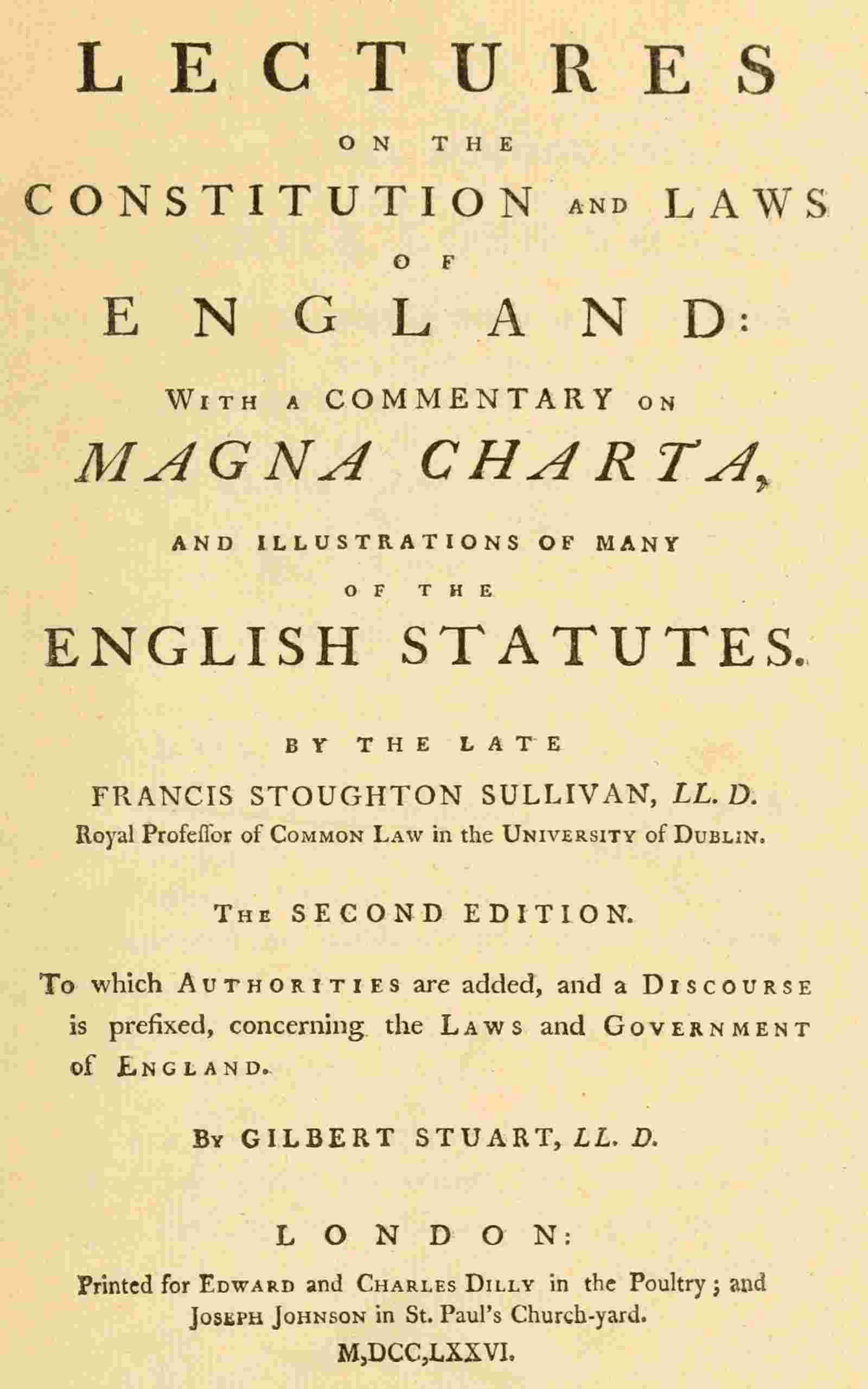
Lectures on the constitution and laws of England / With a commentary on Magna Charta, and illustrations of many of the English statutes
Explore more books like this:
About This Book
A series of university lectures examines the development and operation of English constitutional and statutory law, offering a commentary on a foundational charter and illustrations of many statutes. The text traces the institutional origins of feudal customs in the post‑Roman and Germanic migrations, explains tenure and property concepts such as investiture, fealty, various kinds of grants and serjeanty, and describes legal procedures and sanctions. It compares simple early legal systems with the complexity of later laws, and concludes with methodological guidance and authorities intended to aid students studying the common law and constitution.