
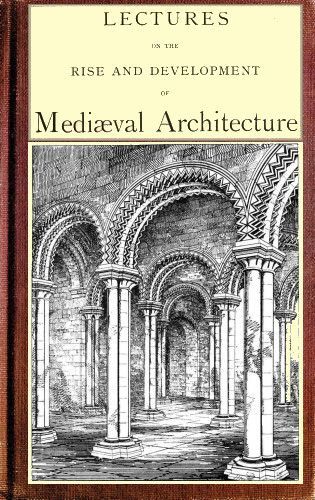
Lectures on the rise and development of medieval architecture; vol. 1
Explore more books like this:
About This Book
The lectures trace the revival and growth of medieval architecture from the post‑Roman decline through Romanesque forms into the Pointed manner, emphasizing the Western Church and the Eastern Empire as preservers and transmitters of building tradition. They survey early northern and continental schools, revival efforts by later rulers, and notable early monuments, then analyze technical systems—arcuated versus trabeated construction—and vaulting types such as barrel, groined, and sexpartite bays. Structural innovations are shown to drive stylistic change: the shift from semicircular to pointed arches, the use of flying buttresses, and the development of rib-work are treated as responses to practical statical problems rather than purely aesthetic choices.
About the Author

More Books by This Author
You May Also Like
 A architectura religiosa na Edade Média
by Augusto Fuschini
A architectura religiosa na Edade Média
by Augusto Fuschini
 A B C of Gothic Architecture
by John Henry Parker
A B C of Gothic Architecture
by John Henry Parker
 A Guide to Peterborough Cathedral / Comprising a brief history of the monastery from its foundation to the present time, with a descriptive account of its architectural peculiarities and recent improvements; compiled from the works of Gunton, Britton, and original & authentic documents
by George S. Phillips
A Guide to Peterborough Cathedral / Comprising a brief history of the monastery from its foundation to the present time, with a descriptive account of its architectural peculiarities and recent improvements; compiled from the works of Gunton, Britton, and original & authentic documents
by George S. Phillips
 A guide to the Cathedral Church of Saint John the Divine in the city of New York / Fifth Edition
by Edward Hagaman Hall
A guide to the Cathedral Church of Saint John the Divine in the city of New York / Fifth Edition
by Edward Hagaman Hall
 A History of Architecture in all Countries, Volume 1, 3rd ed. / From the Earliest Times to the Present Day
by James Fergusson
A History of Architecture in all Countries, Volume 1, 3rd ed. / From the Earliest Times to the Present Day
by James Fergusson
 A History of Architecture in All Countries, Volume 2, 3rd ed. / From the Earliest Times to the Present Day
by James Fergusson
A History of Architecture in All Countries, Volume 2, 3rd ed. / From the Earliest Times to the Present Day
by James Fergusson