
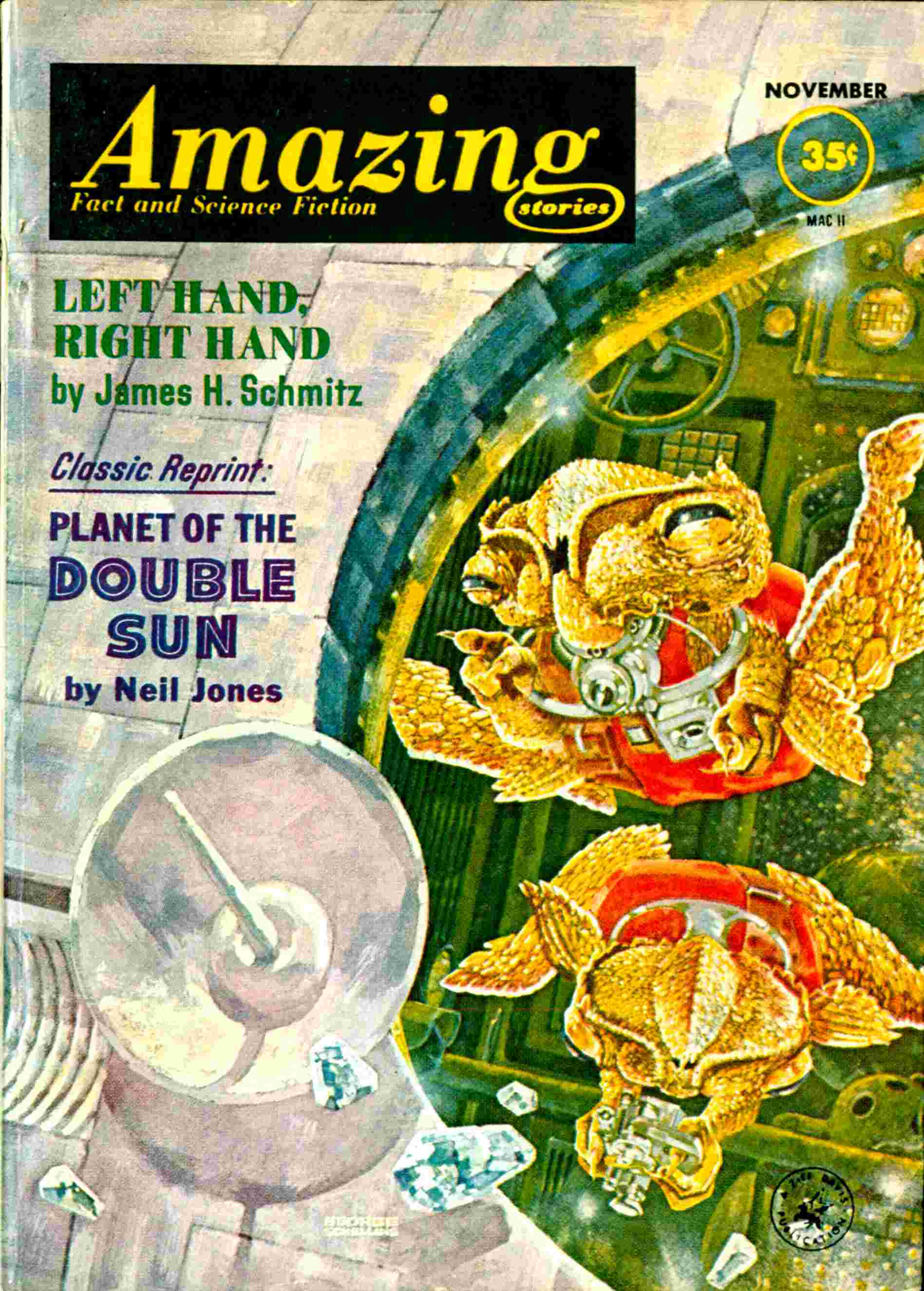
The Project Gutenberg eBook of Left hand, right hand
Title: Left hand, right hand
Author: James H. Schmitz
Illustrator: George Schelling
Release date: November 30, 2023 [eBook #72272]
Language: English
Original publication: New York, NY: Ziff-Davis Publishing Company, 1962
Credits: Greg Weeks, Mary Meehan and the Online Distributed Proofreading Team at http://www.pgdp.net
LEFT HAND, RIGHT HAND
By JAMES H. SCHMITZ
Illustrated by SCHELLING
Men were tortured ... men were killed ... and the Earth
Scientists chatted pleasantly with the Tareeg. Were
they traitors or were they waiting for The Ice Men?
[Transcriber's Note: This etext was produced from
Amazing Stories November 1962.
Extensive research did not uncover any evidence that
the U.S. copyright on this publication was renewed.]
Jerry Newland was sitting up on the side of his bunk, frowning at the floor, when Troy Gordon came quietly into the room and stopped at the entrance to watch him. Not too good, Troy thought after a moment, studying Newland's loose mouth, the slow blinking of the eyes and the slumped immobility of position. Not too bad either—not for a man who, in most practical respects, had been dead for the better part of three years and come awake again only the day before.
But the question was whether Newland was going to recover quickly enough now to be of any use as an ally.
Troy moved forward a few steps into the room, stopped again as Newland raised his head in a sluggish motion to stare at him. For a few seconds, the man's face remained blank. Then he grinned. A strained, unpleasant-looking grin, but a grin.
Troy waited. Newland cleared his throat, said, "I ... I recognized you almost immediately this time! And ... I remembered that this same thing had happened before."
Troy grinned, too, guardedly. "My coming into the room this way?"
Newland nodded.
"It happened yesterday," Troy said. "What's my name?"
"Troy Gordon."
"And yours?"
"Jerry Franklin Newland."
"What do you do?"
"Do?... Oh!" Newland drew a deep breath. "I'm courier pilot for the ... for the...." He stopped, looking first surprised, then dismayed. Then his face wrinkled up slowly, like that of a child about to cry.
"That part's gone again, eh?" Troy asked, watching him.
"Yes. There's some ... there's...."
"You are—or you were—courier pilot for the Cassa Expedition," Troy said. He thumped his heel on the floor. "That's Cassa One, underneath us. We've been away from Earth for three years and eight months." He paused. "Does that help?"
Newland reflected, frowned. "Not much. I ... it seems to be true when you say it." He hesitated. "We're prisoners, aren't we?"
"Uh-huh," he answered, flatly.
"I had that feeling. And you're hiding me here?"
"That's right," Troy agreed.
"Why?"
"Because nobody else knows you're still alive. It's better if they don't, right now."
Newland shook his head, indicated a sign fastened to the ceiling above the bunk in such a way that a man lying in the bunk on his back would catch sight of it as soon as he opened his eyes. "That," he said, "made sense as soon as I saw it just now! I remembered having read it before and what it meant. But otherwise everything's still badly blurred."
Troy glanced up at the sign. It read:
RELAX AND TAKE IT EASY, JERRY! YOU WERE IN A BAD SMASH-UP, AND YOU'VE JUST FINISHED A LONG STRETCH IN THE EMERGENCY TANK OF YOUR SHIP. EVERYTHING'S BOUND TO SEEM A LITTLE FOGGY, BUT YOU'RE GOING TO BE OKAY. DON'T TRY TO LEAVE THE ROOM. IT HAS TO BE KEPT LOCKED, BUT SOMEONE WILL BE ALONG TO SEE YOU IN TWO OR THREE HOURS AT THE MOST.
Troy said, "Your memory will start coming back fast enough. You've made a good start." He sat down, took his cigarette case from his pocket. "I'll go over some of the things that have happened with you. That tends to bring them ... and other things ... back to mind. Care to smoke?"
"Yes, I'd like to smoke."
Troy tossed the cigarette case over to the bunk, watched the pilot reach for and miss it, then bend forward awkwardly to fumble for it on the floor. Reflexes still very bad, he thought. But when Newland had the case in his hand, he flicked it open without hesitation, took out a cigarette and closed the case, then turned it over and pressed the button which snapped on the concealed light. The day before, he had stared at the case helplessly until Troy showed him what to do. So his body had begun to recall more of its learned motion patterns.
Troy said, "I told you the main parts twice yesterday. Don't let that worry you ... you've retained more than most would be likely to do after a quarter of the time you spent in the tank. You weren't in very good shape after the smash-up, Jerry!"
Newland said wryly, "I can imagine that." He drew on the cigarette, coughed, then tossed the case back to Troy who caught it and put it in his pocket.
"Have you got back any recollection at all of what the aliens that caught us are like?" Troy asked.
Newland shook his head.
"Well," Troy said, "they're downright cute, in a way. More like big penguins than anything else. Short little legs. The heads aren't so cute ... a hammerhead shark would be the closest thing there, which is why we call them Hammerheads—though not when we think some of them might be listening.
"They don't belong here any more than we do. They came from another system which is a lot closer than Sol but still a long way off. Now, we aren't the first Earth people to get to Cassa. There was an Earth survey ship poking around the system about twenty years ago, and it seems that the Hammerheads also had an expedition here at the time. They spotted our survey ship but weren't spotted themselves, and the survey ship eventually went back to Earth short two of its men. Those two were supposed to have got lost in the deserts on Cassa. Actually, the Hammerheads picked them up ... Jerry?"
The pilot's head was beginning to nod. He straightened now and took a puff on the cigarette, grinning embarrassedly. "S'all right, Troy!" he muttered. "Seemed to get ... sort of absent-minded there for a moment."
Which was, Troy knew, one of the symptoms of the re-awakening period. Newland's mind had been shut away from reality for a long time, wrapped in soothing, vaguely pleasant dreams while the emergency tank went about the business of repairing his broken body. The habit of unconscious retreat from his surroundings could not be immediately discarded, and particularly not when the surroundings were as undesirable as those in which Newland now found himself. It would be better, Troy thought, to skip some of the uglier details ... and yet he had to tell the man enough to make him willing to cooperate in what would be, at the very least, a desperately dangerous undertaking.
He said, "You're still only three-quarters awake, Jerry. We have to expect that. But the closer you listen and the more information you can absorb, the faster you'll shake off the cobwebs. And that's important. These Hammerheads are a tough breed, and we're in a bad spot."
Newland nodded. "I understand that much. Go ahead."
"Well," Troy said, "whatever that first Earth survey ship had to report about the Cassa system looked good enough so that the administration put Cassa down for a major expedition some day. Twenty years later, we got here again—the interstellar exploration carrier Atlas with eight hundred men on board. I'm one of her engineers. And we found the Tareegs—that's what the Hammerheads call themselves—waiting for us. Not another bunch of scientists and assistants but a war-party. They'd learned enough from the two survey ship men they'd caught to figure out we'd be coming back and how to handle us when we got here.
"Now get straight on a few things about the Hammerheads, Jerry. Their weapons systems are as good or better than ours. In other ways, they're behind us. They've got a fair interstellar drive but can't make the same use of it we do, because they've still a lot to learn about inertial shielding. They have a couple of robot-directed interstellar drones standing in a hangar a few hundred yards from here which can hit half the speed of your courier, but no Hammerhead or human being could ride 'em up and live. The two big carriers that brought them to Cassa One are dead-slow boats compared to the Atlas. And that's about the best they have at present.
"Just the same, they're out to get us. War is the best part of living as far as they're concerned, and they're plenty good at it. So far they've only been fighting among themselves but they're itching for a chance at another race, and now we're it. Capturing an Earth expedition in the Cassa System was only part of the plan to take Earth by surprise."
Newland blinked, said slowly, "How's that? You'd think that might tip their hand. We'll be missed, won't we?"
"Sure we'll be missed," Troy said. "But when? We were to stay here eight years ... don't remember that either, eh? The Hammerheads will have all the time they need to be set for whoever comes looking for us eventually."
"But would they know that?"
Troy said bitterly, "They know everything about Earth that our top brass scientists of the Cassa Expedition were able to tell them. Pearson and Andrews—those names mean anything? They were the Expedition Chiefs when we were captured. One of the first things the Hammerheads did was to have the science staff and other department heads look on while they tortured those two men to death. As a result, they've had all the cooperation they could ask for—more than any decent human being would think of giving them—from our present leadership, the senior scientists Dr. Chris Dexter and Dr. Victor Clingman. They're a couple of lousy traitors, Jerry, and I'm not sure they're even capable of realizing it. Clingman's in charge here at the ground base, and he acts as if he doesn't see anything wrong in helping the Hammerheads."
"Helping the...." Vacancy showed for a moment in the pilot's expression; he frowned uncertainly.
"Try to stay awake, Jerry! There're just a few other things you should try to get nailed down in your memory this time. The Hammerheads are water animals. They can waddle around on land as long as they keep themselves moist, but they don't like it. They've got a religion based on a universal struggle between water and land. Cassa One's nothing but hot desert and rock and big salt beds, so it's no good to them. And the other two planets in the system have no oxygen to speak of.
"Now here's the thing that's hard to swallow. There's a huge lumped-up asteroid swarm in the system. The Atlas stopped for a few days on the way in to look around in it. Dexter and Clingman, after we'd been captured, volunteered the information to the Hammerheads that a lot of that stuff was solid H2O and that if they wanted Cassa One fixed up the way they'd like it—wet—the Atlas could ferry enough asteroid ice over here in billion-ton loads to turn most of the surface of the planet into a sea.
"You understand it wasn't the Hammerheads who had the idea. They don't have anything resembling the ship power and equipment to handle such a job; it hadn't even occurred to them that it could be possible. But you can bet they bought it when it was handed to them. It will give them a base a third of the way between their own system and Sol. That's what's been going on since we landed and were grabbed off ... almost three years ago now.
"And these last weeks there've been, for the first time since we got here, a few clouds in the sky. It means the boys on the Atlas have as many of those mountains of ice riding on orbit as are needed, and they've started shoving them down into the atmosphere to break up and melt. So we ... Jerry, wake up!"
Troy Gordon paused, watching Newland, then shrugged, stood up and went over to take the butt of the cigarette from the pilot's slack fingers. Newland had slid back into catatonic immobility; he offered no resistance as Troy swung his legs up on the bunk and straightened him out on his back.
How much would he remember the next time he awoke? Troy didn't know; he had no medical experience and was working on the basis of remembered scraps of information about the treatment given men recovering from an experience such as Newland's. There were people on the ground station who could have told him what to do, but he hadn't dared ask questions.
It was chiefly a matter of time now. Or of lack of time. What would happen when the giant hauling operation was concluded, when the water which had been carried in from space came creeping across the vast desert plateaus about the station, was something he didn't know. But it was almost certain that if his own plans hadn't been carried out by that time, they never would be.
"Jerry," he addressed the sleeping pilot softly, "if you've wondered why I'm risking my neck to bring you back to life and keep you hidden away from the Hammerheads and Clingman, it's because you're the one man I still can trust in this lousy expeditionary group. It's because you tried to do something about the situation on your own. You don't remember it yet, but when the Hammerheads took over the Atlas you made a break for it in the courier boat. You tried to get away and warn Earth. They shot you down before you could clear atmosphere; but then they couldn't find the wreck. They thought it was down in one of the salt beds and gave up looking for it.
"But I found it in the desert a couple of months later. You'd dropped through into the emergency tank and you were still more or less alive. I smuggled the tank into the station here as soon as I'd rigged up a place where I could keep it. I can use some help, and you'll be the best possible man for the job...."
He stopped, surprised to see that Newland's mouth had begun to work awkwardly as if he were trying to speak. Then a few words came, slow and slurred, but indicating that the pilot's mind had not sunk nearly as far from full wakefulness as during his previous relapses.
"Wha ... want me ... do?"
Troy didn't answer. Not yet, he thought. Not until Newland was no longer helpless. Because, in spite of all precautions, he might be discovered here at any hour; and if that should happen, Troy's secret must still be his own. He could act without Newland's help if necessary.
He waited a few seconds longer, while the pilot's face slowly smoothed out again into comatose blankness. Then Troy turned around quietly and left the room.
Troy Gordon's personal living quarters were on the lowest of the station's three underground levels, behind the central power plant and utilities section. Considerable privacy was their only attraction; and since the arrangement kept Troy, during his off-duty hours, close to his responsibilities as the station's maintenance engineer, neither Dr. Clingman nor the Hammerheads had objected to it. He was a useful man; and to the useful, minor privileges could be extended.
Troy had been able to take advantage of that circumstance. The room in which Newland was hidden lay behind his own quarters, forming an extension to them. The entrance to it was concealed, and while a careful search should have disclosed it, Troy—so far as he knew—had as yet given no one a reason to initiate such a search. The back room was not part of the station's original design; he had cut it secretly out of the rock. With the equipment at his disposal, it had been a relatively minor job.
But it involved a very ugly risk. Discovery would have meant death, and no easy one. With the exception of the cooperating chief scientists, the Hammerheads' attitude towards their captives was largely one of watchful indifference, so long as no one got out of line. But they had taken one measure which insured that, after a short time, there was very little inclination left among the prisoners to get out of line knowingly. At intervals of about a month, whether or not an overt offense had been committed, one more member of Earth's Cassa Expedition was methodically tortured to death by the aliens; and a group of his fellows, selected apparently at random, was obliged to witness the matter while fastened to a device which allowed them to experience the victim's sensations in modified form.
Troy had been included twice in the observing group. He hadn't known whether it implied a personal warning or not. In the Hammerheads' eyes, he was a useful servant; it might be that he was also a suspected one. Nevertheless, it had been necessary to construct the back room. One day, he was returning through the desert from one of the outlying automatic stations under his care when he caught the momentary whisper of a distress signal in his groundcar's receiver. The slight sound had put his hair on end. It was an Earth signal, on an Earth band; and with the Atlas off-planet it could have only one possible source. In seconds, it wavered out and was lost, but Troy already had established the direction.
A week passed before he had the opportunity to obtain a second fix; then, hours later, he was standing beside the wreck of the courier ship. It had plunged into a deep cleft in the rocks and was now half covered by sand; it began to seem less of a miracle that the Hammerhead fliers had not found it. Troy shut off the quavering signal projector, discovered next that the emergency tank had a living occupant, but left Newland where he was while he hurriedly examined the rest of the ship. The courier was hopelessly damaged, but before Troy concluded the examination, his plan against the Hammerheads had been born, at least as a possibility. It took more than two and a half years then to convert the possibility into an operation which seemed at last to have something better than a fighting chance to succeed. For, of course, Troy had told no one of the discovery. A few words might have gained him eager helpers, but might also have reached a man paralyzed by the fear of torture to the extent that he would reveal everything to safeguard himself.
Troy left his rooms, locking the outer door behind him. Moving thirty feet down the narrow steel-floored passage behind the power plant, he entered one of the tool rooms, again closing and locking the door as he went through. It had been a much more difficult and lengthy undertaking to drill a tunnel from the station's lowest level up to the force-screened Hammerhead hangar outside than to carve an additional room out of the rock, but it had been completed months before. The tunnel's hidden station entrance was beneath the tool room floor, the other opening out of the polished rock base of the hangar twenty feet from one of the interstellar drones. The most careful human scrutiny would hardly have read any significance there into the hairline crack which formed an irregular oval on the rock; and since Troy hadn't been found out, he could assume that the Hammerheads' powers of observation were no more acute.
It had been night in the surrounding desert for some hours by now, but the hangar was brightly lit—a very unusual occurrence at such a time. Troy paused, momentarily disconcerted, studying the scene in the hangar through the vision screen installed in the tunnel just below the exit. If the Hammerheads—there were only Hammerheads—present—were initiating some major new activity in the next day or two, his plans might be, if not ruined, at least very dangerously delayed. He counted over a hundred of the creatures, mostly assembled near the far end of the hangar in three orderly groups. A few officers stood together, somewhat closer to him.
Troy chewed his lip anxiously, the moisture-conserving suits they wore for outside duty on Cassa One, which concealed the two sets of swim flippers along their sides and left the top pair of upper limbs ... short, sturdy brown arms with hands larger than human hands, quite as capable and rather unpleasantly human in appearance ... free for use. The transparent, inverted-triangle helmets were clamped down. As he looked on, one of their big atmospheric personnel carriers came gliding into sight behind the immobile ranks. There were commands, and the Tareegs turned and filed into the vehicle, moving with the rapid, awkward little waddle which was their method of progress on land. A minute or two later, the loaded carrier moved out of the hangar, and the lights in the vast structure slowly faded away.
Where were they going? They were carrying the usual weapons, but this was not some dryland drill. Troy could not remember seeing so large a group leave the station before. The uneasy conviction returned that the move must be connected with the fact that clouds had begun to show in Cassa One's skies, that the mile-thick boulders of ice which had been brought across space already were falling through the atmosphere of the desiccated world.
One or two more undisturbed days, Troy thought. In that time it would become clear whether Newland was going to recover sufficiently to be able to play a part in his plans. Only two sections of the shattered courier ship, the inertial shielding and the autonav, had been needed to transform the Hammerheads' interstellar drone twenty feet from the tunnel exit into a spaceship which men could ride and direct. Both those sections had been repairable, and everything else Troy had been able to steal or build in the station. Month after month passed as he brought it all together in the tunnel, familiarized himself with every necessary detail of the drones' mechanisms and fitted in the new installations ... first in theory, then in actual fact. A part of almost every night was spent in the darkened hangar, assembling, checking and testing one section or another, then disassembling everything and taking it back down into the tunnel before the moment came when the Tareeg watch-beams would sweep again through the hangar.
The beam-search was repeated each three hours and twenty-seven minutes throughout the night. Within that period of time, Troy would have to carry out a final complete assembly, let the drone roar into life and send it flashing up through the force-screen and into space.
By now, he knew he could do it. And if he had calculated the drone's capacity correctly, he would then be less than six months from Earth. The Hammerheads had nothing they could send after him.
But once in space, he needed Newland's experience. Everything else would be on board to get them to Earth, but without a trained pilot the probability of arriving only on autonav was something Troy couldn't calculate. With a great deal of luck, he thought, it still should be possible. Newland's skills, on the other hand, would give them something considerably better than an even chance.
But Newland would have to be recovered first. He was still under the ministrations of the emergency tank, embedded now in the wall of the back room beyond the bunk. The tank had to stay there; no amount of planning had shown a way it could be fitted into the drone besides everything else; there simply was no room left for it. And what Troy had learned made it clear that if he lifted into space with Newland before the pilot's behavior was very nearly normal, he would have a half-dead zombie on his hands before the trip was well begun.
That had been his reason for waiting. But the question was now whether he mightn't already have waited a little too long....
Troy checked his watch. Take a chance and begin the final installation at once? It would be an hour before the search-beams came back. The interior of the ships was inspected at irregular periods; he hadn't been able to establish any pattern for that. But to leave his equipment in place in the drone for one day, or two at the most, might not be stretching his luck too far. Then, if Newland shaped up, there would be that much less delay in leaving, that much less time to spend in the Tareeg hangar finishing the job at the end. And no one could tell what new developments the next few days might bring, or how much time they would find that they had left....
He twisted the direction dials on the vision screen, swinging it slowly once more about the darkened hangar. Then he unlocked and shifted the exit switch, and the irregularly carved section of rock above him moved on its lifting rods out of the hangar floor. Troy swung up and out behind it, got to his feet and started over to the drone.
There was a thin, burring noise close to his ear.
Troy stopped in mid-stride, his face tight and wary. The noise meant that his room communicator was being called. Probably some minor technical emergency on the station, but.... He counted off twenty seconds, then turned on the relay mike under his coat collar. Trying to make his voice thick with drowsiness, he said, "Gordon speaking. Who's it?"
"Reese," a carefully uninflected voice told him from the speaker. "Dr. Clingman wants you to come up to his office immediately, Gordon."
Troy felt a sudden sharp prickling of fear.
"At this time of night?" he demanded petulantly. "It's the middle of my sleep period! What's gone wrong now?"
"I wouldn't know," Reese said. "Our senior scientist"—he made the two words sound like a worn, habitual curse—"didn't go into details."
Dr. Victor Clingman was a large, untidy man inclined to plumpness, with stringy blond hair and protuberant pale eyes. His office adjoined that of the Tareeg station commandant—a Low Dsala, in Hammerhead terms—and it was permeated from there with a slightly salty, vaguely perfumed moistness. Rank had its privileges; only the Low Dsala enjoyed the luxury of keeping his station work quarters damp enough to make the wearing of a suit unnecessary. The other Hammerheads waddled about the cold, dry halls completely covered, breathing through humidifiers, and were only occasionally permitted, and then after much ceremony, to enter an area in their section called the Water Room and linger there for several hours.
Troy came into Clingman's office with his tool kit through the double doors designed to prevent moisture from escaping, shivering slightly as the sudden clamminess touched his skin. Clingman, engaged as usual in pecking out something on a writer, shirt sleeves rolled up on his plump arms, ranked piles of notes on the table beside him, turned a pale, unhealthy-looking face towards the door.
"Mister Gordon," he said mildly, dragging the "mister" out a little as was his habit. He nodded at the wall to Troy's left. "Our recording mechanisms became inoperative again ... and just as I was in the process of noting down some very interesting fresh clues as to the probable origin of the Tareeg coup system. Will you try to attend to it?"
"Right away," Troy said, his vague fears dispelled. Clingman's recorders were a standard problem; the repair parts for such items were on the Atlas which had not come down into atmosphere for almost a year. There probably had been no reason to feel apprehensive about a night call to the office. It had happened on such occasions before.
He went to work, glancing over from time to time at the senior scientist who was frowning down pensively at the writer. Before the Hammerheads executed his predecessors, Dr. Victor Clingman had been head of the Biology Department on the Cassa Expedition, and his interest in the subject had not changed, though it was now centered exclusively on the life habits of their captors. The Tareegs did not seem to object to his preoccupation with them. Possibly it amused them; though Clingman had told Troy once, rather complacently, that his research already had proved to be of some usefulness to the Tareegs in answering certain questions they had had about themselves. That might also be true. On several occasions, at any rate, Troy had found either the Low Dsala or another Hammerhead officer in Clingman's office, answering the scientist's questions in high-pitched, reedy voices which always had the suggestion of a whistle in them. All of them apparently had been taught human speech, though they rarely chose to use it.
Clingman cleared his throat, asked without turning his head, "Did I tell you, Gordon, that the Tareegs' known history goes back to considerably less than a thousand years, by human time reckoning?"
"Yes, you did, doctor," Troy said. It had become almost impossible for him to do work for Clingman—and Clingman invariably called on him personally when he had some mechanical chore on hand—without listening to a lengthy, rambling discourse on the scientist's latest discoveries about the Tareegs. It was an indication, he thought, that Clingman had grown increasingly hungry for human companionship of any kind. He could hardly fail to know that the majority of the station's human component was aware he had originated the suggestion made by the leading scientific group to the Hammerheads concerning the possibility of turning Cassa One into a Tareeg water world, and that he was generally despised for it. Troy's noncommittal attitude might have led him to believe that Troy either had not been informed of the fact or happened to be a man who saw nothing very objectionable in such an act.
Troy was, as it happened, less certain than some of the others that Clingman and the men like Dr. Chris Dexter, who had been directing the ice-hauling operations of the Atlas, had come to a deliberate, cold-blooded agreement among themselves to save their own skins by offering to help the Hammerheads against mankind. It was perhaps more likely that they had acted in unthinking panic, following the gruesome executions the Hammerheads had forced them to witness. That would be more forgivable, if only slightly so. It was difficult to be sure about Clingman in any way. He might be unpardonably guilty in his own mind and still no less frightened than before—for who knew, after all, what the Tareegs ultimately intended with their prisoners? On the other hand, he might actually have buried all such considerations beneath the absorbed, objective interest he appeared to take in them.
Troy had paid no more attention than he could help at first to Clingman's scholarly monologues on his favorite theme. His own thoughts avoided the Hammerheads as far as possible. But as his personal plans began to develop and the chance that he might reach Earth grew into something more than a wildly improbable hope, he realized that the more he learned about the new enemy, the more valuable an eventual report would be. Thereafter he listened carefully, memorizing all of Clingman's speculations, and gradually developed some degree of detached interest of his own in the creatures. They had a curious history, short though it was, a history of merciless strife on twin water worlds of the same system in which any records of a common background had been long lost or destroyed. Then had come the shock of mutual discovery and renewed battling, now on an interplanetary scale, which ended in a truce of carefully guarded equality between the rival worlds.
"That situation, it seems possible," Clingman had said once, "may have led to the legend of the lost home-world of the Tareegs." It was a cautious reference to the obvious fact that neither Tareeg planet would have been willing to admit that it might be no more than an ancient colony of its twin. A remote and glorious ancestral world which had brought both colonies forth as equals was a much more acceptable theory. "And yet," Clingman went on, "the legend might well be based in fact. And it may be that we, with our skills, will enable the Tareegs to rediscover that world...."
It sounded, Troy had thought, with something like amused disgust, as if the scientific brass had prudently worked out a new scheme to preserve itself after the Cassa One operation closed out.
"There also, of course," Clingman continued, blinking his pale eyes reflectively at Troy, "we have the origin of the parallel legend of the Terrible Enemy. What except the conquest of the home-world by a monstrous foe could have caused it to forget its colonies? In that light, it becomes a little easier to understand the ... ah, well ... the ... cautious distrust the Tareegs have shown towards the first intelligent species they encountered in interstellar space."
And that sounded like an attempted apology—not so much for the Tareegs and their manner of expressing cautious distrust as for Dr. Victor Clingman's collaboration with them. But Troy said nothing. By then he was very eager to hear more.
He did. Almost week by week, something new was added to the Hammerhead data filed away in his mind. Much of it might be unimportant detail, but Earth's strategists could decide that for themselves. The Tareeg coup system Clingman was mulling over again tonight had been of significance at least to the prisoners; for it probably was the reason the majority of them were still alive. The two High Dsalas who, each representing one of the twin worlds, were in joint command of the Tareeg forces here would have gained great honor merely by returning to their system at once with the captured Earth expedition. But to have stayed instead, silently to have assumed personal responsibility for the creation of a new world fit for Tareeg use—that assured them honor and power beyond belief when the giant task was over and the announcement went out....
The awareness that Clingman was speaking again broke into Troy's thoughts.
"Almost everything they do," the scientist observed musingly, "is filled with profound ceremonial meaning. It was a long while before we really understood that. You've heard, I suppose, that cloud formations have appeared on this side of the planet?"
Troy was about to answer, then checked himself, frowning down at the cleanly severed end of the lead he had been tracing. Severed? What....
"Gordon?"
"Uh ... why, yes, I've seen them myself, doctor." Troy's mind began to race. The lead had been deliberately cut, no question of that. But why? He might have spent another hour checking over the recording equipment before discovering it—
"It means, of course," he heard Clingman saying, "that the dry sea basins of Cassa One gradually are filling with water. Now, we know the vital importance to the Tareegs of being able to immerse themselves in the—to them—sacred fluid, and how severely they have been rationed in that respect here. One might have thought that, from the High Dsalas down, all of them would have plunged eagerly into the first bodies of water to appear on the planet. But, no ... so great a thing must not be approached in that manner! A day was set, months in advance, when it could be calculated that the water level would reach a certain point. At that hour, every Tareeg who can be spared from essential duty will be standing at the shore of the new sea. And together...."
Abruptly, the meaning of Clingman's words faded out of Troy's mind.
The sudden nighttime summons to Clingman's office—had it been no accident after all? Had he done something in the past few hours to arouse suspicion, and was he being detained here now while his rooms were searched? Troy felt sweat start out on his face. Should he say anything? He hesitated, then reached quietly into the tool kit.
"... and only then"—Clingman's voice returned suddenly to his consciousness—"will the word be prepared to go back, and the messenger ships filled with the sacred water so that it can be blended at the same moment with the twin worlds' oceans, to show that Cassa One has become jointly a part of each...."
Messenger ships—the interstellar drones, of course. And the big troop of Hammerheads which had been taken from the station in the personnel carrier less than an hour ago.... His hands trembling a little, Troy quickly closed the recorder, picked up the tool kit.
Clingman checked himself. "Oh ... you've finished, Gordon?" He sounded startled.
Troy managed to work a grin on his face. "Yes, doctor. Just a broken lead. And now, if you'll excuse me...." He started to turn away.
"Ah, one moment!" Clingman said sharply. "There was ... I ... now where...." He gazed about the table, pushing fretfully at the piles of notes. "Oh, yes! Dr. Rojas ... Room 72. You were on your way up here when he attempted to reach you. Something that needed ... well, I forget now what he said. Would you mind going over there immediately?"
"Not at all." Troy's heart was pounding. If there had been any doubt he was being deliberately delayed, it would have vanished now. Dr. Rojas, of course, would have something waiting that "needed" Troy's attention before he got to Room 72. A call from Clingman would arrange for it.
But if they were suspicious of him, why hadn't he been placed under arrest? They don't want to scare me off, Troy thought. They're not sure, and if I'm up to something they don't want to scare me off before they know just what it is....
He'd swung around to the hall, mind reaching ahead through the next few minutes, outlining quickly the immediate steps he would have to take—and so he was almost past the Hammerhead before he saw it. The door to the Low Dsala's offices had opened quietly, and the Low Dsala stood there five feet away, the horizontally stalked eyes fixed on Troy.
Troy started involuntarily. He might be very close to death now. To approach a Hammerhead ... let alone the station's ranking officer ... unbidden within a dozen steps was a dangerous thing for a prisoner to do. The Dsala's left hand hung beside the ornament-encrusted bolt-gun all the officers carried—and those broad torturers' hands could move with flashing speed. But the creature remained immobile. Troy averted his eyes from it, keeping his face expressionless, walked on with carefully unhurried steps, conscious of the Dsala's stare following him.
It was one of the comparatively few times he had seen a Hammerhead without its suit. If one knew nothing about them, they would have looked almost comical—there was a decided resemblance to the penguins, the clown-birds of Earth, in the rotund, muscular bodies and the double set of swimming flippers. The odd head with its thick protruding eyelobes and the small, constantly moving crimson triangle of the mouth were less funny, as were the dark, human-shaped hands. Troy felt a chill on his back when he heard the Dsala break into sudden speech behind him: a high, quick gabble in its own language. Was it expressing anger? Drawing the door quietly shut, he heard Clingman begin to reply in the same tongue.
Reese looked briefly up from the intercom desk as Troy stopped before it. "Finished with Clingman?" he asked.
"Uh-huh," Troy said. "Any other little jobs waiting before I can get back to sleep?"
"Not so far," Reese told him sourly. "Pleasant dreams." He returned his attention to the panels before him.
So Dr. Rojas, as had seemed almost certain, had put in no call for him. But if he didn't show up at Room 72, how long before they began to wonder where he was? Perhaps four or five minutes....
Troy stepped out of the elevator on the maintenance level forty seconds after leaving Reese, went quickly on into the engine room. One Hammerhead guard stood watching him from the far end. As a rule, three of them were stationed here. They were accustomed to Troy's appearances, and he had been careful to establish as irregular a pattern as was practicable in attending to routine chores, so that in an emergency his motions would draw a minimum of attention. Ignoring the guard now, he carried out a desultory inspection of a set of wall controls, paused four times to remove four minor sections of machinery and drop them into his tool kit, and was leaving the big room again a minute and a half later.
Out in the passage, he re-opened the kit, quickly snapped three of the small steel parts together. The carrying of firearms naturally was not a privilege the Tareegs extended to human beings; but the newly assembled device was a quite functional gun. Troy thumbed three dozen hand-made shells out of the fourth piece removed from the control equipment, loaded the gun and shoved it into his pocket.
The door to his quarters was locked, and there were no immediate signs inside that an inspection might have been carried out during his absence. Troy moved over to the rarely used intercom view-screen, changed some settings behind it, and switched it on. The hidden back room appeared in the screen, and—in spite of his near-certainty about Clingman's purpose in detaining him—Troy felt his face whiten slowly with shock.
Jerry Newland was no longer lying on his bunk, was nowhere in the room. A gaping opening in the wall behind the bunk showed where the emergency tank Troy had brought in from the crashed courier ship had been installed. So they not only had the pilot in their hands—they already were aware of his identity and of the condition he was in.
Troy felt a surge of physical sickness. Left to himself, Newland would have died in the desert without regaining consciousness as the tank's independent power source began to fail. Troy had saved him from that; but very probably it was the Tareeg death the pilot faced now. Troy switched off the screen, started back to the door, fighting down his nausea. Self-blame was a luxury for which he had no time. He couldn't help Newland, and there was not an instant to lose. Within a few hours, he could still be in space and take his chances alone at getting the warning to Earth.
But first the search for him must be directed away from the Tareeg hangar. And that, very fortunately, was an action for which he had long been thoroughly prepared....
The Hammerhead guard at the station's ground-level exit also had been reduced to one soldier. And here the appearance of the maintenance engineer's groundcar on its way to one of the automatic installations out in the desert was as familiar an occurrence as Troy's irregular inspection visits in the engine room. The guard watched him roll past without moving and without indication of interest. Troy glanced at his watch as the exit closed behind him. Not quite six minutes since he'd left Clingman's office ... they should already have begun to check on his whereabouts, and the fact that he alone of all the humans at the station had access to a groundcar would then be one of the first things to come to their minds.
He slowed the car near a tiny inspection door in the outer wall of the station, cut its lights, jumped out and watched it roll on, picking up speed as it swerved away to the east and rushed down into the dark desert. Months before he had installed the automatic guidance devices which would keep the car hurrying steadily eastwards now, changing direction only to avoid impassable obstacles. It might be that, at a time of such importance to the Tareegs, they would not attempt to follow the car. If a flier did discover it from the air, the vehicle would be destroyed ... and it was rigged to disintegrate with sufficient violence then to conceal the fact that it had lacked a driver.
Troy opened the inspection door, then stopped for a moment, staring back at the Tareeg hangar beyond the station. Light had been glowing through its screens again when he came out; now the hazy translucence of the screens was drawing sideways and up from the great entrance rectangle. Another of the big personnel carriers nosed slowly out, moved up into the air and vanished against the night sky. If it was loaded as close to capacity as the one he had watched from inside the tunnel, almost two thirds of the Hammerhead force at the station had gone by now to attend the rites at Cassa One's new sea.
He waited while the force-screen restored itself over the entrance. Immediately afterwards, the lights in the hangar turned dim and faded away. Troy climbed in through the inspection door, locked it and started back down to the maintenance level.
With a little luck, he thought, he might even be able to work undisturbed now inside the interstellar drone he had selected for his escape. He would have to be back in the tunnel when the search-beams came through again ... he suspected they might be quite sensitive enough to detect the presence of a living being inside one of the ships. But the Hammerheads themselves might not show up again until he was prepared to leave. And then it wouldn't matter. If they did appear—well, he would get some warning from the fact that the hangar lights would begin to come on first. Not very much warning, but it might be enough.
The passage leading past his quarters was empty and quiet. Troy remained behind a corner for a minute or two listening. If Dr. Rojas had reported his failure to arrive at Room 72, the Tareegs must also have learned by now that he had left the station, and the last place they would think of hunting for him was here. But somebody—Hammerhead or human stooge—might be in his rooms, making a second and more thorough investigation there.
Everything remained still. Troy came quietly out into the passage, went down it to the tool room next to his quarters, opened the door, taking the gun from his pocket, and slipped inside. With the door locked, he stood still a moment, then turned on the lights.
A glance around showed that nobody was lurking for him here. He darkened the room again, crossed it, removed the floor section over the tunnel entrance and slipped down into the tunnel. Working by touch, he pulled the floor section back across the opening, snapped it into place and started up the familiar narrow passage he had cut through the desert rock.
He couldn't have said exactly what warned him. It might have been the tiny click of a black-light beam going on. But he knew suddenly that something alive and breathing stood farther up the passage waiting for him, and the gun came quickly from his pocket again.
His forehead was struck with almost paralyzing force. Stungun ... they wanted him alive. Troy found himself on his knees, dizzy and sick, while a voice yelled at him. Human, he thought, with a blaze of hatred beyond anything he'd ever felt for the Tareegs. Traitor human! The gun, still somehow in his hand, snarled its answer.