
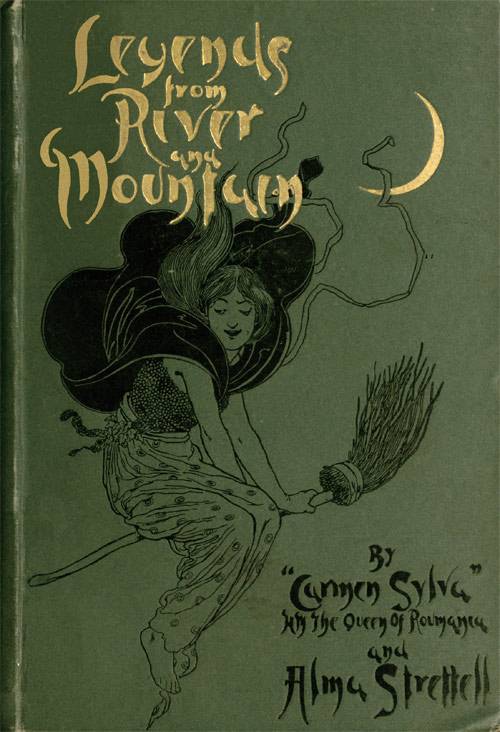
The Project Gutenberg eBook of Legends from River & Mountain
Title: Legends from River & Mountain
Author: Carmen Sylva
Alma Strettell
Illustrator: T. H. Robinson
Release date: June 26, 2016 [eBook #52417]
Most recently updated: October 23, 2024
Language: English
Credits: Produced by Suzanne Shell, Paul Clark and the Online
Distributed Proofreading Team at http://www.pgdp.net (This
file was produced from images generously made available
by The Internet Archive/Canadian Libraries)
LEGENDS FROM RIVER AND MOUNTAIN
FROM “THE CAVE OF JALOMITZA.”—p. 146.
But thereupon the horse was changed into a hawk, that shot down from a giddy height, and bore her away in his talons.
Legends from * * * * *
River & Mountain
By Carmen Sylva (H.M. the
Queen of Roumania) and Alma
Strettell. With Illustrations
by T. H. Robinson
London: George Allen
156 Charing Cross Road
1896
Printed by Ballantyne, Hanson & Co.
At the Ballantyne Press
INTRODUCTION
The first ten of these stories are taken from the German of Carmen Sylva, who has kindly given the translator her special permission to add them to the following collection of legends. The originals are to be found in her charming volumes of Roumanian tales: “Pelesch Märchen” and “Durch die Jahrhunderte.”
Many of them are associated with the mountains which surround her home among the pine-woods of Sinaia; others belong to the districts traversed by the Pelesch river, the merry stream that dashes through the ravine at the foot of her garden, “whispering all sorts of wonders and secrets to those who have ears to hear.”
The remaining tales in the volume are collected from different parts of Germany. “The Little Glass-man,” a legend of the Black Forest, is taken from “Hauff’s Märchen”; the other stories are all compiled from, or founded upon, legends to be met with in various German collections, such as Ziehnert’s, Pröhle’s, &c.[1] Most of them, however, are there set forth in so condensed a form, and with such scanty detail, that they could hardly prove of interest as stories, and therefore, they have in sundry cases been somewhat amplified and developed; or, where there was a resemblance between several legends belonging to different districts, indicating that they had a common source, their varying incidents have been worked into one tale.
It will be seen that the latter part, at least, of this volume makes no claim to be considered as an addition to the serious literature of Folk-lore. Its endeavour is rather to furnish the younger readers of the present generation with a fresh supply of stories—half legend, half fairy-tale—of a kind with which the children of an earlier day were familiar, but which are now less often to be met with; stories which came to them also from foreign lands, and were invested with a charm which it has been vainly sought, as the compiler fears, to impart to the present series.
September 1895.
CONTENTS
| PAGE | ||
| I. | The Jipi. (Roumania) | 1 |
| II. | The Serpent-Isle. (Roumania) | 19 |
| III. | Vîrful Cu Dor. (Roumania) | 37 |
| IV. | Furnica. (Roumania) | 55 |
| V. | The Caraiman. (Roumania) | 69 |
| VI. | The Stags’ Valley. (Roumania) | 81 |
| VII. | The Witch’s Stronghold. (Roumania) | 101 |
| VIII. | Piatra Arsa. (Roumania) | 121 |
| IX. | Rîul Doamnei. (Roumania) | 131 |
| X. | The Cave of Jalomitza. (Roumania) | 139 |
| XI. | The Nixies’ Cleft. (Saxony) | 149 |
| XII. | The Flying Castle. (The Hartz Mountains and Baden) | 163 |
| XIII. | The Silver Nail. (The Hartz Mountains) | 177 |
| XIV. | A Doubting Lover. (The Riesengebirge) | 195 |
| XV. | A Legend of Walpurgis-Night. (The Hartz Mountains) | 203 |
| XVI. | Seekers after Gold. (Saxony and the Hartz Mountains) | 215 |
| XVII. | The Maiden’s Rock. (The Elbe) | 239 |
| XVIII. | The Water-Snake. (The Hartz Country) | 251 |
| XIX. | The Little Glass-man. (The Black Forest)— | |
| I. The Sunday-Child | 271 | |
| II. The Cold Heart | 302 | |
LIST OF ILLUSTRATIONS
I
THE JIPI
There is in Roumania a group of mountains named the Bucegi-group. Among these the two peaks of Jipi tower aloft, close together, as though gazing defiantly at one another, and between them the Urlatoare, or “roaring stream,” dashes down, a cloud-like waterfall, into the valley below, and storms onward over every barrier towards the town of Prahova.
They say that long, long ago the Jipi were twin-brothers, who loved each other so well that one could not live without the other, or eat a mouthful of bread the other did not share; nay, more—that when one was asked a question, the other answered it, and that when one did himself some hurt, the other wept and would not be comforted. They were as fair as morning and evening, as slender and straight as lances, as swift as arrows, as strong as young bears. The mother who had borne them looked upon them with pride and joy, and would say, as she stroked their curly heads, “Andrei and Mirea, my beautiful sons, may your fame become so great that even the stones shall discourse of it.”
They were of noble blood, and dwelt in a castle upon a lofty crag, where they lorded it as though the whole world belonged to them. They often jestingly declared that they should have to wed one wife only between them, since they were sure never to find two quite alike, and that the best plan would be for them never to wed at all. But of this their mother would not hear, for she longed to cradle her sons’ sons upon her knee and sing them lullabies.
She would often sing the ancient lays of their country to her boys, of an evening, while she sat spinning and the noble lads hung fondly about her. Andrei would kneel at her feet, while Mirea leant upon the arm of her chair, and drew in the sweet scent of the heavy, dark braids that shone lustrous through her delicate white veil.
“Our mother is still quite a young woman,” said Andrei.
“Yes, indeed,” cried Mirea; “she has not yet a single grey hair.”
“Nor a wrinkle,” rejoined Andrei.
“We shall find no wife worth our mother,” continued Mirea, kissing the veil upon her head.
“Thou dost cast them all into the shade,” laughed Andrei, and kissed the fingers that were spinning such wondrous fine threads.
“Our father was a happy man,” cried the one. “And we are lucky children,” rejoined the other. Then the mother would smile at the tender dialogue, and tell them tales of their grandmother, and of the rough times she lived in—of her stern father and yet sterner husband.
The meals that the three partook of together were as merry as though the house had been full of company; and, indeed, when guests were really present they grew graver, as beseemed the dignity of their house. They were the most kindly of hosts, and spent many a night upon the bare ground, that their soft couch might be given up to some stranger guest. All who entered there felt at ease in that happy home, wherein love made its dwelling.
One day the two brothers were out hunting a bear that had been making sore havoc in the district. They climbed up the steepest of their cliffs to find him, and got at last upon his track, as a loud growling and a shower of dislodged stones betokened. At the very moment, however, that Mirea was about to cast his spear, another flew out of the underbrush hard by and smote the beast in the vitals. A peal of silvery laughter followed the stroke. Then the bear, growling with rage, rose upon his hinder feet and made for the patch of undergrowth. Andrei perceived the danger in which the bold huntsman stood, and while Mirea called out indignantly, “Let him end the chase he has begun!” his brother exclaimed, “Canst thou not hear?—it is a boy’s voice!” and casting himself before the bear, which towered high above him, he plunged his knife up to the hilt in its shoulder. The brute clawed the air for a moment and then fell dead. “Oh, what a pity!” cried a clear voice, and from the bushes there stepped forth a wondrously fair maiden, clad in short garments and sandals, and having a white fur cap set upon her wild and abundant brown locks. Her eyes shone beneath dark, highly arched brows; they were green eyes, yet with a glint of gold in them. From her shoulders hung a mantle of snow-white, silky goatskin; like Andrei, she held in her hand a broad hunting-knife, with which she had unflinchingly awaited the onslaught of the bear. “What a pity,” she cried again, “now it is not I that have slain him!” and her eyes filled with tears. Andrei stood quite shame-faced, gazing at the bear, as though he would gladly, to please the lovely maiden, have restored him to life again. To conceal her ill-humour, she thoughtlessly thrust at the brute with her foot—when, behold! he turned in the death-throe and clawed at her once again. But on the instant she was caught back by Mirea, who set her on her feet with the reproving words, “Foolish child!” She gazed upwards in astonishment, for the voice was that of the young man before her—and the face, too, was bewildering in its likeness to his. Open-mouthed, like a child indeed, she looked from one to the other till all three broke out into a storm of laughter.
“You are double!” cried the girl, “like two hazel-nuts in one shell.”
“And two nuts out of one shell we are,” replied Andrei. “But who art thou, little wood-fairy? Perchance some witch in disguise, who will work our undoing.”
“Who can say?” answered the maiden. “Perhaps I am a witch—grandfather often says so; and, indeed, I have only been with him a week yet, and he has had no more of his old pain since I came.”
“We would straightway treat thee as an evil witch, then,” said Mirea, “and carry thee a prisoner to our castle, for having hunted upon our hills without leave.”
“We have a cruel mother, too, at our castle,” added Andrei.
“Good,” cried the maiden. “Her I must see. I am your prisoner!”
She called her attendant huntsman, gave him messages to her grandfather, and bade him bring horses to fetch her home; then she followed the brothers with a light step by the giddiest and steepest paths to the castle.
The lads’ mother, Dame Roxana, stood looking from the castle windows, and wondering what strange shepherd-boy her sons were bringing home with them. The dead bear was carried behind them, slung upon green boughs. As they drew near the castle Dame Roxana exclaimed in alarm, “It is a girl they have with them. Where can they have found her?”
The next moment the sound of youthful voices and footsteps re-echoed through courtyard and hall. “Mother,” cried Mirea, “here we bring thee a prisoner, a hunter who has spoilt our chase! What shall be his punishment?”
Dame Roxana gazed at the young girl in great anxiety. She would fain have sent her away again as quickly as possible; but the vision was so entrancing a one that she could not restrain a kindly smile, and stretched out her hand, which the maiden respectfully kissed. “I think,” said Dame Roxana, “that the worst punishment would be to make this merry child spend a few hours in spinning with an old woman like me!”
“Nay, nay,” the girl replied; “I can spin as lightly as any fairy. The spear has not made my hand heavy. And as for old folks—why, I spend all my time alone with grandfather, who sits in his chair all day, and falls asleep whenever I would tell him aught.”
She was about to lay aside her mantle as she spoke, but Andrei stepped forward and took it from her, while his mother herself lifted the fur cap from her brow and stroked back the damp curly hair. With abundant locks falling about her like a lion’s mane, she seemed fairer than ever, and mother and sons gazed at her in delight.
“What is thy name, dear child?” asked Dame Roxana.
“Urlanda. Is it not an ugly name? They would have called me Rolanda, but it turned into Urlanda, because I was always so wild and untutored. My grandfather dwells on the other side of the mountain. Oh! I have come far to-day.”
“Then thou wilt be all the gladder of the meal that awaits us.”
They led her into the dining-hall, sumptuously decked with Eastern carpets and hangings and massive silver-ware. Here the talk flowed merrily on. Wondrous tales were told of the chase and of adventures with savage bears; but Rolanda would never suffer herself to be outdone, and would cap each tale with one more amazing yet, told in tones as earnest as though she were swearing an oath upon it.
The merriment was heightened by her constant mistaking of one brother for the other, and when Andrei gave himself out as having saved her life, Mirea would eagerly affirm that it was he who had warded off the bear’s last embrace.
“It’s a good thing,” she would cry, “that I have to thank you both for my life, for else, indeed, I should never be able to recognise my preserver.”
When the meal was over she begged for distaff and spindle, “for she wanted to show that her spinning was no hunter’s tale.” This was spoken with a sly glance at the brothers. And, in truth, the threads she spun were as fine and even as a spider’s web, to the great amazement of Dame Roxana.
“I can embroider beautifully too,” said the maiden. “My mother, who could do wonders at it, taught me that, for she hoped to tame me with such fair work. But it was all in vain, for I had always finished before she expected it, and was out and away again to the stables or the chase.” She sighed a little. “But now the stud is sold; and, indeed, who could ride among these wretched mountains, where there is no room? Ah, there are the horses!” and she sprang from her seat. “I must go, or I shall not be home by nightfall; and surely grandfather must know how to chide if he be minded to, for he has such bushy eyebrows!” In a moment she had kissed the hand of Dame Roxana, greeted the brothers with a wave of her furry cap as she cast it upon her curly locks, and was away out of the hall and into her saddle like a whirlwind. But the brothers, too, had their horses ready, and were not to be hindered from bearing their young guest company to the outskirts of their lands. So, greeting Dame Roxana with laughing glances, they rode away, and she looked after them with grave eyes, though a smile was on her lips. Her heart was heavy, she knew not why, and she would fain have called her sons back to her.
It was with difficulty that Rolanda could be restrained from galloping up hill and down dale; only when her pity for the horses was stirred did she draw rein, saying with a sigh, “You call these walking chairs horses!”
As night was now falling, she begged the brothers to seek shelter beneath her grandfather’s roof. The old man was sitting by the hearth when they entered, stroking the white beard that fell down far over his breast.
“And where has this wild creature been now?” he kindly asked.
“In a dreadful prison, because of having trespassed on another’s hunting-ground! And here are my persecutors, whom I have brought with me to prove whether I speak truly.”
The old man’s gaze was full of kindliness as it rested upon the two youths, standing ready to do him homage. The evening meal was soon ready; nor was it less cheerful than that which they had shared at midday at Dame Roxana’s table. At early dawn Andrei and Mirea rode hence again. They were startled, as they passed under the castle windows, at finding themselves pelted by a shower of blossoms. But as they glanced upwards a window was hastily closed, and they saw no one.
This was the first of many mutual visits, of many riding and hunting parties, and pleasant hours passed in merry chatter within doors. But Rolanda had her sadder moments also, when she was more entrancing than ever; then she would speak of her dead parents, and of how lonely she was in the wide world; for her grandfather could not live much longer, and then she would not know whither to turn.
“Oh, cruel words!” Andrei would exclaim. “Are we, then, not thy brothers? and is there no home for thee here?”
“Does our mother not love thee?” Mirea would add.
Then would Dame Roxana’s heart quiver with pain once more; and yet the untutored child had become very dear to her.
Not long after this a clatter of hurrying horse’s hoofs sounded up the hillside, and then upon the stones of the courtyard; it was Rolanda, riding bare-headed and with fluttering locks. As pale as death she burst in upon Dame Roxana. “For God’s sake, let me take shelter with you! Grandfather is dead! I closed his eyes myself; I made him ready for the grave, and laid him there to rest, and felt no fear the while. But now all the kinsfolk have come flocking in, quarrelling over the inheritance, and giving me hard and cruel words because some of it is to be mine. And one bald-headed fellow would straightway have taken me to wife. Ah me! then I was affrighted. Such a wretch! But I told him I was called Urlanda, and was so bad that none would care to marry me. Nor will I have any husband. I will stay here with you until I am turned out.”
It was a hard matter for Dame Roxana to understand this flow of incoherent words, and harder still for her to soothe the agitated girl. She folded her to her heart and stroked the disordered curls; then she led her to the little white bed-chamber, where she had often dwelt before, and told her this should be her home as long as there was a roof over the house.
Rolanda threw herself into her arms, kissed her hands, and promised to become as gentle and calm as a deep, calm lake.
Dame Roxana smiled. “Methinks,” she replied, “that the calm and gentleness will come all in good time, when once thou art a wife.”
“But I would never become a wife. I would always remain a maiden and free—free as a bird.”
Dame Roxana sighed quite low, and listened for the voices of her sons, who had just come home and were asking for Rolanda, whose tumultuous arrival they had witnessed from afar.
A wondrous change took place in the behaviour of the brothers after Rolanda came to sojourn with them.
They had greeted her as their “little sister,” but thereupon the young girl had suddenly grown shy and constrained. They lived out of doors more than ever now, only they no longer went together, but by separate ways; and Rolanda stayed much at home with the mother, and grew dreamy and absent, often shedding tears in secret. When she thought herself unnoticed, her quick glance would travel backwards and forwards between the brothers, as though she would fain discover something that yet remained dark to her. She often still confused the two together, yet now she no longer laughed at this, but gazed anxiously over at the mother. Dame Roxana watched with a heavy heart the dark cloud that seemed gathering over her house, and wept far oftener and more secretly than Rolanda, since the day that each of her sons had confessed to her, alone at the twilight hour, his great, undying, unconquerable love, and had asked—
“Dost think my brother loves her too, he is so changed? And to which of us will she give her heart?”
Dame Roxana offered many a taper in the little mountain chapel at Lespes, and hoped that this painfully made pilgrimage might incline Heaven’s mercy towards them, and ward off a great disaster from her home.
Rolanda had been in a state of indescribable agitation ever since the time that Andrei and Mirea had, each unknown to the other, confessed their love to her. In vain the poor child questioned her heart; she loved them both too well—far too well—to make either wretched; nor could she separate the one from the other in her heart, any more than she could with her eyes. She kept silence towards Dame Roxana, for she could not bear to give her pain; but day by day she saw how the brothers no longer cherished each other, and even how sharp words sometimes passed between them, and that had never chanced in all their lives before.
At last Dame Roxana called the three to her side and spoke.
“I have watched the bitter struggle of your hearts too long. One of you must needs make a hard sacrifice, that the other may be happy.”
“Yes,” answered Mirea gloomily, “one of us must quit this world.”
“For God’s sake!” cried Rolanda, “you would not fight over me?”
“Nay,” said Andrei, with a sad smile, “that were impossible. But one can go hence alone.”
Then said Dame Roxana with uplifted hands, “O godless children! have I, then, borne you and brought you up so feeble that neither of you has the strength to bear his first sorrow? Rolanda, till to-morrow shalt thou have time for thought; by to-morrow we shall all have won strength and courage.”
So they parted.
Andrei took a path that led through the forest to Lespes, and there he knelt in the little rock-hewn chapel and prayed: “O my God! Thou knowest my heart and my strength. Grant that I may be preserved from any sin towards myself, my mother, my brother, or the woman that I love. But if she give herself not to me, then turn me to stone, that I may feel pain no more.” But, by another path, Mirea had come, too, to the little chapel, and had prayed the same prayer. They cast a sorrowful look at one another, and went home, each by himself; for each thought that he alone had offered up the sacrifice.
Dame Roxana appeared next morning as white as the veil which covered the first silver threads in her hair. The two brothers wore the look of men going to their death. Rolanda alone came among them with the glow of joy on her face. She was as though transfigured by an unearthly beauty, that seemed to increase her very height. With gentle dignity she spoke: “Come out yonder with me, my only dear ones; let the decision be given under God’s open sky.”
And ere one of them could stretch out a hand she had flown like a bird over the edge of the cliff.
She glided out before them, hardly seeming to tread on earth; her hands were transparent as wax, and her eyes full of tears as she raised them to heaven. On the edge of a steep and giddy precipice she paused, and knelt before Dame Roxana.
“Give me thy blessing, mother,” she said.
Dame Roxana laid a trembling hand upon the fair, curly head.
“And now,” continued Rolanda in a clear voice, “now hearken to me. I love you both so well, so passing well—far more than myself or my own life—that I cannot give myself to either of you. But whichever brings me back from the abyss, his wife will I be.” And ere one of them could stretch out a hand she had flown like a bird over the edge of the cliff, into the immeasurable depths below. But—oh wonder!—as she fell, she was changed into a foaming waterfall, whose spray floated in the air like a bridal veil. The two brothers would have cast themselves down after her, but they could not, for their feet turned to rock, their arms to rock, their hearts to stone, and so they towered aloft toward heaven. But the unhappy mother spread out her arms, crying, “And I alone must live! Hast Thou no pity, Heaven?” Then with arms outstretched she fell to earth, embracing her children. And, behold! where she lay she was changed into thick, soft moss, that grew and spread farther and farther, till the rocks were half shrouded in it. So they remain, and will remain for ever—the wild white bride, Urlatoare, the self-sacrificing sons, the Jipi, and their loving, tender mother.
II
THE SERPENT-ISLE
The great Latin poet Ovid was banished by the Emperor of Rome, no one knew why, to a desolate spot near the mouth of the Danube, on the shores of the Black Sea. That land has had many masters, and last of all the Roumanians, under King Charles, took it from the Turks. Where Ovid once wandered by that lonely shore there is now a grand hotel, where fashionable ladies and officers sit and listen to the music of the band; a large town, too, lies hard by, but in the poet’s days only a small collection of miserable huts stood there, which men called the city of Tomi. On one side there was nothing to be seen, as far as the eye could reach, but sand and marshes, where at intervals a solitary tree stretched out its barren boughs over some evil-smelling mere; while on the other the endless sea, black and cheerless, rolled its monotonous waves towards the shore. Snowstorms, unknown to an inhabitant of Rome, swept over the land in winter; and in summer the sun beat down with scorching heat, setting the brain on fire and parching the tongue. Wells were scarce here, and Ovid learnt to prize a draught of pure water more than he had ever prized the choicest wines in his Roman cellars. The inhabitants of the country were few—dark-skinned men, whose language was strange to him. The only Romans were men whom he would in former days have thought unworthy of his slightest glance or word—thieves, galley-slaves, or fraudulent officials. Surely he could never have borne such a life, and must have died of misery, save for one only consolation. Every man must have some such, be it only a dog, a flower, or a spider. Ovid had a snake, a tiny, bewitching snake, that always lay curled about his neck or his arm, and in whose eyes he read the most wondrous tales. To his mind she was very likely the victim of some spell—a banished princess in a serpent’s shape—for did he not write the “Metamorphoses”?—and he wove fancies about her by the hour together—of how fair she was in reality, and how unfortunate, his shining little Colubra, as he called her. And as his thoughts wandered thus, and he sat gazing out upon the sea, his eyes would close and he would sink into peaceful sleep. One day, as he thus slept, he dreamed a strange dream; his little snake had suddenly become possessed of human speech, and was whispering softly in his ear, “Come, come with me to the island at the mouth of the Danube—that which they call the Serpent-Isle. There thou shalt witness transformations indeed.” He awoke with a start of surprise; but his little snake was lying quite quietly about his neck, as though she had never spoken a word. Again he fell asleep, and again Colubra whispered, “Come to the Serpent-Isle. Come; trust thy little friend.” The poet awoke once more and gazed at the little creature, that still clung motionless to his throat, and met his eyes with a strange look of comprehension. He slept for the third time, and for the third time Colubra whispered, “Come with me; thou wilt not repent it.” But this time he awoke before she had finished speaking, and she gave him so expressive a glance that Ovid thought to himself, “Why should I not go to the Serpent-Isle? It cannot be a more desolate spot than this is; and if the serpents devour me, then there is an end of my pain for ever.”