
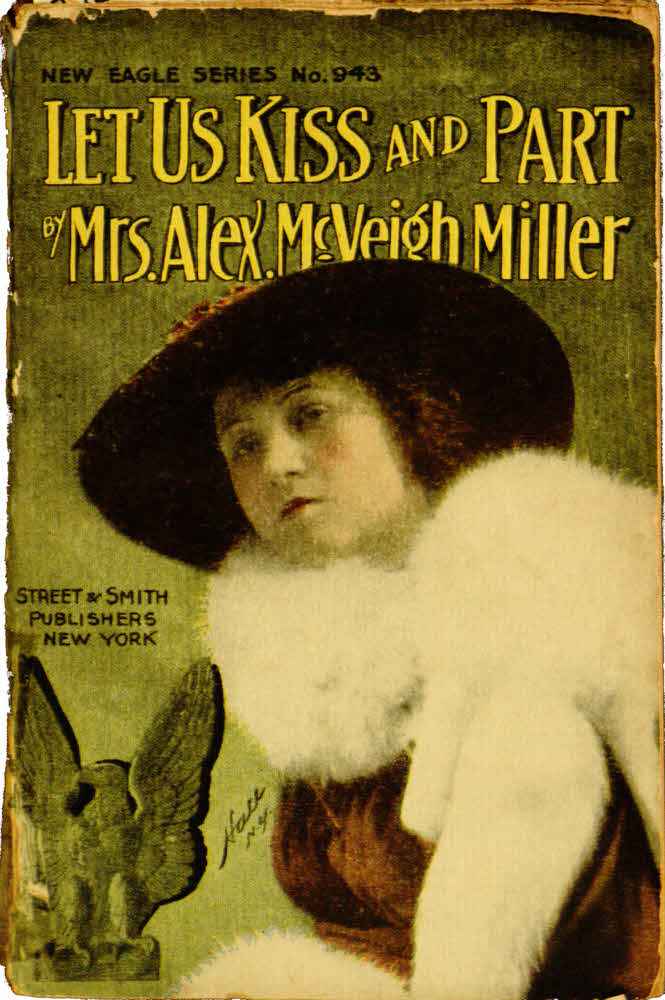
CHAPTER VIII.
“SHE SHALL BE MINE?”
With an evil smile on his face, Carey Doyle whipped up the horse and drove swiftly back to his aunt’s house, his eyes gloating on the pale, unconscious beauty of Jessie’s face as it lay across his knee where he had carefully placed it.
The man’s heart was aroused as it had never been before by this lovely girl, and he vowed to himself that she should become his own.
In the gray dusk of the November day he carried her into the house, to the dismay of Madame Barto, who exclaimed:
“So you were as good as your word! You tried to kill the poor child!”
Carey Doyle denied the impeachment with the greatest sang-froid, protesting that on the contrary he had saved the poor girl’s life in a runaway accident.
“And as soon as you bring her around I want to have a serious talk with you,” he said, as she turned him out of the little hall bedroom where Jessie lay on her narrow cot.
He waited impatiently in the parlor about half an hour before she reappeared, saying:
“She was hard to revive, and hardly knows what has happened to her yet, so I just gave her a sedative and left her to fall asleep while I come to hear what you have to say, Carey.”
“Well, as I told you just now, Laurier’s horses bolted in the park and ran away, pitching him out, and leaving Jessie in. I happened to be looking on and stopped the team and saved her life.”
“Good!” said the fortune teller approvingly, and he continued:
“While I took Jessie into my dogcart to bring her home, two swell Fifth Avenue ladies had Laurier put into a carriage and taken home. Now, aunt, I want you to help me to win Jessie Lyndon, and to give up all such notions as Fate having cut her out for Mr. Laurier. It isn’t likely that he means fair by Jessie, anyway; rich young men don’t often marry poor girls, you know; while I’ll make her my wife at any moment you persuade her to have me.”
“How am I to manage it?”
“Tell her that Laurier was killed in the accident, and keep her a prisoner in her room until she consents to marry me.”
“A risky game—and what am I to gain by it, anyway?” asked madame significantly.
Doyle laughed coarsely:
“Well, I’ve helped you often enough in risky games, so it’s your turn now. You just help me in this, or I’ll split on you. See? And you know what I can say and do if I want to. But you do the right thing and I will, too. Here’s some money, but mind you do the right thing, or you’ll be sorry. I’ll go now and call to-morrow evening to see how our plan works,” he said, rising to go.
Alas, poor little Jessie, surrounded by cruel plotters and a jealous foe, it might have been better if she had died in the heavy sleep that lulled her senses that dreary night rather than awaken to the sorrow of the next day.
When she sighed and opened her heavy-lidded eyes again, the fortune teller stood by the bed, looking down at her with a penetrating gaze.
“Ah, what a long sleep you’ve had, child. Do you feel better?” she asked.
“Better!” cried Jessie, then a wave of memory swept over her, and she moaned, “Oh, how terrible it was! How came I here? And he—oh, where is he?”
Madame took her hand and answered solemnly:
“You may well ask, where is he? Poor child, how can I tell you the dreadful truth? But you will have to bear it. He—poor Frank Laurier—was killed stone-dead!”
A shriek rang through the room—long, loud, heart-rending!—then Jessie lay like one dead before the heartless woman.
Madame Barto would never forget that day.
Jessie Lyndon’s grief for Frank Laurier when she recovered from her long swoon was indeed heart-rending.
In vain madame expostulated:
“Why should you take on so? You never saw him till yesterday!”
“Oh, I cannot understand it, but I know that he was as dear to me as if I had known him a year!”
“A young girl must not give her heart unsought.”
“Oh, madame, I did not. Oh, my heart!”
The girl flung herself back on the pillows in an agony of grieving that strangled words on her lips, and it was hours later when she asked plaintively:
“Where have they taken him?”
Madame answered soothingly:
“Two lady friends of his were in the park when he was killed—Mrs. Dalrymple and Miss Ellyson of Fifth Avenue—and they had him conveyed to their home.”
Jessie instantly remembered the ladies she had seen in the victoria, especially the dark, brilliant beauty who had frowned at her so blackly.
She gasped faintly:
“Oh, I must see him once more before he is hidden from me forever in the cold, dark grave!”
“Impossible!” cried madame sternly, and though the half-distraught girl knelt to her in an agony of entreaty, she still refused her prayer. Indeed, she could do no less, seeing what a falsehood she had told.
Then Jessie grew angry and desperate.
“You are wicked and heartless to tell me I cannot see him once before he is buried! I defy you! I will go!” she cried, with a passion of which madame had not believed her capable.
The dark, dreamy eyes flashed defiance out of the deadly, pale face, alarming Madame Barto so that she snatched up Jessie’s clothing and bore them away in triumph, exclaiming:
“There, now, I don’t think you will run off to Fifth Avenue in your nightgown, miss!”
And, locking the door on the outside, she left the poor girl to her fate, forgetting that in Jessie’s closet there still remained hanging the cheap, threadbare garments she had worn when she came.
But Jessie remembered, and she quickly put them on again, the torn calico gown, the broken shoes, the old sailor hat—then she drew aside the curtain and looked out, starting to find that the gray November day was near its close and the sky overcast with threatening snow clouds.
How long it seemed since yesterday! He had been twenty-four hours dead.
Dead! Oh, how impossible it seemed for such youth and strength and beauty to be so quickly annihilated. His kiss still burned like fire on her lips and thrilled warmly through her veins.
“Oh, I must see him once again!” she sobbed, and pushed up the sash and measured the distance to the ground with frantic eyes.
It was only a story and a half, and a neglected awning rope fortunately hung from her own window. With a low cry of joy, Jessie caught it and knotted it to the window shutter. When it grew a little darker she climbed up into the window and swung herself out, tremblingly, on the frail support.
Halfway down to the ground the rope broke with her weight, and gave her a fall to the pavement, but the distance was not great, and with a little, stifled moan of pain, she dragged herself up from the ground and hurried off through the darkness, sobbing:
“I know where Fifth Avenue is, and I will go there if it kills me. But I hope that proud, beautiful lady will not be there to wither me with her angry eyes!”