
WeRead Powered by ReaderPub
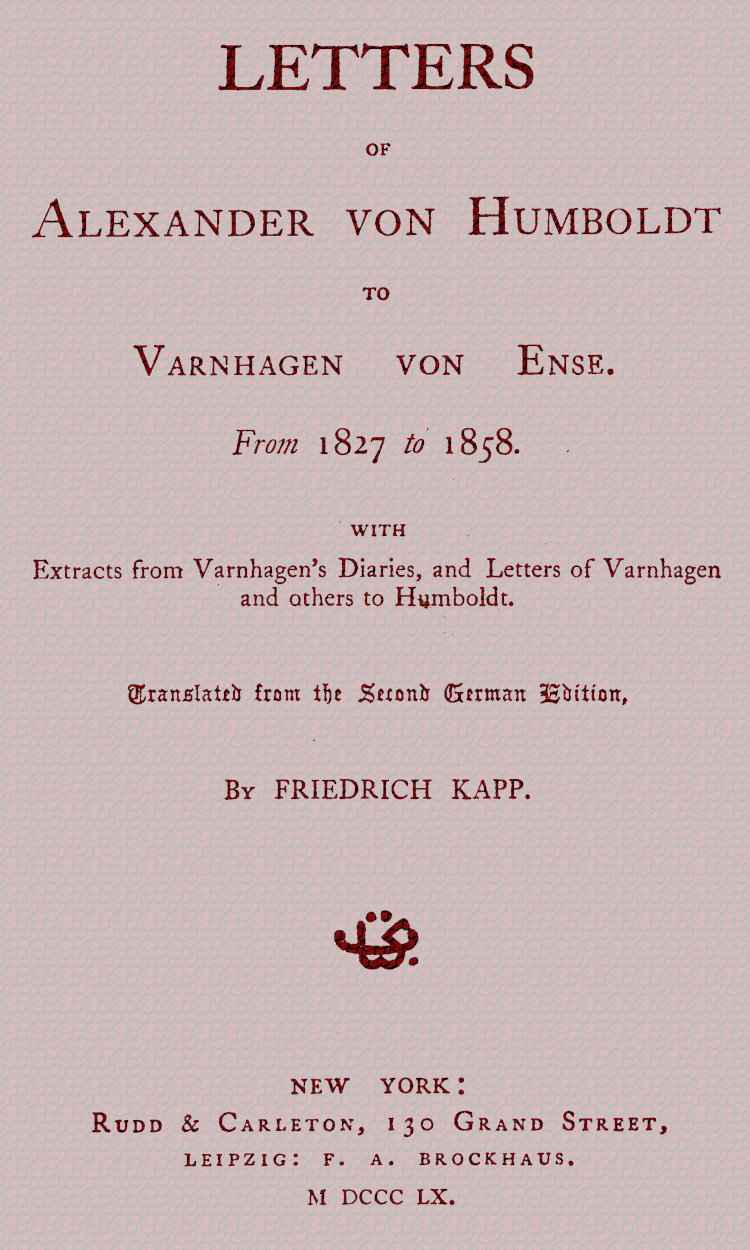
Letters of Alexander von Humboldt to Varnhagen von Ense. / From 1827 to 1858. With extracts from Varnhagen's diaries, and letters of Varnhagen and others to Humboldt cover

Letters of Alexander von Humboldt to Varnhagen von Ense. / From 1827 to 1858. With extracts from Varnhagen's diaries, and letters of Varnhagen and others to Humboldt

Chapter 100: 94. HUMBOLDT TO VARNHAGEN.
Open in WeRead

About This Book

A curated correspondence collects letters from Alexander von Humboldt to his friend and confidant Varnhagen von Ense, supplemented by diary excerpts and letters from other contemporaries. The missives blend personal friendship with professional exchange, discussing scientific observations, lectures, manuscripts, travels, and reactions to peers and events. Editorial apparatus preserves original phrasing and provides contextual notes and extracts that illuminate relationships and chronology. The selection highlights the writer’s methods of observation, precise descriptive habits, and modes of intellectual collaboration. Together the documents form a compact portrait of an engaged scholar whose private reflections and public endeavors intersect across a wide range of topics.

94.
HUMBOLDT TO VARNHAGEN.

Berlin, Tuesday, June 3d, 1845.
One o’clock, A. M.

All the mysteries were solved to-night, dearest friend. I received this afternoon from the department of Foreign Affairs, where they were stored up, fourteen parcels pell-mell, misdirected there from Paris and dating from December to May. The first thing we perceived was your handwriting; the parcel was duly directed and contained, well secured under your seal, your important political letter and a parcel for Comtesse d’Agoult, which I remit with the present. I am quite innocent of what has happened.

In the Rhine and Moselle Gazette, No. 122 of the 29th of May, I am judged guilty of Voltairianism, denial of all revelations, of conspiring with Marheineke, Bruno Bauer, Feuerbach, nay even of the expedition against Luzerne—ipsissimis verbis—and all that on account of my Kosmos, page 381. The King had already been told that my book was the work of a demagogue and an infidel. Whereupon the King wrote me, that he could but say what Alfons said to Tasso:

“And so I hold it in my hand at last
And call it mine, if I may use that word!”

This is poetical and very civil.

With the sincerest gratitude, yours,
A. v. Humboldt.