
WeRead Powered by ReaderPub
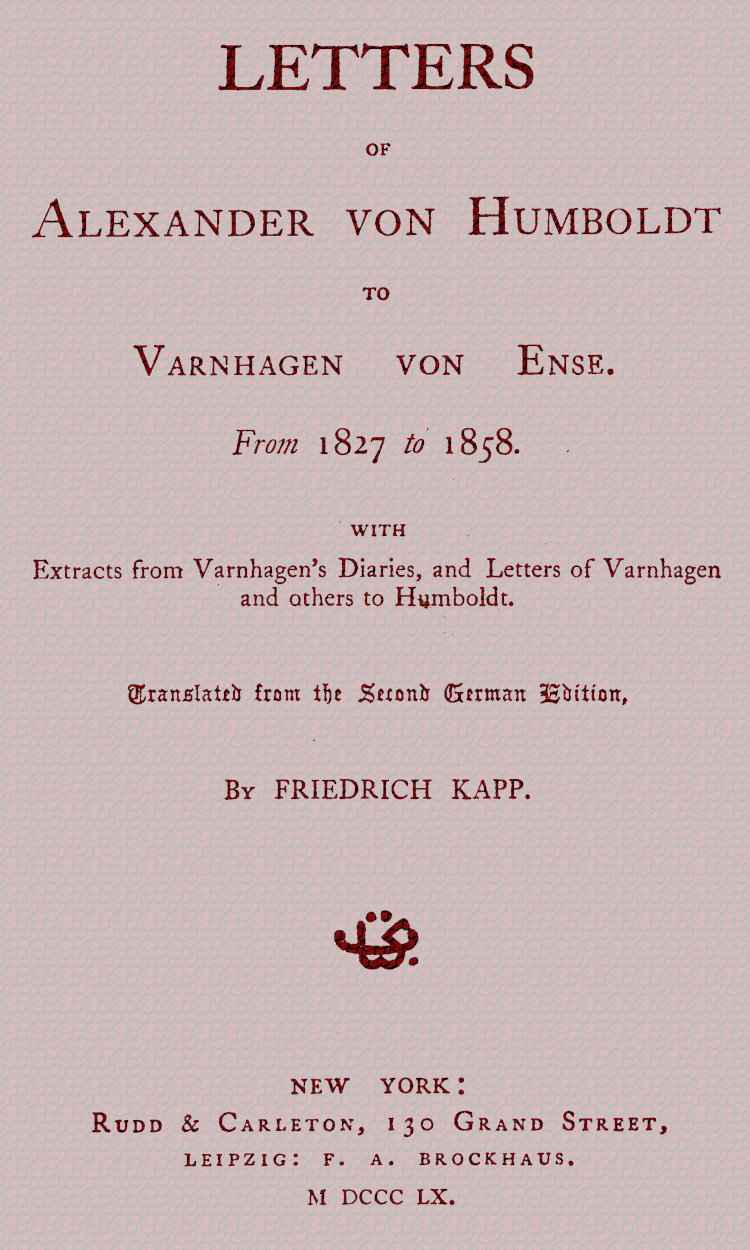
Letters of Alexander von Humboldt to Varnhagen von Ense. / From 1827 to 1858. With extracts from Varnhagen's diaries, and letters of Varnhagen and others to Humboldt cover

Letters of Alexander von Humboldt to Varnhagen von Ense. / From 1827 to 1858. With extracts from Varnhagen's diaries, and letters of Varnhagen and others to Humboldt

Chapter 113: 107. HUMBOLDT TO VARNHAGEN.
Open in WeRead

About This Book

A curated correspondence collects letters from Alexander von Humboldt to his friend and confidant Varnhagen von Ense, supplemented by diary excerpts and letters from other contemporaries. The missives blend personal friendship with professional exchange, discussing scientific observations, lectures, manuscripts, travels, and reactions to peers and events. Editorial apparatus preserves original phrasing and provides contextual notes and extracts that illuminate relationships and chronology. The selection highlights the writer’s methods of observation, precise descriptive habits, and modes of intellectual collaboration. Together the documents form a compact portrait of an engaged scholar whose private reflections and public endeavors intersect across a wide range of topics.

107.
HUMBOLDT TO VARNHAGEN.

Berlin, Feb. 20th, 1846.

Do you guess, my dear friend, who sent me this strange article? Do you guess anything from the seal and the name on the envelope, “M.?” Is that the author, and to what journal may the article belong? Profound, of enlarged political views, it certainly is not. The passage on p. 8 is underscored by the author himself, and it contains a contradiction! Prussia is to have unity in an American confederacy. His remarks, p. 3, on Frederick II. and on his works, and on “Kant a guillotine,” p. 5, are as Minister Thiele would write them. I am indignant at both. The author knows all the news, all the names, all the gossip, of the “Eckensheher,”[45] and is touched by the liberalism of Bodelschwingh, p. 14, who still defends every day the expulsion of the Baden Representatives. He does not dare to name Eichhorn with censure. The last line only is grand and fine.

With unalterable devotion,
Yours,
A. v. Humboldt.
Friday.