
WeRead Powered by ReaderPub
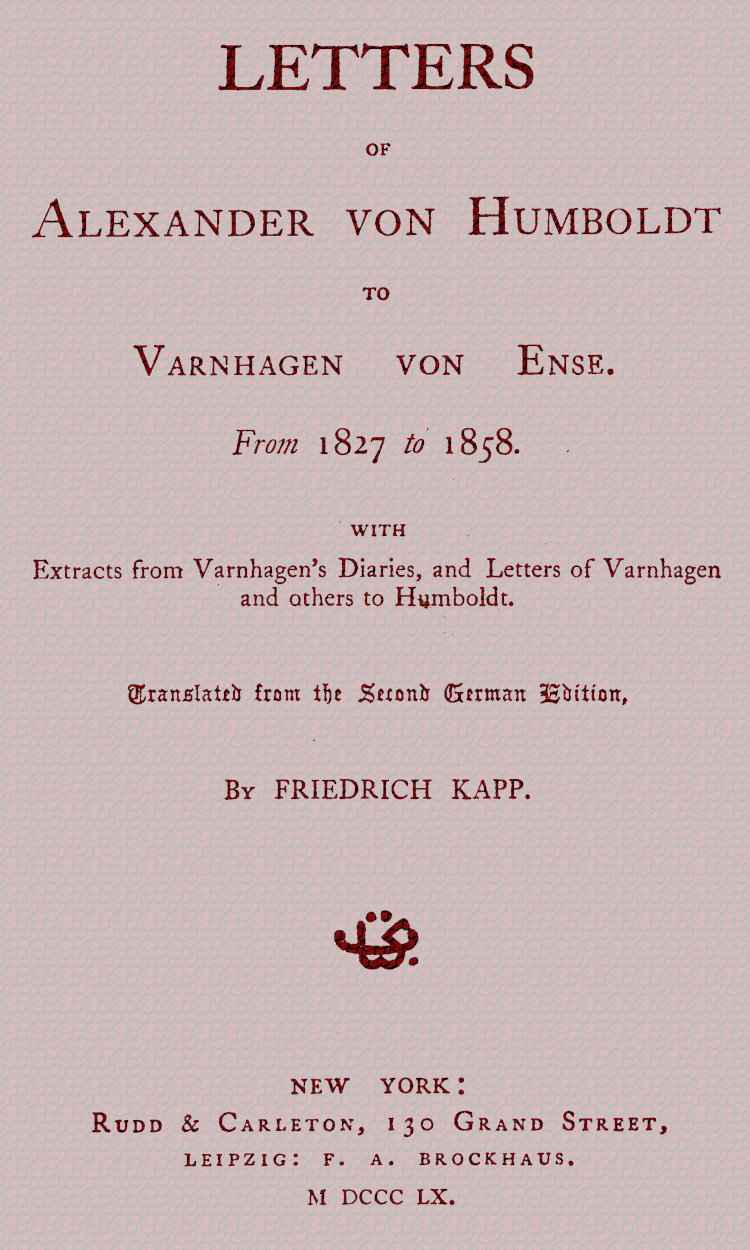
Letters of Alexander von Humboldt to Varnhagen von Ense. / From 1827 to 1858. With extracts from Varnhagen's diaries, and letters of Varnhagen and others to Humboldt cover

Letters of Alexander von Humboldt to Varnhagen von Ense. / From 1827 to 1858. With extracts from Varnhagen's diaries, and letters of Varnhagen and others to Humboldt

Chapter 12: 10. HUMBOLDT TO VARNHAGEN.
Open in WeRead

About This Book

A curated correspondence collects letters from Alexander von Humboldt to his friend and confidant Varnhagen von Ense, supplemented by diary excerpts and letters from other contemporaries. The missives blend personal friendship with professional exchange, discussing scientific observations, lectures, manuscripts, travels, and reactions to peers and events. Editorial apparatus preserves original phrasing and provides contextual notes and extracts that illuminate relationships and chronology. The selection highlights the writer’s methods of observation, precise descriptive habits, and modes of intellectual collaboration. Together the documents form a compact portrait of an engaged scholar whose private reflections and public endeavors intersect across a wide range of topics.

10.
HUMBOLDT TO VARNHAGEN.

Berlin, 3d of Feby., 1833.

I am eternally grateful and affected by your noble letter. Grace and euphony of language should always be joined to purity of character and gracefulness of manners.

My brother was here for two days, but almost always under the shock of the waves, dashing from the Court. Princes have the right to pray without ever being deprecated. He ordered me to tell you, dear friend, how very sensible he is to the flattering nature of your offer; but he is just now so much occupied with the publication of the quarto edition on the affinity of Asiatic languages with the Sanscrit, that he cannot accept what he considers, nevertheless, as highly important. He desires, in honor of the celebrity of the great departed one,[8] that you should undertake the task. I am painfully concerned to hear that you enjoy, together with your ingenious friend, but a small bit of health, which you kindly lend each other—something of a mutual self-instruction, or Azais-compensation, which afflicts me very much. I have received a long letter of Mrs. Cotta. It seems she will assume the editorship of the Allgemeine Zeitung, an anti-salique enterprise altogether. Is it not strange, how, at certain epochs, a certain principle seems to penetrate all mankind? Resuscitation of reverence for the past, not-to-be-disturbed love of peace, distrust in the possibility of amelioration, hydrophobia against genius, religious compulsion for unity, mania-diplomatica for protocols.... Cardines rerum.

Note by Varnhagen.—I had replied in Rahel’s name, who was prevented by sickness, to the note of the 1st inst., directed to her, and in a postscript had expressed the desire Minister de Humboldt should write the critique of Faust, just then to be published for the Jahrbücher der Kritik.