
WeRead Powered by ReaderPub
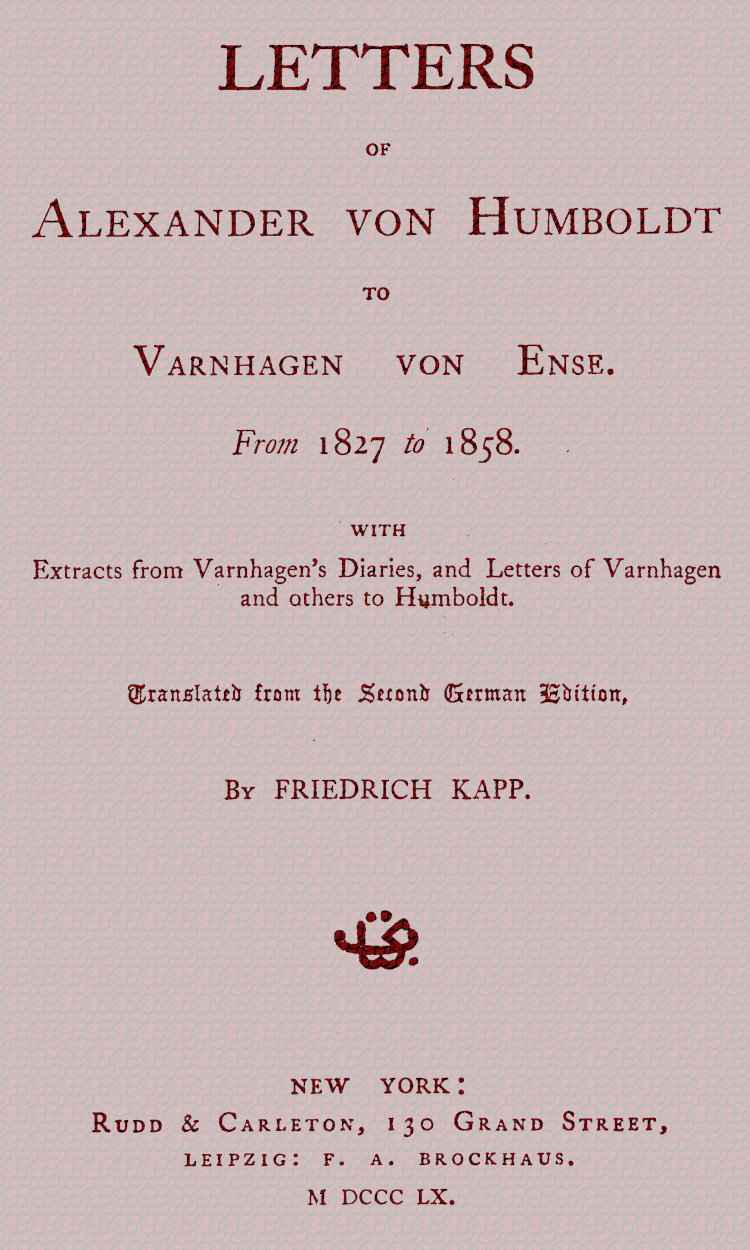
Letters of Alexander von Humboldt to Varnhagen von Ense. / From 1827 to 1858. With extracts from Varnhagen's diaries, and letters of Varnhagen and others to Humboldt cover

Letters of Alexander von Humboldt to Varnhagen von Ense. / From 1827 to 1858. With extracts from Varnhagen's diaries, and letters of Varnhagen and others to Humboldt

Chapter 148: 141. HUMBOLDT TO VARNHAGEN.
Open in WeRead

About This Book

A curated correspondence collects letters from Alexander von Humboldt to his friend and confidant Varnhagen von Ense, supplemented by diary excerpts and letters from other contemporaries. The missives blend personal friendship with professional exchange, discussing scientific observations, lectures, manuscripts, travels, and reactions to peers and events. Editorial apparatus preserves original phrasing and provides contextual notes and extracts that illuminate relationships and chronology. The selection highlights the writer’s methods of observation, precise descriptive habits, and modes of intellectual collaboration. Together the documents form a compact portrait of an engaged scholar whose private reflections and public endeavors intersect across a wide range of topics.

141.
HUMBOLDT TO VARNHAGEN.

Potsdam, November 4th, 1849.

What pleasure you have given me, dear friend, by so agreeable a communication from England! But on account of my brother’s memory, and in order to reply to those who calumniate me for remaining at this court, I am very anxious to see my response to the deputies of Potsdam correctly printed in a liberal journal. I would like to send it to the “Constitutionelle Zeitung,” which has not yet mentioned the subject. I have no copy, however—nothing but the bit of paper I sent you. Have the goodness to send it back to me soon.

How important is the news from Paris! The forward one may attain the consulate for life (to which the words durée et stabilité seem to refer); but he will fall, nevertheless, and awake the sleeping lion. Liberty will lose nothing by it, and the German statesmen (are there any such besides Herr von Gagern?) will then understand, that in the centre of Europe is the France of 1789, the same, about the nullity of which so many sarcasms have been uttered. The centres of gravity change.

With cordial friendship, yours,

A. Ht.
Sunday.