
WeRead Powered by ReaderPub
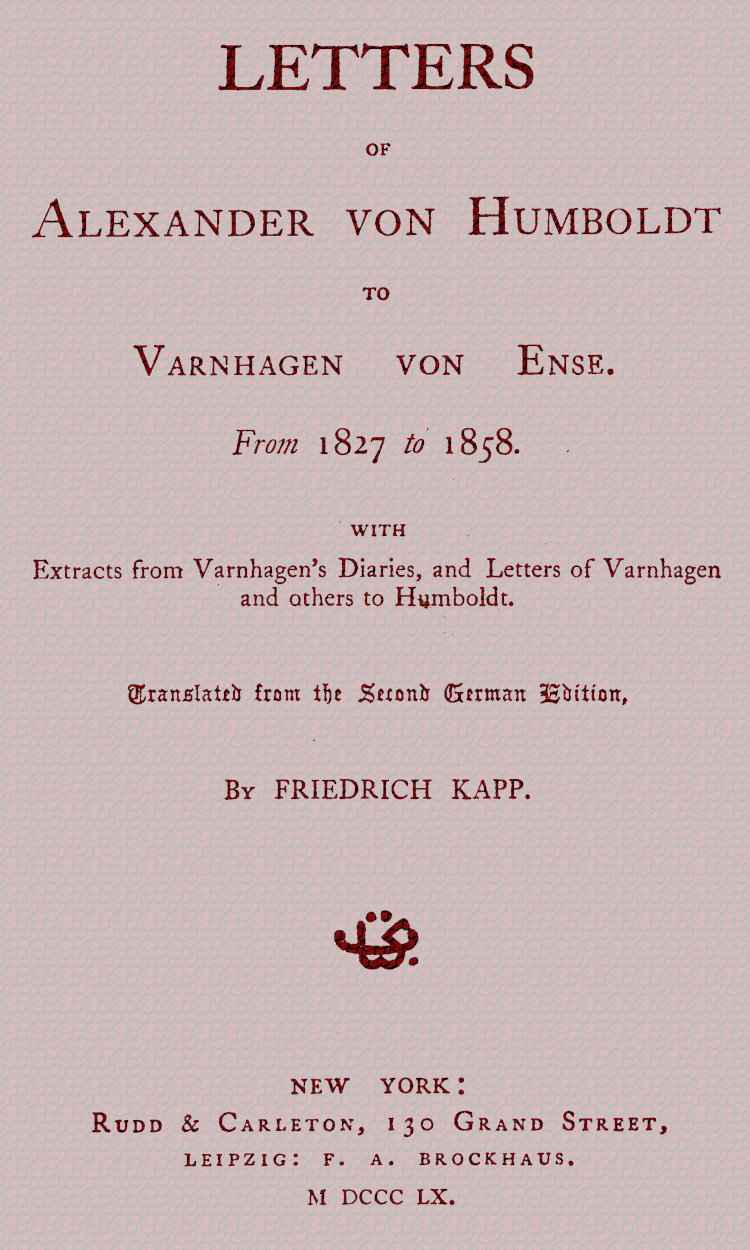
Letters of Alexander von Humboldt to Varnhagen von Ense. / From 1827 to 1858. With extracts from Varnhagen's diaries, and letters of Varnhagen and others to Humboldt cover

Letters of Alexander von Humboldt to Varnhagen von Ense. / From 1827 to 1858. With extracts from Varnhagen's diaries, and letters of Varnhagen and others to Humboldt

Chapter 159: 151. HUMBOLDT TO VARNHAGEN.
Open in WeRead

About This Book

A curated correspondence collects letters from Alexander von Humboldt to his friend and confidant Varnhagen von Ense, supplemented by diary excerpts and letters from other contemporaries. The missives blend personal friendship with professional exchange, discussing scientific observations, lectures, manuscripts, travels, and reactions to peers and events. Editorial apparatus preserves original phrasing and provides contextual notes and extracts that illuminate relationships and chronology. The selection highlights the writer’s methods of observation, precise descriptive habits, and modes of intellectual collaboration. Together the documents form a compact portrait of an engaged scholar whose private reflections and public endeavors intersect across a wide range of topics.

151.
HUMBOLDT TO VARNHAGEN.

Berlin, March 14th, 1853.

Hearty thanks for the comfort derived from the characteristic word of Fontenelle’s, hitherto unknown to me—but twenty years are too short to see anything better! Your Buelow von Dennewitz is great and good news to me! The treasure of the warm-blooded Leopold von Buch I return inclosed. May not Friedrich Schlegel’s astronomical vision be connected with conversations I had with him at Vienna on the certainty that we shall see the southern cross rise again in Germany, where it has already shone in historic ages? Let me remind you of a passage in my Kosmos (II. p. 333), which derives some interest for you from its reliable chronological date. “It was not more than 2900 years before our era that the cross became invisible in Northern Germany. The constellation had ascended as far as the tenth degree above the horizon. When it disappeared from the Baltic skies, the pyramid of Cheops had already stood five hundred years. The shepherd nation of the Hyksos invaded Egypt seven hundred years later. The past becomes apparently less remote when we can measure it by reference to memorable events.”

Persevere in your diligence upon Buelow von Dennewitz, who became very dear to me in Paris. Fond of music, he was very affable in the family of Lafayette, in the little chateau of Lagrange, at Paris—Lafayette’s country-seat, where Buelow was quartered.

Yours,
A. v. Humboldt.

I shall bring volume VI. myself.

Note by Varnhagen.—As a comfort for his eighty years, I had written to Humboldt that even these could be transformed into a comparative youth, as appeared by Fontenelle’s example, who, at the age of a hundred years, attempted to pick up a fan dropped by a lady, and, unable to do it as quickly as he wished, exclaimed, “Que n’ai je plus mes quatre vingt ans!” Of Friedrich Schlegel I had told him, that shortly before his death, he prophesied to Tieck, at Dresden, that, at no very remote period, though he could not exactly define it, a mighty change would take place in the heavens, the great constellations would leave their places, and combine to form an immense cross.