
WeRead Powered by ReaderPub
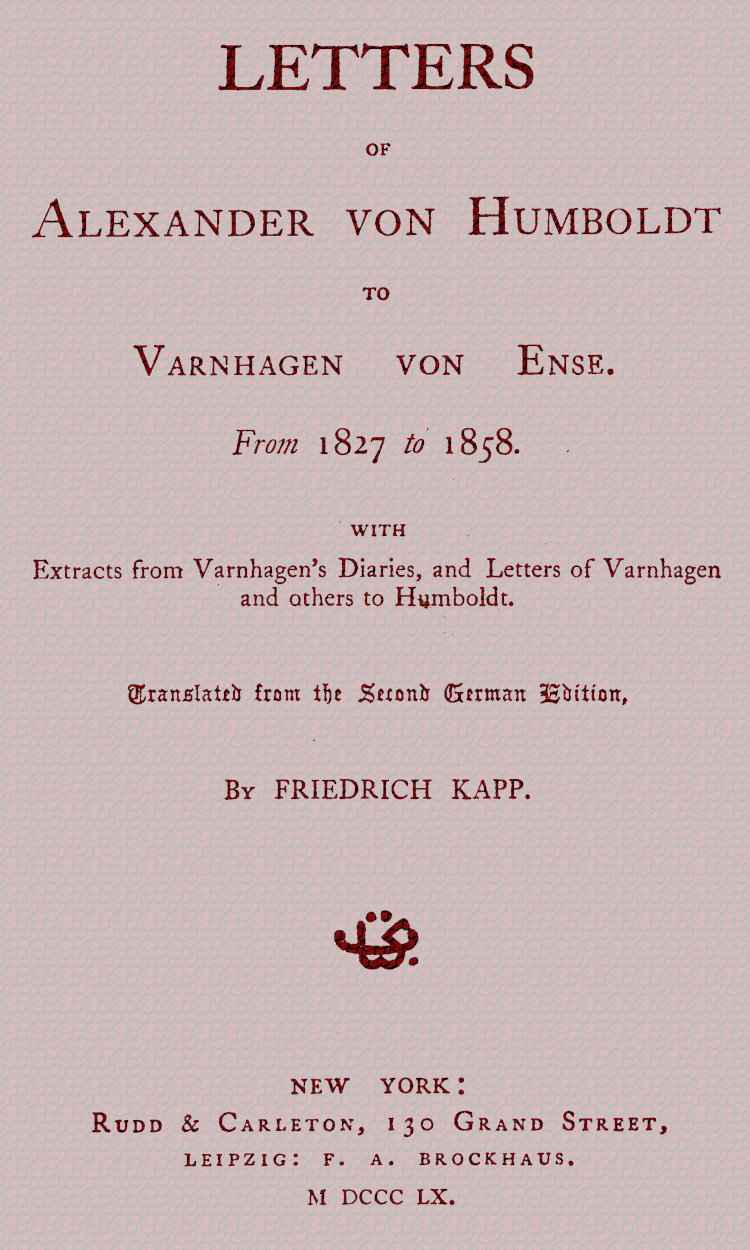
Letters of Alexander von Humboldt to Varnhagen von Ense. / From 1827 to 1858. With extracts from Varnhagen's diaries, and letters of Varnhagen and others to Humboldt cover

Letters of Alexander von Humboldt to Varnhagen von Ense. / From 1827 to 1858. With extracts from Varnhagen's diaries, and letters of Varnhagen and others to Humboldt

Chapter 171: 163. HUMBOLDT TO VARNHAGEN.
Open in WeRead

About This Book

A curated correspondence collects letters from Alexander von Humboldt to his friend and confidant Varnhagen von Ense, supplemented by diary excerpts and letters from other contemporaries. The missives blend personal friendship with professional exchange, discussing scientific observations, lectures, manuscripts, travels, and reactions to peers and events. Editorial apparatus preserves original phrasing and provides contextual notes and extracts that illuminate relationships and chronology. The selection highlights the writer’s methods of observation, precise descriptive habits, and modes of intellectual collaboration. Together the documents form a compact portrait of an engaged scholar whose private reflections and public endeavors intersect across a wide range of topics.

163.
HUMBOLDT TO VARNHAGEN.

Berlin, July 10th, 1854.

Such a rough “Hind Pomeranian!”[70] direct answer, dear friend, you could certainly not expect from me! I have no idea of the question about the animation of pinewood at the King’s table, where everybody believes in it as in the Persian host seen in the air at the Eichsfeld. The “drama” of the “Kreuz Zeitung,” like everything emanating from this bad party, sick with mental poverty, bears the stamp of cowardly malice! You are not to be pitied, for you possess a treasure in the power of animating recollections of the great period of 1813. I have always kept at a respectful distance from the Revue des Deux Mondes, which is edited with spirit and address. Two parties may hate the same thing without hating it from the same motives. The present Liberals there think themselves justified in barking, but not biting, after the fashion of the Berlin muzzles, “because, without the rescuer[71] they would all have been drenched in blood.” Credat Judæus Apella!

Your faithful,
A. v. Humboldt.

Monday.—At another funeral![72]

A workman, unknown to me, addressed me at the funeral of Benjamin Constant: “N’est-ce pas, mon bon Monsieur, vous n’avez rien de si beau en Prusse, mais ce sera bien plus beau quand nous enterrerons M. de la Fayette.