
WeRead Powered by ReaderPub
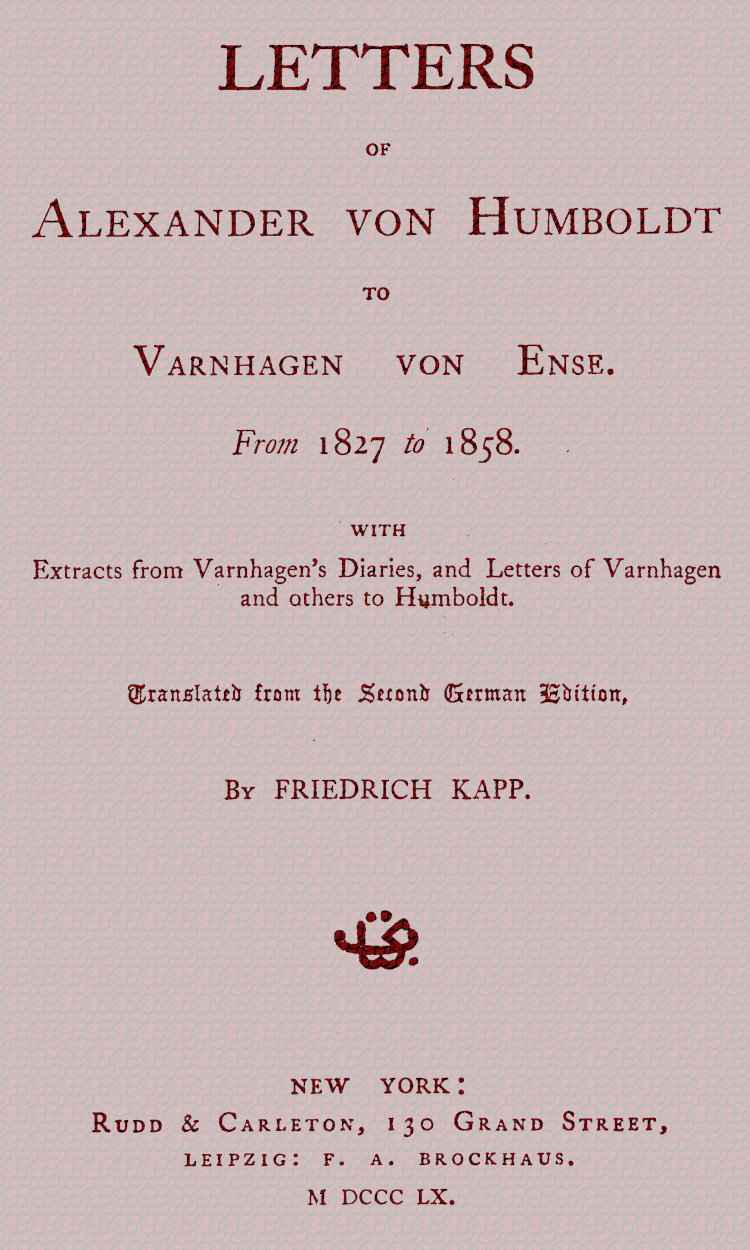
Letters of Alexander von Humboldt to Varnhagen von Ense. / From 1827 to 1858. With extracts from Varnhagen's diaries, and letters of Varnhagen and others to Humboldt cover

Letters of Alexander von Humboldt to Varnhagen von Ense. / From 1827 to 1858. With extracts from Varnhagen's diaries, and letters of Varnhagen and others to Humboldt

Chapter 173: 165. HUMBOLDT TO VARNHAGEN.
Open in WeRead

About This Book

A curated correspondence collects letters from Alexander von Humboldt to his friend and confidant Varnhagen von Ense, supplemented by diary excerpts and letters from other contemporaries. The missives blend personal friendship with professional exchange, discussing scientific observations, lectures, manuscripts, travels, and reactions to peers and events. Editorial apparatus preserves original phrasing and provides contextual notes and extracts that illuminate relationships and chronology. The selection highlights the writer’s methods of observation, precise descriptive habits, and modes of intellectual collaboration. Together the documents form a compact portrait of an engaged scholar whose private reflections and public endeavors intersect across a wide range of topics.

165.
HUMBOLDT TO VARNHAGEN.

Berlin, July 31st, 1854.

Alas! no! I was in error thinking that the monument for Weimar was definitely bought, only that the enlargement of it, desired by our excellent lady friend, was given up. In the circles with which I am acquainted we cannot hope for an active participation. The expression, “Is not art itself a vestment?” is fine and felicitous.

Most gratefully yours,
A. v. Humboldt.

Monday, waiting for the train to leave.

In the United States there has, it is true, arisen a great love for me, but the whole there presents to my mind the sad spectacle of liberty reduced to a mere mechanism in the element of utility, exercising little ennobling or elevating influence upon mind and soul, which, after all, should be the aim of political liberty. Hence indifference on the subject of slavery. But the United States are a Cartesian vortex, carrying everything with them, grading everything to the level of monotony.