
WeRead Powered by ReaderPub
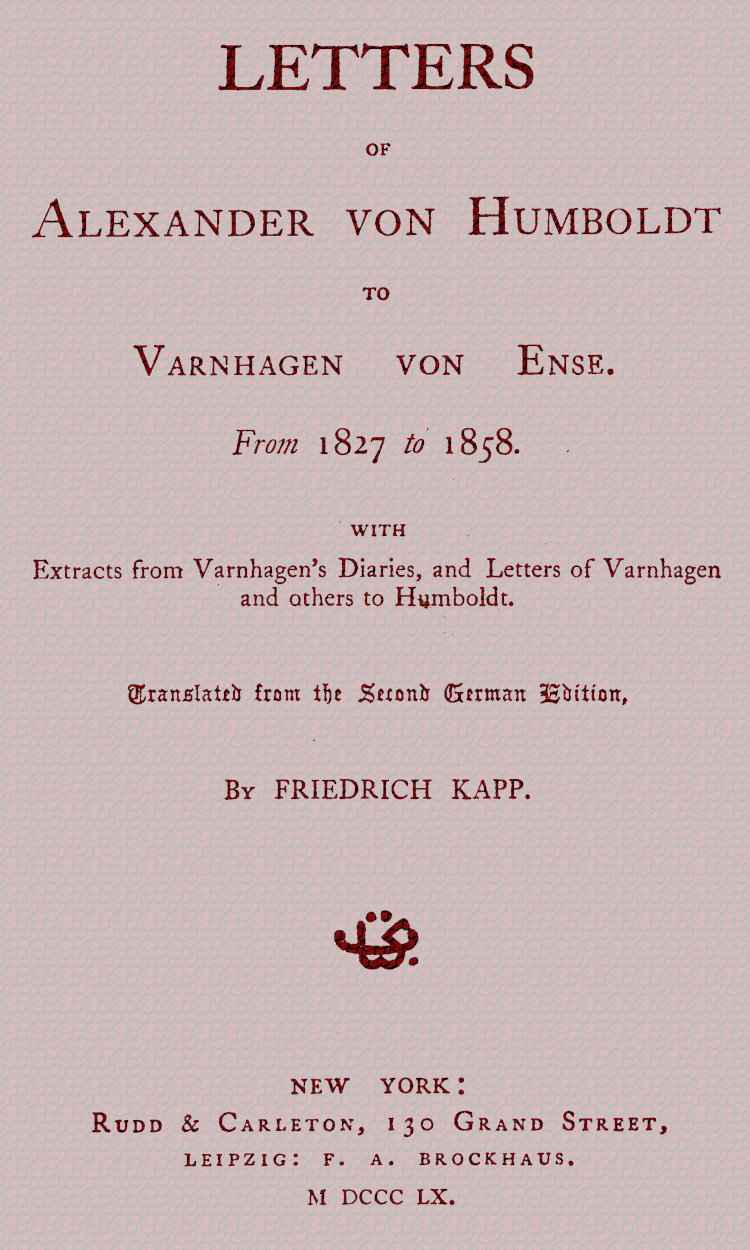
Letters of Alexander von Humboldt to Varnhagen von Ense. / From 1827 to 1858. With extracts from Varnhagen's diaries, and letters of Varnhagen and others to Humboldt cover

Letters of Alexander von Humboldt to Varnhagen von Ense. / From 1827 to 1858. With extracts from Varnhagen's diaries, and letters of Varnhagen and others to Humboldt

Chapter 179: 171. VARNHAGEN TO HUMBOLDT.
Open in WeRead

About This Book

A curated correspondence collects letters from Alexander von Humboldt to his friend and confidant Varnhagen von Ense, supplemented by diary excerpts and letters from other contemporaries. The missives blend personal friendship with professional exchange, discussing scientific observations, lectures, manuscripts, travels, and reactions to peers and events. Editorial apparatus preserves original phrasing and provides contextual notes and extracts that illuminate relationships and chronology. The selection highlights the writer’s methods of observation, precise descriptive habits, and modes of intellectual collaboration. Together the documents form a compact portrait of an engaged scholar whose private reflections and public endeavors intersect across a wide range of topics.

171.
VARNHAGEN TO HUMBOLDT.

Berlin, January 27th, 1856.

With joyful thanks I profit by your Excellency’s goodness in sending me the copy of your beautiful response to the deputies of the city of Berlin. Were it not presumption to praise, where praise has already become a habit and a superfluity, I should say that the speech is as full of sterling merit as of noble intention. The brightest passage, to my mind, is the (I hesitate whether to call it felicitous or masterly) allusion to the King, in terms so dignified and delicate, so warm and graceful; and every pure heart must at once acknowledge, that in this connexion the remark was singularly appropriate and beautiful. In your Excellency’s last favor, the expression, “Madame de Quitzow,” at first puzzled me a good deal. But I may boast of having solved the riddle by the power of the head—as the Jews say, where we speak of cudgelling our brains—and am constrained to acknowledge that the little sally is not only a good joke, but proportionably a mild measure of punishment. The Grand Duke of Saxe-Weimar desired to see me; but I found myself chained down to my rheumatic complaint.

With faithful reverence and most grateful devotion, unalterably your Excellency’s most obedient,

Varnhagen von Ense.