
WeRead Powered by ReaderPub
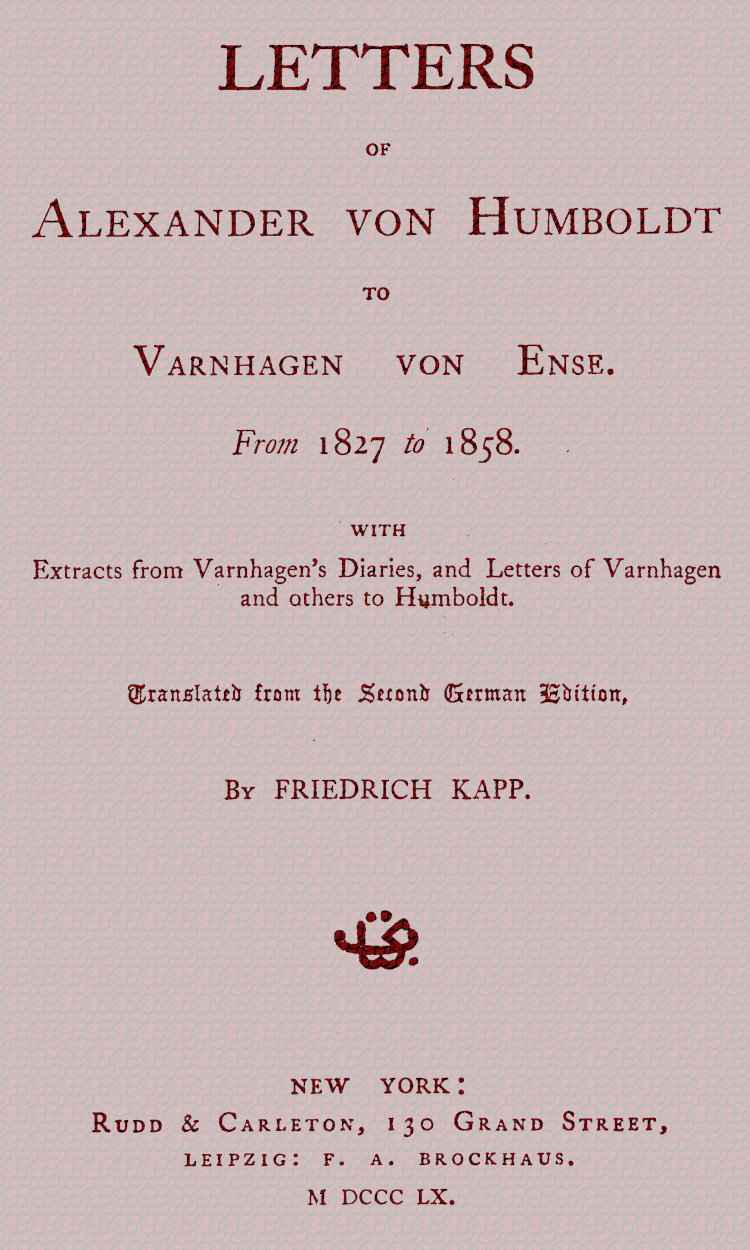
Letters of Alexander von Humboldt to Varnhagen von Ense. / From 1827 to 1858. With extracts from Varnhagen's diaries, and letters of Varnhagen and others to Humboldt cover

Letters of Alexander von Humboldt to Varnhagen von Ense. / From 1827 to 1858. With extracts from Varnhagen's diaries, and letters of Varnhagen and others to Humboldt

Chapter 209: 201. KARL ALEXANDER, GRAND DUKE OF SAXE-WEIMAR, TO HUMBOLDT.
Open in WeRead

About This Book

A curated correspondence collects letters from Alexander von Humboldt to his friend and confidant Varnhagen von Ense, supplemented by diary excerpts and letters from other contemporaries. The missives blend personal friendship with professional exchange, discussing scientific observations, lectures, manuscripts, travels, and reactions to peers and events. Editorial apparatus preserves original phrasing and provides contextual notes and extracts that illuminate relationships and chronology. The selection highlights the writer’s methods of observation, precise descriptive habits, and modes of intellectual collaboration. Together the documents form a compact portrait of an engaged scholar whose private reflections and public endeavors intersect across a wide range of topics.

201.
KARL ALEXANDER, GRAND DUKE OF SAXE-WEIMAR, TO HUMBOLDT.

Weimar, April 3d, 1857.

A misunderstanding is the key to my behavior towards ——. I believed and expected that he, after he had, in January, I believe, asked the permission to search our archives, would immediately come hither. Then only of course I would have paid his expenses. Just in these last days I wondered neither to hear nor to see anything of ——.

Then arrived the second letter of your Excellency, which, asking explanation of me, gives explanation; and I hasten to answer it by saying that —— may come in about ten days, and I would be prepared in any case to make the payment, the amount of which your Excellency yourself named. According to understanding, both of us, I and the traveller, would consider ourselves entirely free yet, and therefore observe due discretion on the proper cause of this journey.

Dante would have spoken still more truly if he had said: “Viver ch’ è un correr a l’eterna gioventù.” You prove it, for eternally your immortal spirit rejuvenates, its excellence is also a proof of this.

In grateful reverence and love, your faithfully most submissive

Karl Alexander.