
WeRead Powered by ReaderPub
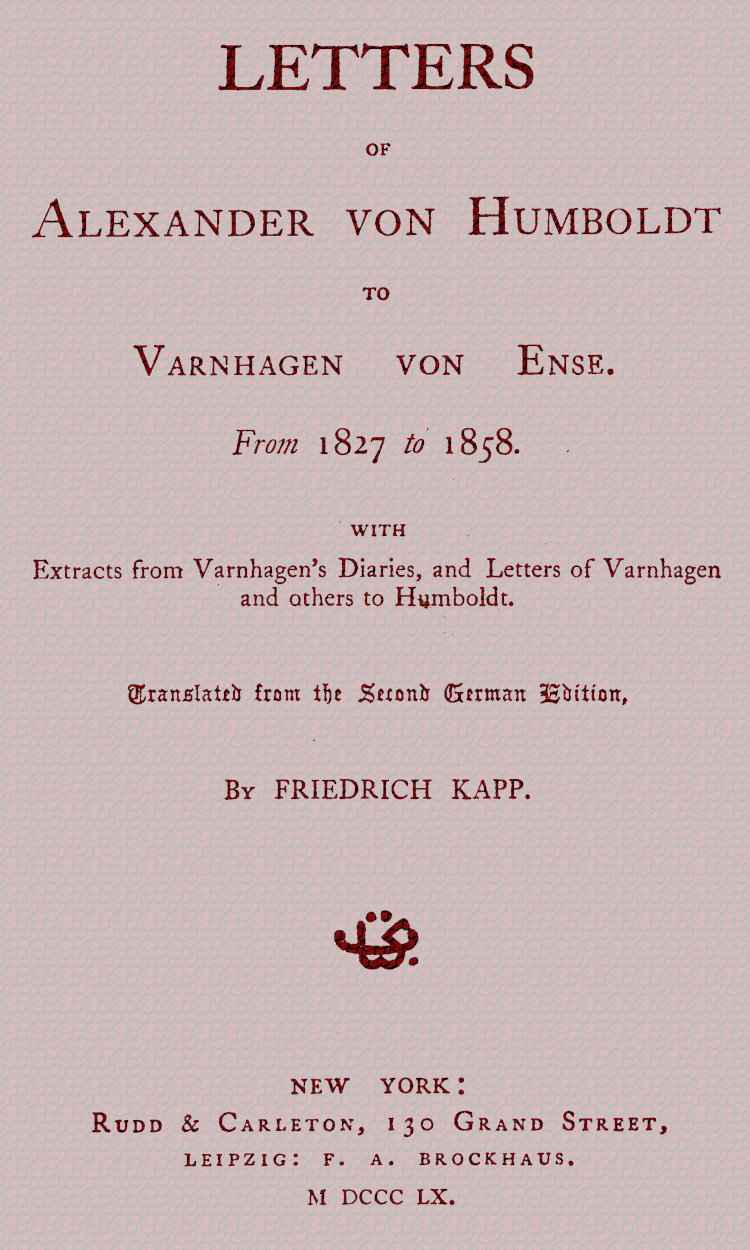
Letters of Alexander von Humboldt to Varnhagen von Ense. / From 1827 to 1858. With extracts from Varnhagen's diaries, and letters of Varnhagen and others to Humboldt cover

Letters of Alexander von Humboldt to Varnhagen von Ense. / From 1827 to 1858. With extracts from Varnhagen's diaries, and letters of Varnhagen and others to Humboldt

Chapter 21: 19. HUMBOLDT TO VARNHAGEN.
Open in WeRead

About This Book

A curated correspondence collects letters from Alexander von Humboldt to his friend and confidant Varnhagen von Ense, supplemented by diary excerpts and letters from other contemporaries. The missives blend personal friendship with professional exchange, discussing scientific observations, lectures, manuscripts, travels, and reactions to peers and events. Editorial apparatus preserves original phrasing and provides contextual notes and extracts that illuminate relationships and chronology. The selection highlights the writer’s methods of observation, precise descriptive habits, and modes of intellectual collaboration. Together the documents form a compact portrait of an engaged scholar whose private reflections and public endeavors intersect across a wide range of topics.

19.
HUMBOLDT TO VARNHAGEN.

Berlin, May 15th, 1835, Tuesday.

My time is, unfortunately, so much occupied by the many princely strangers, and I am so affected by the cold, though not at all bracing weather, that I can scarcely find leisure to thank you, dear friend, for the “Bollmann”[12] and the biographical sketch of him, in which I recognised at once your pen, and also the “retouchings,” when the “Staats Zeitung” fell into my hands. One should not undertake to speak of distinguished men in such papers; it is a difficult task, even for a man of your genius, to keep the proper course between the family, the censor, and the cold, indifferent public.

The name of “Mundt” has recalled to me some remarkable pages of his “Madonna,” on the tendency of the Germans to sentimental lucubrations. There is much truth in these observations, and I thought to read my own sentence in them. So much, dear friend, on this world, to us, now unhappily deserted.

Always gratefully,
A. Humboldt.

I feel some sorrow, nevertheless, that you refuse to see the Grand-Duchess.