
WeRead Powered by ReaderPub
Letters of Alexander von Humboldt to Varnhagen von Ense. / From 1827 to 1858. With extracts from Varnhagen's diaries, and letters of Varnhagen and others to Humboldt cover

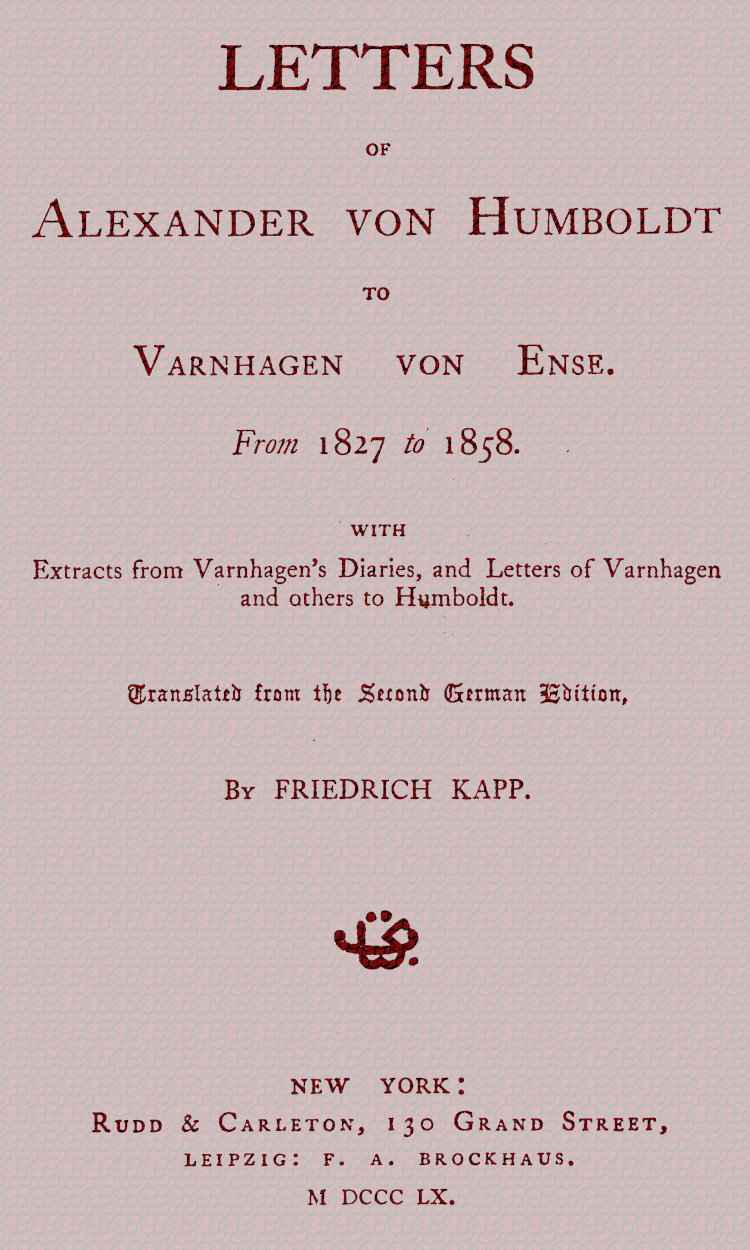
Letters of Alexander von Humboldt to Varnhagen von Ense. / From 1827 to 1858. With extracts from Varnhagen's diaries, and letters of Varnhagen and others to Humboldt

Chapter 215: 206. HUMBOLDT TO VARNHAGEN.
Open in WeRead

About This Book

A curated correspondence collects letters from Alexander von Humboldt to his friend and confidant Varnhagen von Ense, supplemented by diary excerpts and letters from other contemporaries. The missives blend personal friendship with professional exchange, discussing scientific observations, lectures, manuscripts, travels, and reactions to peers and events. Editorial apparatus preserves original phrasing and provides contextual notes and extracts that illuminate relationships and chronology. The selection highlights the writer’s methods of observation, precise descriptive habits, and modes of intellectual collaboration. Together the documents form a compact portrait of an engaged scholar whose private reflections and public endeavors intersect across a wide range of topics.

206.
HUMBOLDT TO VARNHAGEN.

Berlin, April 25th, 1857.

“The gate of the oracle, the abyss of the archives of state, analogies leading down to the depths of the sea.” This is inferior to the last letter. Rafael’s manner is not always the same. I am surprised to find that curiosity appears to have led him to avoid seeing —— before the journey to Hanover! Preserve the vapid letter, my dear friend! The bottom of the sea refers to a map of the sea from Newfoundland to Ireland, which I recommended to the Grand Duke, but which is not to be procured because it was published in Carthage by Perthes! The Times flatter themselves, in all seriousness, that the French race is on the point of extinction; well, the pugs are extinct also.

Yours,
A. v. Humboldt.

I have disagreeable rudera of the correspondence with a certain Dr. Gross Hoffinger, in Vienna, who accuses himself of having written against Prussia in 1848, and now asks Prussia to recommend him to the Austrian government. Have you any recollection of him?

Note by Varnhagen.—“Carthage” means Gotha, a town not far from Weimar, but under the sovereignty of the Duke of Saxe-Coburg, between whom and his cousin there is a constant rivalry, such as of old existed between Rome and Carthage.