
WeRead Powered by ReaderPub
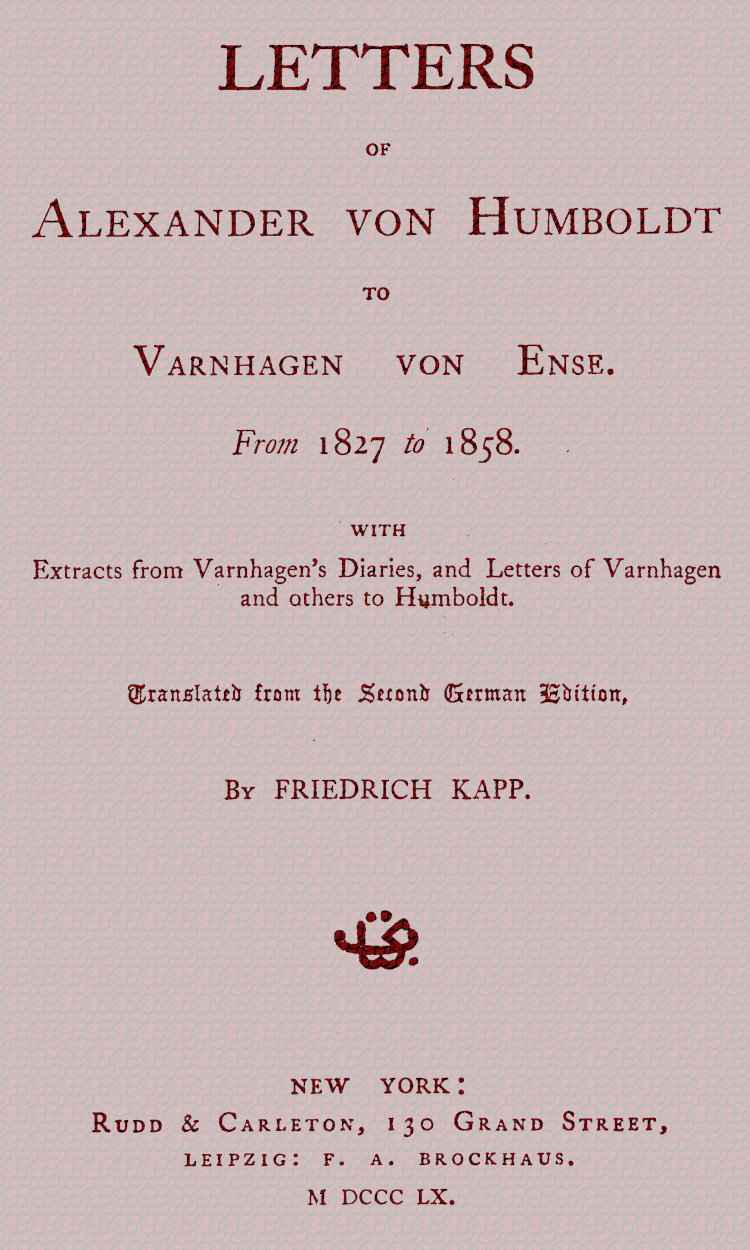
Letters of Alexander von Humboldt to Varnhagen von Ense. / From 1827 to 1858. With extracts from Varnhagen's diaries, and letters of Varnhagen and others to Humboldt cover

Letters of Alexander von Humboldt to Varnhagen von Ense. / From 1827 to 1858. With extracts from Varnhagen's diaries, and letters of Varnhagen and others to Humboldt

Chapter 220: 211. THIERS TO HUMBOLDT.
Open in WeRead

About This Book

A curated correspondence collects letters from Alexander von Humboldt to his friend and confidant Varnhagen von Ense, supplemented by diary excerpts and letters from other contemporaries. The missives blend personal friendship with professional exchange, discussing scientific observations, lectures, manuscripts, travels, and reactions to peers and events. Editorial apparatus preserves original phrasing and provides contextual notes and extracts that illuminate relationships and chronology. The selection highlights the writer’s methods of observation, precise descriptive habits, and modes of intellectual collaboration. Together the documents form a compact portrait of an engaged scholar whose private reflections and public endeavors intersect across a wide range of topics.

211.
THIERS TO HUMBOLDT.

(FROM THE FRENCH.)
Paris, May 14th, 1857.

My Dear M. de Humboldt—I take the liberty of commending to your goodness shown so often to myself and to Frenchmen generally, M. Duvergier de Hauranne, who goes to Germany to show it to his young son. You know our country too well for me to tell you what important and always honorable part has been sustained by M. Duvergier de Hauranne in our assemblies, where he has ever been faithful to the cause of rational liberty; and not faithful alone, but eminently useful. Having returned to private life and devoted himself to study, he goes to see your excellent country, and I thought I could not do better than to recommend him to your kindness. To his young son it will be an imperishable recollection to have seen the illustrious savan who does the greatest honor to the century, and whom we Frenchmen have the vanity to consider as French, and belonging to us no less than to Germany.

I do not write on current affairs here, for M. Duvergier de Hauranne knows them, and can make you acquainted with them better than any other man.

Accept the renewed homage of my respectful attachment.

A. Thiers.