
WeRead Powered by ReaderPub
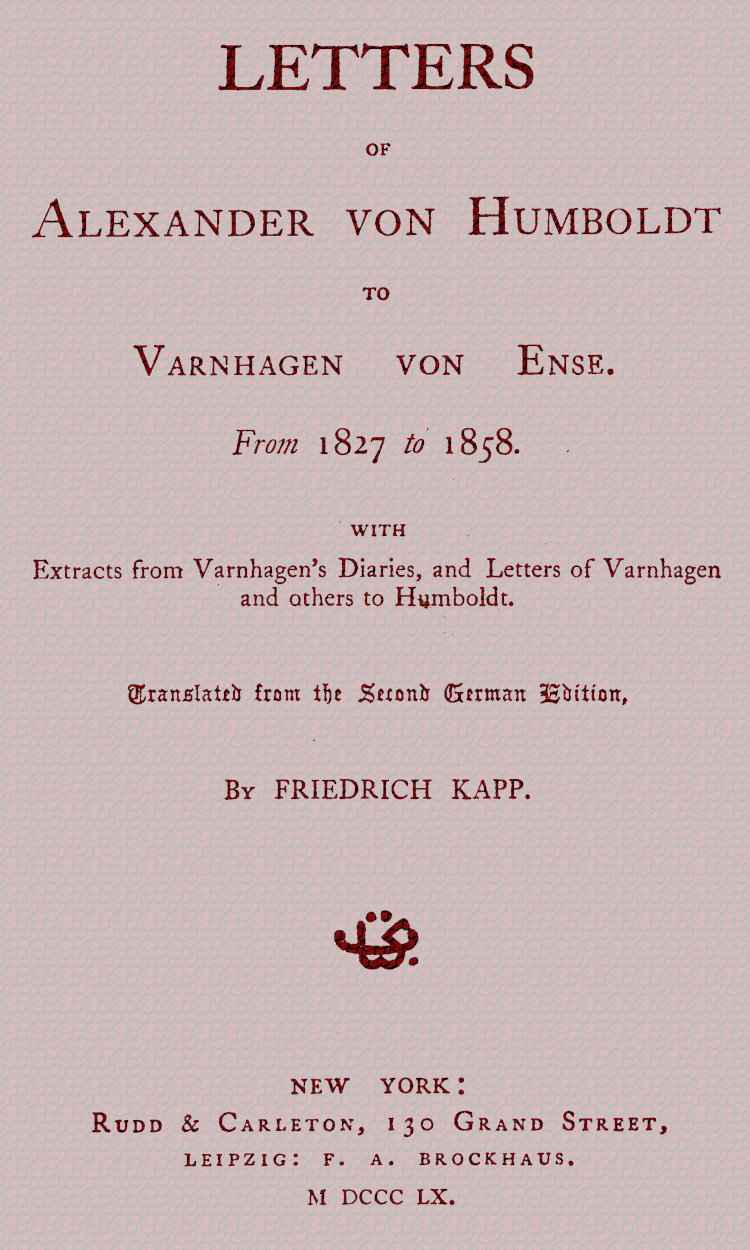
Letters of Alexander von Humboldt to Varnhagen von Ense. / From 1827 to 1858. With extracts from Varnhagen's diaries, and letters of Varnhagen and others to Humboldt cover

Letters of Alexander von Humboldt to Varnhagen von Ense. / From 1827 to 1858. With extracts from Varnhagen's diaries, and letters of Varnhagen and others to Humboldt

Chapter 23: 21. HUMBOLDT TO VARNHAGEN.
Open in WeRead

About This Book

A curated correspondence collects letters from Alexander von Humboldt to his friend and confidant Varnhagen von Ense, supplemented by diary excerpts and letters from other contemporaries. The missives blend personal friendship with professional exchange, discussing scientific observations, lectures, manuscripts, travels, and reactions to peers and events. Editorial apparatus preserves original phrasing and provides contextual notes and extracts that illuminate relationships and chronology. The selection highlights the writer’s methods of observation, precise descriptive habits, and modes of intellectual collaboration. Together the documents form a compact portrait of an engaged scholar whose private reflections and public endeavors intersect across a wide range of topics.

21.
HUMBOLDT TO VARNHAGEN.

Berlin, Saturday, 23d of May, 1835.

If the “Morgenblatt” of the 18th of May should fall into your hands, dear friend, please glance at a rather offensive article therein, entitled “Wilhelm von Humboldt’s Funeral.” My brother is said to have died abandoned by his family. I take but little notice of such misrepresentations. I should wish to know, however, is “that other thing” which my brother was “ignorant of, besides music, and which one dare not name”—is it God, or some lewdness? I do not know what it possibly can be! Please, dearest one, to find out how this assertion is explained by the public. The cause of my brother’s retiring from public life is also so world-known, that it is singular to intimate that one did not know whether it was by his own fault. I call with pleasure on your acuteness and affection. Supply my deficiency in the first.

Most thankfully yours,
A. Humboldt.