
WeRead Powered by ReaderPub
Letters of Alexander von Humboldt to Varnhagen von Ense. / From 1827 to 1858. With extracts from Varnhagen's diaries, and letters of Varnhagen and others to Humboldt cover

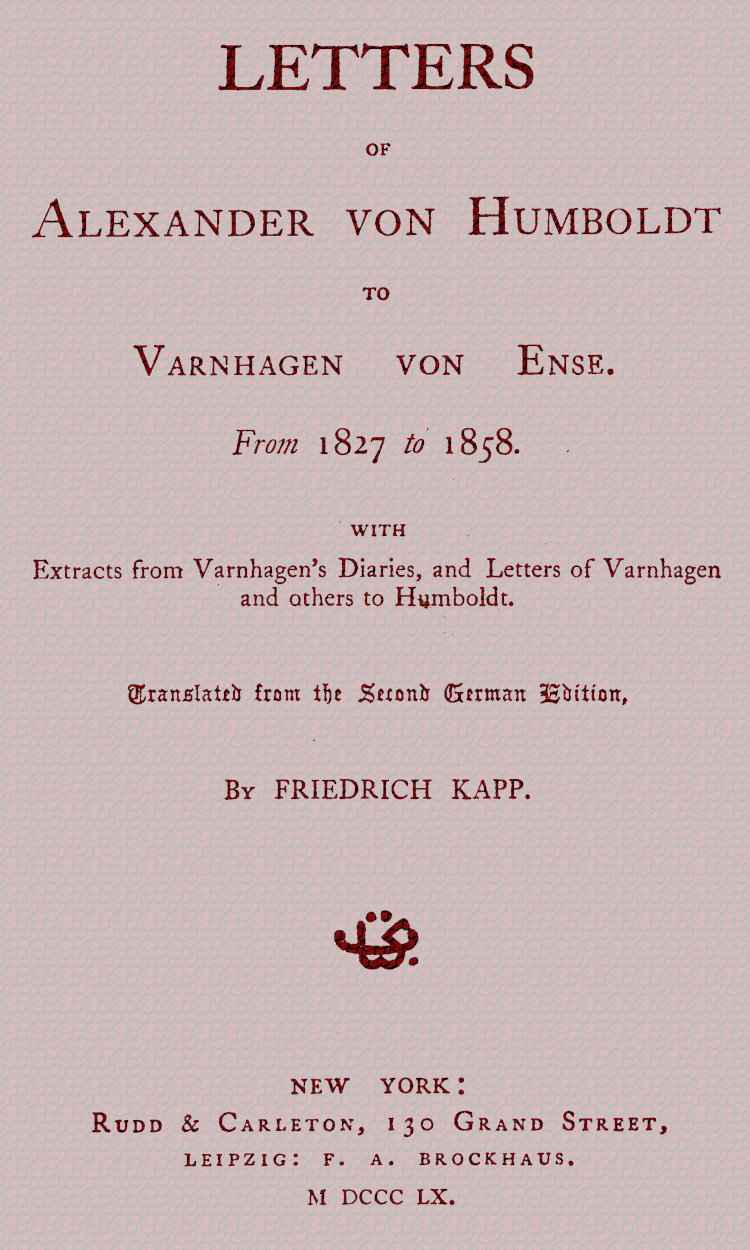
Letters of Alexander von Humboldt to Varnhagen von Ense. / From 1827 to 1858. With extracts from Varnhagen's diaries, and letters of Varnhagen and others to Humboldt

Chapter 42: 40. HUMBOLDT TO VARNHAGEN.
Open in WeRead

About This Book

A curated correspondence collects letters from Alexander von Humboldt to his friend and confidant Varnhagen von Ense, supplemented by diary excerpts and letters from other contemporaries. The missives blend personal friendship with professional exchange, discussing scientific observations, lectures, manuscripts, travels, and reactions to peers and events. Editorial apparatus preserves original phrasing and provides contextual notes and extracts that illuminate relationships and chronology. The selection highlights the writer’s methods of observation, precise descriptive habits, and modes of intellectual collaboration. Together the documents form a compact portrait of an engaged scholar whose private reflections and public endeavors intersect across a wide range of topics.

40.
HUMBOLDT TO VARNHAGEN.

Monday, March 9th, 1840.

The Crown-Prince, to whom I brought, this morning, your thoughtful “Lebensbuch,” has ordered me to express to you, revered friend, his “most friendly thanks.” It reminded him, at the same time, of your “Sophie Charlotte,” your “Seydlitz,” your always delightful language, and your skill in portraying difficult relations of life. The liberal passage on Grimm I read to him. It pleased him much, and brought on a conversation on Hanover. He expressed himself very sensibly in regard to it. “The King of Hanover does not understand how to treat Germans: he does not know how to win them, by availing himself of their loyal emotions. On the day when the news of the final election in Göttingen arrived in Hanover, I would have sent an aide-de-camp or a civil officer to Göttingen, to thank the professors, and ask them whether they would like to have the whole seven professors reappointed.” These are words flowing from a noble soul. Of your article on Niebuhr, I do not speak to the Crown-Prince, though I entirely agree with you regarding it.

With old attachment,
Yours,
A. v. Hdt.