
WeRead Powered by ReaderPub
Letters of Alexander von Humboldt to Varnhagen von Ense. / From 1827 to 1858. With extracts from Varnhagen's diaries, and letters of Varnhagen and others to Humboldt cover

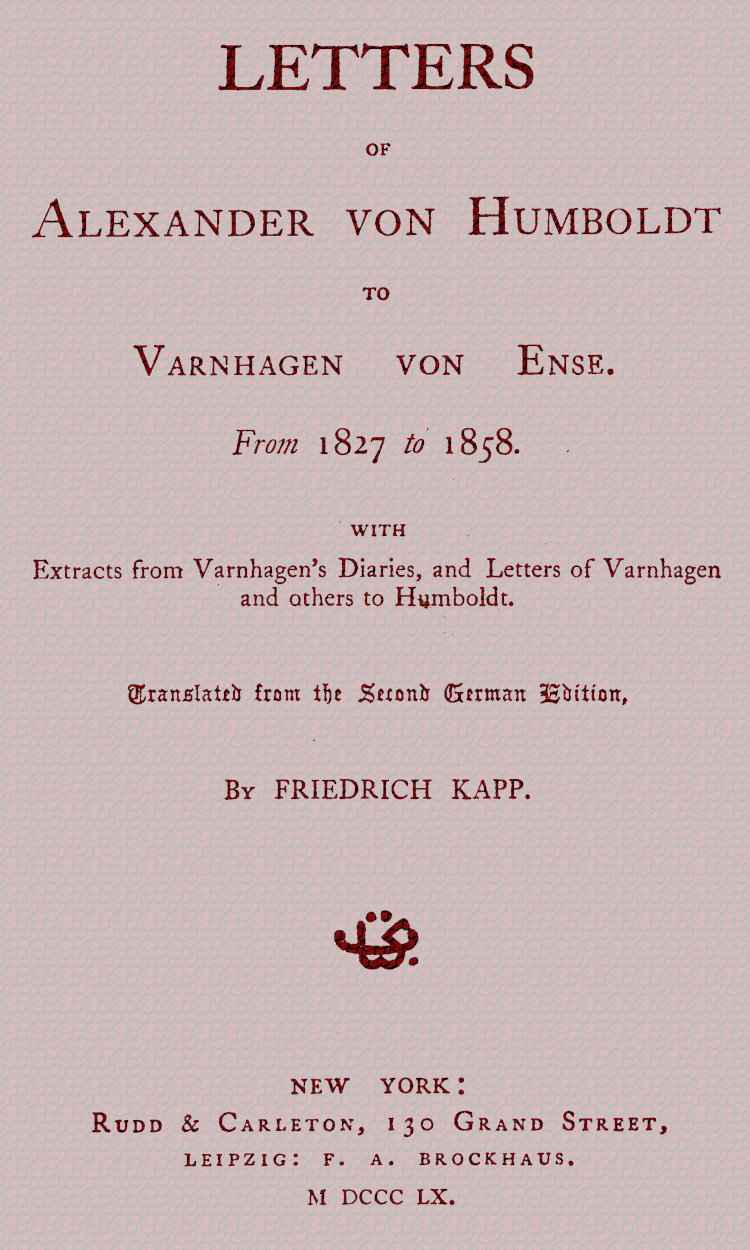
Letters of Alexander von Humboldt to Varnhagen von Ense. / From 1827 to 1858. With extracts from Varnhagen's diaries, and letters of Varnhagen and others to Humboldt

Chapter 45: 43. HUMBOLDT TO VARNHAGEN.
Open in WeRead

About This Book

A curated correspondence collects letters from Alexander von Humboldt to his friend and confidant Varnhagen von Ense, supplemented by diary excerpts and letters from other contemporaries. The missives blend personal friendship with professional exchange, discussing scientific observations, lectures, manuscripts, travels, and reactions to peers and events. Editorial apparatus preserves original phrasing and provides contextual notes and extracts that illuminate relationships and chronology. The selection highlights the writer’s methods of observation, precise descriptive habits, and modes of intellectual collaboration. Together the documents form a compact portrait of an engaged scholar whose private reflections and public endeavors intersect across a wide range of topics.

43.
HUMBOLDT TO VARNHAGEN.

Thursday, April 9th, 1840.

Here are two Salamanders. The black (black bordered) king of Denmark is not only a Norwegian constitutional, but also a mineralogical king, who has written pretty good memoirs on Vesuvius. The predecessor having been an astronomical king, who proposed prize questions on comets, presented great men like General Mueffling and myself with chronometers, and died of a comet on the night of the discovery of Galli’s comet, the Danish astronomers were, probably, rather anxious for their heavenly pursuits under the reign of such an earthly (or rather subterranean) monarch. I was called upon to remind the King of his old predilection for me. I therefore resorted to the pretext, never before made use of by me, of congratulating him on his accession to the throne. This is the cause of the black drama. The letter is plain and sensible.

A. Ht.

Please read in Mr. Quinet’s the passage on Goethe and Bettina, and return the venom to me.