
WeRead Powered by ReaderPub
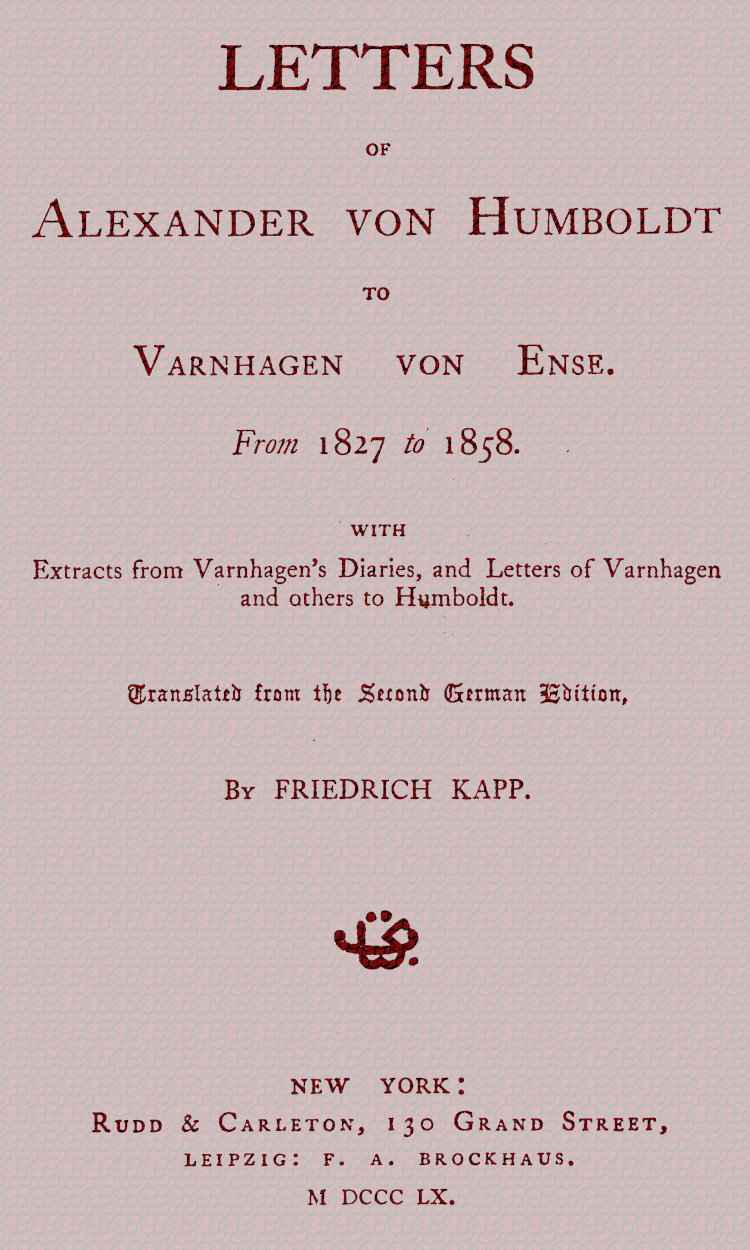
Letters of Alexander von Humboldt to Varnhagen von Ense. / From 1827 to 1858. With extracts from Varnhagen's diaries, and letters of Varnhagen and others to Humboldt cover

Letters of Alexander von Humboldt to Varnhagen von Ense. / From 1827 to 1858. With extracts from Varnhagen's diaries, and letters of Varnhagen and others to Humboldt

Chapter 67: 65. HUMBOLDT TO VARNHAGEN.
Open in WeRead

About This Book

A curated correspondence collects letters from Alexander von Humboldt to his friend and confidant Varnhagen von Ense, supplemented by diary excerpts and letters from other contemporaries. The missives blend personal friendship with professional exchange, discussing scientific observations, lectures, manuscripts, travels, and reactions to peers and events. Editorial apparatus preserves original phrasing and provides contextual notes and extracts that illuminate relationships and chronology. The selection highlights the writer’s methods of observation, precise descriptive habits, and modes of intellectual collaboration. Together the documents form a compact portrait of an engaged scholar whose private reflections and public endeavors intersect across a wide range of topics.

65.
HUMBOLDT TO VARNHAGEN.

Thursday, 31st March, 1842.

On my return from Potsdam with the King I received the “Loa-Tseu,” a work with a peculiar flavor of ante-Herodotian antiquity. Your note accompanying the Chinese philosopher impresses me painfully. I find that you have not yet received the courage arising from a consciousness of restored physical strength. That the vigor of your intellect never suffered is shown in each of your letters. I think I have not lost any of them. About a week ago I wrote you a long one of four pages about that “Christianly-dogmatising philosopher,” and my reply to the inquiries of the “Biographer,” who pestered me with his pietistic curiosity. Did that letter come to hand safely? It contained also much chit-chat on my brother’s first erudition. You don’t make any mention of my talkativeness. I trust it will not be a source of trouble to me. We have succeeded with Buelow. He may be here next Saturday. It may be the beginning of something good; or the end of it—le bouquet—the stage effect of foot-lights. I met with Tholuk and Bekedorff yesterday at Potsdam at dinner. No other occasion would have favored me with their apparition. With constant devotion yours,

A. Ht.