
WeRead Powered by ReaderPub
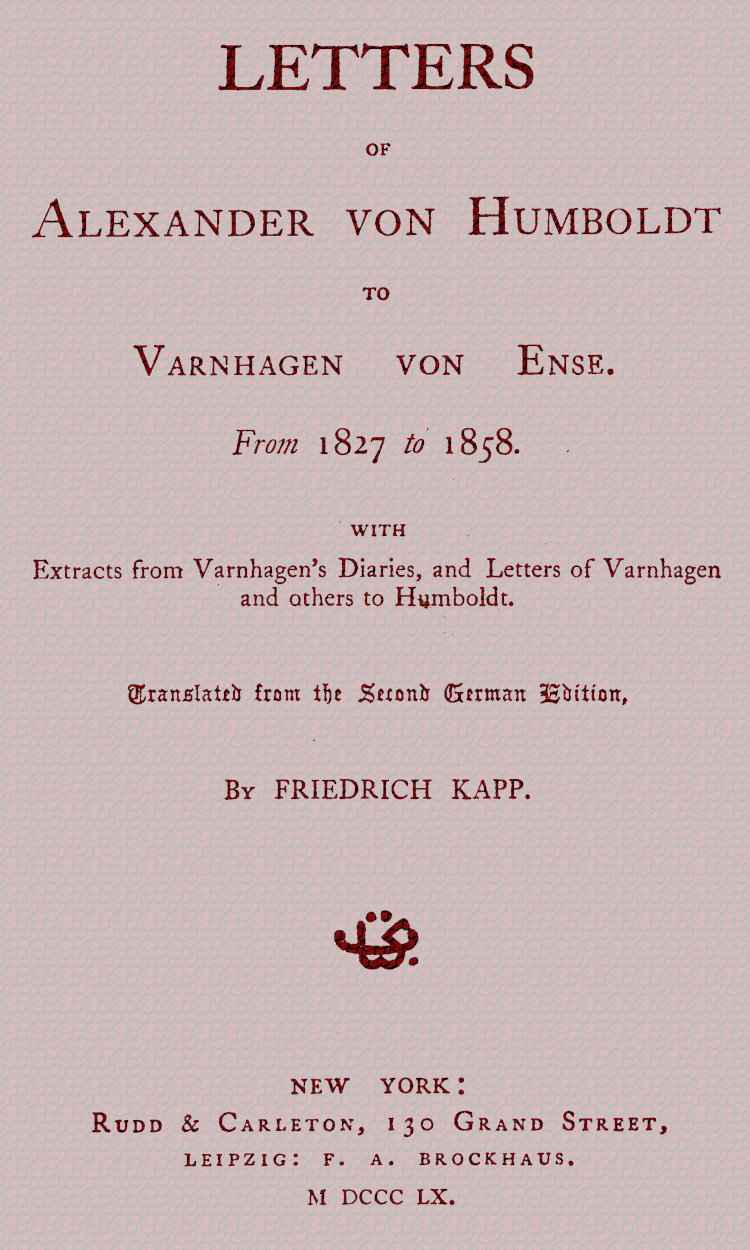
Letters of Alexander von Humboldt to Varnhagen von Ense. / From 1827 to 1858. With extracts from Varnhagen's diaries, and letters of Varnhagen and others to Humboldt cover

Letters of Alexander von Humboldt to Varnhagen von Ense. / From 1827 to 1858. With extracts from Varnhagen's diaries, and letters of Varnhagen and others to Humboldt

Chapter 8: 6. HUMBOLDT TO VARNHAGEN.
Open in WeRead

About This Book

A curated correspondence collects letters from Alexander von Humboldt to his friend and confidant Varnhagen von Ense, supplemented by diary excerpts and letters from other contemporaries. The missives blend personal friendship with professional exchange, discussing scientific observations, lectures, manuscripts, travels, and reactions to peers and events. Editorial apparatus preserves original phrasing and provides contextual notes and extracts that illuminate relationships and chronology. The selection highlights the writer’s methods of observation, precise descriptive habits, and modes of intellectual collaboration. Together the documents form a compact portrait of an engaged scholar whose private reflections and public endeavors intersect across a wide range of topics.

6.
HUMBOLDT TO VARNHAGEN.

Berlin, 26th of April, 1830.

I have just come home from Potsdam, and find your dear letter and your present, so very agreeable to me. The “Zinzendorf[5] will delight me very, very much. He is an individual physiognomy like Lavater and Cardanus. The recent pietism, which began to break out at Halle, made me smile. I rejoice that you will kindly accept my “Cri de Pétersbourg”—it is a parody recited at Court—the forced work of two nights; an essay to flatter without self-degradation, to say how things should be. As you and your high-gifted wife, my ancient and kind friend, rejoice in anything agreeable that happens to me, I wish to say that the King sends me to the Emperor to attend the meeting of the Potentates. I shall probably go with the Crown-Prince, who will meet the Empress at Fischbach.

Yours,
A. Ht.

Zinzendorf’s letters to the Saviour were rather more legible.[6]