
WeRead Powered by ReaderPub
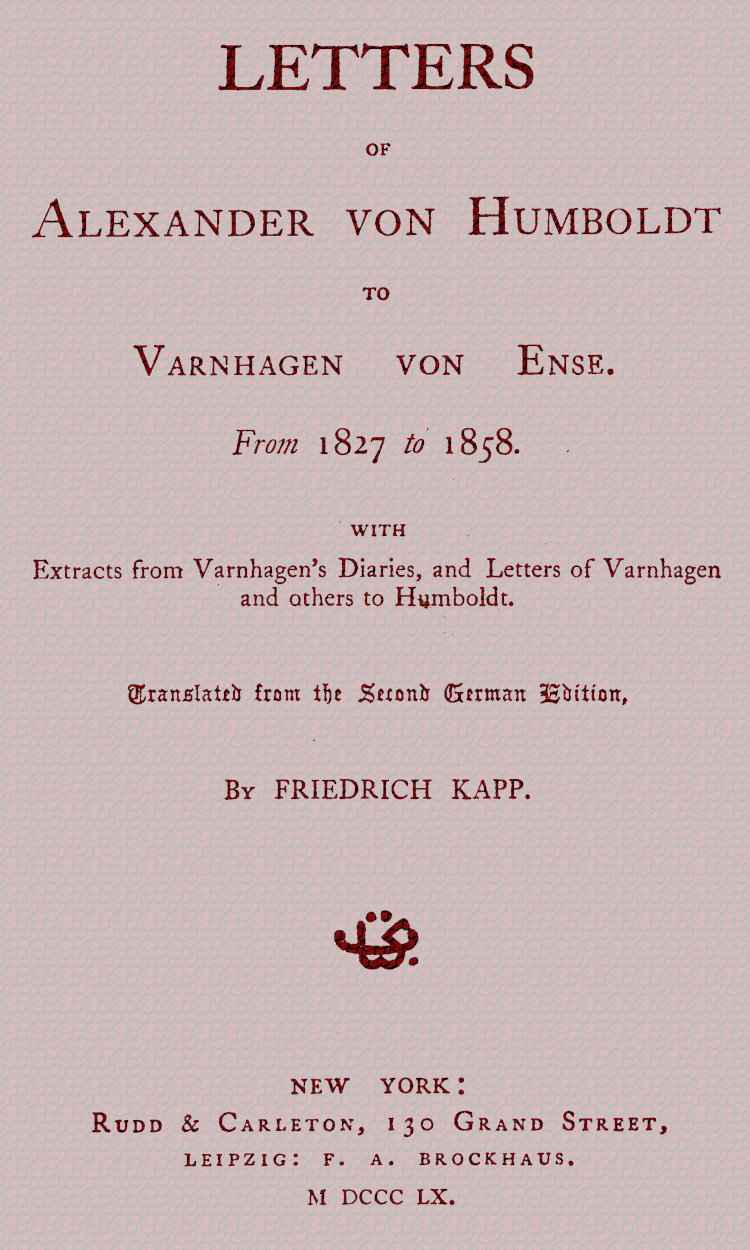
Letters of Alexander von Humboldt to Varnhagen von Ense. / From 1827 to 1858. With extracts from Varnhagen's diaries, and letters of Varnhagen and others to Humboldt cover

Letters of Alexander von Humboldt to Varnhagen von Ense. / From 1827 to 1858. With extracts from Varnhagen's diaries, and letters of Varnhagen and others to Humboldt

Chapter 91: 85. METTERNICH TO HUMBOLDT.
Open in WeRead

About This Book

A curated correspondence collects letters from Alexander von Humboldt to his friend and confidant Varnhagen von Ense, supplemented by diary excerpts and letters from other contemporaries. The missives blend personal friendship with professional exchange, discussing scientific observations, lectures, manuscripts, travels, and reactions to peers and events. Editorial apparatus preserves original phrasing and provides contextual notes and extracts that illuminate relationships and chronology. The selection highlights the writer’s methods of observation, precise descriptive habits, and modes of intellectual collaboration. Together the documents form a compact portrait of an engaged scholar whose private reflections and public endeavors intersect across a wide range of topics.

85.
METTERNICH TO HUMBOLDT.

Vienna, October, 1843.
My Dear Baron:

You were kind enough to present me a copy of your “Asie Centrale.” I call it your because discoveries lawfully belong to those who make them, and because it is often better to make a discovery than to become the possessor of its results.

I have begun the perusal of the work, which is among those to which I look for mental relaxation, just as minds differently constituted from mine are apt to have recourse to light and futile productions. This is really the case. I often feel the necessity of some relief from my monotonous duties, and it is then that I seek fresh elements of life and vigor in works of profound learning. A book, therefore, like yours, is to me a source of the richest enjoyment. I learn, and I love to learn, and I feel no jealousy of your great erudition.

What I most admire in your work is “the method.” You understand tracing a line without ever losing sight of it, and therefore you arrive safely at the end—which is not always the good fortune of those who start well enough upon the road. Please send me the volumes complete—I shall receive them with gratitude.

I pray you, dear Baron, accept the assurance of my highest consideration and old attachment,

Metternich.