
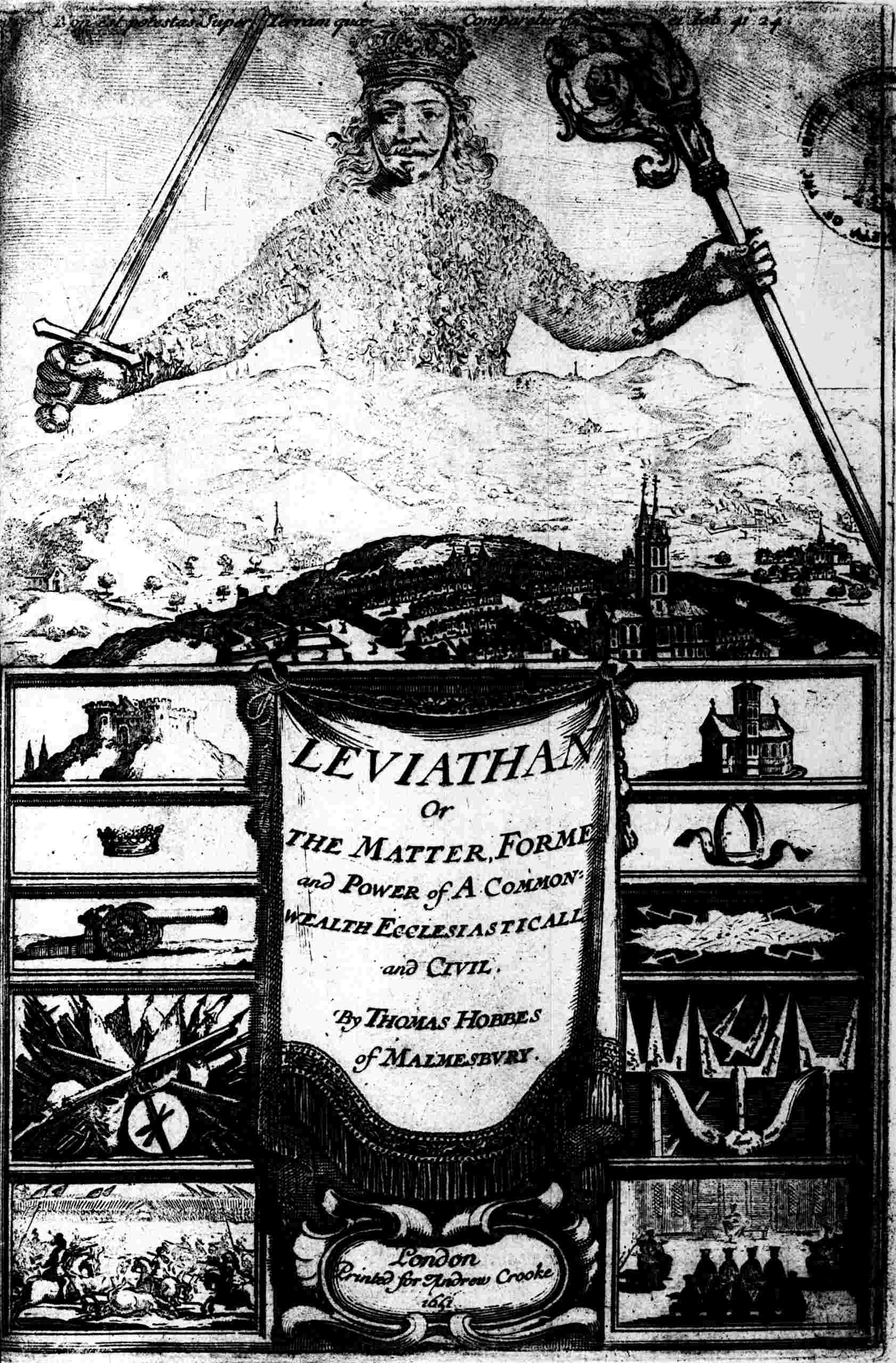
The Project Gutenberg eBook of Leviathan
Title: Leviathan
Author: Thomas Hobbes
Release date: May 1, 2002 [eBook #3207]
Most recently updated: September 17, 2025
Language: English
Credits: Edward White and David Widger
LEVIATHAN
By Thomas Hobbes
1651
LEVIATHAN OR THE MATTER,
FORME, & POWER OF A COMMON-WEALTH
ECCLESIASTICAL AND CIVILL
Thomas Hobbes of Malmesbury
Printed for Andrew Crooke,
at
the Green Dragon
in St. Paul’s Churchyard,
1651.
This E-text was prepared from the Pelican Classics edition of Leviathan, which in turn was prepared from the first edition. I have tried to follow as closely as possible the original, and to give the flavour of the text that Hobbes himself proof-read, but the following differences were unavoidable.
Hobbes used capitals and italics very extensively, for emphasis, for proper names, for quotations, and sometimes, it seems, just because.
The original has very extensive margin notes, which are used to show where he introduces the definitions of words and concepts, to give in short the subject that a paragraph or section is dealing with, and to give references to his quotations, largely but not exclusively biblical. To some degree, these margin notes seem to have been intended to serve in place of an index, the original having none. They are all in italics.
He also used italics for words in other languages than English, and there are a number of Greek words, in the Greek alphabet, in the text.
To deal with these within the limits of plain vanilla ASCII, I have done the following in this E-text.
I have restricted my use of full capitalization to those places where Hobbes used it, except in the chapter headings, which I have fully capitalized, where Hobbes used a mixture of full capitalization and italics.
Where it is clear that the italics are to indicate the text is quoting, I have introduced quotation marks. Within quotation marks I have retained the capitalization that Hobbes used.
Where italics seem to be used for emphasis, or for proper names, or just because, I have capitalized the initial letter of the words. This has the disadvantage that they are not then distinguished from those that Hobbes capitalized in plain text, but the extent of his italics would make the text very ugly if I was to use an underscore or slash.
Where the margin notes are either to introduce the paragraph subject, or to show where he introduces word definitions, I have included them as headers to the paragraph, again with all words having initial capitals, and on a shortened line.
For margin references to quotes, I have included them in the text, in brackets immediately next to the quotation. Where Hobbes included references in the main text, I have left them as he put them, except to change his square brackets to round.
For the Greek alphabet, I have simply substituted the nearest ordinary letters that I can, and I have used initial capitals for foreign language words.
Neither Thomas Hobbes nor his typesetters seem to have had many inhibitions about spelling and punctuation. I have tried to reproduce both exactly, with the exception of the introduction of quotation marks.
In preparing the text, I have found that it has much more meaning if I read it with sub-vocalization, or aloud, rather than trying to read silently. Hobbes’ use of emphasis and his eccentric punctuation and construction seem then to work.