
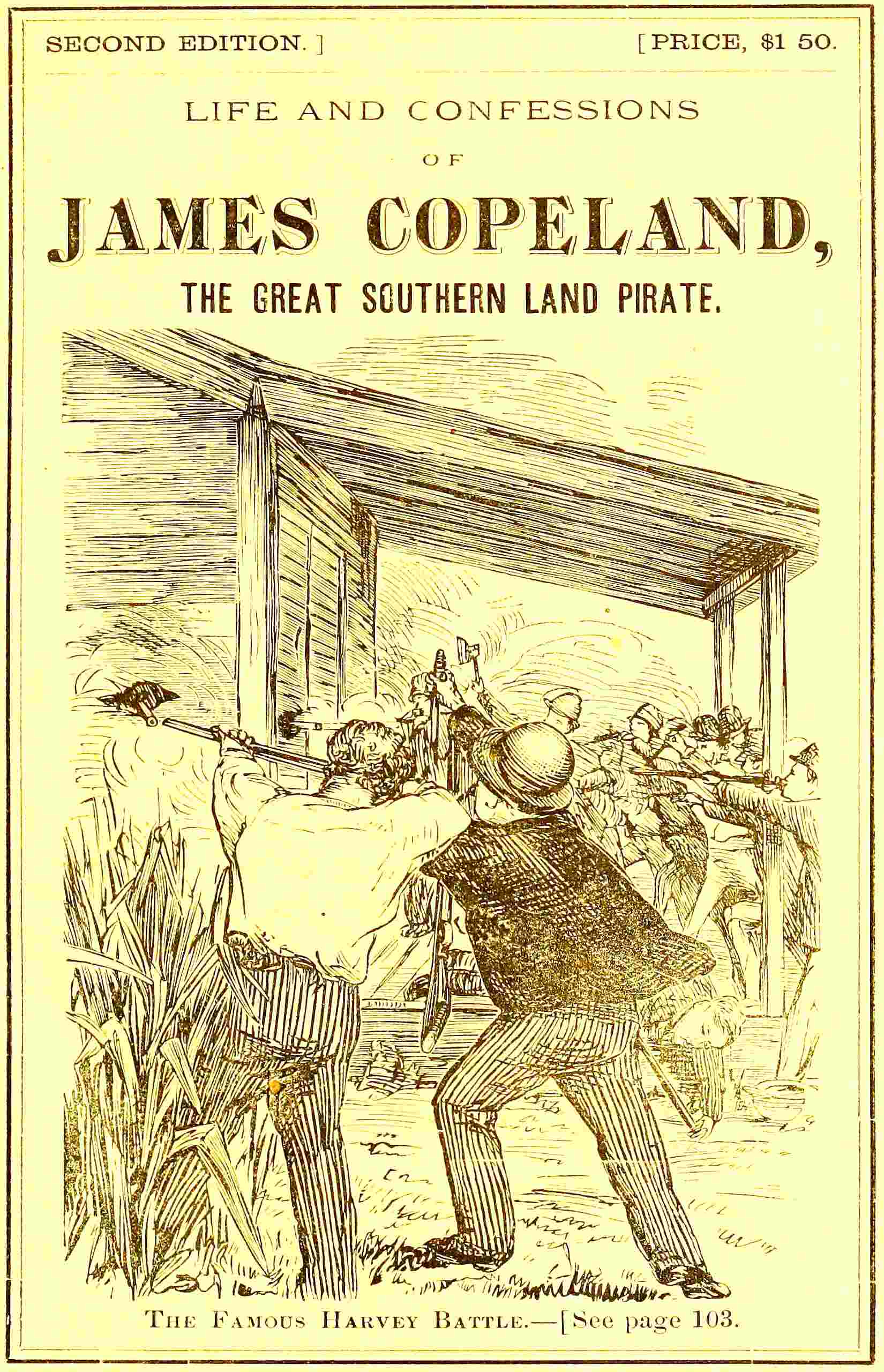
APPENDIX.
PLANS DEVISED TO PRESERVE THE LIFE OF COPELAND.
THE LAST BOLD EFFORTS TO SAVE THE LIFE OF JAMES COPELAND
PROVED INEFFECTUAL; BUT THE SAME AGENTS SUCCEEDED
BY REFINED MOVEMENTS IN PROCURING THE
ACQUITTAL OF JOHN COPELAND.
The organization of the Wages and Copeland Clan embraced a diversified talent of an extraordinary grade in different departments of operations. It commanded some of the ablest ability belonging to the bar and the medical profession, with other agents who could be hired or engaged for temporary assistance. It requires more than a cursory contemplation to anything like a full comprehension of the lengths, and breadths, and depths of its vast theaters of operations. Many, perhaps, not admitted to the council and secret conclaves of the organization, could be engaged for a stipulated sum to perform important services in defense and protection of its active members, who might inwardly condemn its pernicious fields of operations against the best interests of society. Whether such conduct can stand the test of reason and argument it is for others, with the reader, to determine. The worse the case the richer the fees for the lawyer, and so of the medical profession. As frequently happens, the lawyer scruples at nothing to win a victory for his client. In some places this course is fashionable and not at all odious. As long as the attorney keeps his defense within legitimate bounds, and avails himself of every lawful opportunity for the advantage of his client, no well-balanced mind can be disposed to censure, because on the other side, the prosecution will do the same. But when foul and corrupt means are resorted to; when the most vicious and depraved of actions are brought in play to screen the guilty and make crime respectable, then it is that public sentiment should be loud against such abominations, no matter whether against the medical or legal profession, or against any other class who can be brought to perform the services of infamy.
The period betwixt the imprisonment and execution of James Copeland, three parties from Alabama came and settled in Perry county, Miss., one in, and the other two about Augusta. These three performed their part so well—so concealed and reserved as to pass for gentlemen in the highest degree respectable. But few, if any, had suspicion until afterward of their object to assist the captured in escaping the last penalties of outraged law.
One of the three, who settled in Augusta; a skilled doctor and surgeon, behaved himself so well in every respect—on all occasions exhibiting a winning and an affable deportment—everybody’s friend with the most lavish of generosity—sparing no exertions to gain the confidence and admiration of those in power and of influence; this is the man who proposed to the sheriff the plan to save the life of James Copeland. This proposition was made betwixt the time of his conviction and execution. The particulars are as follows:—The doctor to the sheriff: “There is now a fine opportunity of making one thousand dollars in gold, providing that you will act in concert with me in permitting certain things to be done before the execution of Copeland.” There was something so bland, so expert, and so graceful in the conduct of the strange doctor as to make him friends wherever he went. He insinuated himself into the confidence of the sheriff; and when the proposition was made for certain things to be done before execution, for and in consideration of a thousand dollars, the curiosity of the sheriff could not be otherwise than powerfully excited to learn all particulars of the plan in contemplation, and, accordingly, so far indulged or humored the beginning so as to obtain the whole of what was then behind. The doctor continued, and gave the name of him who had a thousand dollars to pay for the preservation of the life of Copeland; and to be done in the following manner, secure from exciting any suspicion whatever. The doctor to the sheriff: “Allow me about half an hour before the time arrives for your taking him out of jail to the place of execution, to go in under the pretence of shaving and dressing him suitably to the solemnity of the occasion, during which time I will perform an operation in tracheotomy by inserting into the trachea, or wind-pipe, a small silver tube sufficient for the admission of air into the lungs to keep up some degree of respiration, so that when he shall have hung the allotted time, he can be cut down and by an extension of the tube, he can be so buried as to prevent the extinction of life; which, as soon as convenient, he can be disinterred and so cared for by artful means until the recovery so far progress as will enable him to successfully escape.”
The sheriff listened to all this with a smile, and treated the whole as rather a plausible romance than a possible reality; but firm to the duties of his office, he yielded not to the temptation; yet to maintain good faith as to what transpired before the proposition was fully made, and for prudent considerations in regard to his own safety, he has refrained from publishing this narrative at an earlier date, because conscious that the public interests, though delayed, would best be served by so doing in the long run.
Shortly after the execution of James, John Copeland, the brother of the former, was arrested, brought to the same jail, and tried in the same case, and for the same crime of murder.
The State was represented by George Wood, Esq., and the defence by Wirt Adams as principal. Both sides labored hard and wonderfully skillful. The argument of the latter occupied about three or four hours in delivery. The evidence against John Copeland was quite as strong as against his convicted brother, but the juries were of different material. The three strange immigrants from Alabama, who then had recently settled in and about Augusta, managed to get on the jury. This was not hard to do, as the county had pretty much been exhausted before to get an acceptable jury not disqualified by some objections brought forth. When the jury retired, the three here referred to, having the most ingenuity, lead the other remaining part, the consequence of which was a verdict of acquittal. This verdict aroused the indignation of the public both far and near—murmurs everywhere, and satisfaction nowhere. So irritated were the populace that, in all probability, the life of Copeland would have been taken by violence the night after his liberation, but for the timely notice given him for immediate escape.
The following morning he was heard from as being seen on the opposite side of Leaf river, about thirty miles below Augusta, in the direction for Pascagoula river. It is supposed he went almost direct to Angelina county, Texas, where his mother and family settled after leaving Mississippi.
But little time had elapsed after this before the Sheriff of Perry received a letter from Col. Pickering, of this (Angelina) county, warning him of the necessity of being on his guard—that Thomas, another brother of the Copeland family, had left that vicinity for Mississippi; and, according to the general belief there, with a design on the life of the Sheriff; but although he passed through the county of Perry, by the way of Black Creek, to Mobile, Alabama, yet if he made any secret movement for the assassination, he never knew it.
The Copeland family, in Angelina county, instituted a formidable prosecution against Col. Pickering, but his reception of the pamphlet containing the confession, caused the District Attorney of that place to dismiss the prosecution, and for this the Copeland family was heard to swear vengeance against the Sheriff who had published them; therefore, well taken were the grounds of fear entertained by Col. Pickering. Immediately after the acquittal of John Copeland, the three strange immigrants left for parts unknown.
S. S. SHOEMAKE, THE ARCH-MONSTER OF ATROCITY AND THE PERFECTION OF DECEPTION, WITH HIS JOHN R. GARLAND LETTER.
An organization may soon come to naught, even though founded on principles in every respect sound, healthy and legitimate, if the individuals composing it are defective in brains and energy, the exercise of which are essentially necessary for continued existence. But an organization, based on the contrary of such principles, may continue for years to perpetrate the darkest of human atrocities—spreading terror or devastation both far and wide, if its members, or the leaders, possess the mental force requisite to plan, to command and to execute according to the proper definitions of skill, disguised treachery, and firm intrepidity brought to bear against the less suspecting, but the more honest members of society.
The unfolding of the character of S. S. Shoemake will reveal all the traits of vice, of meanness, of guilt, and of all which contributes to the perfection of human treason and perfidy.
Some of the most masterly strokes of guile and consummate deception are to be found in his John R. Garland letter and the subsequent circumstances with it connected. The ancient Judas fell very far short in comparison with this modern specimen of cruelty, of plunder, and of hypocritical imposture. A marauder, a being destitute of honor, pride or principle, and the very incarnation of all that is vile and abhorrent. This is the man whose character, to some extent, will next be unveiled in detail.
But a short time elapsed after the publication of Copeland’s confessions until a letter, signed John R. Garland, was received by the Sheriff of Perry county, making inquiry about S. S. Shoemake and two others by the names of J. and D. Doty—all implicated in Copeland’s confessions. This letter, as will afterward be shown, was written by Shoemake himself, and was mailed at DeKalb, Kemper county, Mississippi, the substance of which will next be given:
DeKalb, Miss., October —, 1858.
J. R. S. Pitts, Sheriff Perry County, Miss.:
Dear Sir—As I feel very much interested in the future welfare of this immediate section of our country, and am desirous of ascertaining the names of all men of degraded character, so far as practicable, who might chance to live among us, and more especially those characters as represented to you by Copeland, in his recent confessions as a united band of land pirates, which fact has been apparent with me for some years past of the existence of such a clan throughout our entire country. And believing that we have some of the same characters residing within our midst, I thus communicate in confidence to you, trusting that you will be kind enough, on the reception of this, to answer the same, and inform me whether or not the names of S. S. Shoemake, and two other men here, J. Doty and D. Doty, are the same persons as implicated by Copeland in his confessions to you.
So far as the former character is concerned, there is no doubt existing in the minds of the people here but that he belongs to some secret clan. His conduct, and every action through life, go to establish this conclusion. He spends the greater portion of his time away from home, and at times is absent from home for months, none knowing here anything of his whereabouts. And in this way, to the mystery of every one, he makes his peregrinations throughout the country, but whether near or distant is unknown to us. Frequently after having been absent until the community would begin to wonder and ask the question as to the cause of such continued detention, as well as the actuating motives for so much of absence, but none can give any solution—none any intelligence in reference to him. To say the least, there is great suspicion mingled with much curiosity.
Generally when he returns home from making those protracted journeys, he manages so as to arrive some time during the night, bringing with him droves of horses, mules, and sometimes more or less negroes. After his return, the first thing that is known of him, he is seen in the grog-shop bright and early in the morning, waiting the arrival of the bar-keeper for his morning bitters. In this way he seems to be continually whiling away his time—claiming to be acting in behalf of a State committee. On meeting this person, S. S. Shoemake, one that is not personally acquainted with him would not for a moment suspect anything wrong, for he is calculated by his affable deportment, on first acquaintance to make a very favorable impression on the mind.
As we feel much interested in this vicinity relative to this matter, I trust that you will, on receipt of this, give us the desired information above asked for, as there is no favor within your power that you could at this time extend to us that would be received with so much gratitude.
When addressing your communication, you will please remember not to direct to me, but simply address your letter to box, No. 27, DeKalb, Kemper County, Mississippi.
I make the above request in order that my designs may not be frustrated—also, you will please suffer no person to see this communication.
Hoping to hear from you soon, I remain,
Very respectfully,
John R. Garland.
This extraordinary letter elicited the following reply:
Augusta, Mississippi, ——, 1858.
John R. Garland, DeKalb, Miss.:
Dear Sir—I am in receipt of yours bearing a recent date, asking me for information relative to certain characters within your vicinity. Giving three names, you wish to know if they are the same persons who were implicated by Copeland in his confession to me.
In answer, at the time of writing the confession, I could have located all the parties given me as members belonging to the Wages and Copeland clan, but did not at the time deem it expedient to do so, because believing that the people in the different sections of the country wherever they might live would be very apt to know them from their general character. But from the description you give of S. S. Shoemake, and from one memorable remark that Copeland made at the time he gave me this name, I am constrained to favor the opinion that he is the same person as both he and yourself have pointed out.
Very respectfully,
J. R. S. Pitts.
SHOEMAKE VISITS THE SHERIFF IN PERSON WITH HIS BOGUS AUTHORITY FROM THE PROBATE JUDGE OF KEMPER COUNTY.
But a short time intervened after the correspondence until Shoemake himself suddenly made his appearance in person at the door of the parlor in which the sheriff at the time was engaged in reading. In reaching so far, Shoemake had passed the outer gate, fronting the street, unnoticed by the watch-dog, or by any of Hon. Drewry Bynum’s family with whom the sheriff was boarding. Shoemake boldly opened the parlor door, and, after a graceful and dignified salutation, next inquired if the sheriff was present. Being answered in the affirmative, he was then invited to walk in and take a seat, for which he returned the usual compliments of civility. His next expressed wish was to retire to the sheriff’s office, which was situated within a few paces of the dwelling-house—all enclosed within the same yard, as he had communications to make on official business. Both retired accordingly, when, as soon as properly seated, Shoemake drew from his breast-pocket a large document, written in a beautiful style and evidently prepared with great care and taste. This instrument of writing was produced to show his authority from the Probate Judge of Kemper county to pursue and apprehend a certain person named and described, for stealing eleven negroes belonging to minor heirs of said county. This instrument of authority was soon detected as counterfeit—not having the legal impress—the court seal of the county from which it pretended to have emanated. This fact, in connection with the introduction of his own name, very properly put the Sheriff on his guard as to subsequent movements which were to follow. Shoemake continued to the effect that the thief, from the direction in which he had been traveling, would be more than likely to cross at the junction of Bowie creek with Leaf river, which is situated about twenty miles above Augusta. Shoemake further added his belief that the thief was making for some point on the seashore at or near Mississippi City, and that he had called on the Sheriff to accompany and assist him in the capture. To this application the Sheriff peremptorily refused, remarking at the same time that the Probate Court was then in session, and that he could not be absent for the period of time necessarily required in a task of this sort without material injury to business transactions and the duties of his office. To this unqualified refusal Shoemake sat for a moment in a silent pause. If the Sheriff himself could not accompany him, he had no desire to have any of the deputies with him.
Appearing very much disappointed in this object to decoy off the Sheriff, and feeling satisfied that all further attempts in this direction would prove abortive, he all at once exhibited a different phase of countenance, and in a jocular manner slapped the Sheriff on the knee, remarking at the same time, “How or where did you get my name associated with the Copeland Clan?” The Sheriff answered, “Why, my dear sir, do you acknowledge the name as recorded in Copeland’s confessions as belonging to you?” Shoemake made no direct reply, but observed that the people about where he lived were endeavoring to saddle the reflections on him, and that the same was having a very deleterious effect against him. This being so, he requested of the Sheriff, as an act of favor or kindness, to have his name erased, or disposed of in some other way, such as would remove the odium attached, and that he believed the Sheriff to have the power to do all this with propriety. The Sheriff was a little startled as well as excited at such an absurd proposition, and quickly replied to the following effect: “Your requested favor cannot be performed. The matter has altogether passed out of my hands, and it is utterly beyond my control to make any changes. I have only given publicity to the confessions of Copeland, and if he has wrongfully implicated any one the remedy is by an action of law, or better still, by a counter statement supported by the testimony of those whose veracity cannot be doubted.”
Shoemake, discomfitted in his own case on this point, then referred to a correspondence betwixt himself, George A. Cleaveland and others, all of whom were implicated in the pamphlet complained of, and said, from all the information he could gather, unless something was done to relieve the complainants the Sheriff would be sure to have more or less trouble from that quarter. The reply made was pretty much to the same effect as in his own individual case—no hope of success as far as the Sheriff was concerned.
The next question brought forward was an inquiry about a communication from some one at DeKalb, Miss., concerning himself. He was answered in the affirmative to the effect that such a communication had been received. “Very well,” said he, “will you be so kind as to let me see it?”
“I cannot,” replied the Sheriff, “and for this reason, that the author of it made a special request not to let any person see it; consequently I cannot without a breach of good faith, do violence to the request made and involve myself in difficulties, when all can be so easily avoided.” This reply did not satisfy him. He again solicitously pressed for inspection, urging that some d—d rascal had been writing about him, and that he believed it was one by the name of White. He was informed immediately that no person by that name had ever sent any communication whatever, and that he was certainly laboring under wrong impressions in this particular.
He utterly failed to get to see the communication in every effort made for this purpose. The effects were visibly marked on his countenance. Rage and anger, despair and disappointment, with all other of defeated passions, seemed to flit over him in rapid succession; but without any representation in words—only rising with a farewell, such as appeared to the Sheriff ominous of something else, and anything but pleasant in his judgment. After leaving the office he remained in Augusta but a very short time, and when about leaving the place altogether he was heard to say that he would some day meet the Sheriff “at the hatter’s shop.”
SHOEMAKE RETURNS WITH A WRIT FOR THE SHERIFF’S ARREST.
For some five or six weeks after his departure the Sheriff heard nothing more of him; at the expiration of which time he returned in company with a man by the name of Gilbert, though in reality supposed to be one of the Copeland family. This time he bore a requisition from the Governor of Alabama to the Governor of Mississippi for the body of the Sheriff; and strange, and to this day mysterious as it may appear, the requisition was granted.
Some few days previous to the arrival of Shoemake and his assistant, the Sheriff had left Augusta for the Mississippi Sound on a journey to make arrangements for hymenial considerations. Learning the facts of his absence, they set about gathering all the information they could from negroes and the less suspecting class of others relative to his whereabouts and the anticipated time for his return. Having got the information wanted, forthwith they started in pursuit—traveling the same way by which he was compelled to return to Augusta. It is called the Mississippi Cut Road—better known by the name of the Allsberry and McRae railroad. It runs on range line eight, from Augusta to Mississippi City—all the timber on this line being cut and cleared away some thirty-five years ago. It failed of completion, it is said, through the dishonesty of one or more on whom the responsibility devolved; and the only relic now remaining is a good dirt road, for the benefit of the present traveling community.
On this road, not a great distance from Red Creek, there is an extensive morass, which has been cross-wayed for public accommodation, which otherwise would be impassable on horseback. When Shoemake and his assistant arrived at this place they remained, according to the statements of persons in the neighborhood, one or two days in ambush, stationing themselves one on each side of the cross-way, evidently with a design to prevent the Sheriff from seeing either until he had advanced some distance on it, then to close in upon him from both directions, which would have prevented any earthly chance of escape by any other way—the morass is of such a nature as to swallow up in any other part.
Author making his escape from two of the Copeland Clan.—[See Page 135.
At last becoming impatient, they decided to move on toward the Gulf; and, accordingly, stopped at Red Creek for the night following. But, let it be borne in mind, that they so arranged as to remain at different houses, one on the north, and the other on the south side of the creek, so as to be certain not to miss the Sheriff on his return by that way. The houses where they stopped at for the night were near the ferry—kept for the accommodation of travelers. If the Sheriff had left the coast that morning, as anticipated by the two, he, according to the day’s ride, would have been almost certain to have reached one of the houses here referred to, as no other suitable place near could have been found, which would have brought him in direct contact with the pursuers. But by being detained that morning at Mississippi City, he did not leave in time to reach either place where they were staying, and he of necessity stopped the night in question with an old gentleman by the name of Byrd—about fifteen or twenty miles from the ferry. This old gentleman had been a resident of that section of country for a great number of years, and was well acquainted with Wages and McGrath; also with the truth of many of the incidents as related in Copeland’s confessions.
After the usual breakfast hour next morning, the Sheriff availed himself of the earliest opportunity to resume his travel toward Augusta. On his way, some ten or fifteen miles distant from where he that morning started, to his great surprise, he suddenly came in contact with Shoemake and his colleague. They were seated within a one-horse buggy, with another very fine animal fastened to it, and with saddle and other necessaries ready for the rider in case any emergency might occur. They all met together on the top of a little hill, quite steep, with such other circumstances attending as obstructed sight until in quite close contact. The place of meeting was not more than fifty paces from an occupied dwelling house. This fact was, no doubt, the main cause of preventing them from making, perhaps, a fatal attack. The meeting was as of perfect strangers, though, in reality, each side knew the other again. The Sheriff well knew Shoemake, and, from his uneasy countenance, as well as the countenance of the other with him, the Sheriff was satisfied that they knew him.
He having passed, as he thought, a sufficient distance beyond their view, he increased the speed of his horse to a rate of about eight or nine miles an hour for the remainder of the day, which carried him some fifty miles or more from the spot of meeting. He was fully impressed with the idea, at the time of meeting, that they were in pursuit of him for evil and dangerous purposes, which idea was fully confirmed by information gathered that day on travel as to their very suspicious conduct at different points of progress; however, in his heart, he was thankful that he had so far made his escape. His rapid travel onwards for that day was lonely indeed—passing through a wild, desolate region of country, but very sparsely populated—for miles not a human being to be seen; stock in abundance on either side of the road, with here and there frightened deer at seeing him, as it were, flying through space for safety and repose. Night fast coming on, with exhausted fatigue from excessive exercise, and beginning to despair of reaching home that night, he resolved on going to the house of a well-known friend, J. T. Breeland, situated a distance from the highway, and had to be approached with the convenience of a by-path. He succeeded in reaching this house in time for late supper. Here he met with all the accommodations that heart could desire. Luxuries plenty, conversation agreeable, with a welcomeness which must ever be appreciated, and more than this, consolation afforded when most needed. The next was retirement for sleep, but little of sound repose was enjoyed; the ghastly scenes of the clan were before his eyes, with struggles for existence betwixt him and his pursuers.
Early next morning, an ample breakfast having been supplied, he, after having received many kindly admonitions from his friend by way of strict caution, left, and reached home, Augusta, about ten o’clock next morning; and about twelve o’clock, only two hours later, Shoemake, with his colleague, also reached the same place.
Immediately on their arrival, he made every preparation for battle, determined to repel force by force if that was their object. But collision was prevented by a timely notice from Hon. Wm. Simmons, to the effect that they had authority from the Governor of Mississippi for his arrest, and that he was at liberty to see the same.
In obedient response to this exhibited authority, Shoemake and his colleague were informed that if they would wait a sufficient length of time to make ready with a number of friends for protection to accompany, he would have no objection whatever to going with them. Their polite answer came to the following effect: “That if desired, they would wait any reasonable length of time to enable him to have all the conveniences wanted.”
The news and circumstances connected with his arrest spread throughout the country with almost the speed of electricity. In many instances the reports were very much exaggerated—causing many persons, on the spur of the moment, to become furiously incensed, to such an extent as to threaten the most formidable results of desperation; and but for his appeals for order and due process of law, the most fatal acts of violence might have been committed.
Within a period of three or four days, he had so arranged his business as to be in entire readiness for departure, and so gave notice accordingly. Punctual to the time, he, with about twenty volunteers, mounted and well equipped for protection, when arrangements were made for immediate departure for Mobile, Alabama, all leaving merrily, and soon reached the place of destination. Arriving at the Lafayette House, kept by a Mr. Fulton, in the city of Mobile, all fared while there very sumptuously.
As early as practicable the next morning, the Sheriff went to the office of Hon. Percy Walker, to procure his professional services. This object being accomplished by a compensating fee of five hundred dollars. The next thing to be done was for his counsel to ascertain the amount of the several bonds to be given as required by law. This task was quickly over, the bonds satisfactorily given, and he was immediately released. These last incidents transpired about or near the middle of January, 1859; and the City Court was to open on the 23d of February, following, allowing thirty or forty days to prepare for defence. But before continuing in the connected order, some comments are necessary on what has preceded already.
SHOEMAKE’S OBJECT WAS ASSASSINATION.
A character so infamously conspicuous as Shoemake’s is, should not ordinarily be passed over. It should be thoroughly understood so far as his diabolical conduct is known; and this, in all probability, is only a small part of his treacherous and bloody career. Well might James Copeland remark to the Sheriff in prison: “This said Shoemake is a big dog among us.” The foregoing reports of Shoemake’s operations are not all; he will again be introduced as playing a distinguished part on the subsequent trial of the Sheriff, and when he will there be pointed out as the main witness for the prosecution, with his oath invalidated, and the worst features of perjury attaching; these, in conjunction with the facts established on trial, sufficiently proved him to be the author of the “John R. Garland letter.”
The human machine, as a whole, because of common appearance, does not strike the attention with that force which is essential to a full comprehension of the grand and mighty work produced by an invisible and inscrutable agency of an unseen power. It is dissection, analyzation, and physiological researches which only can reveal the wonderful structure and astounding recovery of the human system. Shoemake’s vast fields of diversified operations—mixed, complicated, and clothed in every external form of delusion, when viewed as a whole, but a very imperfect idea can be reached of this covert and monster man. Dissection and analyzation are necessary. The main-springs of his movements must be brought to light. The veils and curtains must be torn away so that the internal workings of his soul can be seen.
Let the reader go back to the time of his writing the John R. Garland letter. There will be found a master-piece of dissimulation. Under a fictitious signature, he describes himself, in some particulars of crime and lawlessness, with astonishing accuracy. He gives instructions for the reply to be sent without name to a numbered box in the post office, at DeKalb, under the pretensions of favoring the spread of the printed “confessions” and of dealing heavy blows against Shoemake—the most desperate of human characters.
Some two or three weeks after, this followed by his visit in person to the sheriff of Perry county. Here, suddenly and unexpectedly, he reaches the door of the apartment where the sheriff was seated, unnoticed by the watch dog or by any member of the family. Opens the door and puts on the airs of gentlemanly civility. Pretends to have important official business, so much so as to require secrecy in the sheriff’s office. There exhibiting high authority, but feigned and spurious, for capturing a renowned thief, who had succeeded in getting away with eleven negroes; and wants the sheriff to accompany him on such an important expedition over roads wile and desolate. Failing in this object, he next introduces the subject of his own, the John R. Garland letter, and said it had been written by a d——d rascal by the name of White—urging with all his powers of solicitation to see the letter, but without success. He furthermore attempts, by all the arts of sophistry, to induce the sheriff to make changes in the “confessions,” and, failing in this, then tries the weapons of intimidation by declaring that trouble more or less must fall on the sheriff if something were not done to relieve George A. Cleaveland and others in Mobile.
The reader perfectly understanding the above, must certainly come to the following conclusion, that Shoemake had a threefold object in view by this visit to the sheriff. First, and the most preferable, was assassination, and, if no opportunity offered for this in his office, to get him off, under false pretensions, on solitary and dreary roads for the better accomplishment of the same. Secondly, to get hold of the John R. Garland letter, which he knew must be very dangerous in any other hands but his own. Thirdly, to publicly kill the sheriff and the “confessions” by inducing him to make changes.
Shoemake when next he appeared in Augusta, it was on a different mission. This time, he was armed with real authority from the Governor of Mississippi for the arrest of the sheriff. But finding him absent, he assiduously and very ingeniously sets to work to gather all possible information as to his whereabouts and the time for his return. This done, in hot pursuit he makes his departure for the seizure of his object. He travels forward with alacrity until he reaches an extensive morass; then, with his colleague, ambushes both sides of it, for a day or two, so as to close in from both ways, if opportunity afforded, on his object, and make escape impossible—ready with a convenient horse for any emergency which might occur. Despairing of meeting with the sought after prize, onward he goes until he reaches the ferry—the distance of a day’s ride from Mississippi City, where he expected another opportunity for getting hold of the man he wanted—so arranges as for one to remain on each side of the ferried river—again rendering passage impossible without discovery. Again disappointed, onwards he proceeds, and in a short time comes in contact with the person in pursuit of, but in such a situation as to mar his purposes at that point. They pass, both sides knowing each other. He travels a short distance forward—then turns back after his object, who has fled at the rate of about eight or nine miles the hour—succeeds in reaching Augusta only two hours behind his object. Then makes known his mission of arrest—seeing the tremendous public excitement prevailing which threatened his existence, politely agrees to wait a reasonable length of time for his nominal prisoner—four days waiting for in making preparatory arrangements to have a sufficient protective force to accompany, when all set out for Mobile—here reached, then, the sheriff in the buggy with him, then drives rapidly down one street, up another, and round the corners with a velocity that kept some three or four of the protective force in a gallop to keep up with the speed.
The reader will once more draw his own inferences. He will plainly see that the principal aim again was assassination as the better method among outlaws of disposing of troublesome persons. The lying in ambush for one or two whole days on both sides of the morass, on both sides of the next river, the hurried rapidity of the return to overtake the sheriff before reaching Augusta, and the last effort to get clear of the “protective force” in the city of Mobile by forced speed through complicated streets; all these facts in connection are plain to the unprejudiced mind as to the ultimate object in view. Indirectly corroborative, there is another fact, which will be further noticed in the sequel, to the effect of one by the name of Cornelious McLamore from Kemper county, an important witness on trial, who crushingly and effectively broke down the testimony of the said Shoemake, but in all probability his life paid the forfeit; for McLamore from that time to the present has never more been heard of—his remains likely burnt or buried in some dismal swamp—another victim to the vengeance of the “clan.”
Shoemake, the big dog among the band, this is the man, this the agent from the Governor of Alabama, from the Governor of Mississippi, employed to execute the highest of delegated State authority! If the then Governor of Mississippi can reconcile the rectitude of such action to his mind, the public is very far from approving the same. At the time the press from almost every quarter was loud in its denunciations against the conduct of the Governor. He must have known that the extensive ramifications of the Wages and Copeland Clan had produced a reign of terror almost everywhere, and he must also have known that the “confessions” had done more for its dismemberment and final dissolution than anything else; then why did he attempt to play into its expiring hands, against public sentiment and justice, when the imputed but misnamed crime of publication was done in New Orleans, La., and the author, who had only committed the “confessions” to paper, residing in Mississippi, and more especially while hundreds were satisfied of the truth of the narrations? However, from these revelations, the fact is made patent that wealth and a few distinguished persons can wield mighty influences against reason and justice; against common sense and the best interests of society.
IMPORTANT INFORMATION GATHERED ABOUT THE BURIED TREASURE.
The order of events will now be continued consecutively from the time of the Sheriff giving bond and being released. Before the opening of the city court he was left with thirty or forty days to prepare for defense, during which time he visited Ocean Springs and a few other watering places on the Mississippi Sound, remaining a few days at Shieldsboro, now Bay St. Louis, and there made acquaintance with old Mr. Toulme and two other prominent gentlemen, who informed him that just after the publication of Copeland’s confessions they took a copy of said work, and made a visit out to Catahoula swamp, in that county, in quest of the buried treasure referred to in the said confessions as having been deposited there by the clan for safe keeping. The map of this depository was lost during the famous Harvey battle, near Red Creek, in Perry county. These gentlemen informed him that they found the place as described by Copeland, and that every tree and line of demarcation as delineated in his description of the place could not have been more accurately given. They stated that there were three places of deposit, showing that in time there had been three kegs buried, which, from every appearance, indicated as though they might have been removed some eight or ten years prior to that time. The old keg staves and iron hoops were still remaining, and the perfect impress made by the burial of these kegs still existed, with a grown lining of moss which time had brought forth; on the whole exhibiting quite an antique appearance.
There has been much speculation and curiosity manifested among many as to who was the fortunate person who found this buried treasure. Let it be remembered that the Harvey battle occurred in some part of the year 1848. The description and mystic map of the place in connection with this treasure was lost in the time of this battle. Until the “confessions” were published in 1858 the public knew nothing about the buried money, but when they come out curiosity and opinion ran to an extensive height. Now this information was given to the Sheriff by one living in that section of country when the collision happened. He told him that a few days after the “battle” he found an instrument of writing which he could neither read nor in any way understand, and the same with all others around who saw it. To them it appeared more of a wonder and “puzzle fool” than anything else. He kept it by him for the sake of holding something partaking of mystery and curiosity. But having business some short time after in the city of Mobile, Ala., he carried this mystic paper along with him to this place. While there one evening on the streets he met with some of his former acquaintances. Thinking that this curiosity would amuse, he exhibited it for common inspection, and while examining and discussing the same, one by the name of George A. Cleaveland came up to peep, and requested to examine more minutely, when, after looking for a while, he folded it up in a very careless manner which then found a place in his pocket, remarking at the same time that it did not amount to much anyway, and walked off.
The person who brought this paper, not being aware of its value, did not care enough about it to make any objections to his carrying it away with him.
But the new possessor, in all probability, fully understood the mystic lines contained in it, and soon turned them to signal account. From rather a pecuniary condition of embarrassment at the time, as the Sheriff has been informed, he very soon afterward made an advertisement through the public journals of the city, expressing a desire to purchase twenty able-bodied negroes and the like number of mules and drays, all of which he bought accordingly in a short time afterward, and more; and from that time to the day of his death remained independent, all the while increasing rapidly in wealth and external prosperity.
THE TRIAL.
SIMPLE AND UNADORNED TRUTH STRUGGLING WITH ALL THE FORCES
OF TALENT, WEALTH AND PROPPED UP FALSEHOOD—THE CONVICTION
ONLY A VICTORY IN NAME FOR THE PROSECUTION,
BUT IN REALITY A LASTING TRIUMPH FOR THE DEFENCE.
PRELIMINARY REMARKS TOUCHING THE TRIAL.
An error—a fault in the working of a machine, or in physical operations generally, is soon discovered and admits of very little discussion, as to whether all is right or something wrong. Too much friction, a cog broken, or some other mechanical defect in mechanical construction, and the machine will soon stop; and so of physical movements; a disease or some radical defect in the constitution is soon discovered by bad pains and bad health; and if no recuperative remedy can be applied, the consequence will soon be a death stoppage. But in the moral world, the difficulties are far greater and more extensive. Immaculate truth and unmixed error are soon acknowledged, but when deeply blended together, ages may elapse before any considerable or healthy progress can be made. In physical science, and in mechanical discoveries, the progress has been prodigious; but it is a question very much open to dispute, whether the world is now purer, better, and happier than it was three thousand years ago, notwithstanding the centuries of statesmanship and legislation. In physical realities, all appear to hail improvement with a welcome satisfaction, and gladly receive truthful discoveries, no matter from where they come, as if immediately experiencing a direct and general interest in all such demonstrations; but it is far more complicated in moral phenomena. Effects, either for good or evil, require a longer time for development, and are subject to influences from far more numerous and intricate causes, less capable of demonstration, and less capable of determining the share each exercises in the production of compound effects. Two persons may be equally honest, equally able, and equally desirous for the common good of the nation; but they will hotly dispute as to the proper means to be applied for this end; but if the opinions or theories of each could be immediately put to the test, and the results at once seen as in mechanical operations, a very different state of society would soon exist. If we could have a process of analyzation in moral transactions, so as to make the deformities of separated error at once manifest, and so with respect to the beauties of immortal truth, we might indulge a well grounded hope for rapid conquests toward the perfection of mankind.
Author’s Trial in Mobile, Ala.—See page 144.
Differences in organizations and in education, with vast extensions of clashing interest; these, when properly directed, may be rather a blessing than otherwise; but when allowed to run into the wildest excesses without any restraint whatever, the evils must be frightful in the train of consequences. The excessive philanthropist is on for freedom, and will sacrifice every other consideration for the success of his ardent object, regardless of the reacting forces of despotism. The creature of inordinate ambition does not stop to consider who is right and who wrong—down with every obstacle in his way, that has a tendency to impede his ultimate design. The theological devotee prefers his own denomination to all others—his own all right—the rest all mixed up with much objectionable error. The individual who has made so much wealth, and attained to so great a height of pecuniary prosperity by means, no matter whether fair or foul, desires no change, even though it may be for the benefit of tens of thousands—his own individual or conventional interest will have more value in his estimation than the interests of united millions in conflict. Generally, those who have risen to honors, distinctions, and emoluments by the vicious elements in society, will spare no exertions which talent and wealth can command for the perpetuation of the same circumstances of public wrongs. But, it is true, where there are freedom of thought and action, public vices cannot accumulate beyond a limited extent before conflicting interests and passions will bring on the appropriate or temporary remedy; yet the victors not unfrequently, ere long, run into as wild excesses as their erring but fallen predecessors! so then it would appear that revolutions only amount to a change from one sort of excesses to another equally as pregnant with evils. Yet in spite of all these apparently vain and oscillating circumstances, there are underlying movements at work in the nature of occult causes driving on nations to either dissolution or a better and more enduring form of government.
If a government is so defective that it cannot sufficiently protect life and property; if its conduct is so fickle and uncertain as to destroy confidence and stability in the future, convulsion, decay, and death must inevitably come if the organic abuses are too great to admit of any other remedy.
Untempered liberty is worse than despotism; it is barbarism—might reigns and not right. All the passions of licentiousness are let loose, and the many weak are lawful prey for the few strong.
The idea which commonly prevails as regards frequency of elections being the effective remedy for all abuses of government, though plausible, is sophistry and the height of fallacy according to the lessons which experience have taught. It is all very easy and fine to contend for short terms of elections—all very captivating to contend that if one officer well performs his duty, he can either retire into private life with all the grateful honors of his country, or, for meritorious services, he can be re-elected for another term, all of which is the most powerful incentive to do right, and, at the same time, the most formidable barrier against intentional wrong. But what does experience loudly proclaim? “For the short term you will be in office, make all you can, scruple at nothing, laugh justice in the face, trample on the principles of rectitude, and you will be admired in the present and immediate future only as a consummate political trickster which may, without shame, be imitated by other succeeding actors. But if you mean to be honest, and tender of just rights and claims, with a desire for the common good of your country in rewarding meritorious services and encouraging the sources of true national prosperity, you will only be laughed at for your folly.” These constant elections, as it were, open the store-houses for a general scramble, for a wordy warfare of frothy declamation, for abuse and misrepresentation of all the nobler traits of human nature—making virtue a crime and fashionable vices respectable. The most expert in business of this sort, are generally the successful ones in the contest. Before the excitement of one election is over, another more intense begins. Under present circumstances, no one can calculate with any reasonable probability of continuance of the present form of government beyond a period of four years while there is no security for keeping wild and inflamed passions within proper bounds.
Correct public sentiment, when free to choose, is apt to have a government of the same nature. Is it public sentiment that forms the character of government, or government which forms the character of public sentiment? Both of these considerations may be true. It is quite possible to conceive how a few intelligent and well-meaning persons, commanding a sufficiency of power, can improve the character of a nation; and under other circumstances, vice versa.
We want a government sufficient to restrain the strong and protect the weak. We want a government competent to make good laws, and strong enough to execute them. We want a government determined to protect life and property, so that industry can be encouraged, and a confidence in the permanent stability of it maintained. We want a government that will purify the bar, and give a judiciary of competency and integrity such as will grace and adorn the bench for “its disposition to do justice to all.” We want a government resolved to inflict punishment and stamp with enduring disapprobation any league or infamous association for the triumph of crime, no matter how distinguished or wealthy its members may be.
The particulars of the trial now to be given, is a striking illustration of the league for the triumph of wrong, in which not only the executive heads of several States were concerned, but also other high officials in power, with more of distinguished persons in different capacities.
As the caption states, their triumph was only in name. The retribution of truth and justice is sometimes tardy in execution; but, longer or shorter, it is sure to come. Nearly fifteen years have elapsed, since this trial terminated, and the public has remained uninformed to this day of the more important features connected with it. This long silence has favored the continuance of wealth, power, and the honors of office for the prosecutors; while the defendant was unjustly brought to the verge of ruin by the enormous expenses attending the trial. The phases are now being changed—one side going out and the other coming in—one recovering strength and the other experiencing decline and fall with reference to the future—consequences which should immediately have followed the trial, for if justice could be forthwith done without so much expense and delay, the evil perpetrators would soon come to an end; or, at least, would soon become diminished in numbers.
As stated in another place, the interval betwixt the times of giving bond and trial amounted to near forty days. One part of this interval was devoted to making preparations for trial; the other part was consumed in visiting on the coast with a view to gather such information as might be of interest afterwards. The information as to the discovery of the place of deposited money in Catahoula swamp is one link in the chain of circumstances which attest the truth of the “confessions;” another is the finding of the mysterious map in a few days after the famous Harvey battle, which is in perfect agreement with another part of the said confessions, together with the singular circumstances in connection, which were the means of George A. Cleaveland getting possession of the map, with other subsequent circumstances showing the strongest of probability that he not only understood it, but also succeeded in getting the buried gold from Catahoula swamp.
But the opening of the city court and the time for trial were near at hand, and the sheriff or defendant, had to leave the coast hurriedly to repair forthwith to Mobile. He arrived there some two or three days prior to the opening of court. He there found considerable anxiety and excitement prevailing on the subject. A number of collected friends from distant parts of Mississippi were there to be present and hear the trial, which was the general theme of conversation and speculation everywhere. Fortunate for the defendant, he arrived in time to summon quite a number of important witnesses, who were accidently in the city from various points on the line of the Mobile & Ohio railroad attending a railroad meeting. DeKalb, Kemper county, was well represented in this meeting. The delegates from this town all being men of moral worth and of superior intelligence; J. H. Gully, P. H. Gully, H. C. Rush, A. B. Campbell, Cornelius McLamore, and the illustrious J. S. Hamm, then presiding judge of his district, all from the above named place. In DeKalb, S. S. Shoemake had resided for a number of years, and these gentlemen from the same place were very valuable as witnesses in the estimation of the defendant; and, of course, he had them summoned without delay right on the ground.
THE RECORDS OF THE TRIAL FROM THE CITY COURT OF MOBILE.
The Clerk of the City Court of Mobile has twice been applied to for particulars, or for a copy of the records of the trial. In his first reply the present Clerk freely confesses the records of the case to be misty, suspicious, deranged, and altogether unsatisfactory, without venturing any further opinion on the matter. In his second reply he confesses in still stronger terms, if possible, of the confusion of the records; important papers not on file; much missing; more deranged, and very hard, with any amount of application of labor to make anything of value intelligible for rigid comprehension—one case, Shoemake’s, entirely disappearing from the docket, and no circumstances or account left to show the cause for the same.
In substance, here follows an extract from the Clerk’s replies: “I find by the Clerk’s indorsement, that in the November term, 1858, the Grand Jury found bills for four cases of libel against J. R. S. Pitts, and four indictments were framed accordingly in the same term. They are found docketed, numbers 61, 62, 63 and 64, to be prosecuted severally by G. Y. Overall, C. F. Moulton, G. A. Cleaveland and S. S. Shoemake. There are four appearance bonds for six hundred dollars each, dated January 25, 1859. The writ of arrest is dated January 15, 1859. But the indictments are all missing. There is nothing here on file or on record showing any action of either the Governor of Alabama or the Governor of Mississippi with respect to the processes for arrest. The case number 64 has entirely disappeared, and no trace left to account for the same. In the February term, 1859, the trial of J. R. S. Pitts commenced on the 23d, continued through the 24th, and on the 25th was given to the jury, who on the 2d day of March rendered a verdict imposing a penalty of fifty dollars, to which finding the Court further ‘ordered that the defendant be imprisoned in the common jail of the county for the space of three months, and on the non-payment of the fine and costs that he be further imprisoned until discharged according to law.’ The case tried must have been that of Overall, 61, the papers of which have entirely disappeared, as I cannot find them on file. The two remaining cases, numbers 62 and 63, were continued from term to term until February 28, 1863, when a forfeiture of bond was taken against the defendant and his sureties, Colin McRae and James H. Daughdrill, and then continued through several terms to 21st of March, 1864, when judgment final was entered, and execution issued, which execution was ordered to be returned by the Commissioners of Revenue on the payment of all costs, the costs being paid by said Daughdrill said execution was returned. The matter remained in this condition until January, 1867, when the defendant and his sureties were finally released by the Commissioners of Revenue.
“The names of the Petit Jury who tried the case are Wm. B. Hayden, James B. Post, George Mason, George M. Brower, Edward Guesnard, John R. McBurney, W. H. Marchan, Henry T. Eatman, Walter L. Young, Benjamin F. Hunt, John A. Bevell and Wm. H. Vincent. The only witnesses I can find any record of are the prosecutors for themselves. The attorneys for the prosecution were R. B. Armstead, solicitor, and Anderson & Boyle, while Manning and Walker appeared to have conducted the defense.
“Imperfect as this history of the case is, it has cost me much search and labor to collect from the disconnected, confused and garbled materials left me for reference. The whole affair is a myth.”
COMMENTS ON THE RECORDS.
This communication from the City Clerk of Mobile is valuable in more points than one. In another place he states that there is in his office on file an affidavit from Shoemake relative to the prosecution. The nature and subject of this affidavit was not inserted in the Clerk’s communication. Why this affidavit of Shoemake’s as one of the prosecutors, and none to be found from any of the other three prosecutors, is a profound mystery. Again, affidavits before Grand Juries, in connection with prosecution for libel, surpasses ordinary comprehension. The missing of so many papers, and the derangement of all others, might be charged to the neglect or carelessness of the custodian, the then Clerk, but how can the legerdemain disappearance of Shoemake’s name from the trial docket be accounted for? No reasons—no cause for the same can be found! The present Clerk is bewildered, and can give no explanation on the matter. Such being the case, is it not reasonable to presume that the leaders of the prosecution then controlled the files and records of the office to suit convenience? Prosecution foul in the commencement needs props, subterfuges and mystery in every stage of progress.
But the most impenetrable darkness of all is, Shoemake’s name being found on the trial docket as one of the prosecuting parties. The order in which they stand on the docket is cases number 61, 62, 63 and 64, corresponding with which the prosecutors are G. Y. Overall, C. F. Moulton, G. A. Cleaveland and S. S. Shoemake; and in agreement with the same, four appearance bonds are found. The question now for solution is, did Shoemake really get a bill from the Grand Jury of Mobile at the November term, 1858, along with the other three? The files and records show that he did. Now let it be borne in mind that this man was the agent to bear the requisition from the Governor of Alabama to the Governor of Mississippi for the arrest of J. R. S. Pitts. Let it also be borne in mind that J. R. S. Pitts is positively certain that he never gave any bond to cover the case of Shoemake—only three, Overall, Moulton and Cleaveland’s; and that before receiving the Clerk’s communication, he never knew that Shoemake was one of the docketed prosecutors; but he did learn during the time of his trial, that Shoemake tried to get a bill in the February term, 1859, and signally failed. Choose either end of the dilemma and the difficulty is not at all obviated. If he did get a bill, the rascality is equally manifest. To go to Mobile, Ala., to prosecute while he was a resident of Mississippi, and J. R. S. Pitts also a resident of this State, is utterly incomprehensible in any other light than a flagrant outrage on every principle of law and justice. If he did not get a bill, the files and records show forgery of the darkest hues. So, then, from whatever stand-point the whole affair is viewed, atrocity and corruption of the most aggravated character stare the impartial inquirer in the face from every direction.
As before seen, the trial opened on the 23d of February, 1859. The indictments were for libel in three cases as the defendant understood the same. The prosecutors, first, G. Y. Overall; second, C. F. Moulton, and the third, G. A. Cleveland. As it had been previously arranged by them on the State docket, the defendant had first to answer the charge of G. Y. Overall. Had he been placed the last on the docket, the prosecution would have, in all probability, signally failed in every case; and even this first case, with all the deep-laid designs in connection, would have been a failure but for the extraordinary resources for the forcing of a verdict by foul means.
The design here contemplated is only to give a brief abstract of the more momentous features of the trial, because the whole given, would be inopportune in a condensed work of this nature.
SHOEMAKE AND B. TAYLOR IN COURT.
As before noticed in another part of this work, S. S. Shoemake will again be introduced as playing a very conspicuous part, not only on trial, but also before the Grand Jury, which was organized for the then present term of the City Court.
Notwithstanding the “records” to the contrary, the following information was given to the defendant, at the time of his trial, by one of the jurors himself. Shoemake, although an old resident of Mississippi, the defendant also a resident of the same State, and the work complained of published in New Orleans, Louisiana, yet he, with audacity enough, went before the said Grand Jury to get another bill for libel in favor of himself and against the defendant, but was sadly disappointed. This Grand Jury had had more time for thought and reflection than the preceding one, and peremptorily refused his application. Had he been unjustly injured, his redress would have been from the juries of Mississippi; but he had penetration enough not to make any efforts of this nature in Mississippi, well knowing that his character was too well-known here to succeed in making juries subservient to his dark purposes of crime and dissimulation.
On the day of trial, the counsel for the defence availed himself of the earliest opportunity to make application for further time, on the grounds of absence of material testimony, but without the desired effect; the Court over-ruled the application, and both sides were ordered to proceed to trial instanter.
While the Sheriff of this court was calling in witnesses for the prosecution, the name of Bentonville Taylor was particularly noticed by the defendant. This man, as was afterward learnt, had been conveyed by the clan from Williamsburg, Mississippi, and appeared quite unexpected on the part of the defence. His knowledge about the case then pending, could have been but very little or nothing at all, and was evident to all who were more conversant with the facts, that his presence there was not in behalf of justice, but for sordid objects of pecuniary gain.
The first witness brought to the stand by the prosecution was S. S. Shoemake. He came up with an air of boldness and majesty not easily described. Calm, deliberate, and with an external appearance of the perfect gentleman, he gave his testimony with elegance and beauty of language, almost sufficient “to deceive the very elect.” His testimony, such as it was, was pretty much confined to a pretended conversation betwixt the defendant and himself during the journey together while under circumstances of arrest; to the effect that the defendant had confessed to him that the names given in the life of Copeland, were not at all reliable, and that the authenticity of the work was entirely valueless. This pretended conversation was wholly a concocted fabrication of his own to serve the ends of the prosecution. But the character of this man in a few more minutes elicited, will satisfy the reader as to what amount of credit his testimony was worth.
His then uninterrupted evidence being given, the next ordeal was his cross-examination by the counsel for the defence. The envelope alone, which at first contained the John R. Garland letter, was handed to him with this question asked: “Did you address this envelope?” After looking at it for a while he answered: “I believe this to be my hand-writing.” He was next asked if he had at any previous time addressed a letter or communication of any sort to the Sheriff of Perry county, Mississippi. He answered that he had no recollection whatever of addressing a letter to the Sheriff of Perry county, Mississippi, who was then seated at the bar before the Court. The John R. Garland letter itself was next handed to him, with the request to state to the Court and Jury if he was the writer of said letter, which had been written and mailed at DeKalb, Mississippi. Here Shoemake hesitated and faltered considerably; and, in a moment, seemed to be fully conscious of the complete wreck before him. A transition so sudden from the heights of promising success to the most forlorn and abject condition of reverse, was too much for him to surmount. In this instance, he manifested a great reluctance to, or desire to evade giving a direct answer, but being forced by the Court to give a definite reply, he answered at last with emphatic words that he was not the writer or author of the John R. Garland letter. Now, for the succeeding and successful conflicting testimony.
The witnesses who had been previously summoned, were now called forth to testify to the hand-writing of the John R. Garland letter, as well as to the general character of S. S. Shoemake, as to whether or not his being a man of truth and veracity. After examining the letter, several of them expressed, according to the best of their knowledge, that the hand-writing was S. S. Shoemake’s; and also, from his general character, they could not believe him on oath. But another witness called for and introduced, Cornelius McLamore, gave still stronger and more decisive testimony. No man could have had greater facilities for thoroughly understanding all about Shoemake than Cornelius McLamore. He, without any doubt whatever declared the hand-writing to be, undoubtedly, S. S. Shoemake’s, and that he for another could not believe him on oath.
M’LAMORE FELL A VICTIM TO THE VENGEANCE OF THE CLAN.
This is the same gentleman treated of in another place, who so mysteriously disappeared the evening after the trial, and, from that time to the present, has never more been heard of. Whatever fate he met with, no one has ever been able to tell; but from all the circumstances connected, it must be almost certain to the thinking mind of all that he was cruelly murdered by the conspiring clan, who had so long maintained a sad career of blood and revenge, with all the practiced modes of concealment.
The following is an extract from a letter dated DeKalb, May 21st, 1871, written by a prominent gentleman and ex-Sheriff of the county in which the town of DeKalb is situated:
“There has never been any person living in the county by the name of John R. Garland. Mr. McLamore has never been heard of since the time he was a witness in your case, during the month of February or March, 1859.”
Two powerful motives predominated for the termination of his existence. The first, the unrelenting revenge for the crushing defeat he gave to others, and particularly to Shoemake while on the witness-stand. And secondly, to prevent an indictment for perjury against Shoemake; for it will be remembered that he swore positively to the hand writing of Shoemake, who had immediately before denied the same on oath in open court. These two considerations, together with having just sold his cotton, the money for which he had then in his possession, will account for his presumptive murder. No one could better understand the hand writing of Shoemake than Cornelius McLamore, for, as the defendant has been authoritatively informed, the former was during some time book-keeping for the latter.