
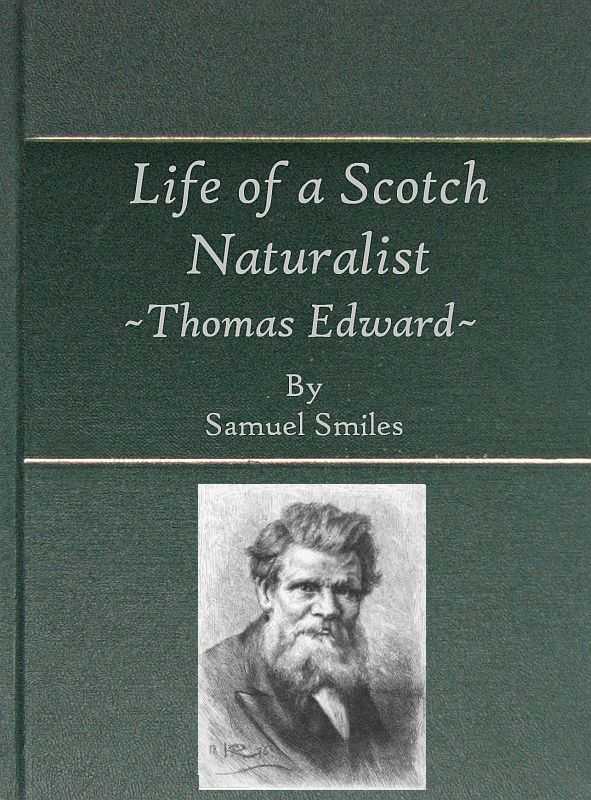
The Project Gutenberg eBook of Life of a Scotch Naturalist: Thomas Edward, Associate of the Linnean Society.
Title: Life of a Scotch Naturalist: Thomas Edward, Associate of the Linnean Society.
Author: Samuel Smiles
Release date: June 7, 2015 [eBook #49154]
Most recently updated: October 24, 2024
Language: English
Credits: Produced by Charlene Taylor, Emmy and the Online Distributed
Proofreading Team at http://www.pgdp.net (This file was
produced from images generously made available by The
Internet Archive/American Libraries.)
LIFE OF A SCOTCH NATURALIST
OF
A SCOTCH NATURALIST
THOMAS EDWARD
PORTRAIT AND ILLUSTRATIONS BY GEORGE REID, R.S.A.
Fourth Edition
LONDON
JOHN MURRAY, ALBEMARLE STREET
1877
[The right of translation is reserved.]
Printed by R. & R. Clark, Edinburgh.
PREFACE.
The history of the humblest human life is a tale of marvels. Dr. Johnson said that there was not a man in the street whose biography might not be made interesting, provided he could narrate something of his experiences of life, his trials, his difficulties, his successes, and his failures.
I use these words as an introduction to the following biography of my “man in the street.” Yet Thomas Edward is not an ordinary man. Eighteen years since, I mentioned him in Self-Help, as one of the most extraordinary instances of perseverance in the cause of science that had ever come under my notice.
Nor was he a man of any exalted position in society. He was a shoemaker then; he is a shoemaker still. For nearly thirty years he has fought the battle of scientific poverty. He was one of those men who lived for science, not by science. His shyness prevented him pushing himself forward; and when he had done his work, he was almost forgotten.
How he pursued his love of Nature,—how he satisfied his thirst for knowledge, in the midst of trials, difficulties, and troubles,—not the least of which was that of domestic poverty,—will be found related in the following book. Indeed, it may be said of him, that he has endured as much hardship for the cause of science, as soldiers do in a prolonged campaign. He spent most of his nights out of doors, amidst damp, and wet, and cold. Men thought him mad for enduring such risks. He himself says, “I have been a fool to Nature all my life.”
He always lamented his want of books. He had to send his “findings” to other naturalists to be named, and he often lost them. But books could not be had without money; and money was as scarce with him as books. He was thus prevented from taking rank among higher-class naturalists. He could only work in detail; he could not generalise. He had to be satisfied with the consolation that Mr. J. Gwyn Jeffreys once gave him. “Working naturalists like yourself,” said he, “do quite as much good service in the cause of science as those who study books.” Edward, however, doubted this; for he considered works on natural science to be a great help to the working naturalist. They informed him of what others had done, and also of what remained to be done.
Those who would know something of what Edward has accomplished in only one department of his favourite subject, should consult Messrs. Bate and Westwood’s History of the British Sessile-eyed Crustacea, where his services to the cause of science are fully and generously acknowledged. Of the numerous Crustacea mentioned in that work, Edward collected a hundred and seventy-seven in the Moray Firth, of which twenty were New Species.
In 1866, Edward was elected an Associate of the Linnean Society,—one of the highest honours that science could confer upon him. Since then, however, he has been able to do comparatively little for the advancement of his favourite study. He had been so battered about by falling from rocks in search of birds, and so rheumatised by the damp, wet, and cold, to which he was exposed at night,—for he was obliged to carry on his investigations after his day’s work was over,—that he was unable to continue his investigations in Natural History.
In the Appendix will be found a Selection of the Fauna of Banffshire, prepared by Edward. I have been able to find room for only the Mammals, Birds, Fishes, and Crustacea. I wish it had been possible to give the Star-fishes (Rayed Echinodermata), Molluscs, Zoophytes, and other objects; but this would have filled up the book, and left no room for the Biography.
It was not my intention to have published the book in the ornate form in which it now appears. But my friend Mr. Reid,—being greatly interested in the man and his story,—and having volunteered to illustrate the work “for love,” I could not withstand his generous offer. Hence the very fine portrait of Edward, so exquisitely etched by Rajon; and the excellent wood engravings of Whymper and Cooper, which illustrate the volume.
It is scarcely necessary to say that the materials of the book have been obtained from Edward himself, either by written communication or by “word of mouth.” Much of it is autobiography. Edward was alarmed at the idea of what he communicated being “put into a book.” He thought it might do me an injury. “Not a copy,” he said, “would be bought in Banff.”
However this may be, the writing of the Biography has given me much pleasure. It has led me to seek health amidst the invigorating breezes of the North; and to travel round the rugged shores of Aberdeen and Banff, in search of the views of bays and headlands with which Mr. Reid has so beautifully embellished the book.
It may be objected—“Why write the life of a man who is still living?” To this it may be answered, that Edward has lived his life and done his work. With most of us, “Hic jacet” is all that remains to be added. If the book had not been written now, it is probable that it never would have been written. But it may be asked,—“Is the life really worth writing?” To this question the public alone can give the answer.
London, Nov. 1876.
CONTENTS.
| CHAPTER I. | |
| EARLY YEARS. | |
Edward born at Gosport, Portsmouth—The Fifeshire Militia—Return
to Cupar—Residence at Kettle—Settles at Aberdeen—The
Green—How Edward became a Naturalist—The sow Bet—Stolen
by Gipsies—The Inches, Aberdeen—Fondness for
“Beasts”—An incorrigible boy—Imprisoned at home—Sets the
house on fire—Is laid up by fever—His Recovery—Birds’ Nests—Rubislaw
Quarries—The Wasp’s Nest |
Pages 1-20 |
| CHAPTER II. | |
| SCHOOLS AND SCHOOLMASTERS. | |
Edward goes to school—Plays the Truant—The fishwives—Bell
Hill—Grannie’s Plunge—A Kae taken to school—Edward’s expulsion—Sent
to his second school—The Horse-leeches—Edward
expelled—The third school—The Sparrow’s nest harried—Takes
the nest to school—The birds “chirrup”—The Master bit by
a Centipede—Edward thrashed terribly—Expelled from his
third school—A night under the logs—Results of his punishment—Hunt
after an adder—The adder sold |
21-46 |
| CHAPTER III. | |
| APPRENTICESHIP. | |
Goes to work—A Tobacco-spinner—Factory at Grandholm—The
Banks and Braes of the Don—The Brig o’ Balgownie—Spires of
St. Machar—Working at the factory—The Sedge-warbler—The
Kingfisher—Country rambles—Apprenticed to a Shoemaker—Charles
Begg—Shoemakers’ pets—Begg’s brutality—Edward’s
pets killed—Wishes to be a sailor—Tries in vain |
47-60 |
| CHAPTER IV. | |
| RUNS AWAY FROM HOME. | |
Sets out for the Kettle—His provisions—His money—Tries to sell
his knife—Ruins of Dunnottar Castle—Bervie—Encounter with
tramps—Montrose—Sells his knife—Sleeps in a haycock—Arbroath—The
sailors’ wives—Dundee—The Long-tailed Titmouse—Cupar—Reaches
the Kettle—Reception by his uncle—Sets out
for home—Uncivility of a gamekeeper—Adventure with a Bull—Rests
near Stonehaven—Reaches Aberdeen—His reception at
home |
61-74 |
| CHAPTER V. | |
| RESUMES WORK. | |
Offers himself as a sailor—Resumes shoemaking—Wild Botanical
Garden—Tanners’ pits for puddocks—The picture shops—The
Penny Magazine—Castlegate on Fridays—Gunmakers’ windows—Tries
to emigrate to America as a stowaway—He fails—Joins
the Aberdeenshire Militia—Chase of a butterfly—Is apprehended—Is
reprimanded and liberated—Enlists in the 60th Rifles—Assists
as a pew-opener—Leaves Aberdeen for Banff |
75-86 |
| CHAPTER VI. | |
| SETTLES AT BANFF. | |
His employment—Finds time to follow his bent—His Caterpillars
among the workmen—His landlady—Marries a Huntly lass—Settled
for life—Self-education in Natural History—Stuffs birds—His
want of education—Want of books—Shy and friendless—Avoids
the public-house—His love of Nature—The ocean—The
heavens—Makes a collection—His gun and paraphernalia—His
equipment—Sleeps out of doors at night—Exaggerated rumours
about him—Frequents Boyndie churchyard—Lies in holes
during rain—Disagreeable visitors—Awful night in Boyndie
churchyard—Moth-hunting at night—Terrible encounter with
Badgers |
87-103 |
| CHAPTER VII. | |
| NIGHT WANDERERS. | |
Animals wandering at night—Their noises and cries—The Roe-deer
and hare—The Rabbit—A Rabbit fight—The Fox—The Badger—The
Field Mice—The Weasel—Attack by a Weasel—Pertinacious
Rats—The Otter—The Polecat—Boyne Castle—Fight with a
Polecat—The Long-eared Owl—The Brown Owl—A chorus of
Frogs—Birds of prey—Landrail, Sedge-warbler, Rook—Songsters
at night |
104-128 |
| CHAPTER VIII. | |
| FORMS A NATURAL HISTORY COLLECTION. | |
Situation of Banff—Macduff—Cliffs of Banffshire—Gamrie—The
fishing-boats—Gardenstown—The fishermen—Crovie—Hell’s
Lum—Troup Head—Pennan—The dens of North Aberdeenshire—Aberdour—Church
of Aberdour—Inland county of
Banff—Ben Macdhui—Edward’s rounds—Pursuit of two Geese—Pursuit
of a little Stint—Shoemaking—Edward’s traps—His
collection of insects—Collection destroyed—Loss of dried plants—Exhibits
his collection at Banff |
129-152 |
| CHAPTER IX. | |
| EXHIBITS HIS COLLECTION AT ABERDEEN. | |
Aberdeen his city of expectations—Dramatic bird-stuffing—Collection
taken to Aberdeen in six carriers’ carts—Exhibited in Union
Street—The handbills—Appeal to the people—The expected
rush—General visitors—Professional visitors—An interrogator—Edward
disbelieved—“The thing impossible”—Edward’s vindication—Invites
his mill mates—Temperance and drunkenness—Edward
a mystery—A lady visitor—Appeals to “The Millions”—The
exhibition a failure—Edward in despair—The beach—The
flock of Sanderlings—The Providential Bird—The collection
sold—Departure from Aberdeen |
153-180 |
| CHAPTER X. | |
| RESUMES HIS FORMER LIFE AND HABITS. | |
Re-enters his desolate dwelling—Return of his family—Begins
again—Redoubles his zeal—His paraphernalia—Ramble in the
Balloch Hills—A successful search—A furious storm comes on—Crossing
the moor—A haven—The chip-boxes destroyed—A
terrible woman—His hat and insect boxes—How to preserve—A
referee—Edward’s certificate from the Justices—Love of birdnesting—Accident
at Tarlair—Falls from a cliff, and is rescued—Draws
on his Savings Bank |
181-202 |
| CHAPTER XI. | |
| BEGINS TO PUBLISH HIS OBSERVATIONS. | |
The Rev. Mr. Smith—The Bridled Guillemot—Grammar—Scraps
from the newspapers—The Death’s-head Moth—Butterflies and
locusts—Locusta migratoria—Saw-flies—The Spider—Notes in
Natural History—Rare birds—The Bee-eater—The Bohemian
Waxwing—The Brown Snipe-Edward’s pursuit—The Snipe
escapes—Adventure on Gamrie Head—The Fox’s lair—The
precipice—The Peregrine Falcon-Feeds upon its prey—Flight
of the Falcon—Slides down the rocks—Discovers a Spinous
Shark—Returns home |
203-229 |
| CHAPTER XII. | |
| RAMBLES AMONGST BIRDS. | |
Mr. Smith’s articles published in the Zoologist—Edward’s power
of observation described—The beautiful Heron—Cries of the
Birds at Ness Bogie—The motherly Wild Duck—Burial of the
Wild Duck—The Pickietars—The Pickietar fishing—The
Pickietar shot—Rescued by his friends—Edward’s closeness of
observation—The Turnstone—Its description—Its labours—The
Turnstones turn over a Cod—The little Auk—Sea-fowl
nurseries—Pennan—Sleeps in Hell’s Lum—The sea-birds at
night |
230-251 |
| CHAPTER XIII. | |
| LITERATURE AND CORRESPONDENCE. | |
Death of the Rev. Mr. Smith—Mr. Smith’s helpfulness—Observation
of the Partridge—The Rev. Alexander Boyd—Loch of
Strathbeg—The Waterfowl at Strathbeg—Swans—Geese—Ducks—Winter
and summer birds—The Ring Dotterel—A pursuit—Mr.
Boyd’s article—Encouragement of native talent and genius—Death
of Mr. Boyd—Publication of ‘Birds of Strathbeg’ in
Naturalist—Mr. C. W. Peach—Writes articles for the Zoologist—Finches—Crows
and Crab-shells—The Heron and the Crows—A
fight in the air—Crows, Hares, and Rabbits—Cold and
Whisky—Edward’s health fails—Again draws on his Savings
Bank |
252-278 |
| CHAPTER XIV. | |
| BY THE SEA-SHORE. | |
Marine objects on the shores of Banffshire—Edward’s sea-traps—Captures
a rare fish, Bloch’s Gurnard—The incoming wave—Big
fish the best dredgers—Helped by the fishermen—Helped by
his daughters—The Cod’s bill of fare—Haddocks—Advice to the
fishermen—The fishers of Macduff—The Blue-striped Wrasse—The
Saury Pike—Yarrell’s Blenny—Black Goby—Equoreal
Needle-fish—Edward’s self-education—How he got his fishes
named—“Give him books!”—Edward’s enthusiasm |
279-296 |
| CHAPTER XV. | |
| DISCOVERIES AMONG THE CRUSTACEA. | |
Mr. Bate of Plymouth—His work on Crustacea—Praniza Edwardii—The
Anceus—Edward’s letter to Mr. Bate—Entomostraca—Parasites
from short Sun-fish—Present of a Microscope—A possible
Sub-curatorship—Edward disappointed—Freemasonry
among naturalists—Rev. A. M. Norman—Fish parasites—Mysis
spinifera—New species discovered—Vibilia borealis—Observation
of Eurydice pulchra—Edward’s difficulties—Nest building
crustacea—New Shrimps and Parasites—The Zoologists in
ecstasies—The “Sessile-eyed Crustacea” published—Mr. Bate’s
eulogiums on Edward’s discoveries—New Crustacea found by
Edward in the Moray Firth |
297-323 |
| CHAPTER XVI. | |
| DISCOVERIES AMONGST ZOOPHYTES, MOLLUSCS, AND FISHES. | |
Edward brings home Zoophytes to observe—The Star-fish—The
Brittle Stars—A six legged Starfish—Rosy-feather Star—The
great Sea-cucumber—Dead Man’s Paps—The Ascidians—Want
of observers—New Ascidian sent to Mr. Alder—Drummond’s
Echiodon—Mr. Couch of Polperro—The Wrasses—A jumping
Wrasse—A new Midge—Couchia Thompsoni—Colonel Montague—Montague’s
Midge—Midges in Moray Firth—Edward’s
Midge (Couchia Edwardii)—Other new fishes—Difficulties with
the Museum—Edward elected Associate of the Linnean Society—Other
societies elect him member—The “prophet without
honour in his own country” |
324-349 |
| CHAPTER XVII. | |
| ANTIQUITIES—KITCHEN-MIDDENS. | |
Edward’s illness—Studies galvanism—Curator of Banff Museum—Practises
Photography—Antiquities of Banff—The old Town
Cross—The Drinking Fountain—The Kjökken Mödding at Boyndie—Early
population, Lapps or Fins—Shelly-bush—Investigates
the shell mounds at Boyndie—Loch of Spynie—Contents
of the shell-mounds—The Stone period—The Old Bone—Conjectures
about it—The old bone condemned—Sir Roderick
Murchison—The bone, part of the Plesiosaurus dolichodeiras—Banff
Museum |
350-372 |
| CHAPTER XVIII. | |
| CONCLUSION. | |
Edward’s labours drawing to a close—Still craves after Nature—His
wife accompanies him to Huntly—Traps at Tarlair—Another
discovery to announce—Nilsson’s Goby—His numerous
discoveries—His observations at last accredited—His self-reliance
and perseverance—His sobriety—His family—His power
of Will—Pride—Never despair—Money considerations—Things
he has not done—Edward at home—His outside helpers—His
failures—“Here I am Still” |
373-388 |
FAUNA OF BANFFSHIRE.
ILLUSTRATIONS
By GEORGE REID, R.S.A.
| Portrait of Thomas Edward. | Etched by P. Rajon. | Frontispiece. | |
| Engraved by | |||
| Banks and Braes o’ Don | J. W. Whymper. | To face page | 1 |
| Aulten Links, Aberdeen | ” | page | 42 |
| Brig o’ Balgownie | ” | To face page | 48 |
| The Spires of St. Machar | ” | page | 49 |
| Charles Begg’s Shop, Gallowgate | ” | page | 55 |
| Grandholm Mills | ” | ” | 60 |
| Ruins of Dunnottar Castle | J. D. Cooper. | ” | 63 |
| Distant View of Montrose | J. W. Whymper. | ” | 65 |
| Castlegate, Aberdeen, on Fridays | J. D. Cooper. | ” | 79 |
| Boyndie Churchyard | J. W. Whymper. | To face page | 100 |
| The Castle of the Boyne | J. D. Cooper. | ” | 116 |
| Fraserburgh | J. W. Whymper. | page | 128 |
| Bay of Aberdour | J. D. Cooper. | ” | 134 |
| Mouth of the Don | J. W. Whymper. | To face page | 176 |
| The Shore at Aberdeen | ” | page | 180 |
| Tarlair—View of North Coast of Banffshire | J. D. Cooper. | To face page | 196 |
| Gamrie Head | J. W. Whymper. | ” | 218 |
| Village of Pennan | J. D. Cooper. | ” | 250 |
| Red Head of Pennan | J. W. Whymper. | page | 251 |
| Bay of Boyndie, from Banff Links | J. W. Whymper. | ” | 278 |
| Broadsea, near Fraserburgh | J. D. Cooper. | ” | 291 |
| Spynie Castle and Loch | J. W. Whymper. | ” | 359 |
| Banff Museum | ” | ” | 372 |
| “Here I am Still” | ” | To face page | 388 |
| Edward’s House, Low Shore, Banff | J. D. Cooper. | page | 438 |
OTHER ILLUSTRATIONS.
| Map of North Banffshire and North Aberdeenshire | Pages | 136-7 |
| Praniza Edwardii | ” | 299 |
| Nests of Nest-building Crustacea | ” | 312 |
| Edward’s Midge (Couchia Edwardii) | ” | 344 |
| The Old Bone in Banff Museum | ” | 369 |
LIFE OF A NATURALIST.
CHAPTER I.
EARLY YEARS.
Thomas Edward was born at Gosport, Portsmouth, on Christmas day, 1814. His father, John Edward, was a private in the Fifeshire Militia. Shortly after his enlistment at Cupar, he went to Aberdeen to join his regiment. While stationed there, he became acquainted with, and afterwards married, Margaret Mitchell, a native of the place.
Not long after John Edward’s marriage, his regiment was ordered to Portsmouth. Towards the close of the continental war, militia regiments were marched hither and thither, from one end of the country to another. The regular troops had mostly left England, to meet the armies of Napoleon in the Peninsula and the Low Countries. The militia were assembled in camps along the coast, or were stationed in garrisons to hold watch and ward over the French prisoners confined there. Hence the appearance of the Fifeshire militia at Gosport, where the subject of our story was born.
When the battle of Waterloo had been fought, and peace fell upon Europe, the English army returned from abroad. The militia were no longer needed for garrison duty, and the greater number of them were sent home. The Fifeshire Militia were ordered to Fife, and took up their quarters at Cupar. During that time, John Edward’s wife and family resided at the village of Kettle, about six miles south-west of the county town. They lived there, because John was a native of the place, and had many relatives in the village.
At length the militia were disembodied. Edward returned to Kettle, and resumed his trade of a hand-loom cotton weaver. After remaining there for some time, he resolved to leave for Aberdeen. His wife liked neither the place nor the people. Kettle was a long straggling sleepy village. The people were poor, and employment was difficult to be had. Hence Edward did not require much persuasion to induce him to leave Kettle and settle in Aberdeen, where his wife would be amongst her own people, and where he would be much more likely to find work and wages to enable him to maintain his increasing family.
Arrived at Aberdeen, John Edward and his wife “took up house” in the Green, one of the oldest quarters of the city. Their house stood at the head of the Green, near Hadden’s “Woo mill.” The remains of the old Green were lower down the hill. The Denburn ran at the foot of the Street. There were also the Inches, near the mouth of the Dee, over which the tide flowed daily.
Since then, the appearance of that part of Aberdeen has become entirely changed. Railways have blotted out many of the remnants of old cities.[1] The Green is now covered with houses, factories, and the Aberdeen Railway Station,—its warehouses, sidings, and station rooms. A very fine bridge has been erected over the Green, now forming part of Union Street; the Palace Hotel overlooking the railway station and the surrounding buildings.
Thomas Edward was brought up in his parents’ house in the Green, such as it was sixty years ago. It is difficult to describe how he became a naturalist. He himself says he could never tell. Various influences determine the direction of a boy’s likings and dislikings. Boys who live in the country are usually fond of birds and bird-nesting; just as girls who live at home are fond of dolls and doll-keeping. But this boy had more than the ordinary tendency to like living things. He wished to live amongst them. He made pets of them; and desired to have them constantly about him.
From his birth he was difficult to manage. His mother said of him that he was the worst child she had ever nursed. He was never a moment at rest. His feet and legs seemed to be set on springs. When only about four months old, he leapt from his mother’s arms, in the vain endeavour to catch some flies buzzing in the window. She clutched him by his long clothes, and saved him from falling to the ground. He began to walk when he was scarce ten months old, and screamed when any one ventured to touch him. And thus he went on, observing and examining,—as full of liking for living things as he was when he tried to grasp the flies in the window at Gosport.
When afterwards asked about the origin of his love for Natural History, he said, “I suppose it must have originated in the same internal impulse which prompted me to catch those flies in the window. This unseen something—this double being, or call it what you will—inherent in us all, whether used for good or evil, which stimulated the unconscious babe to get at, no doubt, the first living animals he had ever seen, at length grew in the man into an irresistible and unconquerable passion, and engendered in him an insatiable longing for, and earnest desire to be always amongst such things. This is the only reason I can give for becoming a lover of Nature. I know of none other.”
While living at Kettle, the child began to walk. He made friends with the cats and dogs about the house. He was soon able to toddle out of doors. At first, he wished to cultivate the acquaintance of the cocks and hens and ducks, of which the village was full. But they always ran away before he could get up to them and caress them.
There was, however, another, and a much more dangerous creature, whose acquaintance he sought to make. This was a sow called Bet, with a litter of pigs. Whenever he was missing, he was found looking in at the pigs. He could not climb over the paling, but could merely look through the splits.
The sow was known to be ferocious, and she was most so when she had a litter of pigs. Edward’s mother was afraid lest the sow should injure him by biting his hands or face through the bars of the cruive.[2] Therefore she warned him not to go near the beast. But her warnings were disregarded. When she asked, “Where’s Tam?” the answer invariably was, “Oh! he’s awa wi’ the pigs.”
One day the boy disappeared. Every hen-house, every stable, every pigstye, and every likely corner of the village, was searched; but in vain. Tom was lost! He was then little over a year old. He could not have gone very far. Somebody raised the cry that he had been “stolen by the gipsies!” It was remembered that some tinkers had been selling their brooms and pans in the village that afternoon; and it was immediately concluded that they had kidnapped the child. It was not so very unreasonable after all. Adam Smith, the author of the Wealth of Nations, had been kidnapped by a gipsy woman when a child at Kirkcaldy, many years before; and such things live long in popular recollection.
A hue-and-cry was accordingly got up in Kettle about the bairn that had been stolen by the gipsies. Their camp was known to be in the neighbourhood,—about three miles off. Tom’s uncle and three other men volunteered to go early next morning. The neighbours went to their homes, except two, who remained with the mother. She sat by the fire all night,—a long, wretched, dreary night. Early in the morning the four men started. They found the gipsy camp, and stated their grievance. They “wanted the child that had been kidnapped yesterday.” “What?” said the chief gipsy; “we never kidnap children; such a dishonest deed has never been laid to our charge. But, now that you are here, you had better look for yourselves.”
As the searchers were passing through among the carts and tents, they were set upon by a number of women and girls, and belaboured with every kind of weapon and missile. Those who had neither sticks nor ropes, used their claws. The men were unmercifully pummelled and scratched before they could make their escape. They reached Kettle in a deplorable state,—but without the child!
All hopes of his recovery in that quarter being ended, another body of men prepared to set out in another direction. But at this moment they were amazed by a scream outside the house. All eyes were turned to the door, when in rushed the pig-wife, and, without the least ceremony, threw the child into his mother’s lap. “There, woman, there’s yer bairn! but for God’s sake keep him awa frae yon place, or he may fare war next time.” “But whar was he?” they exclaimed in a breath. “Whar wud he be but below Bet and her pigs a’ nicht!”[3]
When the family removed to Aberdeen, young Edward was in his glory. The place where he lived was close to the outside of the town. He was enabled to roam into the country by way of Deeside and Ferryhill. Close at hand were the Inches,—not the Inches of to-day—but the beautiful green Inches of sixty years ago, covered with waving algæ. There, too, grew the scurvy grass, and the beautiful sea daisy. Between the Inches, were channels through which the tide flowed, with numerous pots or hollows. These were the places for bandies, eels, crabs, and worms.