
APPENDIX II. ARRANGEMENTS OF MOZART'S CHURCH MUSIC.
ARRANGEMENTS OF MOZART'S CHURCH MUSIC.
EVEN cantatas which appeared under Mozart's name (Leipzig: Breitkopf and Hartel, and elsewhere) are perhaps, after his operas, the most widely known of his works, and upon them in a great measure rests his fame as a composer of church music. Of these cantatas, however, only one, the second (and that with altered words), was left in its present state by Mozart; the others were all put together after his death from separate portions of various church compositions, often widely differing in the time, the object and the style of their composition, and having undergone arbitrary alterations and additions. Nothing but the newly adopted words holds them together, and these are generally trivial, often in direct contradiction to the spirit of the original words.
The parody of Goethe's song "Der du Leid und Sehnsucht stillest," which in Cantata III. replaces the original "Alma redemptoris," may serve as an example. This double injustice done to the composer may be explained as arising from the tendency of an age which turned to its own immediate convenience any music which came to hand, with little feeling for the work of art as a whole and little respect for the right of the author to the integrity of his work or for the claims of historical accuracy.
The following is the result of a survey of the cantatas and their component parts (Anh., 124-130 K.):—[See Page Image]
Cantata I. consists of the Kyrie (p. i), Panis omnipotent!ae (p. 10), Viaticum (p. 15), and Pignus futurz gloriae (p. 16) of the Litany 125 K-
Cantata II. is the Litany 109 K.
Cantata III. is pot together from the Sanctus of the Mass 259 K. (p. 3); the Benedictus of the Mass 220 K.; the Gloria of the Mass 259 K. (p. 9); the Offertorium 72 K. (p. 15); and the Credo of the Mass 259 K. (p. 25).
Cantata IV. consists of the Kyrie and Gloria of the Mass 220 K. (p. 3); Motetto 277 K. (p. 12); Gratias (p. 19); and Domine (p. 21) of the Mass in C minor 427 K. [employed in the "Davidde Penitente" 469 K. as Chorus 4» "Si pur sempre," and Duet 5, "Sorgi o Signore **]; Magnificat of the Vesper 193 K. (p. 26).
Cantata V. is formed of the Kyrie (p. 1), Et incarnatus, to the close of the Credo (p. 6), Benedictus (p. 12), Agnus Dei (p. 20), and Gloria (p. 25) of the Mass 258 K.
Cantata VI. contains the Dixit of the Vesper 193 K. (p. 1); Laudate Dominum (p. 13) and Magnificat (p. 20) of the Vesper 321 K. Cantata VII. is put together from the Kyrie (p. 1) and Benedictus (p. 5) of the Mass 259 K.; an air from "Davidde Penitente" (469 IL, 3) "Lungi le cure ingrate" (p. 14); the Agnus Dei (p. 26) and Dona nobis (p. 29) of the Mass 259 K.; and the Dixit of the Vesper 321 K. (p. 33).
After this, it was not surprising that the choruses from "Konig Tham os" should have been used as sacred music, or that the "Frei-maurercantaten" (429,471 K.) should have been treated in the same way (Vol. II., p. 407). Nor was it unusual to find an altered text (church-like in character) supplied to sacred compositions. But secular music was also appropriated by the Church. The beautiful adagio of the grand serenata for wind instruments (361 K.) has been turned into an offertory, "Quis te comprehendat" (Anh., 110 K.). The air for Nancy Storace (405 K.),"Ch' io mi scordi di te," has been fitted to the words "In te domine speravi," and the obbligato piano part transferred to the organ (Anh., 120 K.). The air from "Titus" (19),"Deh per questo istante," with the words "O Deus, ego te amo" (Anh., 112 K.), and Adamberger's air, "Per pietà non ricercate" (420), with the words "Omni die die Mariae" (Anh., hi K.), are both used as offertories. V. Novello published the wonderful ensemble from the second finale in "Figaro" "Più docile io sono e dico di si," with the words "O Jesu mi, miserere nobis!" as a motett with organ accompaniment, and has appended the remark: "This motett may be used at Benediction." It is to be hoped that there is no truth in the report that Leparello's "Notte e giorno faticar" and Don Giovanni's "Fin che dal vino," have been travestied as a "Docti sacris" and a "Lauda Sion."
ARRANGEMENTS OP MOZART'S CHURCH MUSIC.
Further than this, however, whole Masses have been arranged from Mozart's operas; and at the beginning of this century a "Missa di Figaro. Don Giovanni" was not unknown to church choirs. One example of the kind may be described as evidence of the fact. In the collection of K. Zulehner of Mayence there was preserved a "Coronation Mass" in C major, with Mozart's name as composer, of which a copy was sent to me by Herr Schott of Mayence. All the movements, with the exception of the Credo, are identical with whole movements or smaller portions of "Cosî fan Tutte," with alterations of key and instrumentation, and here and there the addition or omission of a part, as follows:—
The Kyrie is the terzet (10) "Soave sio il vento," transposed into C major and turned into a four-part chorus by the addition of a tenor part, and with two flutes to fill in the harmonies. Christe eleison is the first movement of the duet (4), "Ah guarda sorella," transposed into G major, for soprano and tenor, with two oboes and two horns, shortened here and there, and the ritomello placed at the end. At the beginning of the Gloria, after a few unimportant bars by the adapter, the motif of the first chorus of the second finale is made use of (p. 230); then follow for the Gratias agimus the first seventy bars of the air (11) "Smanie implacabile" as a soprano solo in F major. The Qui tollis consists of seven bars not borrowed, but at the Miserere occur four bars from the first finale (p. 115), "Ed il polso," and after the repetition of the original Qui tollis at the word "suscipe," the first finale (p. 115), "Ah se tardo," is continued to the end of the movement. "Quoniam tu solus" to the end of the Gloria is the terzet (3) "Una bella serenata," unaltered up to the addition of the fourth part in the tutti passages; the closing ritornello is omitted. In the Gloria, flutes, oboes, horns, and drums and trumpets are employed in the customary alternations. Sanctus and Osanna are the andante of the first finale shortened by six bars, transposed into C major, and the parts rather differently arranged to suit the words. Benedictus is the duet and chorus (21) "Secondate," transposed into F major, and accompanied by stringed instruments flutes, and oboes; the chorus enters at "Osanna." Agnus Dei begins with eleven original bars, then follows "Idol mio" from the second finale, with the part of Despina omitted. Dona nobis is the closing ensemble of the opera. I gather from a letter addressed to G. Weber that Zulehner was of opinion that Mozart wrote the Mass before the opera; that, on the contrary, the Mass was pieced together from the opera by some church musician, no external evidence is required to prove.
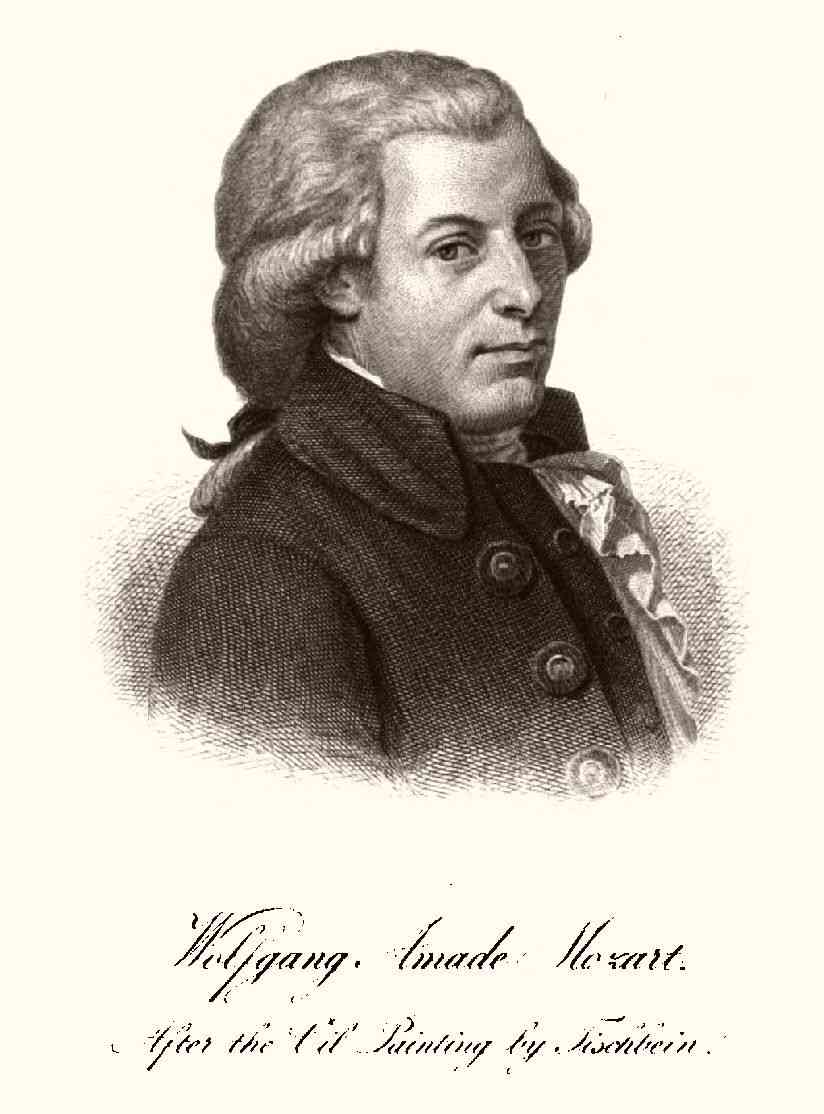
APPENDIX III. PORTRAITS OF MOZART.
HE earliest portrait of Mozart, a half-length in oils, now in the
Mozarteum, lithographed in Nissen, represents him as a boy of seven years old, standing near the clavier, clad in the violet gold-laced court dress of the Archduke Maximilian, which had been presented to him in 1762 (Vol. I., p. 28). His hair is frizzed and powdered, his hat under his arm, his sword by his side; his left hand is thrust into his vest; his right on his side. The round good-humoured boyish face, with its candid eyes, looks out as if from a disguise. During the stay of the Mozart family in Paris in 1763, an accomplished admirer, L. C. de Carmontelle, painted them in a group; the picture was engraved by Delafosse in small folio, with the title under:—
"LEOPOLD MOZART, Père de MARIANNE MOZART, Virtuose ägée de onze ans, et de J. G. WOLFGANG, Compositeur et Maître de Musique ägé de sept ans."
Wolfgang, finely dressed and frizzed, is sitting at the harpsichord in a pillared hall, apparently open to the air, and playing from some open music. The little head is evidently a good likeness, and there is a charming expression of earnest attention. His father stands close behind him, and accompanies on the violin; the sister is standing on the other side of the harpsichord, turning towards her brother and singing from some music. In the same year a small oil picture, containing many figures, was painted; it was formerly in the gallery of the Duke of Rohan-Chabot at Schloss-Rurik, and is now in the Museum at Versailles. Mozart is seated at the clavier, on which a "basse de viole" is lying, and playing or singing; he is accompanied on the guitar by the opera-singer Veliotte. The Prince de Beauveau, in a cherry-coloured coat decorated with the blue Grand Cross, is seated behind the young musician, glancing absently at a paper which he holds in his left hand. The Chevalier de la Laurency, gentilhomme to the Prince de Conti, is standing in a black velvet coat behind Mozart's chair; the Prince de Conti is talking to M. de Trudaine; Mdlle. Bagaroty is standing before a group of ladies, viz.: Madame la Maréchale de Mirepoix, Madame de Viervelle, Madame la Maréchale de Luxembourg, and Mdlle. de Boufflers, afterwards Duchesse de Lauzun. The Prince d'Henin is preparing tea, while listening attentively to Mozart's music. In another group are Dupont de Velse, brother to M. d'Argentai; the Countesses Egmont, mother and daughter, and President Henaut at the fireplace.
The last group shows us the Comtesse de Boufflers standing before a well-spread table; by her side is the Comte de Chabot (Duc de Rohan) in conversation with the Comte de Jarnac. The Maréchal de Beauveau is pouring out a glass of wine for Bailli de Chabrillant; Meyrand, the famous geometrician, stands sidewards. The picture is full of life and expression. All the company are listening in amazement and delight to Mozart's bewitching tones. He is in an apple-green silk coat with knee breeches, and his feet do not touch the floor. His countenance is fresh, his look full of expression, and the little powdered perruque gives him a somewhat pedantic look, at which the spectators are evidently amused.
Wolfgang was painted several times during his Italian tour. At Verona Lugiati made a life-size portrait of him in oils, in two sittings, as his father writes home. "La dolce sua effigie mi è di conforto ed altresi di eccitamento a riprendere qualche fiata la musica," he writes to the mother (April 22, 1770). Sonnleithner, who discovered the picture by the aid of the Imperial Sectionsrath W. Booking, gives a detailed account of it. Mozart is seated playing the clavier, somewhat to the left of the spectator, in a carved arm-chair; his youthful and intellectual countenance is turned towards the spectator. He wears a red court dress embroidered in gold, and has a diamond ring on the little finger of his left hand. Upon the clavier, above the keyboard, is written: "Joanni Celestini Veneti, MDLXXXIII." Upon the open music-book can be distinctly read:—[See Page Image]
This piece, therefore, must have possessed some peculiar interest for the Veronese. Below, in the centre of the narrow, beautifully carved gold frame, there is a white plate with the following inscription:—
Amadeo Wolfgango Mozarto Salisburgensi puero duodenni
In arte musica laudem omnem fidemque prætergresso eoque nomine Gallorum Anglorumque regi caro Petrus Lujatus hospiti suavissimo effigiem in domestico odeo pingi curavit anno MDCCLXX.
In the same year the celebrated artist Pompeo Battoni of Rome painted a life-size head of Mozart, which came into the possession of Mr. Haydon of London; it is now the property of J. Ella, who has placed it in the South Kensington Museum, and rendered it familiar in an engraving by H. Adlard. The head is turned almost full-face towards the spectator, the right-hand holding a roll of music-paper. The animated countenance has an évident resemblance to the Verona portrait, but with more of a view to PORTRAITS OF MOZART. effect, being in fact what is called idealised. After his return from Italy in 1772, a portrait of Wolfgang was painted which his sister possessed; it is the one of which she wrote to Sonnleithner (July 2, 1819) that he looked yellow and sickly in it, having only lately recovered from a severe illness. Before Mozart left Salzburg in 1777, a portrait was painted which, according to his father (November 27, 1777), was highly successful. Padre Martini, having begged for a likeness of Wolfgang for his collection, the father had a copy of this one made and sent it to him in the beginning of December, 1777, "in a black frame, with a handsomely gilt edge." "I delayed complying with your request until now," he writes to the Padre (December 22,1777), "for want of a skilful artist. There is, in fact, none such residing in our town; and I have always been in hopes that, as does sometimes happen, a clever artist might visit Salzburg—I therefore postponed it from time to time. At last, however, I was forced to commission a local artist to undertake the portrait. As a painting it is of little worth, but, as regards the likeness,
I assure you that it resembles him exactly. I have written his name and age behind the picture." In the library of the Liceo Filarmonico at Bologna there is an oil picture from Padre Martini's collection, of which Dr. Zangemeister sent me a photograph and a minute description. At the top of the frame, in white letters, stands:—
CAV. AMADEO WOLFGANGO MOZART ACCAD.
FILARMON. DI BOLOG. E DI VERONA.
On the back is written (probably by an Italian, not by L. Mozart):—Joannes Crisostomus Wolfgangus Amadeus Mozart Salisburgensis Teuto, auratæ Militiæ Eques
Bonnoniensis Veronensisque Accademicus Natus 27 Ianuarü 1756: Ætatis suæ 21.
The portrait represents a man in a brown coat, with the gold cross on a red ribbon round his neck; to the right is a stool, to the left a clavier with black under notes and white over notes; on the desk is a piece of music. But it is impossible to recognise Wolfgang in the portrait; it is that of a man of middle age, stiff in demeanour, and with no resemblance to Mozart. It might be meant for his father, who had promised (August 21, 1778) to send Padre Mardini his own portrait; but this is contradicted by the cross of the order. Probably some confusion has taken place in the arrangement of the collection. Wolfgang took with him on his journey a little medallion as a present to his cousin, among whose remains it was pointed out to me. He is in a red coat, his hair simply arranged, and the very youthful face with its APPENDIX III. intelligent eyes has an open light-hearted expression. Before Mozart went to Munich in 1780 the painter Della Croce at Salzburg began a large family group, and Wolfgang's portrait was fortunately finished before his departure. This large oil-painting, now in the Mozarteum at Salzburg, represents the brother and sister seated at the harpsichord playing a duet. Wolfgang is in a red coat with a white vest and neckcloth, Marianne in a dark rose-coloured dress trimmed with lace, and a red ribbon in her high coiffure; the father, in black, with a white vest and neckcloth, is seated behind the harpsichord, his left hand holding a violin, his right with the bow resting on the harpsichord. On the wall hangs an oval portrait of the mother, with a blue neckhandkerchief, and a blue ribbon in her hair. Wolfgang's sister considered this portrait very like him; and it does in fact give one an impression of individuality. The face is young for his age, but not so gay and animated as in earlier pictures; it has rather a depressed expression, corresponding very well to his mood at the time. After his marriage he had himself painted with Constanze, and sent the two miniatures to Salzburg. "I only hope," he writes (April 3, 1783), "that you may be pleased with them; they seem to me to be both good, and all who have seen them are of the same opinion." Mozart's brother-in-law, the actor Lange, who was an enthusiastic artist, began a portrait of him, seated at the piano, in a light brown coat and white neckcloth, and strove to render the expression of the artist absorbed in his reveries. The picture was only finished as far as the bust, and is now in the Mozarteum at Salzburg; Carl Mozart considered it very like. Mozart's short stay in Dresden in April, 1789, was utilised by Dora Stock, Korner's talented sister-in-law, in taking his portrait in crayons with much delicacy and animation; it was engraved in Berlin by E. H. Schroder, and published by Ed. Mandel. The conception of Mozart's appearance, which afterwards became typical, was formed from a small medallion carved in boxwood in relief by Posch, and now preserved in the Salzburg Mozarteum. This was engraved in octavo by J. G. Mans-feld, 1789 (Viennæ apud Art aria Societ.) with the inscription: "Dignum laude virum Musa vetat mori." On the lower edge of the medallion, among instruments and laurel branches, is a sheet of music with "An Chloe" written on it. This engraving is the foundation of most of the later ones; it was engraved afresh from the medallion by Thäter (Leipzig: Breitkopf und Hartel).
The last portrait of Mozart is a bust, life size, painted by Tischbein during his stay in Mayence in October, 1790. C. A. André discovered and obtained possession of it at Mayence in 1849; it was among the remains of the Electoral court violinist Stutzl. Two men who had themselves seen Mozart—Professor Arentz, of Mayence, and the former court organist, Schulz, of Mannheim, on being shown the picture, and asked whom it represented, recognised their beloved Mozart without a moment's hesitation. At the same time this likeness differs PORTRAITS OF MOZART. considerably from the others current, and it can scarcely be doubted that Tischbein has idealised the features, especially the nose; but the expression of the eyes and mouth has a mixture of sensuousness, roguery, and gentle melancholy, which testify to the artist's intellectual apprehension; while Posch is probably more accurate in outline, but more Philistine in conception. It has been engraved by Sichling in the "Bildnissen berühmter Deutschen" (Leipzig: Breitkopf und Hàrtel), and afterwards diminished for this book.
I consider as apocryphal a small medallion in the possession of Karajan, representing a slender well-dressed youth, inscribed as "Mozart's Portrait;" also a round miniature, belonging to Frz. Henser, of Cologne, of a full-grown man in a grey coat, his hand in his vest, which seems to me to have no resemblance to Mozart. It is signed "Jac. Dorn, pinx., 1780."
APPENDIX IV. (To the English Edition.)
A LIST OF MOZART'S WORKS,
COMPILED FROM THE FIRST COMPLETE
AND CRITICALLY REVISED EDITION, NOW BEING PUBLISHED BY BREITKOFF AND HARTEL, LEIPZIG.
| Volume I. | Volume II. |
FOOTNOTES
FOOTNOTES OF CHAPTER XXXIV.
1 (return)
[ The Greiners had quartet
parties every Tuesday during Advent and Lent (Car. Pichler, Denkw., I., p.
127. Jahrb. d. Tonk., 1796, p. 71).]
2 (return)
[ Luigi Boccherini
(1740-1805), who was almost a contemporary, followed his own bent in
numerous quartets, quintets, and trios, uninfluenced by the works of
others, and not himself exerting any lasting influence (Piquot, Notice sur
la Vie et les Ouvrages de L. Boccherini. Paris, 1851).]
3 (return)
[ The advertisement (Wien.
Ztg., 1785, No. 75, p. 2191) ran: "Mozart's works require no praise, and
to quote any would be superfluous; we can only assure the public that we
are offering them a masterpiece. This is confirmed by the fact that the
quartets are dedicated to his friend Joseph Haydn, Kapellmeister to Prince
Estcrhazy, who honoured them with all the approbation which one man of
genius can bestow upon another."]
4 (return)
[ Dittersdorf,
Selbstbiogr., p. 238.]
5 (return)
[ Nissen, Nachtrag, p. 62.]
6 (return)
[ Cramer, Magazin der
Musik, II., p. 1273.]
7 (return)
[ Gyrowetz, Selbstbiogr.,
p. xx. Jahrb. d. Tonkunst, 1796, p. 77.]
8 (return)
[ A. M. Z., I., p. 855.]
9 (return)
[ Fétis attacked this
introduction in the Revue Musicale, V., p. 601, and maintained his opinion
against Pernes (Ibid., VI., pp. 25, 32). An equally lively onslaught upon
Fétis was made in a detailed analysis by C. A. Leduc (A. M. Z., XXXII., p.
117), and renewed (A. M. Z., XXXIII., pp. 81, 101) after an answer by
Fétis (Rev. Mus., VIII., p. 821), and also by C. M. Balthasar (A. M. ZM
XXXIII., p. 493). Thereupon G. Weber subjected the passage to a searching
examination, and acknowledged finally that the combinations of sound were
unpleasing to his own ear.]
10 (return)
[ Càcilia, XIV., p. 2.]
11 (return)
[ Ulibicheff, II., p.
254.]
12 (return)
[ The conjecture of Fétis
that the first violin follows the second at the second instead of the
third crotchet of the second bar, by reason of a printer's error, is
disproved by Mozart's own manuscript (also by his Thematic Catalogue).]
13 (return)
[ Lenz, Beethoven, II.,
p. 78.]
14 (return)
[ The same object is
entirely fulfilled by Beethoven in the introduction to the Symphony in B
flat major, to say nothing of the Quartet in C major. The cheerful
serenity pervading the symphony, and the occasional stronger accents of
passionate feeling, are, as it were, prefigured in the introduction, where
we hear the rolling of the storm which is to clear and freshen the
atmosphere.]
15 (return)
[ A. M.Z., III., p. 350.]
16 (return)
[ Joh. Bapt. Schaul,
Briefe über den Geschmack in der Musik, p. 8.]
17 (return)
[ Cf. Musik. Briefe von
einem Wohlbekannten, II., p. 40.]
18 (return)
[ Two bars are added as
an extension of the conclusion as in the minuet of the Quintet in C major
(515 K.).]
19 (return)
[ There are groups of
seven bars in the minuet of the later Quartet in F major (590 K.), and of
five bars in the trio.]
20 (return)
[ This movement has been
scored by Beethoven; the original is in Artaria's possession.]
21 (return)
[ A siciliana occurs
among the variations in a sonata for pianoforte and violin (377 K., 3),
simpler and shorter than the one under consideration, and altogether
omitting the transition to the major key. The same form is the basis of
the rondo to the pianoforte Trio in G major (496 K.), but freely carried
out. The siliciana is employed, according to old usage, for the slow
middle movements of an early Sonata in F major (280 K.), and of the
pianoforte Concerto in A major (414 K.).]
22 (return)
[ The Hadyn quartets,
written in 1787 for the King of Prussia, are well known.]
23 (return)
[ From 1787 to 1797
Boccherini drew a considerable pension from Frederick William II., for
which he had to furnish annually some quartets and quintets, compositions
much loved and often played by the King (Reichardt, Musik. Monatsschr., p.
17. Mus. Ztg., 1805, p. 232. Picquot, Not. sur L. Boccherini, pp. 16,
112).]
24 (return)
[ In March, 1788, Mozart
announced (Wien. Ztg., 1788, No. 27 Anh.) three new quintets—these
two, and the one arranged in C minor—at four ducats a copy.]
25 (return)
[ Wien. Ztg., May 18,
1793, p. 1462.]
26 (return)
[ So also in the
unfinished sketches of a number of qointet movements (79.84 Anh., K.).]
27 (return)
[ Picquot, Not. sur L.
Boccherini, pp. 19, 28, 123]
28 (return)
[ Prince Grassalcovicz
reduced his full band to a "Harmoniemusik" (Jahrb. d. Tonk., 1796, p.
77).]
29 (return)
[ Trûbensee and Wendt as
oboists, the brothers Stadler as clarinetists, Rub and Eisen hornists,
Kautzner and Druben bassoonists (Cramer, Magaz. Mus., I., p. 1400. Musik.
Korresp., 1790, p. 31).]
30 (return)
[ Mozart arranged the
"Entfuhrung" for wind instruments (Vol. II., p. 210).]
31 (return)
[ A. M. Z., XV., p. 668
(Schletterer, Reichardt, I., p. 327).]
32 (return)
[ Mozart praised Albert's
good "Harmoniemusik" to his father from Munich (October 3, 1777). A
special wind band was engaged for the table music at the Augarten (Jahrb.
d. Tonk., 1796, p. 78).]
33 (return)
[ Nicolai speaks highly
of the "Harmoniemusik," which was performed every evening before the main
guard at the court (Reise, IV., p. 558).]
34 (return)
[ Carpani, Le Haydine, p.
81. Gyrowetz, Biogr., p. 5.]
35 (return)
[ Musik. Korr., 1791, p.
366.]
36 (return)
[ The serenata has two
minuets, the second of which is especially Haydnlike in character. Perhaps
they were intended to be omitted in the rearrangement, for in Mozart's
autograph score they are only copied and inserted.]
37 (return)
[ The beginning of an
eight-part allegro is among the sketches.]
38 (return)
[ The first bars of an
adagio for clarinets and three basset-horns were written out (93 Anh.,
K.), and an allegro for two clarinets and three basset-horns (95 Anh., K.)
was somewhat further advanced.]
39 (return)
[ So it is given by Meyer
(L. Schröder, I., p. 357) for the year 1781 (cf. A. M. Z., XXIV., p. 268),
and the tables in the Jahrb. d. Tonkunst, 1796, p. 92, agree with his
statement.]
40 (return)
[ K. R[isbeck], Briefe
ûb. Deutschld., I., p. 279.]
41 (return)
[ Nicolai, Reise, IV., p.
542.]
42 (return)
[ Nicolai, Reise, VI., p.
702.]
43 (return)
[ So Kalkbrenner told me
in Paris, in 1837.]
44 (return)
[ Niemetschek, Biogr., p.
41. (Note: Misnumbered in the print edition—DW)]
45 (return)
[ Rich. Wagner, Kunstwerk
der Zukunft, p. 85. It was just this "Cantabilität" with which Nàgeli
reproached Mozart, who according to him "cannot be termed a correct
composer of instrumental music, for he mingled and confounded
'cantabilität' with a free instrumental play of ideas, and his very wealth
of fancy and emotional gifts led to a sort of fermentation in the whole
province of art, causing it rather to retrograde than to advance, and
exercising a very powerful influence over it" (Vorlesungen, p. 157). It
certainly appears strange in our times to see Mozart considered as the
disturbing and exciting element in the development of art; and Nägeli was
thoroughly sincere and in earnest in his musical judgments.]
46 (return)
[ E. T. A. Hoffmann says
of this symphony (called the "swan song"): "Love and melancholy breathe
forth in purest spirit tones; we feel ourselves drawn with inexpressible
longing towards the forms which beckon us to join them in their flight
through the clouds to another sphere." A. Apel attempted to turn the
symphony into a poem, which was to imitate in words the character of the
different movements (A. M. Z., VIII., p. 453). Cf. Ludw. Bauer's
Schriften, p. 471.]
47 (return)
[ It is characteristic
that in the first and last movements the second theme is only fully
expressed when it enters for the second time in the minor; in the major
key it is far less expressive.]
48 (return)
[ A mistake long
perpetrated in the andante has been pointed out by Schumann (N. Ztschr.,
XV., p. 150. Ges. Schr., IV., p. 62). In both parts four bars (I., 29-32;
II., 48-51) are repeated twice, with altered instrumentation; this is
altogether inexcusable, for it causes the same transition from D flat
major to minor (G flat major, A flat minor) to occur twice in succession.
A glance at the original score makes the matter clear. Mozart originally
wrote the four bars 33-36 (II., 52-55), and then added the other version
on a separate page, probably as being easier; they were copied one after
the other by mistake. That he intended the demisemiquaver passage for the
wind instruments may be inferred from the arrangement with clarinets to be
presently noted, where it is given to those instruments.]
49 (return)
[ Palmer (Evangel.
Hymnologie, p. 246) finds no pain in this symphony, only pure life and
gaiety.]
50 (return)
[ H. Hirschbach says,
apparently quite seriously (N. Zeitschr. Mus., VIII., p. 190): "There are
many people who fight shy of Beethoven's music, finding his earlier
symphonies tolerable, but the later bizarre, obscure, and so on; but
Mozart's G minor symphony is acknowledged to be a masterpiece, though here
and there may be one who thinks this so-called symphony really does not
deserve the name, for it is distinguished neither by originality nor
workmanship, and is a commonplace mild piece of music, requiring no great
effort for its production (even if we set aside the greater demands of the
present day), and it was apparently not considered as a great work by
Beethoven."]
51 (return)
[ It has been called, I
do not know when or by whom, the "Jupiter" symphony, more, doubtless, to
indicate its majesty and splendour than with a view to any deeper
symbolism.]
52 (return)
[ Sechtcr gave a
technical analysis in the appendix to Marpurg's Kunst der Fuge (Wien:
Diabelli) II., p. 161. Lobe, Compositionslehre, III., p. 393.]
53 (return)
[ Nägeli (Vorlesungen, p.
162) subjects this symphony to a searching criticism, in order to prove
that Mozart (to whom he allows great originality and power of combination,
extolling him as the first to form the orchestra into a perfect organic
whole) was wanting in repose, and often shallow and confused.]
54 (return)
[ Ad. Kullak (Das
Musikalisch Schöne, p. 80) remarks that numerous calculations undertaken
by him serve to show that Hadyn and Mozart, in the majority of their
works, keep pretty close to the law of proportion laid down by Zeising
(according to which a whole divided into unequal parts will not give the
effect of symmetry unless the smaller parts bear the same ratio to the
larger as the larger to the whole), and that in some cases they follow it
exactly.]
55 (return)
[ Mendelssohn's Briefe,
II., p. 337.]
56 (return)
[ Marx, Musik. des
Neunzehnten Jahrh., p. 68.]
57 (return)
[ Ad. Kullak, Das
Musikalisch Schöne, p. 149.]
58 (return)
[ Ambros, Gränzen der
Musik und Poesie, pp. 64,123, 141.]