
Winstanley tells us that work was commenced in 1696. Government so far smiled upon the undertaking that the guardship Terrible was appointed to accompany both Winstanley and his men on their journeys between Plymouth and the rock; the log-book and journal of this vessel afford us authentic details of the progress of the building. On Saturday, June 6, we find that Captain St. Loe and ‘the Ingineer’ were taken from Plymouth to the Eddystone. But their stay on this occasion was of short duration. The regular work began on July 14, and the plan seems to have been to bring the Terrible to an anchor at a short distance from the Eddystone, and then to despatch Winstanley, and such workmen as he took with him, in the long-boat, to the rock, leaving them to work all day and fetching them back at night; such entries as these in the log being typical of the rest: ‘July 15—proving calm, sent the Ingineers (sic) by long-boat to work; we lying by, off and on, all day. At night they came on board us again. 16th, at 4 a.m., sent the long-boat with the Ingineers to the stone again, returned at night,’ and so on. The Terrible was, except when pursuing some French privateer that chanced to come in sight, in pretty constant attendance, Commissioner St. Loe often coming out from Plymouth to visit the work. Not unfrequently the man-of-war lay off ‘the stone’ all night. Except for an occasional rough day, which prevented Winstanley and his men landing, work was kept on continuously till August 15, when the Terrible was ordered to Ushant, and we hear no more of the works that year.
Winstanley tells us something of what this first year’s work comprised. ‘The first summer was spent in making twelve holes in the rock, and fastening twelve great irons to hold the work that was to be done afterwards.’
It was his hope to finish the Eddystone lighthouse in the second year’s work—that is, if he could get adequate assistance from the naval authorities at Plymouth. It was—so he told the Trinity House, and the Trinity House told the Admiralty—his intention to begin work so soon as the calm summer days permitted it. And on June 30, 1697, the commissioners of the Navy wrote to Commissioner St. Loe informing him of the fact, and directing ‘all possible encouragement and assistance’ to be given ‘for the effecting an undertaking that may lead to so much public good, by means of the guardship Terrible and her boats and men,’ not only for the carrying off and bringing on shore, when occasion should require it, the persons employed in this work, ‘but for defending them from any attempts that may be made by the enemy for obstructing the same, unless the guardship and her boats be otherwise employed on his majesty’s service’—in such case some other man-of-war at Plymouth was to take the Terrible’s place. This it seems was an additional favour granted at Winstanley’s request, since, by want of an arrangement of that kind, a great deal of valuable time had been lost in the past.
Now let us see what the log of the Terrible for 1697 has to tell us. Presumably Winstanley and his men had been taken to the Eddystone prior to June 14, on which date we find the Terrible ‘standing off’ the rock, and guarding it; but we have no note of her having landed any one upon it. The next two or three days were spent on similar duty, the vessel anchoring each night in Cawsand Bay, and proceeding to the Eddystone at daybreak. On June 25, Commissioner St. Loe came on board and the Terrible at once sailed with him to the fleet cruising in the Channel, returning to Plymouth Sound at night. From the 27th to the 30th she appears to have been fog-bound off Fowey, and here we may leave her to return to what was meanwhile passing on the Eddystone.
It would seem that Winstanley and his men had, this year, not returned at night to the guardship, but had slept on the rock, the Terrible returning each morning to guard them; but, as we see on June 25, St. Loe, without following his instructions by making other provision for watching the Eddystone, should the Terrible be otherwise employed, had put himself on board the guardship and sailed to the fleet. On returning to Plymouth she appears to have endeavoured to resume her position off the rock, but, in the fog, missed her way, and finally cast anchor, much to the west of it, off Fowey, and here she remained for the next three or four days.
This was a grand opportunity for the French privateers. Probably on the first day of the Terrible’s absence, one of their vessels, ‘a small French challoope,’ as she is called, sent her boat, manned with thirty armed men, who, landing on the rock, soon overpowered Winstanley and his handful of labourers, and forcing them into the guardship’s boat stripped them stark naked, cut them adrift, and carried the engineer back to the privateer, which, on taking all on board, steered away to sea[3].
How the luckless workmen in the Terrible’s boat got back to shore we do not know, but by some good fortune they must soon have done so, and have given intelligence of what had happened; since, within a few days—namely, on the afternoon of the 28th—information of this affair had actually reached the Admiralty. On the following day, Josiah Burchett, the secretary, addressed an apparently well-deserved rebuke to St. Loe:—
‘Admiralty, June 29, [16]97.
‘Sir,
... ‘The Board are surprised to heare of the Enginer who was erecting a Light House on the Eddystone being taken away by a French boate and carryed to France, and the more soo because the order sent you relateing to this matter particularly directed that they should have the assistance of the Terrible guardshipp, together with her boates and men, when she was not employed on other necessary services, not only for carrying off and bringing the workmen a shore, but for defending them from any attempts which might be made on them; and it is the direction of their Lordshipps that you doe let them know how it comes to pass that these people had not a sufficient strength to defend them from the enemy according to the said orders, and you having been short in the relation of this unhappy accident, the Board would have you informe yourself, as well as possibly you can, how this whole matter happened and give them a particular account there of.’
More to the point than this inquiry made of Commissioner St. Loe, was the request made by the Admiralty on the following day to the Commissioners of Sick and Wounded, that they should get Winstanley exchanged ‘as soon as possible may be.’ This was apparently done, and the prisoner, none the worse for his short captivity[4], was at work upon the Eddystone with his former workmen by July 6, when the Terrible made an early start from Plymouth and landed those whose business took them to ‘the stone’ by eight o’clock. Narcissus Luttrell makes two references to the event, one on July 3, 1697: ‘The Lords of the Admiralty have sent to France to have Mr. Winstanley, the engineer, who was taken off the Edistone rock, near Plymouth, exchanged according to cartell.’ Ten days later he records the fact that Winstanley had returned, ‘being exchanged according to cartell.’ Narcissus, it may be here observed, himself became personally and financially interested in the Eddystone later on. The rule seems now to have been for the Eddystone party to return to the Terrible at or about sunset, and sail back to Plymouth; a method more cautious, but which evidently impeded the progress of the work, since they often lay weather-bound at Plymouth for several days, as the summer was a very stormy one. It is noteworthy that when Sunday was a fine day the ox or the ass was pulled out of the pit without hesitation.
It is curious that Winstanley himself makes no mention of this exciting occurrence. All he says of the second year’s work is that it was spent in making a solid body or round pillar, twelve feet high and fourteen in diameter, which, when finished, gave him and his men more time to work on the stone itself, and ‘something to hold by.’
In the early part of the third year, 1698, the wooden pillar was raised, which, to the vane on the top, was eighty feet high. Being all finished, with the lantern and all the rooms in it, ‘we ventured,’ says Winstanley, ‘to lodge there, soon after midsummer, for the greater dispatch of the work.’ By so doing the engineer and his men received a sharply enforced lesson, which taught them to judge, by comparison, what a winter’s gale would be like on their sea-girt home, and what might be the isolation and privation of those whose lot it would be to dwell there during a considerable part of the year. The very night of taking up their residence on the rock, a fierce storm raged in the Channel; waves broke over the building, drenching the inmates and their scanty store of provisions, washing away their building material, and filling them, all unused to such exhibitions of Nature’s fury, with the wildest alarm. The storm continued for several days and nights, and it was only on the eleventh day that their boat from Plymouth was able to venture near the Eddystone. We can imagine with what thankful hearts Winstanley and his men came on board her, and returned for rest and refreshment in more secure quarters.
Before long the engineer and his men returned to the rock, and must have laboured with considerable energy, since by November 14, 1698, the whole structure was complete, and the tallow candles—for such was the lighting power used in the first Eddystone lighthouse—lighted. It is not difficult to picture the satisfaction with which Winstanley watched the ray of light, slight and dim as it was, penetrating into the darkness of that November night, his triumph at the accomplishment of his task, and his charitable satisfaction at the thought of its benefit to his fellow-men.
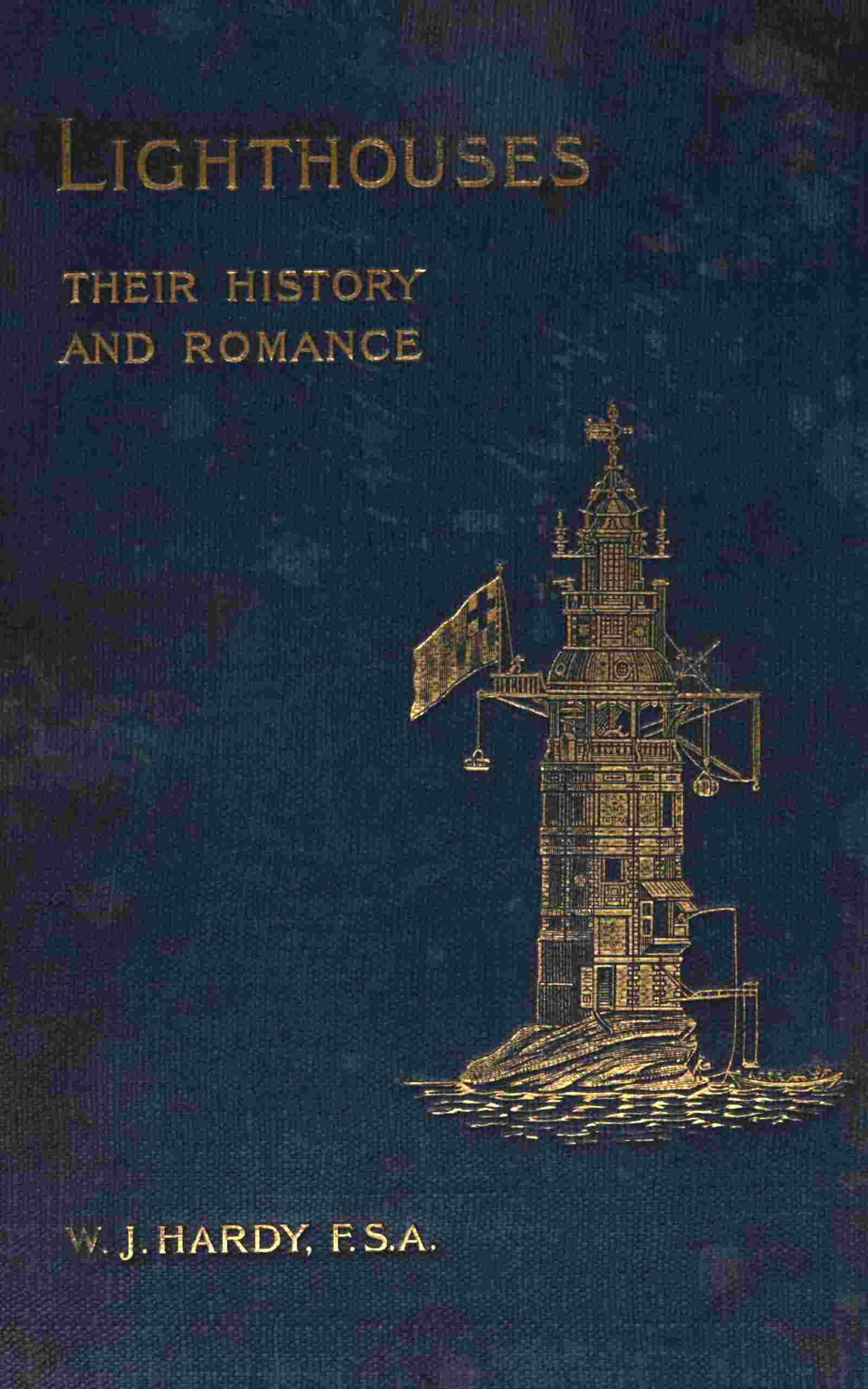
Here is the wonderful work which his fertile imagination had produced. One has only to glance at it to see how deficient it was in every requisite element of stability, how it was susceptible to the action of the storm. Its polygonal form rendered it peculiarly liable to be swept away by the waves; whilst the upper part courted every wind of heaven, being ornamented with large wooden candlesticks, and burdened with useless vanes, cranes, and other ‘top-hamper,’ to use a sailor’s phrase. Had Winstanley been seeking to erect a Chinese pagoda, his work would have been singularly successful.
Its gaudy painting, with suns, compasses, and mottoes, was all in keeping: the last included Post tenebras lux, Glory be to God, Pax in terra. The rooms included a kitchen and accommodation for the keepers, a state-room, finely carved and painted, a chimney, two store cupboards and two windows. This is Winstanley’s own description accompanying the engraving. In this picture he complacently fishes from the state-room window. How unlike other lighthouses! It was a tower of defence; it possessed a kind of movable shoot on the top, by which he could shower stones upon an enemy attacking the building on any side. How characteristic of the man—the jeers and warnings of his fellow-men only excited his obstinacy.
WINSTANLEY’S EDDYSTONE LIGHTHOUSE.
The question of returning to the mainland did not then much disturb the minds of the dwellers in the lighthouse. They had purchased experience by their recent incarceration, and had no doubt with them a good store of provisions. When, however, a month had passed, and no boat had been able to come to them, these provisions had dwindled, and the inmates of the lighthouse must have been beginning to tire of their lodging, to yearn for the comfort of the home fireside—especially at the festive season then so near upon them. At last only three days before Christmas, the Plymouth boat came out with relief-men and provisions, and carried back Winstanley and those with him to the shore: ‘We were,’ says the engineer, ‘almost at the last extremity for want of provisions, when, by the providence of God, came two boats’ with supplies, ‘and the family that was to take care of the lights.’
At Plymouth tidings of the appearance of the light had, no doubt, been eagerly sought after, and each incoming vessel questioned on the subject. When the first news reached port we cannot say, but it must have done so early in December, as on the 17th of that month, the Trinity House ordered the following notice to be inserted in The London Gazette and posted at the various ports of the kingdom, in which, as we see, allusion is made to the fact that the light had then been ‘for some time’ kindled: ‘The Masters, wardens, and assistants of Trinity House having at the request of navigation[5], with great difficulty, hazard, and expense erected a light-house upon a dangerous rock called the Eddiston, lying at the mouth of Plimouth Sound, as well for the avoiding the said rock as for the better directing of ships thro’ the channell and in and out of the harbour aforesaid. They doe hereby give notice that the said light hath been kindled for some time; and that being discernible in the night at the distance of some leagues, it gives entire satisfaction to all masters of ships that have come within sight thereof.’ This being so it was expected that vessels would cheerfully pay the dues for its support, sanctioned by the king’s patent.
We do not learn when the ‘family’—sent to the lonely rock just before Christmas, 1698—was relieved, or of what that family consisted. If it included a man and his wife only, then it is to be hoped that the couple selected had either won the Dunmow flitch or would at least be deserving of it; the Eddystone rock would have been close quarters for a pair not happily matched.
SILVER MODEL OF EDDYSTONE LIGHTHOUSE AFTER ALTERATION.
It is probable that early in the following year, 1699, Winstanley returned to the Eddystone to see how the structure had borne the wintry blast. He found it unshaken, but he also found that it was not nearly high enough; the sea, dashing against the rocks, being frequently thrown above the lantern, and often for long together completely hiding the light. He therefore determined, besides strengthening the foundations, to take down the upper part of the building and rebuild it, as shown in the silver model of it here figured. This was so much higher than that removed that the total elevation was 120 feet. Even with this alteration Winstanley tells us that in great storms the sea ‘flies, in appearance, 100 feet above the vane.’
That William III took a personal interest in the Eddystone lighthouse is proved by the fact that, through Major-General Trelawny, he commissioned a certain Thomas Bastin, the brother of an officer in the army, and a man who tried to ease the pinch of poverty by sketching various notable buildings, to make for him accurate pictures of Winstanley’s work both before and after its alteration; these, in January, 1702, were hanging in one of the king’s apartments at Kensington. How we learn the fact is that his majesty had forgotten to pay Mr. Bastin’s little bill, which came to £30, and so there is some correspondence on the subject in the Treasury papers.
Besides the natural dangers of Eddystone there were some that we may term artificial, to which those who resided there were exposed. We have seen how, during the progress of the work, the men from a French vessel swooped down on the undefended workmen and treated them in no very agreeable manner; but it was not only from foes that the ‘islanders’ were liable to attack: ‘Spare us from our friends’ might well have been their motto had they coveted one. What days those were, those days of vigorous ‘pressing’ for sea service! there was recruiting then, with a vengeance. Perhaps it was needful, perhaps it was not; any way, it was carried on with a want of discrimination too often apparent in those whose hands are tied up with red tape, for we find that even the light-keepers of the Eddystone—or at least the male portion of them—were not safe from the press-gang’s grasp. They were ‘pressed’ into his majesty’s service, though very speedily released.
There is not much history of the first Eddystone lighthouse, after its completion, handed down, so we may pass quickly to its closing chapter; and a tragic one it is. When altering his building in 1699, Winstanley had laughed at the fears of the inmates who, on many a night during the previous winter, had verily believed their last hour had come. He wished he might be there during the fiercest gale that ever swept the Channel, for his lighthouse was as safe as a castle. This was a bit of bravado. Men of scientific experience had pointed out the defects in the construction of Winstanley’s wonderful work—defects which we have only to look at our illustrations to see for ourselves, and which are almost as apparent after the alterations in the building.
But despite all that was said to him, Winstanley persisted that his lighthouse was perfectly secure. We know what happened. How his wish to be in the lighthouse under circumstances that would test its strength to the utmost was gratified, and what was the result.
An old man, who was alive in 1780, could perfectly remember the scene at the Barbican steps, Plymouth, when, with every appearance of ‘dirty’ weather, Winstanley persisted in setting off for the lighthouse on the afternoon of November 26, 1703. But the story of the great storm that raged that night and the following day has often been told—too often to bear repetition here. Inland, almost as much as at sea, its fury and its fatal consequences were experienced. Around Winstanley’s house at Littlebury it whirled dead leaves and broken wood against the window panes, and shook the very building itself to and fro, yet but one thing, one ornament, fell to the ground—that was the silver model of the wonderful lighthouse. At what hour this happened we do not know, neither do we know the exact time at which the Eddystone lighthouse, with its inmates, fell into the sea, so we cannot say if there was any agreement between the two; but there were not wanting many folks who lived round about in the Essex farms and villages who firmly believed that the fall of the silver model was Mrs. Winstanley’s warning of the tragedy at Plymouth.
The memory of that terrible gale lingered long in the minds of those who experienced it; the papers of the day are filled with accounts of pitiable disasters and of hairbreadth escapes; but no incident made a deeper impression in the mind of the public than the overthrow of Winstanley’s lighthouse—‘going souse into the sea like the Edistone’[6] was a favourite saying long after other incidents in the hurricane had been forgotten.
Apart from everything else, the destruction of the Eddystone lighthouse was a very heavy financial loss to Mrs. Winstanley: the principal part of her husband’s capital had been invested in the undertaking; he had, we learn from official papers, expended on the building and maintenance of the lighthouse at the time of its destruction, £6,814 7s. 6d.—for this vouchers were forthcoming—and he had received from dues £4,721 19s. 3d., which left him at least £2,000 and more out of pocket; but it was also shown that quite £1,000—for which the vouchers had perished in the lighthouse—had been paid by Winstanley, from first to last, over the building, so that his estate was the loser of something over £3,000 by the disaster.
That being so, Mrs. Winstanley might reasonably look, with assurance of success, to the petition that was quickly presented to the crown—pointing out that she was a fit and deserving object for the bestowal of a pension from the royal bounty. After due time had been wasted in official correspondence this was given in the shape of a donation of £200 and pension of £100 a year.