
It was unlikely that the Eddystone lighthouse, which in the few years of its existence had proved so beneficial to navigation, would be allowed to remain for long unrestored, more especially as the loss of life and treasure upon the Eddystone reef, which followed on the destruction of the lighthouse, bore terrible testimony to its utility. John Lovett, a London merchant, purchased Winstanley’s interest in the patent, and entered into an agreement with the Trinity House, by which it was arranged that the corporation’s name should be used in applying to Parliament for licence to gather tolls for a new Eddystone lighthouse so soon as it should be erected. Parliament readily passed the requisite bill, and the new building was commenced.
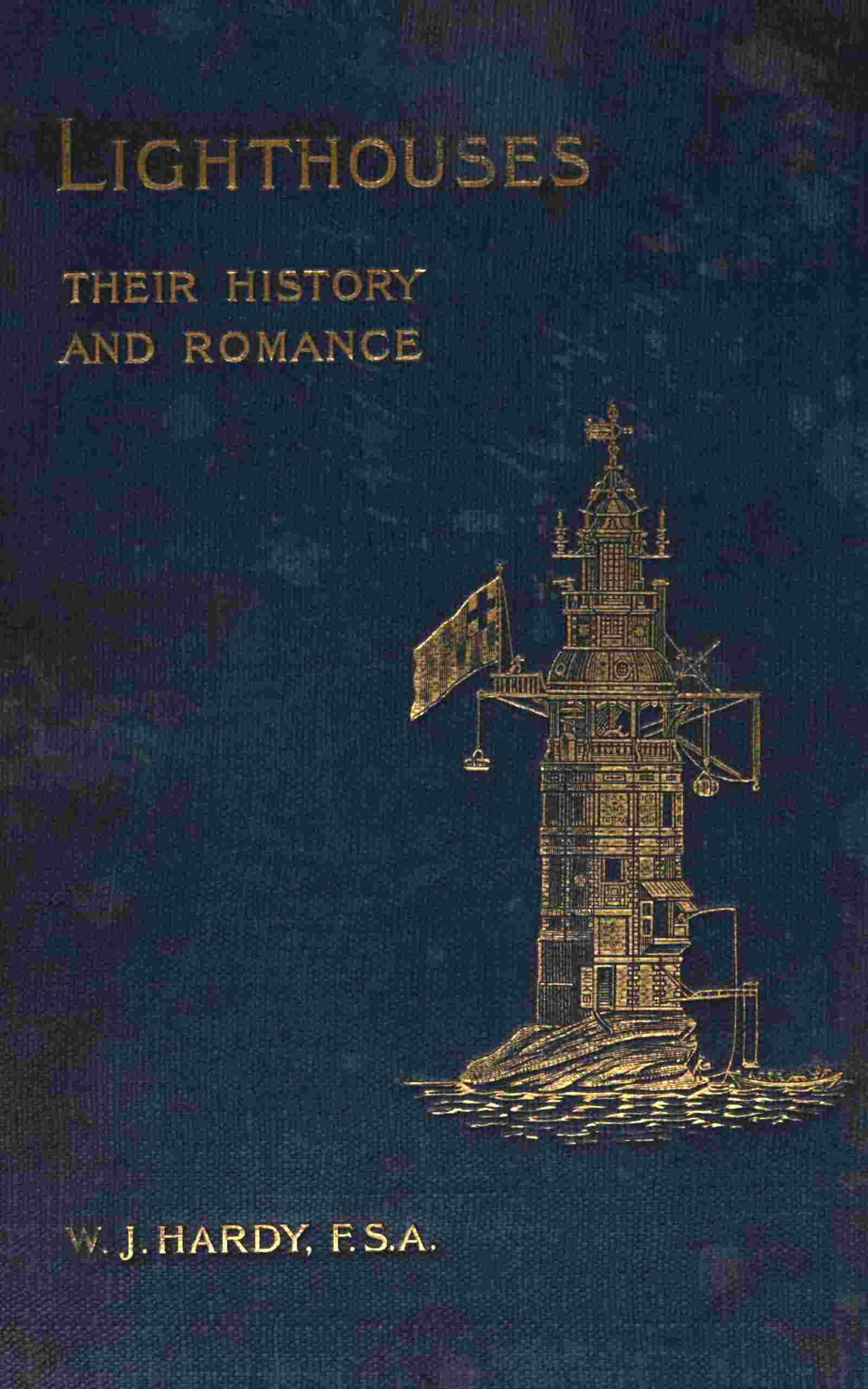
The structure then raised is generally spoken of as ‘Rudyerd’s lighthouse,’ being built and designed by the John Rudyerd already referred to, who was, as we pointed out, a silk mercer in Ludgate Hill. A silk mercer is not, perhaps, quite the man we should go to nowadays to act as architect and engineer for a lighthouse; but to him his fellow merchant, Lovett, entrusted the erection, and Rudyerd, aided by a couple of shipwrights from Woolwich Dockyard, set to work and erected a wooden tower built, for some distance up, around a core of granite, which managed to withstand for more than half a century the gales that swept the Channel, and might, for all we know, have been standing there to-day, had it not been consumed by fire.
RUDYERD’S EDDYSTONE LIGHTHOUSE.
In erecting the tower, Rudyerd and his shipwrights had much the same difficulties to contend with as Winstanley: the sudden storms and the sudden descents of the press-gangs each in turn considerably hindered the work; and at last it became necessary for government to grant special protections from pressing for all those in any way engaged in building the lighthouse. These protections are interesting documents; they give a minute description of the personal appearance of the person protected, and prove incidentally that many, indeed most, of the men that had been employed by Winstanley were again employed by Rudyerd; altogether the staff of workers and boatmen numbered about twenty.
As the men employed by Rudyerd had also worked on the first Eddystone lighthouse, they would naturally possess a lively recollection of the exciting incident of the descent of the French privateer already described; and one cannot wonder that they now asked for something more than protection from the press-gang’s grasp—they demanded that of a man-of-war to watch by the rock so long as they worked there; and without it they would not go. The Admiralty saw no necessity for such waste of a ship’s time; it argued, in well-framed official language, that the men’s fears were vain, since on the previous occasion the French king had severely punished his officer who took them prisoners, and had at once sent back Winstanley himself ‘with encouragement.’
But the workmen were not to be talked into going to the Eddystone unprotected by British guns. Winstanley may have been treated with the courtesy described, but they had not been; they had the vivid remembrance of some time spent at sea in an open boat and in the costume of galley slaves.
At last the Admiralty gave way, a man-of-war was set apart for service at the Eddystone, and the timber tower, that for long had lain ready at Plymouth, was towed out to the rock, set up on the site of the former lighthouse, and before very long—on August 28, 1708—the candles in the lantern were illuminated.
From first to last Rudyerd’s lighthouse had cost Lovett hard on £10,000; but, as his lease was to be for ninety-nine years from the time of kindling the lights, he might reasonably have considered he was making a profitable investment. Yet, like so many lighthouse speculators, he was doomed to disappointment. Difficulties were experienced in collecting the dues, and troubles and annoyances of various kinds continually arose, with the result that he died, probably a ruined man, not long after the building was finished; the fortune over the Eddystone lighthouse was made by his successors in title—the mortgagees of the undertaking who came into possession on Lovett’s death.
Of incidents connected with the history of the Eddystone under their ownership we do not hear much; Rudyerd’s structure was obviously more secure than Winstanley’s, yet for many years it was not without considerable anxiety that the friends of those in charge of the lighthouse awaited tidings of the safety of the building after any particularly heavy storm had swept the Channel. But as year by year these left the lighthouse unshaken such alarms subsided, and we find that the post of keeper of the Eddystone lights was one keenly sought after.
The principal thing those stationed on the rock had to complain of was occasional shortness of their food supply. For a considerable time the provision of this was left to the owners’ agent, one Pentecost Barker, whose diary has been preserved. Now, whether from Mr. Barker’s bad management or from his employers’ stinginess, those on the rock, according to the entries in his journal were left much too often with insufficiency of food and insufficiency of candles for the lantern. See what he enters under December 8, 1729: it was ‘a day of terrible perplexity’ to him, for the ‘people on the Eddystone’ had no candles. Without casting a slur on his memory, we cannot but think that this was his own fault, for, says he, this ‘so teazed and fretted’ him that he had a fit. This was very sad; but there are other entries in his diary which suggest that the fit may have been produced not so much by mental agitation as by what he took to allay it!
As most of us know, Rudyerd’s lighthouse was entirely destroyed by fire in December, 1755, after an existence of forty-eight years. How this fire originated is uncertain; probably the candle-flames, blown by an unusually strong gust of wind, came in contact with the woodwork of the lantern and set it alight. The fire was discovered at two in the morning, as one of the keepers went from the watching-room to snuff the candles, and it spread with amazing rapidity. There were then three keepers on the rock, and these had, each of them, very narrow escapes from burning; yet only one death could be directly attributed to the fire. This was of an old man of ninety who, as he stood on the rock gazing open-mouthed at the progress of the flames, swallowed a portion of molten lead. Helpless with agony he was lifted into the relief boat that came out to the rock, and on its reaching Plymouth was carried to the hospital, where he lingered for several days; after death, the surgeons opened his body, and found in it a lump of lead weighing seven ounces.