
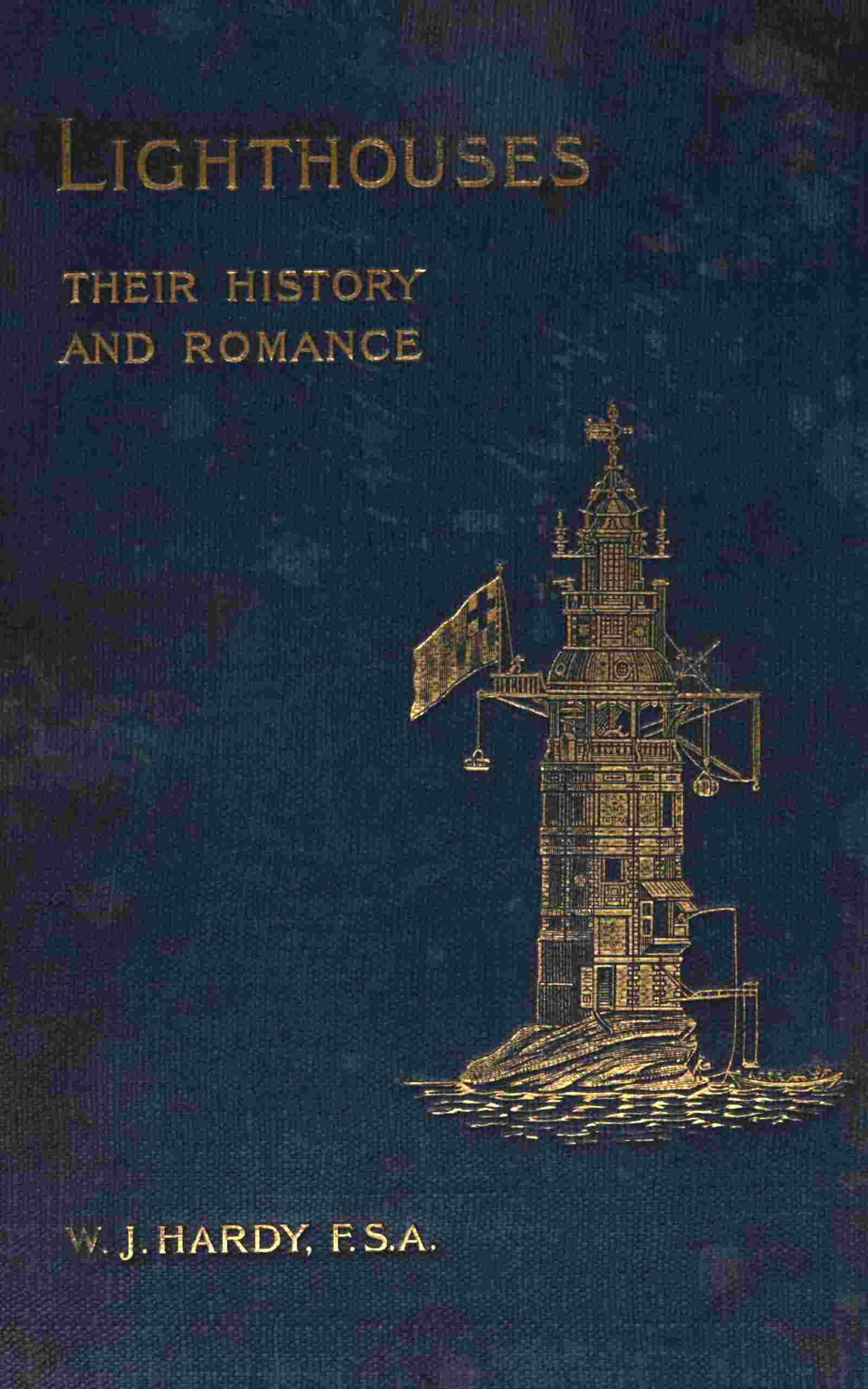
The destruction of the second lighthouse at the Eddystone could not have happened at a more unfortunate time, for the long dark nights of the next few months were the worst in the year for vessels passing up and down Channel in proximity to the rock. It is strange, therefore, that, though the proprietors took in hand the rebuilding of the lighthouse immediately after the fire, the means, then well known, of marking dangerous shoals by a lightship, were not sooner taken. No lightship was placed by the Eddystone rock till the August following the fire.
The man consulted by the proprietors about rebuilding the lighthouse was John Smeaton, who, by the way in which he carried out the work, won for himself a fame that has lasted till to-day. The lighthouse built by him withstood the storms of years, and, as we most of us remember, it was only in 1881 that it was deemed necessary actually to remove it and to build another lighthouse on another part of the Eddystone rocks.
THE EDDYSTONE BUILT BY SMEATON.
When Smeaton first met the proprietors he alarmed their economical feelings by proposing to build a stone and not a wooden lighthouse; but so powerfully did he urge the ultimate saving that would be effected by having a building of this more durable material that he left them with an order to carry out the work as he thought fit, and he started off to Plymouth to execute his commission.
SMEATON’S MODE OF DOVETAILING THE STONES.
Many were the difficulties he encountered; the mayor of the town would not lend him the Guildhall as a room in which to piece together his models—he thought it would ‘spoil the floor’; for the same reason the keeper of the Assembly Rooms refused the use of his chief apartment; it was, he said, the only decent dancing-floor in Plymouth, and his life would be a burden to him if he permitted it to be spoilt—there was a large feminine population at Plymouth! Then Smeaton had the same trouble with the press-gangs that Winstanley and Rudyerd had experienced. His workmen, too, caused him some anxiety; there were many incipient ‘strikes’ among them, and though he seems to have known how to deal with such outbreaks, they naturally retarded the work and ruffled his temper a great deal.
Smeaton’s troubles with the press-gangs certainly seem a little remarkable, as we read of them. Surely in the half century that had elapsed since Winstanley and Rudyerd had been annoyed by such outbursts of official vigilance, even government departments must have become more enlightened. Yet here, in 1755, and during the next two or three years, we find the officers of the ‘press’ acting with a want of discrimination equal to that their predecessors had displayed fifty years before, and repeatedly hindering the good work being carried on at the Eddystone by ‘pressing’ the workmen and boatmen into the king’s service. It must be said, in fairness to the heads of the Admiralty, that, when the matter was brought to their notice, they speedily directed the men’s release; the officers’ excuse generally was that they did not believe the men’s story, that they were employed on ‘Eddystone service’; so Smeaton soon saved this excuse being made by painting on the main-sail of the Eddystone store-boat a large picture of the lighthouse, and by giving to each of the workmen a stamped silver medal[7] which served as a talisman in case the press-gang interfered with them on shore.
Smeaton began work at the stone-yard at Mill Bay, Plymouth, in March, 1757, and shortly afterwards on the rock itself; and on August 24, 1759, the last stone of the lighthouse had been fixed in position. On it was engraved the short but expressive motto: Laus Deo!
What a contrast was the whole building, even to this devout utterance, to the production of Winstanley’s fantastic imagination; yet, perhaps, a less fanciful mind, a less imaginative disposition than his, would not have hazarded what, in his day, was regarded more or less as a mad project, and so the possibility of the lighthouse on the Eddystone rocks might have remained undemonstrated.
SMEATON’S CHANDELIER.
The corona in which the candles were to be placed, and all the ‘tackle’ for hanging it, reached the Eddystone on October 17, and Smeaton tells us with pride that, in less than half an hour after its arrival, it was placed in position and the candles fixed in the sockets prepared for them. Then the signal was given to the lightship, hard by, that her services were no longer required, and she, hoisting her sail and hauling up her anchors, made her way back to Plymouth. At dusk Smeaton lighted his candles, and found, to his great satisfaction, that by opening vent holes at the bottom of the lantern he could keep down the temperature, and so, in summer, prevent the candles from melting—a feat which Winstanley and Rudyerd had failed to accomplish.
The light in the new lighthouse was pronounced excellent, and boats coming within hail of the rock told of the testimony to its goodness that incoming vessels had brought to Plymouth. Smeaton might well be proud of his work—and so no doubt he was; but he showed no anxiety to return to shore to receive the plaudits and congratulations of mankind. He, and some of his helpers, waited in the lighthouse, attending to its duties, till the two men he had selected as keepers arrived there; then he and his companions sailed back to Plymouth. Thus, as Smeaton himself writes, after ‘innumerable difficulties and dangers, was a happy period put to this undertaking,’ without loss of life or limb.
From that day to this not a night has passed on which the Eddystone rocks have been unmarked by a light, though, as the reader was reminded a little way back, Smeaton’s building no longer performs the duty of a lighthouse. As the illuminating power was in Winstanley’s time, so it remained until the opening years of the present century, when a general improvement in coast-lighting was being adopted. It is really surprising that candles, with the trouble they necessitated, lasted so long as they did as lighthouse luminants, for we must remember—what the present generation is probably forgetting—that candles in those days needed continual snuffing to keep them bright; and it is amusing to read in Smeaton’s account of his lighthouse the evident pride with which he refers to a contrivance, worked by the Eddystone clock, which sounded a gong every half-hour, so warning the keeper on duty that he must apply his snuffers to the four-and-twenty candles in the lantern!
SECTION OF THE EDDYSTONE LIGHTHOUSE BUILT BY SMEATON.
The improved lighting at the Eddystone came into operation on the Trinity House acquiring possession of the lighthouse on the expiry of the lease—that would be about the year 1807. Very soon afterwards it was discovered that the rock on which the building stood was becoming undermined by the action of the tide. Robert Stevenson was consulted in 1813, and for the next sixty years the records of the Trinity House show that repairs to the lighthouse of some kind or other were being carried on almost continuously. But this stopping cracks, underpinning, and shoreing up could not go on indefinitely; and in 1877 the board resolved to instruct Sir James Douglas, its late engineer-in-chief, to build a new Eddystone lighthouse on a neighbouring rock which offered a perfectly solid foundation—the improved diving appliances of modern days of course rendered possible a much more complete submarine examination of the spot selected. It is worthy of note that, whilst engaged in their explorations, the divers found a number of relics of the first lighthouse, including the weights of the large standard clock that had given Winstanley and his keepers the time, and which the waves had swallowed up a hundred and seventy years before, when the unstable and fantastic tower was blown into the sea.
The present Eddystone lighthouse differs in many important respects from Smeaton’s; instead of the tower being a curved shaft from its foundation, Sir James Douglas has designed his building with a cylindrical base, which not only prevents the waves from breaking against the tower itself, but provides a convenient landing-stage and exercise ground all round the lighthouse, a boon which a recent visitor to the lighthouse tells us is greatly appreciated by the keepers.
About incidents connected with the erection of this fourth lighthouse on the Eddystone it is scarcely necessary to say very much, for they are in the recollection of most of us. Both the foundation stone and the last stone of the tower were placed in position by the present Duke of Saxe-Coburg and Gotha, late Master of the Trinity House, the former in 1879 and the latter in 1881. Dangerous as was much of the work performed, Douglas could say at its completion, as Smeaton had done, that from it there had resulted neither loss of life nor injury to limb; yet some of those engaged in the building operations experienced hairbreadth escapes: Mr. Douglas, a son of Sir James, was standing on the old tower, superintending its un-building, when a portion of the machinery employed struck and hurled him towards the sharp rugged rocks seventy feet below; had he fallen upon these, he must inevitably have been dashed to pieces. The workmen on the tower, on the rocks, and in the supply-boat, were powerless to help or save him, and, silent and horror-stricken, waited the end. Suddenly a shout burst from the lips of all, ‘Saved!’ and the young engineer was borne high above the angry rocks on the breast of one of the huge waves that rolled in from the westward, and quickly rescued by the men in the supply-boat.
THE PRESENT EDDYSTONE LIGHTHOUSE.
Granite is the material of which the present lighthouse is built, and the blocks are skilfully dovetailed together, so as to give the building the strength of solidity; indeed, for five-and-twenty feet from the base it is actually solid, with the exception of a large water-tank let into the granite. It stands 130 feet above the high-water mark, and so in height exceeds any of its predecessors. The light is given by an oil lamp fitted with a burner which was invented by Sir James Douglas, and which possesses illuminating power equal to that of a quarter of a million candles—more than six thousand times the power of that shed from Smeaton’s light. It is visible at sea for over fifteen nautical miles, so that in a westerly direction its range overlaps that shed from the Lizard, the lighthouse of which we shall speak next.
The living arrangements in the new Eddystone are the most approved, and all is done to render the keepers’ isolation as little irksome as possible. Irksome to a certain degree it must always be—the very isolation necessitates that, and this is frequently prolonged beyond the period intended; for communication with the rock on the days arranged is not always possible, and it is since the erection of the present lighthouse that the keepers’ food supply has been on one occasion nearly exhausted. When the boat from Plymouth at last effected a landing it was found that those on the rock were reduced in their store to a few biscuits.
So much for the history of the four lighthouses that, in turn, have marked the Eddystone reef; but before speaking of the next lighthouse along the coast that claims our attention, there is one word more to be said about the third Eddystone. Smeaton’s massive tower was—on the present lighthouse being completed—taken down, stone by stone, and re-erected on Plymouth Hoe, where, as a landmark, it still renders service to the mariner. Thus the curious reader may see for himself what his ancestors a few generations back regarded, and rightly regarded, as the most wonderful lighthouse ever erected. If he likes he can go within it and see the interior arrangements just as they were when the building stood on the Eddystone—the candelabra in its original position, the clock which reminded the keepers of ‘snuffing time’ for the candles, and besides these, sundry relics of John Smeaton himself. Then, if in after days, when far from Plymouth and its bright and breezy Hoe, he desires to refresh his memory, to call to mind what the old lighthouse was like, he has only to pull out of his pocket any current copper coin of the realm, and there, to the left of Britannia, he will find a small but faithful representation of the building which won for its builder so famous a name.