
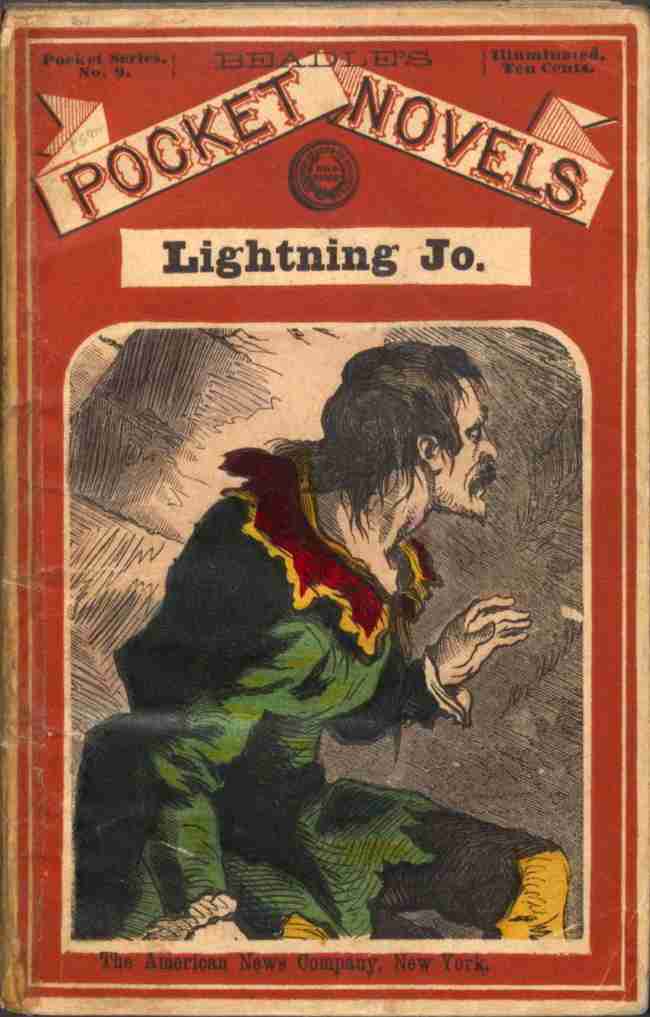
CHAPTER X. AT FULL SPEED.
All through this singular fight, Lightning Jo had kept within reach of his mustang, which occasionally put in a kick now and then, in the hope that he might be turned to account; but the tumult and uproar became so terrific, that he finally became panic-stricken, and with a whinny of the wildest terror, he made a plunge among the scarcely-less excited animals, when his furious struggles added to the fearful uproar, which was already sufficient to drive an ordinary man out of his senses.
Lightning Jo, as we have said, knew that his friends were coming over the hills at the topmost bent of their speed; but the flight of his horse, and the rapid closing in of the Comanches, made further delay fatal, and with the promptness that was a peculiar characteristic of the man, he grasped his loaded rifle in his hands, and made his desperate struggle for freedom.
This was simply an attempt to dodge beneath the horses’ bellies out beyond them, where he knew his own fleetness could be depended on to carry him safely into the company of his own men.
And now began a most extraordinary performance, and an exhibition of Lightning Jo’s miraculous quickness of movement was given, such as would seem incredible in a description like ours. He was walled in on every hand by the swarming Comanches, but by the matchless use of his tremendous arms, he kept back the scores from entangling him in their embrace; until, all at once, he was seen to make a leap upward, directly over the shoulders of those immediately surrounding, and he shot beneath the belly of the nearest mustang like a whizzing rocket.
And, as he did so, he gave utterance to that strange yell of his, like the yelping prairie-dog, whose bark is cut short, as he plunges headlong into his hole, by the sudden whisking of his head out of sight.
The Comanches who caught the dissolving view of the scout, made a desperate struggle to capture him, and those who were still mounted, and saw him leaping beneath their animals, turned them aside, and cut, slashed and thrust at him in the most spiteful fashion, while others sprung off their horses, and did their utmost to intercept and cut him off, or to trip him to the earth, or to disable him in some way that would prevent his succeeding in his threatened escape from their clutches.
It would be a vain attempt to follow his movements in the way of description, when the eye itself was unable to do so; and, despite the astonishing celerity of the Comanches, whose nimbleness of movement is proverbial in the West, they were completely baffled in every effort they made to entrap him.
Here, there, everywhere, he was seen, shooting out sometimes from between a horse’s legs, and then was in another place before the animal could resent the shock given him—in front—in the rear—leaping to one side—backward—forward—and threw the whole troop into confusion—every now and then giving utterance to that indescribable yell, so that the red-skins were actually in chase of that—and all the time steadily approaching the outer circle of mustangs, and ever keeping in mind the proper direction for him to follow, to meet the much-needed soldiers.
And all this took place in one-tenth the time required in our references. The bewildering dodging and doubling of Lightning Jo continued until he shot from beneath the last horse, and then with a triumphant screech, he sped away like a terrified antelope.
Hitherto the efforts of the Comanches had been directed toward capturing the redoubtable scout, and they soon dashed their animals after him on a full run, in the hope of riding him down before he could reach the assistance which they knew was so close at hand.
It proved closer indeed than they suspected; for they had hardly started upon the fierce pursuit when a rattling discharge of rifles rose above the din and confusion, just as the whole company of United States cavalry thundered over the ridge, and came down upon them like the sweep of a tornado that carries every thing before it.
There were a few exchanges of shots, and then the Comanches would have excited the admiration of a troop of Centaurs by their display of horsemanship. Speeding forward like a whirlwind, the shock of the opposing bodies seemed certain to be like that of an earthquake; but, at the very instant of striking, every Indian shied off, either to the right or the left, and by a quick, rapid circle of their well trained animals, they shot away beyond reach of harm from cavalry, and skurried away over the hills and ridges, disappearing from view with the same astonishing quickness, that made successful pursuit out of the question.
Driven away in this unceremonious fashion, the Comanches were compelled to leave their dead upon the field—the wounded managing to take care of themselves, and to get out of harm’s way, ere the cavalry could swoop down upon them. The fashion of giving quarter, in the contests between the Indians and white men, has never been very popular, and at the present day, it may be considered practically obsolete, so that the Comanches displayed only ordinary discretion in “getting up and getting”—if we may be permitted to use the expressive language of the West itself, in referring to an engagement of this kind.
Accustomed as were these men to the exhibitions of the wonderful powers of Lightning Jo, they were astounded at the exhibition of their own eyes, of the deeds he had done during the few minutes that he had engaged in the encounter with the red-skins. The troop gathered around the battlefield, and were commenting in their characteristic manner upon his exploits, when the scout himself, seeing his mustang near at hand, made haste to secure him, and leaping upon his back, he lost no time in placing himself at their lead, and turning his face toward Dead Man’s Gulch, he said, in his sharp, peremptory way, when thoroughly in earnest:
“Come, boys, we have lost too much time. We must git there afore dark, if we git there at all.”
Gibbons, the messenger, placed himself beside him, and, as soon as they were fairly under way, Jo remarked to him:
“I hardly know what to make of it. Old Swico is not with them skunks, and I am disappointed. It has a bad look.”
“Why so?” inquired his comrade, who was partly prepared for the answer.
“I ain’t sartin—but it looks to me as if the business is finished down at the Gulch.”
“Then why should not the chief, released from there, be here with his men?” continued Gibbons.
“This is only a part of his men; there wa’n’t many Comanches among the hills. I think the old dog sent them off on purpose to bother us and keep us back as much as they could.”
“While Swico and the others have taken another direction?”
“Exactly, and carried the women and children with them; and if so, we might as well turn back to Fort Adams ag’in.”
But the scout, as he uttered these chilling words, set his teeth, and rode his mustang harder than ever toward Dead Man’s Gulch.
CHAPTER XI. THE VALLEY OF DEATH.
The wagon containing the females and the children was that which carried the provisions—the others being piled up with the luggage belonging to the different members of the party, and which they had formed into rude barricades from which they fired out, with such deadly effect, upon the Comanches, who, from the nature of the case, were unable to make any kind of approach without exposing themselves to that same unerring fire.
One of the men, at stated periods, visited the provision wagon, and brought forth lunch for his comrades, who felt no suffering in that respect—their great trial being the lack of water. But for the providential supply, secured in the manner already narrated, human endurance would not have permitted the whites to have held out longer than the beginning of this terrible, and what was destined to prove the last, day—the one following the departure of Gibbons, the messenger, for Fort Adams.
It should be made clear at this point also that, of the half-dozen women, and the same number of children, not one had husband, or father, or blood-relative among the defenders, so that, while their situation could scarcely have been more trying, it was deprived of the poignant anguish of seeing the members of their own household shot down in cold blood before their eyes.
No pen can depict the gratitude and love they felt for these men, who, it may be said, were giving up their lives to protect them; for, at the first appearance of the dreaded Comanches, every one of them could have secured their safety by dashing away at full speed, upon their fleet-footed mustangs, and leaving the helpless ones to their fate.
But of such a fashion is not the Western borderer, who will go to certain death, rather than prove false to those who have been intrusted to his care. The party had been sent to St. Louis, under an agreement to bring this little company to their homes in Santa Fe, on their return from an excursion to the Eastern States, and there was not one of them who would have dared to ride into the beautiful Mexican town with the tidings that they had perished, and he had lived to tell the tale. Far better, a thousand times, that their bones should be left to bleach upon the prairie, rather than they should live to be forever disgraced and dishonored, and to carry an accusing conscience with them for the remainder of their days.
The children, during the first twenty four hours, probably suffered the most, in their cramped, constrained position, being compelled to remain within the wagon, lest, if they exposed themselves by appearing upon the ground, they should be slain by the Comanches, who availed themselves of every opportunity to retaliate upon the whites.
After it became pretty certain that Jim Gibbons had penetrated and passed through the Comanche lines, Captain Shields prepared for a deadly charge from their enemies, and from his place in his vehicle he called to the others to make ready also.
The men thus talked with each other, while their faces were mutually invisible; but the little circle permitted the freest intercommunication. His advice was followed, and every rifle loaded and kept ready to be discharged at an instant’s warning.
It was terribly annoying to feel, at a juncture like this, that they must husband their fire on account of the failing supply of ammunition, and at the same time manage the business in such a way that the Comanches themselves should not be permitted to discover the appalling truth.
“Don’t fire too often,” called the captain, in his cautious way, “and when you do make sure that you let daylight through one of the red devils. I think they will open on us in some way, and very soon, too.”
It seemed strange that the uproar and tumult which had marked the flight of Gibbons should be succeeded in its turn by such a profound silence as now rested upon the gulch. From the place where our friends crouched not a single Comanche could be seen, nor could their location be detected by the slightest sound.
From far away on the prairie came the faint sound of a rifle—but in the immediate vicinity all was still.
Captain Shields was of the opinion that Swico, the chief, had gathered his warriors around him, just outside the gulch, and was holding a consultation as to what was the best to be done, as it was now as good as certain that, before the dawn of another day, a heavy force of cavalry would be down upon them.
There were some who really believed that the Comanches would now draw off and disappear altogether from the place where they had suffered such a terrible repulse; but for this very reason, the experienced frontiersman, Captain Shields, was certain that the contrary would prove to be the case. The incitement of revenge would prompt them rather to make the most desperate charges and the most furious assaults upon the little Spartan band.
And while the old hunter lay upon his face in the wagon, stealthily peering out, and listening for the first approach of his foes, he coolly calculated the chances of the day.
“Six of us left, and we average three rifles apiece—to say nothing of revolvers that are scattered all among the boys. We can load and fire these, perhaps four or five times apiece—not oftener, certainly—that is, if we can only get the opportunity to load and fire them. After that— Well, everybody has got to die some time.”
At this, he stealthily moved around, and peered out at the wagon containing the helpless ones, and he muttered:
“All seems to be quiet there, and I guess none of them have been reached by these bullets whizzing all about them, which may be either good or bad fortune.”
Then as he resumed his position of guard, he cleared his vision with his hand, and added:
“It’s mighty rough on them. We men are always expecting such things, and are sort of ready for it; but for helpless women and children— Helloa! what in the name of Heaven can that be?”
CHAPTER XII. “WHAT IS IT?”
Captain Shields might well give utterance to this exclamation, for just then his eyes were greeted with the most singular sight he had ever seen in all his life. He rubbed his eyes and stared, and finally turned to young Egbert Rodman, who just then crawled into the wagon.
“If I was a drinking man,” said he, “I would swear that I had the jim-jams sure. Look out the wagon, Rodman, and tell me whether you see any thing unusual, or different from what we have been accustomed to look upon for the last day or two.”
The young man did as requested, and the exclamation that escaped him convinced the somewhat nervous officer that his head was still level, and his brain was playing no fantastic freak with him.
The sight which greeted their eyes, and so excited their wonder, came first in the shape of a horse, which, walking slowly forward, steadily loomed up to view, until it stood directly on the border of the gulch, where, at a hundred yards distant, and with the clear sunlight bathing him, every outline was distinctly visible.
But it was not the horse, but that which was upon it, that so excited the wonder and speculations of those who saw him. Close scrutiny gave it the appearance of an animal standing upon all-fours upon the back of the horse, like Barnum’s trained goat Alexis. It was, however, three times the size of that sagacious creature, and an Indian blanket was thrown over it, so that little more than the general outlines could be discerned.
This enveloping blanket reached to the neck of the “what is it?” leaving the head entirely exposed. This was round, and bullet-shaped, and moved in that restless, nervous way peculiar to animals. It seemed as black as coal, and resembled the head of one of those giant gorillas which Du Chaillu ran against in the wilds of Central Africa.
A strange chill crept over the two men, as they felt that this animal was looking steadily down upon the encampment, as if meditating a charge upon it, and only waiting to select the most vulnerable point.
The steed supporting this nondescript stood neither directly facing nor broadside toward the whites—but in such a position that their view could not have been better. The horse remained as stationary and motionless as if he were an image carved in bronze.
No other living creature being in sight, the eyes of the little band of defenders in Dead Man’s Gulch were speedily fixed upon this strange phenomenon, and its movements were watched with an intensity of interest which it would be hard to describe.
“It is some Comanche deviltry,” was the remark of Egbert Rodman, after he had surveyed the object for several minutes. “They have grown tired of running against our bullets, and are about to try some other means.”
“But what sort of means is that?” asked the captain, who beyond question was a little nervous over what he saw.
“That is rather hard to tell, until we have some more developments; but you know that the red-skins, from their earliest history, have been noted for their ingenious tricks, by which they have outwitted their foes, and you may depend upon it that this is one of their contrivances, although I must say that I do not see the necessity for any such labored attempts as that, when they have every thing their own way; and, if they would only make a united and determined charge, we should all go under to a dead certainly.”
Captain Shields, however, like many of the bravest men, was superstitious, and he was inclined to believe that there was something supernatural in the appearance of this thing, and, although he hesitated to say so, yet he looked upon it as having a most direful significance concerning himself and his friends.
Still the horse remained perfectly motionless, and the quadruped, with the blanket thrown over his back, was steadily gazing down upon them, from his perch upon the back of another quadruped.
The profound stillness that then reigned over the prairie and in Dead Man’s Gulch was rather deepened by the sound of the faintest, most distant report of a gun that seemed to have come from some point miles and miles away, in the direction of Fort Adams, proving plainly that the pursuit of the flying messenger was not yet given over.
Egbert Rodman concluded that there was a very easy and speedy way of settling the business of convincing the awed captain that there was nothing possessed by this curious animal that was not the common possession of his race. As he stood, partly turned toward him, he could not have desired a better target for a carefully aimed rifle, and he determined to tumble him from the back of the horse, and thus put a speedy end to that bugbear of the captain’s.
Without saying a word as to his intentions, he carefully thrust the muzzle of his rifle through the aperture in the canvas of the wagon, and sighted at about where he supposed the seat of life to be. He held his aim only long enough to make certain, and then pulled the trigger and looked out to see the “what is it?” pitch to the ground, and reveal his particular identity in his death-struggles before their eyes.
But what did he see? The creature, standing in precisely the same posture, and looking steadily down upon them, as unmoved as though such a thing as a gun had never been invented.
But Egbert, although very much astounded, was not yet prepared to admit that the nondescript was impregnable against a good Springfield rifle, even if those about him were under a superstitious spell.
And so, with the same steadiness of eye and nerve, he reached out and took a second rifle from beside him, and shoved this through the “port hole.”
The same unexceptionable target remained, and he resolved that this time there should be no failure. He was a good marksman, and he made certain aim, while more than one breathlessly watched the result.
The same as before! Not a sign of the thing being harmed in the least!
“Shoot no more!” said Captain Shields, in an awed voice, “there is nothing mortal about it! It is sent to warn us of what is so close at hand!”
CHAPTER XIII. “THE COMANCHES ARE COMING.”
When Egbert Rodman fired and missed the second time at the apparition at the top of the gulch, his emotions were certainly of the most uncomfortable kind.
He was now certain that in both instances he had hit it fairly and plumbly in the very point aimed at, and it was equally certain that he had not harmed it in any way.
The mustang did not stir an inch, nor did any movement upon the part of its strange rider indicate that he or it was sensible of the slightest disturbance from the two bullets that had been aimed at its life. Clearly then it was useless to waste any more precious ammunition upon it, when it was simply throwing it away.
Still Egbert was too intelligent and well educated to share fully the belief of Captain Shields, although he could not avoid a cold chill, as he proceeded to load his two discharged pieces, for, to say the least, it was inexplicable, and no man can feel at ease when face to face with a danger which proves to be invulnerable against effort upon his part.
With the exception of Egbert, the other men believed the same as did their captain, and the vim and spirit that had marked their courageous defense up to this point, now deserted them, as the sad, despairing conviction imparted itself to each, that all hope was now gone, and they had but to wait the coming of inevitable doom.
The mustang with the moveless apparition upon it deepened the spell of terror that rested upon the whites, by starting down the hill in the direction of the encampment. He walked with a slow, deliberate tread, like a war-horse stepping at the funeral of his master, and it may be said that the blood of the staring bordermen froze in terror at the sight.
Undoubtedly their senses would so far have left them, that they either would have dashed out of the gulch, or cowered down in terror behind their barricades, like children frightened at the approach of some hobgoblin.
But this last great calamity was spared them; for, while yet at a considerable distance, the mustang came to a sudden and dead halt, paused a moment, and then, with a snort of alarm, turned about and dashed away at headlong speed.
The mustang was gone so speedily that there were many who were not aware of the manner in which he had made his exit, and were ready to believe that he had vanished like a vision of the night, a proceeding in perfect keeping with their idea of the phenomenon itself.
The hours dragged wearily by until noon came and passed, and not a sign of an Indian had been seen, nor had the frightful apparition reappeared. When the survivors saw that the sun had really crossed the meridian, there were several who began to feel the faintest revival of hope, while one or two were inclined to believe that the Comanches had withdrawn in a body and would be seen no more, discouraged by the desperate resistance they had encountered, and the escape of the messenger, and the probable coming of a body of cavalry from Fort Adams.
While Egbert Rodman could not share in this belief, yet, to relieve the suspense which oppressed all, he determined to pass outside the encampment and learn whether or not there was any foundation for such belief.
Of course, great risk was incurred by doing this, but all had become used to risks, and he leaped from the wagon and ran at quite a rapid rate up the hill, the entire group watching him with an interest scarcely less than that with which they had scrutinized the approach of the apparition.
The relaxation in the vigilance of the Indians had been taken advantage of by the whites, especially by the women and children, the latter of whom, with the innocence of their age, were running back and forth and frolicking, with as much gayety as if playing upon the green at home, with no thought of death in their minds.
“That chap will never get any sense in his head till it is put there by a bullet,” remarked Captain Shields, as he stood attentively watching his young friend, secretly admiring, in spite of his words, the intrepidity which he had displayed from the first.
“Why did you permit him to go?”
“Good heavens! I didn’t permit it; the first thing I knew, I seen him jump out of the wagon and start up the hill. Didn’t I try to stop him when he was after the red devil with his canteen, and what good did it do?”
“It seems to me that it would be so easy for him to run directly to his death.”
“So it would, and for that matter, it would be powerful easy for any of us to do the same; but he’s about to the top of the gulch,” added the captain, turning away to watch his progress.
Such was the case, and every voice was now hushed, and every eye was fixed upon Rodman, as he slackened his gait, and, stooping down, made his way as stealthily to the top of the declivity as the most veteran scout could have done.
When he should reach there and look around, all knew that he would give a signal which, indeed, would be that of life or death to them.
They marked him as he crept on his hands and knees to the very top, and then, removing his cap, peered over. Then he rose partly to his feet and turned his head in different directions, and just as the trembling whites were beginning to take heart again, he suddenly wheeled about, and came running down the gulch like a madman, waving his hand and shouting something to his friends which was incomprehensible from his very excitement.
“Back to the wagon, every one of you!” commanded Captain Shields, turning to the women. “Don’t wait a second! That means that the Comanches are coming! To your stations, boys, and let us die like men!”
CHAPTER XIV. THE LAST DAY IN DEAD MAN’S GULCH.
Only a few seconds and Egbert Rodman was in the middle of the encampment, breathless and wild.
“The whole horde of Indians are coming back!” he called out, as soon as he could frame the words. “They are but a short distance away and will be here in the next minute!”
The words had scarcely been uttered when the borders of the gulch were swarming with yelling Comanches. The women had barely time to scramble under shelter, when the red-skins were upon them.
“Fire, as you can load and aim!” called out Captain Shields, while yet his men were leaping to their places. “Don’t wait, but let them have it! We may as well die fighting like men!”
Crack! crack! barked the rifles of the scouts, in a regular fusillade among the horsemen, the fatal results being instantly seen, in the Comanches here and there dropping from the backs of their mustangs.
This destructive fire accomplished the best thing possible, in that it prevented the wholesale charge that was so much to be dreaded; as it could not fail to be deadly fatal almost on the instant.
The incessant sleet of bullets sent into the ranks of the red-skins created an unexpected confusion, and just as our friends had reached the last round of their ammunition, they fell back out of range, and dismounting, crept to the edge of the gulch and began firing down upon the encampment, just as the scouts themselves would have done had the position been reversed.
Despite the exaggerated assertion of the startled Egbert, as he dashed into the camp, Captain Shields became well satisfied from the glimpse he had gained, that the Comanche force was divided, and he was now fighting against only a portion of those against whom he had been pitted before, the others, as he rightly suspected, having followed on in the pursuit of the flying messenger, and with the purpose of entrapping and ambuscading the cavalry that would be sent, in all probability, to the rescue of the little band of whites.
But there was little consolation to be derived from this discovery, as there were certainly over a hundred Comanches at hand, and they unquestionably had the power, when they should choose to put it forth, to crush out of existence himself and every one of his brave men. One single determined charge, a few minutes’ appalling conflict around the wagons, and then not a man need be left to tell the awful tale of the last appalling massacre of Dead Man’s Gulch.
The red-skins kept up the cautious policy of lying flat upon their faces, just over the edge of the ravine, and aiming deliberately down into the encampment. By this time the canvas of the wagons was riddled, and knowing pretty well at what points to aim, the greatest caution was necessary upon the part of the scouts to escape the bullets that were flying all about them.
Fully a dozen of these merciless wretches directed their exclusive attention to the wagon which they knew contained the helpless members of the party, and such a steady fire was kept up on it that the canvas in a few minutes looked like a sieve, pierced in every part by bullets, many of which imbedded themselves in the impenetrable planks of which the wagon-body was composed.
This was the first time since the opening of this dreadful siege that such a demonstration was made, and the unrelenting malignity which characterized it, excited the wonder of the scouts, who believed that the Comanches were so infuriated at the losses already suffered, that some of the survivors who may have lost their closest relatives, were bent upon exterminating every one, man, woman and child, without awaiting what might be considered the inevitable capture of the females.
But provision had been made against this very thing from the first. The sides of the vehicle, behind the canvas, had been walled up with packages and bundles, in such a skillful fashion, that so long as the little party could be made to keep between them and near the center of the wagon-body, they were as impervious to the rifle-shots as if incased in an ironclad of the navy.
This steady stream of fire from the boundary of the gulch continued until the greater portion of the day had passed. So long as it continued without any concentration upon the part of the Comanches, Captain Shields was satisfied, for nothing short of a cannonade could demolish the barricades that had withstood such a terrific fire for so many hours.
With the sole purpose of preventing any coup d’état upon the part of the red-skins, the intrepid captain called to his men to send a shot among them now and then, taking care, however, that in every case the rifleman discharged his gun at a fair target.
These opportunities, fortunately for our friends, were few, and they were thus saved the fatal revelation that could have had but one terrible result upon the part of the valiant defenders.
Captain Shields was thus kept so incessantly employed, both in body and mind, that he had little time in which to think of the apparition, and the ominous warning which he fervently believed it foreshadowed; but, now and then, in the heat of the conflict, it came to him with its dreadful depression of spirits, and made him sigh and wish that the “last minute” would come and the agony end.
This fearful fire continued until darkness descended upon the prairie, and when the light failed, a lull came so sudden as to cause a ringing and peculiar lightness of the head that almost drove away the senses of those that remained.
Captain Shields waited a few minutes, and finding a possibility of this quiet lasting for a short time, he determined to make the round, and exchange a few words with his friends. He was alone in the wagon which he had chosen for his sentry-box, and stealing cautiously out, he hurried across the clearing to that containing the women and children. He found them stunned, paralyzed and nearly dead from the awful ordeal through which they had passed, but a little inquiry proved them all untouched by the bullets that had been sent so inhumanly after them.
Then he made the rounds of the other vehicles, and a blood-chilling discovery awaited him. Out of the five defenders besides himself, only one, Egbert Rodman, remained alive, the other four having been struck and killed by the balls of the Comanches!
“What is the use?” said the stunned officer as he took the hand of the young man and helped him out upon the green sward; “we two are the only ones left, and I have fired my last round of ammunition, even to my pistols.”
“So have I,” returned Egbert; “we may as well go to the women and die defending them. The last moment is at hand.”
“It is here!” said Captain Shields, in a clear voice. “Look! there they come!”
As he spoke, he pointed up the sides of the gulch, where, in the dim light of the early night, the horsemen were seen gathering for the final charge. The next moment it came!
CHAPTER XV. THE RESCUE.
The next moment a strange, wild yell broke the stillness, or rather sounded above the thunder of the horses’ hoofs, and the two men, standing sullenly by the wagon in the center of the encampment, and awaiting their doom, like those who, having done all that was possible, could now do nothing else.
Again that indescribable yell rung out over the prairie, and Captain Shields straightened himself like a flash, and gave a gasp of amazement if not terror.
“Did you hear that, Egbert?” he demanded, clutching the arm of the half-stupefied man at his side. “By heavens! they are not Indians, but Lightning Jo and his men from Fort Adams!”
The next minute the clearing within the encampment was filled by a score of men, who, leaping from their horses, and leaving them outside of the circle of wagons, came rushing in upon the little party from every direction.
“Helloa! here, where are you?” shouted the famous scout, “this ain’t a game of hide and seek. Come out and show yourselves.”
This was uttered in a cheery, hearty way, but mingled with the voice could have been detected a tone of awe and dread, like one who in reality was afraid to hear the same answer which he had demanded.
“Here we are,” replied Captain Shields, as he and Rodman walked forward to meet their deliverers.
“But the rest of you—where are they? Speak quick, old fellow,” added Jo, taking the hand of the two, both of whom were his acquaintances; “we are in a hurry, and want to hear all that is to be heard.”
“There they are,” returned Egbert, pointing to the wagons; “some are beneath them, and some are within them, but every one is dead!”
“What!” exclaimed Lightning Jo; “you had women and children with you—they are not all gone? I heard that Lizzie Manning, the sweetest little girl in Santa Fe, or anywhere else, was with you. Where is she?”
“Oh, she is all right,” returned Captain Shields, who had misunderstood the full import of the question; “they are unharmed.”
But by this time Gibbons, who knew just where to look for them, called out that they were safe, and he and many of the soldiers gathered about the wagon to congratulate and give them what assistance was in their power.
Their kindnesses were needed, for during the latter portion of this day all had suffered the most agonizing thirst, the scant supply which had been furnished them so unexpectedly lasting them but a short time, and then seeming to intensify that intolerable craving that drives the strongest man mad, until all were overcome by a sort of stupor, in which they were sensible only of dull, yearning pain, that could not be quieted.
Expecting as much, the soldiers were prepared, and more than one canteen of cool, refreshing, delicious and reviving water was offered to the suffering women and children, and almost instantly new life was imparted to all, and they awoke to a realizing sense of their position, and to the fact that they had been rescued.
“Are you there, Lizzie?” asked Lightning Jo, crowding forward, and peering among the group, who were dismounting from the vehicle that had proven such a friendly shelter and fort to them. “Helloa! I see you! Thank the good Lord! I was very much afeard I’d be too late to save your sweet self.”
And taking the half-fainting girl in his long, brawny arms, he pressed her to his heart and kissed her cheek, just as affectionately and gratefully as he would have done had she been his only daughter restored to life.
And poor Lizzie, now that she saw that the awful danger had passed, could not prevent her woman’s nature from asserting itself. Resting her head upon the bosom of the brave-hearted scout, she could only sob in the utter abandonment of feeling. She knew that so long as Lightning Jo stood near her there was nothing to be feared from any mortal danger that walked this earth; and the tense point to which her mind had been strung for so long a time, now fully reacted, and she became as weak and helpless as the youngest of the children, who were beginning to awake from their stupor. And so, without attempting to speak, she simply sobbed, and allowed her friend to support her in his arms.
The rest of the cavalry were not idle. They made a circuit of the wagons, and, as they learned the dreadful truth, something like a heart-sickness and awe quieted their boisterous voices, and they conversed in low tones, some muttering curses against the red scourges of the plains, while others expressed their sympathy for the brave men who had perished before relief came.
The life of the soldiers on the frontier is such as to accustom them to the most revolting evidences of the cruelty of the Indians; but there were thoughts that were suggested to the cavalry, by the sight in Dead Man’s Gulch, such as did not often come to them.
The long-continued and heroic defense of the little party, the torment of thirst, the vain attacks of the ferocious Comanches, the unflinching bravery of men and women, the steady dropping of the scouts until only ten were left, the total giving out of the ammunition, and then the sullen despair, in which the last defenders awaited the last charge: these pictures came to the minds of the cavalrymen in more vivid colors than they can to the reader who has seen nothing of the wild, daring life of the frontier.
Gibbons quickly told his story to his friends. After the diversion created by Lightning Jo’s scrimmage with the Comanches among the hills, he and his men had put their horses to the full run, and reached the neighborhood of Dead Man’s Gulch just as the lull in the conflict occurred. It was their purpose to charge down upon the red-skins, and give them a taste of vengeance, such as they had not yet encountered; but the cautious Swico had his scouts out, and the approach of the cavalry was signaled to him while they were yet a long way off.
In the hope of still accomplishing something, the majority of the cavalry started in pursuit of the Comanches, while Lightning Jo and a score of his friends hurried on to Dead Man’s Gulch, where the chief interest now lay.
The horses of the soldiers were already exhausted, and they were speedily compelled to return, after having exchanged a few shots with the band of Swico-Cheque, as they skurried away in the darkness.
CHAPTER XVI. HOMEWARD BOUND.
There were too many horrors hanging around Dead Man’s Gulch for the whites to spend any more time there than was necessary. Several of the wagons were overturned upon each other, and then fired, and by the aid of this huge bonfire, which sent a glow out upon the prairie for miles, like the rays of the Eddystone light-house over the ocean, they set about their work of mercy.
In one of the wagons were placed all the bodies of those who had fallen, and the other was fitted up in the most comfortable manner for the women and children. To these several of the cavalry attached their horses, and making sure that every thing that could be of any possible use to the Comanches was burned, the rescuing party started out of the ravine, which was ever afterward to cause a shudder whenever memory recalled the awful experiences to which they were there doomed.
The moon had only fairly risen when the procession slowly wended its way out from the gulch, and off across the prairie, in the direction of Fort Adams. They were indeed what they looked to be, a funeral procession, and another vivid comment upon the terrible errors which have governed the associations of the white and red-men from the very first meeting, nearly four hundred years ago.
The dragging of the two heavily-laden wagons across the prairie could but be a tedious and wearisome task, and in all probability would not be completed until the second day after starting. Of course there was a possibility that Swico would return to the attack, if a suitable occasion should offer, but it was not deemed necessary that the entire one hundred men should remain to escort them into the fort.
And so when the eighty rode back from the fruitless pursuit of the main body of Indians, the arrangements were made for dividing the company, it being well known that Colonel Greaves could ill afford to spare so many men, and would be pleased if such a course could be carried out without any ill results flowing therefrom.
But, first of all, the steeds and their riders needed rest after the tremendous charge over the prairie, and less than a mile from Dead Man’s Gulch, where a sparkling stream of cold water wandered through a grove of trees, the camp was made for the night, the sentinels being stationed at every point, and such precautions made, as to cause every one to feel perfectly safe against any disturbance from the malignant red-skins, who had too much discretion to rush in where they knew they would be only too gladly received by the cavalry.
Several fires were kindled in the grove, and food cooked, the camping-ground being one of the most pleasant that could possibly have been chosen, as there was an abundance of rich grass for their animals, and every thing that could be needed by their riders.
At one of these fires, a little apart from the rest, were three persons, engaged in the most pleasant converse. The long, lank figure, stretched lazily upon the ground, supporting himself upon his elbow, was Lightning Jo, at his ease, with his nature all “unbent” and his humorous self at the surface. As he talked, his black eyes sparkled, and his handsome white teeth were constantly exposed as he asked some question, or made some reply to Egbert Rodman and Lizzie Manning, who were seated upon the opposite side of the fire, rather closer together than was absolutely necessary, chatting with each other and with the scout, who kept “chaffing” them so continuously that they had little opportunity for any private conference of their own.
“You may as well wait, younkers,” said Jo. “I don’t object to you squeezing each other’s hands, jest as you tried a minute ago, when you thought I warn’t looking; but you needn’t try to talk to each other when I’m about. So wait, I tell yer, till some other time, for you ain’t going to get rid of me till you bunk up for the night.”
“No one wants to get rid of you,” retorted Lizzie, as a blush suffused her face, and her eyes sparkled in the firelight. “What do we care for you? I have no wish for any private talk with Egbert.”
“Of course not; nor he with you; any fool can see that in both your looks, ’specially in his. But that’s always the way. I had an aunt once that always was interfering when any young dunces got to fooling round. She had a son, that she thought all the world of. He had learned the shoemaker’s trade, and when he was about forty or forty-five, he got tender on a cross-eyed girl, with red hair, that lived near him, and he went for her. My aunt didn’t like it a bit, and done all she could to break it up. She said if her boy would wait till he got to be a man, she wouldn’t object, if he would pick out a young lady for her worth instead of for her beauty, as he had done. She done every thing to torment the poor feller, giving him medicine to make him sick when he had a special appointment with her, sewing big patches all over his coat, so that he was ashamed to wear it, and locking him in his room and giving him a good strapping when he got sassy and gave her any of his lip.
“Cousin Josh didn’t mind that much, as he said the old woman had been a little peculiar ever since he had been ’quainted with her; but there was one thing that he couldn’t get used to, and that was her way of bouncing down upon him and his senorita, just as they were beginning to act like you two folks, and thought nobody wasn’t looking on. Three times, Josh told me, he had got down on his knees and clasped his hands and shut his eyes, and was making his proposal to his lady, and was just in the sweetest part, when he opened his eyes and saw his mother standing afore him with a sweet smile upon her countenance, and more than once, when he reached out his arm to put around the young lady’s waist, it went over the old woman’s neck, who was alistening near, and who cuffed his ears for being such a fool.
“Josh stood it as long as he could, but finally he got even with her.”
“In what way?” inquired Egbert.
“He got a big skyrocket made, and fastened it to the old lady’s dress, and got a little boy to touch off the fuse. The last seen of my aunt she was whizzing and bobbing through the air, until she went out of sight. As she never came down ag’in, Josh wasn’t bothered any more, and he went on with his courtship and at last got married and lived happy, as such a good boy deserved to be.”
CHAPTER XVII. ON THE BRINK.
The sentinels on duty at the grove detected more than once through the night the Comanches prowling around the encampment; but they evidently saw enough to convince them that it wouldn’t pay to disturb the sleepers, and so they slept on, on, till the bright summer sun pierced the camp, and all was active again. Then, as the preparations were made for resuming the journey to Fort Adams, and a careful reconnaissance of the surrounding prairie was made, not a shadow of a red-skin could be seen.
“I was in hopes that I could get a crack at Swico,” remarked Lightning Jo, as he rode at the head of the company, with Egbert Rodman and Lizzie Manning by his side, he insisting upon her keeping him company when no danger was thereby incurred, as he declared there was no telling when such an opportunity would be given him again, and, as a matter of course, she was only too happy to comply with his wishes.
“I was saying that I had hopes of getting even with Swico, and he and me have an account that must be squared one of these days, but I wasn’t given the chance to draw a bead on his shadow. Howsumever, we’ll get square one of these days, as my uncle used to remark when he cheated me out of my last cent, and then kicked me out doors when I asked him for a trifle. They’ve got some purty big devils among the Comanches, but I think Swico goes ahead of ’em all. Do you know what sort of ornament he has made for himself, and which he thinks more of than any thing he ever had?”
The two replied that they had never heard mention of it.
“He wears a shirt of buck-skin, made without the usual ornaments of beads and porcupine-quills, but hung with a full, long fringe formed from the hair of white women and children! You needn’t look so horrified,” the scout hastened to add, as he noted the expression upon the faces of his friends. “I’ve sent word to Swico that him and me could never square accounts till I got hold of that same thing, and I never can get hold of it till I wipe the owner out, so you can see how that thing has got to be settled atween us.”
“And if you hadn’t come to Dead Man’s Gulch as you did, that fringe would have been ornamented with my tresses,” said Lizzie, looking with an awed, grateful look at her preserver.
“I s’pose,” was the matter-of-fact reply; “the old scamp was expecting me, and I wonder that he waited. But he sloped when some of his scouts sent him word that we was coming. Howsumever, what’s the use of talking? I don’t see as you’ve got any reason to think any thing about him.”
“Where do you suppose this Comanche chief and his band are now?” inquired Egbert.
“Off over the prairie somewhere, looking for more women and children. That’s his forte, as they say down in Santa Fe, and I rather reckon that there are plenty more in the same boat with him.”
The subject, at the present time, seemed distasteful to Lightning Jo. The fight was over, and he considered all danger at an end, and despite the bier, with its awful load, that followed in the rear of the cavalcade, he seemed to feel a certain buoyancy of spirits that was constantly struggling for expression in his words and manner.
The morning was clear and bracing, and but for the lumbering wagons the whole party would have been bounding forward at a rate that would have carried them to Fort Adams within the next few hours.
No interruption occurred until noon, when a halt was made for dinner, the cavalry being provided with sufficient rations to make it unnecessary to use the rifle in quest of game.
By the middle of the afternoon, they were within a dozen miles of the fort; and, as there had been no signs of Indians visible since starting in the morning, it was concluded to be no violation of prudence for the main body to gallop on to their destination, leaving the wagons to follow at their leisure, it being confidently expected that they would come into the stockade shortly after nightfall.
Lightning Jo and a dozen of the best men, including Gibbons, Captain Shields and Rodman, remained with the smaller party. All were mounted, fully armed and provided with an abundance of ammunition, so that no one felt any misgiving as to the result of this proceeding, which at first sight might seem imprudent in the highest degree. In case any formidable body of Indians should put in an appearance, and it was deemed best to avoid a fight, the wagons could be abandoned, and the women and children taken upon the horses with the men, and the flight would be as rapid and sure as could be desired.
Nothing but the sternest necessity could induce Lightning Jo and his party to abandon their dead friends to mutilation and outrage at the hands of the Comanches; but they deemed that necessity so remote as scarcely to require a thought, and so they separated, and the main body rapidly vanished from view.
A few miles further on, the prairie was broken up in ridges and hills of such size as to merit the name of mountains, and Jo declared that several miles could be saved by passing through these. He had done so several times, and knew of a pass through which the wagons could be drawn with as much ease as upon the open plain.
Before entering this, however, he displayed his usual caution by galloping ahead and making a reconnaissance, from which he returned with the announcement that nothing in the shape of Indians was to be feared.
“There seems to be a heavy storm coming,” he added, as he glanced up at the darkening sky, “but we can stand that in the mountains as well as upon the prairies; so let’s go ahead.”
As the little company rode into the ravine, and marked the ominous gathering of the elements, more than one was sensible of a singular depression of spirits—a strange, chilling foreboding such as sometimes comes over us when standing beneath some impending calamity.
And indeed, had Lightning Jo suspected the appalling danger which was already gathering over his brave band, he would have gone a thousand miles before venturing a rod into that ravine!
CHAPTER XVIII. SHUT IN.
The little party of horsemen had scarcely begun their passage through the hills, when it became evident that they were to encounter the storm of which Lightning Jo had spoken. The warm air became of chilly coldness, and blew in fitful gusts against their faces, the sky was rapidly overcast by dark, sweeping clouds, and the rumbling thunder approached nigher and nigher, rolling up from the horizon like the “chariot-wheels over the court of heaven,” while the forked lightning darted in and out from the inky masses, like streams of blood. A few screeching birds went skurrying away in a cloud of dust, and the appearance of every thing left no doubt of the elemental tumult that was on the eve of breaking forth.
“We’re going to catch it, you bet,” remarked Jo, as he looked up at the marshaling of Nature’s forces, clapping his hands to the top of his head, as if fearful that his cap would be whirled out of sight by the tornado-like gust of wind, “but it would be worse out on the perarie than down here.”
He had to shout to make himself heard, although the lovers, Egbert and Lizzie, were riding close to him.
The former shouted back the return in the question:
“Can we not find shelter before the storm comes? We shall all be drenched to the skin, if we are exposed to the deluge for the space of five minutes.”
“Certainly, we can find shelter, and that’s just what I’m going for this minute. We’ll make it afore the deluge comes. If we’d been on the perarie we’d had to hold our hair on, and we’d have got such a basting that it would have taken a lifetime to git over it.”
“Couldn’t we have found shelter in the wagons?” yelled Egbert.
Jo’s face could be seen to expand in a grin, as he made answer in the same vociferous tone:
“Shelter in the wagons? I’ve seen that tried afore—when the covering was slathered to ribbons in the wink of an eye and the wagons went rolling over and over like a log, going down the side of a mountain till they went out of sight, and when we rid our hosses ’long over that same route, we made our camp-fires with bits of wagon for the next fifty miles. I reckon you haven’t had a storm sin’ you left St. Louey?”
“Certainly nothing like that,” was the answer of Rodman, who thought the scout was drawing things with rather a “long bow.” “We had several storms, such as struck us all as being very severe.”
“S’pose you thought so; but they were the gentlest of zephyrs alongside of some that I’ve butted ag’in’. I came over the plains with a party in ’48, when I was purty young, and took my first degree in perarie storms then. We were ’bout a hundred miles out of St. Louey, when we butted ag’in’ a dead head-wind, that got so strong that we see’d purty soon we shouldn’t be able to stand. When I see’d how things was going, and that my hoss was a-slipping backward, I jumped off my hoss, and laid down flat on my face and held onto the ground; but it wa’n’t no use. I see’d my animal going end over end over the plain, looking like a dough-nut turning summersets, and, finding I was blowing loose, I crawled into the wagon in the tallest kind of a hurry.”
“And there you were safe,” remarked Egbert, knowing that something stunning was at hand.
“Yes, I rather think we was,” he answered, ironically. “When I crawled into the ox-wagon, I found all the rest war there, and the old shebang was already going backward, and gaining every second like a steam-engine. You see the wind was dead ahead, and the cover of the wagon acted like a sail, and it warn’t long afore we was a going over the perarie at a rate that you never dreamed of. You can just bet things hummed. I looked out of the side of the coach, and see’d the wagon-wheels going round so fast that you couldn’t see any thing but the hubs, and they had a misty sort of look, from buzzing round in such style. Some of the women got a little nervous, and said they preferred to ride at a little slower gait, and axed me, if it was all the same to me, if I wouldn’t shut off a little steam. All I could do was to put on the brakes, and the minute I done that, I see’d a flash and they was gone!—jist like a pinch of powder—burned up by the friction.
“So I told the folks to compose themselves, as I reckoned we war in for it, and we’d all go to pieces together. Well, now, that shebang kept going faster and faster. I jist tell you things buzzed for awhile. I looked out the tail of the wagon (we war going tail foremost) and see’d ourselves going right straight for Devil’s Humps—which you know is two mountain peaks, something like a quarter of a mile apart. Thinking every thing was up, I jist scrooched down in the wagon and watched to see ourselves go. I s’pose you will think I’m exaggerating, when I tell you we went right up the first mountain-peak, which was half a mile high, as quick as a wink, but there the wagon struck a rock, turned summersets; but it was going so fast that it shot right across from one peak to another, and happening to light right side up, we kept straight on for St. Louey. That ’ere jump from one mount to another rather mixed us up, and some of the women complained of being jarred a little.
“Howsumever, we got straightened up after a bit, and then begun to watch things. I knowed there was fun ahead, when I see’d a thundering big drove of cattle right in our path. They tried to get out of our way, but they couldn’t, and we went right through them like a cannon-shot, and when I looked back I see’d a regular tunnel through the drove of bufflers knocked to flinders. You see there was several purty good-sized streams in our way, and when we buzzed through them, some of us got our clothes a little moist, but we had to let things go, and, to make a long story short, we never held in until we reached St. Louey, where we shot straight through the biggest hotel, and into an old lady’s cellar afore we stopped.
“Of course we was a little shook up, but that was nothing to what we met next day—”
Lightning Jo suddenly paused, in the very middle of the sentence, and his companions saw his face blanch, and his eyes flash, as though he had caught sight of some new and appalling danger.
CHAPTER XIX. THE TERROR OF THE PRAIRIE.
There was no need of Lightning Jo telling what it was that so startled him, for following the direction of his own gaze, every eye saw it on the instant.
On the upper margin of the precipitous chasm or canon, through which they were making their way, at a point about a hundred feet above and directly over them, was the apparition which had so startled Captain Shields when in Dead Man’s Gulch. The mustang was standing as motionless as then, and the same quadrupedal nondescript was perched upon his back, its black head turned a little to one side, while it was evidently gazing down upon them with a fixed, intense stare.
“The devil will be to pay now,” growled Jo, just loud enough to be heard in the roaring wind; “but it’s too late to put back, and we’ll press ahead.”
And resolutely compressing his lips, he drove his mustang to the head of the cavalcade and forced him into a gallop along the canon, the others, of course, following his example.
Neither Egbert nor Lizzie had made the least reference to this apparition, while in converse with the scout, for the reason that each knew he bore the reputation of being a practical man, and would only laugh and tell them that it was a “spook,” that their fright and sufferings caused to appear to their own minds—an explanation which both were inclined to accept up to this point.
But Jo had scarcely started ahead, when several large drops of rain pattering here and there in the gorge, warned them that the threatened deluge was at hand. The winding of the canon, at the point over which they were now hurrying, was such that there was comparatively little about them, although it moaned and sobbed over their heads like the desolate wailing of lost spirits.
“Hurry up, Jo!” yelled Gibbons, from directly in the rear of the lovers, “or we shall be drenched!”
No need of shouting to the scout, who at that moment made a dash a little to one side, and then wheeling his steed squarely about, halted and motioned to the others to join him on the instant.
The shelter was reached.
The horse of the scout stood on the same level with the bottom of the canon; but, the rocky side of the latter, instead of sloping perpendicularly upward, inclined far out over their heads, so that the upper margin projected fully twenty feet further over than did the base, thus giving them the very protection for which they were so hastily seeking.
The party lost no time in arranging themselves beneath this roof, and in a few minutes the two wagons came lumbering up, the horses forced to a much more rapid gait then they had yet attempted.
They had barely time to reach the spot, when the bullet-like drops that had been pattering faster and faster, suddenly and prodigiously increased, and the storm broke forth.
The scene was fearfully sublime—and such as our pen scarcely dare attempt to depict. The rain came down in such blinding torrents that the top of the gorge was shut out from the view of the whites, and a dim, watery twilight gloom enveloped them all. The thunder, that had been somewhat diminishing for the last few minutes, now burst forth in rattling, tremendous discharges, as if heaven and earth were coming together—while the vivid, intense lightning seemed to be everywhere—rending rocks and trees, and playing along the canon in its arrowy flight, setting the whole air aflame.
All stood awed and hushed—no one daring to break the stillness, and scarcely moving during this war of the elements. It seemed as if it were blasphemy for man to seek to speak or interpose during the moments when nature herself was speaking in such trumpet-like tones.
But the storm was as short as it was violent; and, as the booming thunder retreated and gradually died away, in sullen reverberations, the fall of rain slackened, and just as the afternoon was drawing to a close, the last drop fell.
The appearance of the mustang and its strange rider seemed to have produced a remarkable effect upon Lightning Jo, who had lost all his vivacity and humor, and was thoughtful and silent.
“Are we to remain here all night or go forward?” asked Egbert, walking to where Jo stood, leaning against the rocks, with arms folded and moody brow.
“Go forward,” he replied, almost savagely, as he raised himself. “What do we want to stay here for?”
“I see it is nearly dark, and Fort Adams is still a number of miles away. We shall not be able to reach there until far into the night. Why not encamp where we are and finish the journey leisurely in the morning? There seems to be no particular danger.”
“I tell you there is danger,” was the fierce reply of the scout; “did you see that Thing on the mustang?”
“Yes; and I have seen it before.”
“And so have I, and I can tell yer it means something. When that comes ’round, there’s the worst kind of deviltry close on to its heels; you can bet on that.”
“Then we are not yet through with the Indians, after believing we were perfectly clear of them.”
“I didn’t say that—but what I mean is that some deviltry is brewing; we’re right in the middle of these hills, and the best thing we can do is to get ahead while we can.”
“Hush!” exclaimed Lizzie Manning, in an awed voice; “what is the meaning of that?”