
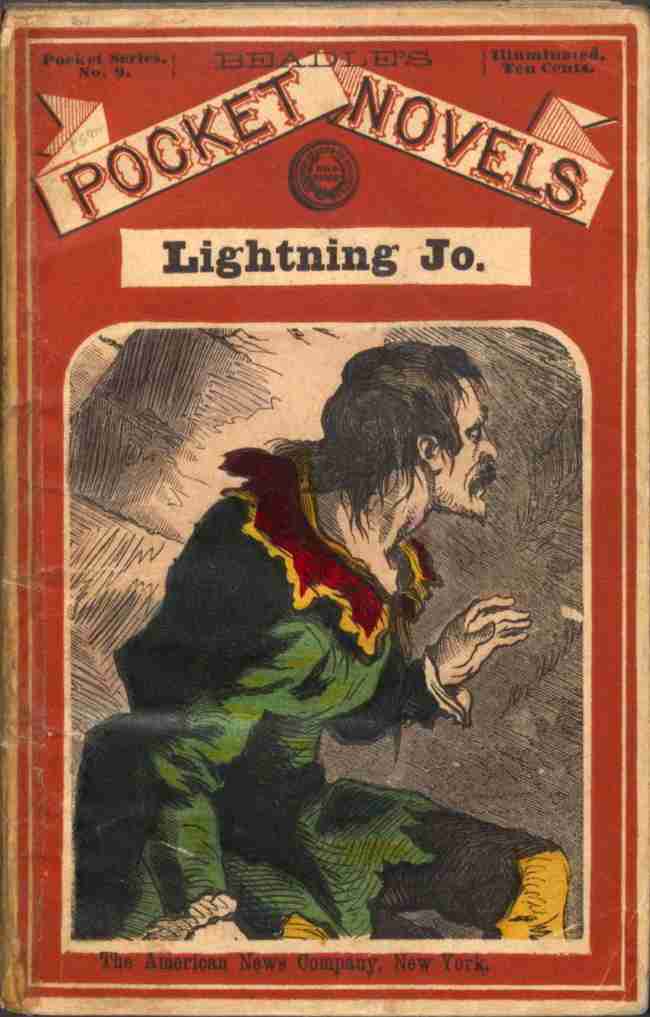
CHAPTER XX. A FEARFUL RIDE.
A dull, increasing roar, like the moaning of the Indian Sea, when the cyclone is being born, struck the ears of the whites, all of whom paused in their conversation and listened, wondering what it meant.
The horses showed signs of restlessness and fear, but they were held sternly in check, while the riders bent all their faculties into that of hearing; and by a common instinct, every eye was turned toward Lightning Jo, as if inquiring of him an explanation of the strange sound.
What the scout thought can only be conjectured; but there was a scared look upon his face that gave all the most gloomy forebodings, and they awaited his words and actions with an intensity of anxiety that can scarcely be described.
The roar, which now drowned every other sound, was like that made by the approaching train, and it had that awful element of terror which comes over one when he feels that a peril is bearing swiftly down upon him from which there is no escape.
“Onto your hosses, every one of you! Cut ’em loose from the wagons, and don’t wait a minute!”
The voice of Lightning Jo rung out like a trumpet and was obeyed on the instant, while by another imperious command of his, the women and children were taken upon the backs of the animals in front of the hunters.
Quickly as all this was done, it was not a moment too soon. In reply to the questioning looks of his friends, the scout pointed up the ravine in the direction whence they had come.
At first sight, there seemed to be a mass of discolored snow spinning down the canon; but the next moment all knew that it was the foam and spray of water, rushing down upon them with the impetuosity of a Niagara.
“Hold fast!” called out Jo; “but there’s no use trying to fight it!”
Even while the words were in his mouth, the appalling torrent came upon them!
There was a blinding dash of spray and mist, and then every horse, with its rider, was carried as quick as a flash off his feet, and shot down the canon like a meteor.
Egbert Rodman, the moment he realized the nature of the danger, reached forward and caught the hand of Lizzie Manning, intending to place her upon the horse, in front of him, as many of the other scouts had done; but ere he could accomplish the transfer, the shock was upon them, and in the stunning, bewildering crash, he was only sensible of going forward with tremendous velocity, down the canon, among his friends, who were all impelled onward by the same resistless force, that made them, for the time, like bits of driftwood heaped in the vortex of the great maelstrom.
“Lizzie! where are you?” he called out, in his agony, groping blindly about him in the tornado of mist, and driftwood, and water; “reach out your hand that I may save you!”
He heard something like an answering cry; but in the rush and whirl, he could not tell the direction nor the point whence it came; and had he known that only a half-dozen feet separated them, it was no more in his power to pass the chasm than it was for him to turn and make headway against the chute that was carrying every thing before it with an inconceivable velocity.
It would be impossible to describe the appalling scene in the canon. Those who lived to tell of it, in after years, shuddered at its recollection and declared that its terror was greater than any through which they had ever passed. The little group who sat waiting and conversing upon their horses had scarcely been caught up and shot forward, when the gloom of the approaching night deepened to that of the most intense, inky blackness, so that no man, speaking literally, could have seen his hand before his face.
It would have made no difference had it been high noon, so far as the question of helping themselves was concerned, although it might have lessened in some degree that shuddering, shivering dread that possessed all, under the expectation every moment of being dashed to fragments against the projecting rocks, or crushed by the debris that was carried tumultuously forward in the rush and whirl of the waters.
“Stick to your hosses, and take things easy!”
The voice of Lightning Jo seemed to come from a point a thousand yards away—whether above or below could not be told by the sound; but all knew that he was somewhere in the torrent, and there was something reassuring in the sound of his ringing voice in this general pandemonium of disaster and death. It encouraged more than one despairing and helpless, and they clung the more tightly and took some courage and hope.
“Jo, can you hear my voice?” called out Egbert Rodman, with the whole strength of his lungs.
“I reckon so,” came back the instant answer.
“Tell me, then, whether you have Lizzie with you, or whether you know where she is.”
“No; can’t tell; thought you and her were together. We’ll fetch up somewhere purty soon—daylight will come in the course of a week—and then we’ll hunt for each other. No use till then—so you keep your mouth shet, and look out that you don’t get your head cracked.”
These seemed heartless words to Egbert; but they were really dictated by prudence and common sense, and he acted upon the advice, so far as it concerned the questioning of the scout.
The mustang of our young friend was swimming as well as he could down the chute, striving only to keep himself afloat. His body was beneath the water, his nose and head only appearing above. Up to this time Egbert had maintained his place upon his back, himself sinking of course to the armpits; but when he heard the warning words of Lightning Jo, he understood how the projecting point of some jagged rock might pass over his animal’s head, and crush his own.
Accordingly he quietly slipped back over the animal’s haunches, and submerging himself to his ears, held on to the tail of the animal, in a position of greater safety—if such a thing as safety can be named in reference to the party caught by the torrent in the canon.
Egbert had scarcely adopted this precautionary measure, when he had reason to thank Lightning Jo for the timely warning.
Something grazed the top of his head, like the whiz of a cannon-ball, proving with what amazing velocity he was shooting down the canon.
“How can any one get out of this horrible place alive?” was the question he asked, as he realized the narrowness of his escape. “We must all be shattered to pieces before going much further. Ah!—”
Just then a wild cry rung out above the din and roar of the waters—the cry of a strong man in his last agony. Driven as if by a columbiad against some flinty projection, he had only time to make the shriek as the breath was driven from his body.
As this spinning downward through the chasm continued for several moments, Egbert endeavored to collect his senses and to think more clearly upon his terrible position.
He was morally certain that a number of the party had already lost their lives, and a twinge of anguish shot through his heart as he reflected upon the females and the tender children exposed to this perilous war of elements. And then, too, the wagon containing the remains of those who had fought so gallantly in Dead Man’s Gulch—what a ghastly fate had overtaken them! It seemed, indeed, as if nature had joined with man in heaping unimagined horrors upon the heads of the weak and defenseless, and that nothing remained but to await shudderingly the fate that could not be postponed much longer.
But amid the rack and turmoil and swirl of the canon, the thought of his beloved Lizzie Manning would present itself, and he could not help wondering, doubting, fearing and hoping all in the same breath.
Was she living and had she survived the ordeal uninjured up to this time? Or had her gentle nature succumbed at the first shock? She had proven herself a heroine in Dead Man’s Gulch, and was she equal to this? If still living, how much longer could she bear the strain upon her system?
But ere Egbert Rodman could conjecture any replies to these questions, he was called upon to make a still more desperate fight for his own life.
His mustang, encountering some obstruction, made such a sudden, furious plunge, that his tail was drawn from the loose grasp of Egbert, who, aiming to renew it, clutched vaguely in the darkness and was unable to reach his faithful animal. He could hear him floundering and neighing close at hand, but there was no use of attempting to reach him, and he called to the horse, in the hope that he would succeed in making his way to him; but he was disappointed in this also, for the noise of the struggles speedily ceased, and he concluded that the faithful animal was dead.
Rather curiously the young man had clung to his rifle ever since he was caught by the water tornado, and now that he was somewhat cooler and more collected, he resolved that nothing but “death should them part.” It was troublesome to swim with it grasped in one hand, but he was quite able to do it, where the current possessed such extraordinary velocity, and he moved forward with little effort on his part.
All this passed in a tenth part of the time taken by us in writing it, and Egbert Rodman had scarcely gained a connected idea of what was going on, when he made the discovery that the channel through which he had been dashed was widening and considerably decreasing. The deafening crash that had been in his ears from the moment he was carried off his feet, now sunk to a dull noise, proving that he had emerged from the canon, and was floating over what might be termed a lake—caused, undoubtedly, by the widening of the pass through which Lightning Jo had attempted to guide the little party, with its two wagons.
With this discovery of the comparative calmness of the water, came, for the first time, something like returning hope to Egbert Rodman, who, feeling confident that there must be a tenable foothold at no great distance, began swimming forward regularly, so as to avoid being carried around in a circle.
Of course such a basin as this must have an outlet as well as an inlet, and it was his purpose to prevent himself being carried away into another similar canon, from which it was hardly possible to make such an escape over again.
This required severe effort, but happily it was accomplished sooner than was expected. While swimming vigorously forward, his feet touched bottom, and although scarcely able to maintain his foothold, yet by using arms and legs and grasping some branches that brushed his face, he succeeded in drawing himself out upon land, and found himself free from the flood.
“Saved at last, and thank God for it!” was his fervent ejaculation. “But what of the rest?—what of the women and children? and Lizzie—where can she be?”
All was of inky darkness about him, and he hardly dared to move for fear of plunging himself into some inextricable pitfall. Only by feeling every foot of the way as he advanced, did he manage to get away from the immediate neighborhood of the din and rush of waters.
Sinking down upon his knees, he crept along for some distance in this manner, until, as near as he could judge, he was in a sort of valley or ravine, much broader than the one in which he and his friends had been overwhelmed by the flood, and which seemed to have escaped the rush of water that had been driven through that.
Finding that it remained comparatively level, he finally rose to his feet again and advanced with more speed, but at the same time, with the caution due such a critical situation.
The wind was still blowing with a desolate, wailing sound, but the rain had ceased entirely; and the night, pitchy dark and cold, could not have been more desolate and cheerless.
“Halloa!” suddenly exclaimed the astonished Egbert, “yonder is a light as sure as the world! Who can be camping out to-night? Be he friend or foe, I must find out.”
With this resolution he started toward the star-like beacon.
CHAPTER XXI. THE LONELY CAMP-FIRE.
The twinkling light of a camp-fire at such a time as this, and in such a place, was enough to make any one cautious, and Egbert Rodman approached it as stealthily as a Comanche would have done himself.
He was somewhat surprised when yet some distance away to observe that there was a single person sitting near it, in the attitude either of deep meditation or intense listening.
“There must be others close at hand, or else he is not aware of the danger he runs,” muttered the young man, as he continued his advance. “Strange, but there is something about him that reminds me of Lightning Jo; and,” he added, the next moment, “Lightning Jo it is; helloa! old fellow, how came you here?”
And forgetful of all else for the time, except his delight in seeing the true and tried comrade, Egbert Rodman rushed forward to give him appropriate greeting.
He saw at once that something was the matter with the scout. He was sitting upon a large stone, with his rifle between his knees, and supporting his chin, was looking absently into the fire, like one whose thoughts were entirely removed from his present surroundings. He merely looked up at the spontaneous greeting of the young friend from whom he had become separated some time before, and staring at him for a moment, again lowered his gaze without saying a word or shifting his position.
But, if he was in a sullen, thoughtful mood, Egbert was not, nor did he intend to keep any prolonged silence in deference to such a whim. He believed he understood the scout well enough to know how to approach him, and in a cheery manner, free from any rude familiarity, he placed himself beside him, and touching his shoulder, said:
“Come, Jo, don’t sit idle here. You seem to be depressed; but rally, and tell me what the matter is.”
The scout seemed to appreciate the consideration shown him, and straightening up, he heaved a great sigh, looked fixedly at his young friend again, but still refused to speak. Egbert was determined to press the matter.
“What is it that troubles you, Jo? Come, out with it; what are you thinking about?”
“Little Lizzie Manning!” was the reply of the scout, in a voice that was sepulchral in its solemnity.
The shaft of a Comanche’s poisoned arrow, driven to the heart of Egbert Rodman, could not have startled him more than did this reply. He gave a gasp as if of pain, and almost fell to the earth, before he could compose himself sufficiently to sit down and collect his thoughts. When he did so, he looked across from the opposite side of the camp-fire, and asked, pleadingly:
“What about her, Jo? Is she living or dead? Can you tell me what has become of her? Don’t keep me in suspense!”
“You didn’t seem in quite so much suspense a little while ago,” he remarked, somewhat resentfully; and then, as if regretting the words, he hastened to add, in a more considerate voice:
“That’s just the trouble, Roddy; you know when the fresh came, we hadn’t any time to look after each other, but we went spinning down the kenyon as if Old Nick was arter us. I heerd you yell, and of course you heerd my answer, but there wasn’t much to be seen then, and so we each kept on sailing on our own hook.”
“But Lizzie! Did you hear nothing of her?” inquired the breathless lover.
“Yes; I did hear her,” replied Jo, with another sigh; “some time arter that I heerd her call out somebody’s name.”
“Whose was it?” asked Egbert, with a painful throb of his heart, and a staring, eager look that brought a wan smile to the face of Jo for the instant, but passing instantly as he made answer:
“As near as I could make out, it was your’n. In course you didn’t hear it, but as I did, I called back to her, and she know’d me on the instant. I axed her how she was fixed, and she said she was on the back of her horse, but had no idea where she was going, or how it was possible for her to get out of this scrape. You can understand that it wasn’t very easy to gabble at such a time, with the roar of the kenyon in your ears. I told her to hang on to her hoss, no matter where he went, and there was a chance of her getting through somewhere. At the same time I didn’t think there was much chance of any one ever coming out of that place alive. I could tell by the sound of the gal’s voice that she wasn’t very far away, and I worked as never a poor wretch worked before to get to her. I tired my hoss out, and when we got down to that ’ere lake, or whatever you’re a mind to call it, I struck out fer myself. The minute I left the mustang, I sung out to her, but I didn’t hear any answer. I yelled ag’in and ag’in, but it warn’t no use, and I swum ashore and made up my mind—well, no—confound it,” added the scout, fretfully, “I haven’t made up my mind, either, that the little gal has been drowned, and we ain’t never more to hear her sweet voice. That’s what I’ve been feeling, and what I was thinking about when you come sneaking up so sly that you thought nobody could hear you.”
“You think, then, that there is a possibility that she may have escaped, after all?”
“Well, there’s the trouble,” returned Lightning Jo, with something of his old familiar look. “When I set to thinking about it, I can’t see any way under heaven by which she could have come out alive, and I s’pose I couldn’t have seen any way how you folks were ever to get out of Dead Man’s Gulch, if I could have knowed how things were there. It is mighty hard, and you feel it, too, if you thought half as much of that little gal as I do.”
Poor Egbert was inexpressibly shocked at this remark, and looked reprovingly at the scout. He made no reply and assumed a thoughtful attitude upon the other side of the small camp-fire; but just then the scout roused up.
“Confound it! what’s the use! I ain’t going to make a fool of myself! This will never do!”
And stretching and yawning, he suddenly raised his voice, and emitted his peculiar yell, that rung among and through the rocks, gorges and ravines with a power that must have carried it a long distance over the prairie.
“What in the name of heaven do you mean by that?” asked the astonished Rodman, suspecting that he was out of his head.
“Some of the poor dogs may have managed to crawl out as did you, and that’ll tell them where to look for me. What do you s’pose I kindled this fire for?”
“To dry your clothes and keep the chill off.”
“Not a bit of it; the night ain’t cold, and there’s nothing in damp clothes that you or I need mind. If it hadn’t been fur these sticks burning, you’d never have found your way here, and it may do the same for others. No, Roddy,” said Jo, in a more natural voice, “we’ve got nothin’ to do but to wait where we are till morning. Then we’ll take our reckoning, and make a search for the gal.”
“And never give up till we find her, dead or alive,” added Egbert, in a low, earnest voice.
“That’s the style. I’m with you there. I s’pose you feel a little hungry and tired?”
“I have hardly had time to think of such a thing as hunger, while I have become sensible of the weariness only after seating myself here—wondering all the time how it was you managed to have such a fire in so short a time.”
“No trouble ’bout that; you see I come down ahead of all the rest, and I wa’n’t in the basin two seconds afore I paddled out. I’ve been in these hills so often before that I know ’em purty well, but there was a little too much darkness for me to make out where I was. I pitched over a half-dozen precipices something less than a mile high, and finally lit here. It wa’n’t any trouble to start a fire, as this rain was a quick and not a soaking one. Falling right on the top of things, it floated off, and I found all the dried leaves I wanted; and after they was started the rest was easy enough.”
It came out further, that overwhelmingly sudden as was the flood that overtook them in the canon, it had not found Lightning Jo unprepared. His rifle was securely “corked” at the muzzle, so as to keep out the water, and his ammunition and a quantity of matches were all preserved in waterproof casings, so that, barring the saturation of his garments, he came out of the terrible bath as well as he went in.
True he had parted from his horse, but that cost him scarcely a thought. The mustang was so well trained that if he succeeded in escaping with his own life, he would manage to find his master with little difficulty; and, in case he had perished, there was no dearth of animals in the West, and there was little fear of Lightning Jo suffering long for such a part of his outfit as a horse.
As Egbert saw his companion heap more fuel on the fire, he could not avoid the thought that he was incurring great risk thereby, as both of them were rendered the best of targets for any skulking foe.
There were trees growing around, most of them of a stunted nature—but the light of the fire could be seen for quite a distance through the hills. The night-wind soughed with a dull, desolate wailing, through the branches, and the roar of the canon sounded distant and faint, growing less every hour, and proving that it was being emptied as rapidly as it was filled.
Finally Egbert Rodman could not forbear asking the question:
“Is there nothing to be feared in the shape of Indians, Jo?”
“No; there’s none here, except—except that Thing that you saw on his hoss. Didn’t I tell you that his coming was to give us notice that something else was coming, and it was on us afore we knowed it. It’s always so.”
“Then you have seen it before?” asked Egbert, who was rather curious to hear what the scout had to say about the creature, which certainly had caused him no little wonderment since he had first set eyes upon it.
“I should think I had,” was the reply, in a hurried voice. “It’s five years since I first heard of it, though Kit Carson did tell me something about some such thing as that being seen in the Apache country more than ten years ago. But the chap that told me was the only one that was left out of an emigrant party of over twenty. He said it come up to their camp one night just as the sun was setting, and arter looking at them for a few minutes rode away at a gallop, and it wa’n’t two hours afore the red-skins was down upon ’em.”
“Is its appearance always the same?”
“I b’l’eve it is, but I ain’t sart’in. Leastways, I could never see any thing different. It always had the blanket thrown over it, and its head was as black as a stack of black cats. The first time I run ag’in’ it was down in the Staked Plain, where a party of us were arter a lot of Comanches that had made a raid on one of the settlements near the Texan frontier. I remember there was a kind of a drizzling rain falling and we was smoking our pipes, with our blankets drawn up round our chins, when the critter rode down on us, and stopped jist as he did with you. There was four of us that blazed away at him, each one aiming at the spot where his heart would have been had he been like other animals; and, when his horse turned about and galloped away with him, without his showing the least oneasiness, you can make up your mind that we was slightly surprised. There was several of us that heard of the Terror of the Prairie, as he is called by some, and we concluded that this was the gentleman, and that a row was sure to take place; so we made ready for ’em, and we had one of the tallest scrimmages that night that any of us ever got mixed up in; but you see we was used to that sort of business, and it wasn’t good policy for the Terror to come down on us and tell us to make ready. We was a little too much ready, and the red-skins got a little more than they counted on. We riddled a dozen of ’em, and got away without losing a man or a hoss, though most of us have got scars that were made in that muss.”
“Wal,” added Jo, “I won’t take time to tell all I know ’bout that critter, which ain’t much, ’cept in the way he has played the mischief round the country. I s’pose when he took a look at you down in the gulch, it meant that he and his folks was coming to visit you, and we got there just ahead of ’em.”
“Captain Shields seemed to know nothing about him, at least he told nothing of what you have just described.”
“Shields was in that party down on the Staked Plain, and got two bullets in him, that he carries to this day: so I reckon he does know something, arter all.”
“And he is somewhere in our neighborhood, unless he has taken a sudden departure.”
“Yes,” added Lightning Jo, in a husky whisper, and with a wild, scared look; “and he ain’t fifty feet from where you’re setting this minute.”
CHAPTER XXII. THOSE WHO ESCAPED.
At this startling announcement Egbert Rodman sprung to his feet, with a bound that carried him entirely over the fire, striking Lightning Jo with such sudden violence as to throw him backward almost flat upon the ground.
“What in thunder is the matter?” exclaimed the scout, laughing outright as he regained his seat; “did he prick you?”
The young man was not looking at Jo, but backward in the gloom, in which he discerned the unmistakable outlines of the terrible nondescript, known as the Terror of the Prairie. It was but a glance that he gained; for, while he looked, it began silently retreating into the gloom, like a phantom born and sent forth by the night, and returning again to its natural element.
Like a flash, Egbert raised his gun, pointed toward the point where it had vanished, and pulled the trigger; but the percussion exploded without firing the charge that had been wetted, during its rush through the swollen canon.
“Never mind,” remarked Jo, with a laugh, “it done jist as much good as if you had fired it; so rest easy on that score.”
“You needn’t tell me that,” was the dogged return of Egbert, “every living creature has some vulnerable point, and that is no exception.”
“All right; if you want to make yourself famous jist find the spot, and pop in a bullet there. Howsumever there always are some folks that think they know more nor others, and p’r’aps they do, and then p’r’aps ag’in they don’t.”
Egbert felt a little irritated at the taunting words of the scout—which irritation was doubtless increased by the keen sense he had of the rather ridiculous figure he had just made; but there was no use of showing any resentment toward Lightning Jo; and, resuming his seat, he began withdrawing the damaged charge from his gun. When sufficiently composed, he asked the rather singular question:
“How many times do you suppose you have fired at this thing, Jo?”
“I don’t know exactly; the first shot told me that it warn’t any use; but I s’pose I’ve let fly at him a half-dozen times more nor less, and I’ve seen five times as many balls sent after him by others. What do you want to know that for?”
“In all these cases did you aim at any particular portion of the animal—his head or his body?”
“We always p’inted our bull-dogs at the spot where his heart would be reached—that is, providing he had any to reach.”
“That proves beyond a doubt that the Terror can not be killed in that manner. How is it that you never aimed at his head?”
Lightning Jo seemed to be surprised at this question, and stared rather wonderingly at Egbert, before he replied:
“Hanged if I know what the reason is. You know it’s the custom among us chaps to aim at the heart instead of the head, the same as we do in a buffalo, ’cause you’re surer of wiping out the critter there than anywhere else. There’s more than one critter that walks the airth that wouldn’t mind a volley in the head, more than they would so many raindrops.”
“Very well then; the next time you or I shoot at him we’ll send the bullet into his head, and then, if he don’t mind that, I’ll be inclined to think there is something strange about it.”
“You will, eh?” replied Jo, with a grunt; “that’s very kind in you, and I hope you won’t forget it.”
“As you say the appearance of the Prairie Terror is always a sure omen of coming disaster, what, in your opinion, does its coming foretell in the present instance? What additional calamity is about to overtake us?”
“We’ll l’arn that afore long; there ain’t any use trying to find out. All I care to find out is what has become of Lizzie, and as soon as the first streak of daylight comes I’m going to find out whether she’s in the land of the living or not.”
The heart of Egbert said “amen” to this, and his prayer was that the long, desolate night might hurry by, and the opportunity come for them to do something together for unraveling the fate of the maiden, for whom both entertained the strongest affection.
Egbert, at the advice of the scout, attempted to sleep—but he had too much on his mind to succeed in doing so. His draggling garments did not give him special discomfort, as the night was only moderately cool and Jo kept the fire burning quite vigorously.
But between his sad forebodings of the fate of Lizzie, whom he seemed to love with a devotion such as had never permeated his being before, and the haunting fear of another visit from the Terror of the Prairie, there was little likelihood of his falling asleep.
The strange tales that the scout had told him of this remarkable creature, and of his extraordinary meetings with him, produced their effect upon Egbert, who, although of a practical nature, with an intelligent mind, was not without a certain imagination, peculiar to those of his age, which made him susceptible to the influences of the time and the place and his surroundings.
The roar of the rushing canon had died out entirely, and probably that very part over which the whites, men, women and animals, had been carried with such tremendous velocity, was now almost entirely dry again. Through the matted, overhanging branches Egbert caught the glimmer of several stars, showing that the storm had cleared away entirely. There was no moon, however, and, in the valley in which they had encamped, the darkness was so profound as to be absolutely impenetrable beyond the circle illuminated by the camp-fire.
Young Rodman found the suspense so intolerable, that he proposed that they should leave this spot and wander among the hills until daylight. He believed that they would encounter some of the survivors, and possibly might learn something regarding Lizzie, who might be in need of the very assistance that would thus be afforded her.
But Lightning Jo had made up his mind to remain where he was, and no persuasion could induce him to change his location. He declared that he could accomplish nothing by stumbling around in the dark, while Egbert would be pretty certain to break his neck in some of the pitfalls that were to be encountered at every step.
And without attempting to depict the dismal expedients which the wretched lover resorted to, to while away the unspeakably dreary hours, we now hasten forward to the moment when the unmistakable light of morning stole through the hills, and Lightning Jo, springing to his feet, declared that the moment had come when the terrible suspense was to end, and they were soon to learn the worst that had happened to the party and to the one dear one—Lizzie Manning.
The first point toward which the two directed their steps was the canon, through which they had had their memorable passage. This was but a short distance away, and, upon being reached, it was found as they had anticipated, entirely clear of running water. Here and there were muddy, stagnant pools collected in the hollows and cavities, but nothing of any living person, or animal, or debris of wagons, was discerned.
“Had we not better descend and follow the canon to the outlet?” asked Egbert. “We shall not miss any thing then on the way.”
Lightning Jo acted upon the suggestion, and after a little searching for a safe means of descent, the bottom was reached, and they pursued their way in silence, agitated by strange emotions, as they recalled the memorable experience of a few nights before.
They walked side by side, neither breaking the impressive stillness by a word, but carefully scanning every foot of ground passed in quest of some remnant of those who had been their companions in the terrible descent.
Suddenly the scout pointed to a wagon-wheel that was driven in between two jutting points of rocks, where it had been immovably fixed by the tremendous momentum.
Both scanned it a few minutes, and, seeing nothing more, passed on for fully a quarter of a mile, when the basin to which reference has been made was reached, and here a great surprise awaited them.
It being quite shallow, the water had been carried away by several outlets, and not a man had been borne beyond. Fragments of the wagons were scattered in every direction, and at one side of the dry lake were to be seen Captain Shields, Gibbons and a number of the men covering up a large grave, while seated around were several women with their children, as miserable and desolate-looking objects as could possibly be imagined.
Not having dared to hope that so many could have escaped, the two paused in mute silence and stared at them, their looks after the first startling shock being directed in anxious quest of the one—Lizzie Manning—a look that was unrewarded by a sight of the beautiful maiden, for whom both were ready to do and dare any thing.
Still hoping that she might be somewhere in the vicinity, they hurried forward and put the all-important question.
Sad to say, no living person had seen her or knew aught regarding her.
And then their own sad story was told. All, of course, had been hurried irresistibly into this basin—some bruised, and almost senseless. Three of the men were killed, and also a mother and her two children. The ghastly cargo of the wagon, containing the remains of those who had fallen in the fight in Dead Man’s Gulch, was also there. The soldiers, who had charge of the women and children, clung bravely to them, and the shallowness of the water enabling the horses to touch bottom almost immediately, they were not long in floundering out upon dry land, where the miserable group huddled together until the coming of day should enable them to see where they were, and to do what was possible for themselves.
When the dawn of light showed them the dreadful number of inanimate bodies, their first proceeding was to give them a decent burial, as it was out of the question to think of taking them to Fort Adams after the destruction of the wagons. And so, from the contents of the wagons, lying everywhere, they gathered up a half-dozen shovels, and as many men went to work with such a vigor and skill that in a few minutes a large, shallow grave was dug, and into this all were tenderly placed and covered up from mortal sight, all shedding tears of the deepest sorrow over the terrible death that had been decreed by inexorable fate.
While they were thus employed, others were absent among the hills in quest of the mustangs, and Jo and Egbert had exchanged but a few words with their friends, when they began coming in with the animals, that were all browsing at no great distance.
Their purpose was to mount the horses as speedily as possible, and to make all haste to Fort Adams. The women and children were in a deplorable condition and needed care and a rest of several days before continuing their journey to Santa Fe.
When this proposal was mentioned to Lightning Jo, he indorsed it at once, telling them to lose not a moment. They had not a particle of eatable food in their possession, and it was extremely difficult to procure any in these hills, which, rather singularly, were known to have been for years almost entirely devoid of game of any description. Consequently, as nothing at all was to be gained by remaining here, the dictate of prudence was that they should depart at the very moment they could make ready.
As a matter of course, Lizzie Manning was among the first that was missed by the group that huddled on the banks of the basin, and so great was the concern regarding her that during the darkness Captain Shields and two of the men groped around the neighborhood in quest of her, calling her name and searching along the shore of the basin for hours. The search was made more extended and thorough, when they had the daylight at their command, but it resulted in an entire failure. Not the least trace was gained, either of her or of the horse which she was known to be riding.
One of the men who had helped to bring in the mustangs took occasion to tell Lightning Jo, in a confidential way, that he had detected signs of Indians, and he believed there was quite a number among the hills, and that it was impossible that they should know nothing of the presence of the whites so near them.
This information surprised the scout and caused him no little uneasiness. He questioned the soldier closely, and became convinced that he was right, and that the whole company were in great danger of attack. Under these circumstances, he took it in hand himself, and told them all of the urgency of haste in reaching their destination.
Scarcely fifteen minutes had passed when every man was upon his mustang, and the females, with their offspring, were distributed among them. Lightning Jo and Egbert Rodman placed themselves at their head, and the scout cautiously led the way through another narrow pass for something like a quarter of a mile, when they reached the open prairie once more.
“And now go,” he added, “and never pause or look back until you ride into the stockade of Fort Adams.”
And his advice was taken and followed almost to the letter; but, even then it is impossible to imagine whether they would have succeeded in reaching the shelter after all without being harassed by the Comanches, but for the fact that ere they had gone three miles they met a party of rescue sent out by Colonel Cleaves, who had become alarmed at their failure to come in during the night. Under the escort of this powerful company of cavalry, the journey was completed in safety, and we now bid them good-by at the friendly fort and turn our attention to those in whom we have a more immediate interest.
CHAPTER XXIII. COMANCHE HONOR.
With the departure of Captain Shields and his party, Lightning Jo and Egbert Rodman set about the task of trailing the missing maiden, if such a proceeding lay within the range of human possibility.
There was something strange and mysterious in this failure upon the part of all to discover any traces of her or her horse. Had both or either of them been dead, this scarcely could have been the case. Every member of the party, excepting herself, had been accounted for, and was either buried in the quiet grave among the hills or else was within the stockade of Fort Adams, beyond the reach of the Comanches in the South-west.
“Where can she be?”
This was the question that the two men put to each other and to themselves a score of times in as many minutes, and to which no satisfactory answer could be given. All was conjecture, and even that was of the most vague nature.
Lightning Jo had very little to say, but he was in deep thought as he moved morbidly about, with his eyes upon the ground, seeking out some clue by which he might take up the hunt for Lizzie, with some slight probability at least of success.
There were two facts which were constantly recurring to Egbert Rodman, and which caused him an apprehension positively tormenting. The Terror of the Prairie had been seen by himself and Lightning Jo but a few hours before, at no great distance from where they were standing at that moment, and he could not avoid connecting this with the disappearance of the maiden. Precisely in what way, it was hard for him to define, but he was convinced beyond a doubt that the two bore some relation to each other.
Furthermore, the declaration of Lightning Jo that the appearance of this nondescript boded coming calamity might be said to have been verified in the present instance; for quickly on the heels of its vanishment came the knowledge of the disappearance of Lizzie and the presence of Comanches in these hills, proving the closeness of the connection between the two. The loss of the maiden to whom his heart clung with such yearning devotion was certainly the greatest calamity that had as yet befallen young Rodman, and he involuntarily shuddered as he recalled that awful ride down the canon, followed as it had been in the case of Lizzie by some after experience, that was all the more appalling to her friends, inasmuch as they knew nothing positive of its nature and could only indulge in the wildest conjecture.
The only thing that afforded any thing like relief or consolation to the lover was the fact that he had the companionship and assistance of Lightning Jo in this search. Whatever was possible to be done for her rescue and safety by mortal man would be done by this wonderful scout, who was already busy making ready, and fully satisfying himself before he fairly started to work in the matter.
Every thing indicated that the two men could not remain long in these hills—for, aside from the fact that the demands of hunger could not be postponed for a much longer period, the probability began to present itself, that the girl was also gone from the vicinity.
“Do you not think it likely,” inquired Egbert, when his comrade paused for a moment, “that when she emerged from the basin, as she did do, that she has managed to reach some hiding-place among the rocks, where she still remains—perhaps asleep?”
This possibility seemed to have been entertained already by the scout, who instantly shook his head in the negative.
“If she’d have done that, some of the boys would have come across her hoss, for he would have managed to get himself into the company of the other mustangs, and would have been seen by them, in looking for the others.”
“But there are our own animals yet; we have seen nothing of them.”
“But the boys did; they told me they see’d ’em both, and I’ll have my critter in sight in less’n two minutes; see if I don’t.”
As he spoke, he uttered a low, quavering whistle, not very loud, but sufficiently so to be heard a distance of several hundred yards. Then pausing a moment he repeated the signal in precisely the same manner, and added, in his way:
“That animal will be here, if he’s got forty Comanches trying to hold him.”
“I only wish I could recover mine so easily,” laughed Egbert, as the scout composedly sat down upon a large stone to await the coming of his faithful mustang, “but I am afraid Mahomet must go to the mountain in my case.”
“When I parted company with mine last night, the understanding was that he was to go off and hunt a little something to eat on his own hook, and he expected to be told when I wanted him.”
“And knowing that he will obey like an obedient child.”
“Exactly—there he comes this minute,” replied Jo, as the tread of some animal was heard but a short distance away.
“Look out, Jo, that it is nothing else,” warned Egbert, stepping back, so as to give the scout free room for whatever might come.
“I know his footstep,” was the response to this, accompanied at the same time by a precautionary movement, consisting in the guide raising the hammer of his rifle and bringing it to the front, where he could discharge it, if necessary, with the quickness of lightning, posing himself at the same time upon one foot, so as to be prepared to leap forward or backward as the case might be.
This precaution had scarcely been taken, when the mustang of Lightning Jo put in an appearance, accompanied by a Comanche Indian, who, sitting astride of the sagacious beast, was in blissful ignorance of whither he was being carried.
His position was the quiet one of ease and self-possession, showing that he had no thought of any impending danger. From this fancied security he was awakened by the sight of Lightning Jo, standing scarcely a dozen feet away, with his rifle pointed full at his breast.
The mustang at a word from his master stopped short, and thus the red-skin was brought face to face with the man, whom he recognized on the instant as the most deadly foe of the Comanche race.
“Get off that hoss, you old galoot! he belongs to me. Slide mighty quick or I’ll slide you!”
The substance of this was uttered in the Comanche tongue, so as to make sure of its being understood, and the action of the red-skin demonstrated that he had no difficulty in comprehending it on the instant; for he slid off the back of the mustang as suddenly and nimbly as if it had all at once become red-hot beneath him.
The savage held a long, beautiful rifle in his hand, and he was evidently on the alert, either for a chance to use it or to dodge away from his captor.
Had the circumstances been any different, the marvelous quickness of the copper-skin doubtless would have enabled him to accomplish his treacherous wish; but neither he nor any living Indian could play it on Lightning Jo. If he thought he could, let him try it—that was all.
The scout wasn’t particular whether he made the attempt or not, as there could be but one result; but the moment the Comanche’s feet touched ground, he ordered him to approach within a half-dozen feet, and then drop his rifle to the earth. The red-skin showed some reluctance in obeying this; but when he caught the glitter of the dark eye fixed upon him, he changed his mind and carried out the command with an amusing alacrity.
“Where are the rest of you devils?” was the first rather pointed inquiry, uttered also in the Comanche tongue, and with the muzzle of the rifle pointed threateningly at the breast of the savage, who replied, with a gesture peculiarly his own:
“There are but a few among the hills—no more than so many (holding up the fingers of one hand); they are hunting for food; they will soon take their departure to join their brother-hunters far to the south.”
“It would be a thundering sight better if they’d all join each other down below,” was the conclusion of Jo, who continued his cross-examination:
“Have any gone away in the night? Did any of the Comanches depart before daybreak?”
“No; there were none here.”
The slight hesitancy, a certain peculiarity that accompanied this reply, convinced Jo, on the instant, that the Indian was telling a downright falsehood, and that, after all, he was gaining a slight clue to the trail of the missing maiden.
His conclusion was that there were a few Indians among the hills, but that the greater majority had left before daybreak. Precisely why they had done so was more than he could understand; but their departure unquestionably had something to do with the disappearance of Lizzie Manning.
Jo was rather abrupt in his questioning, for the next was the pointed demand:
“Tell me where the great chief, Swico-Cheque, is; I want to raise his hair.”
The look that crossed the coppery face of the savage said as plainly as words could have done, that he would have been extremely delighted to see the scout attempt such a thing.
“I don’t know where he is,” he replied, without any embarrassment in his manner; “he went away before the light came.”
There it was! the incautious Indian had let it out after all. Swico-Cheque had taken his departure with the band that went off in the stillness of the night.
The red-skin seemed entirely unaware of the slip he had made, and awaited the further questioning of his captor as the heroic martyr awaits the creeping up of the consuming blaze.
“I don’t know as I want any thing more of you,” remarked the scout, “so I guess you can travel. It would be hardly the thing to scalp you after I look you prisoner, though I’m sure you deserve it.”
This order was unexpected and surprising to the Indian, who stared a moment, as if uncertain that he had heard aright.
“Come, ’light out of this, old greaser!” added Jo, the next instant.
This was all-sufficient. The Comanche stooped down, and picking up his rifle, turned about with a certain dignity and walked slowly away, disdaining to run, although no doubt anxious to get out of that immediate neighborhood with as little delay as possible.
CHAPTER XXIV. A DESPERATE HOPE.
It was not the nature of Lightning Jo to remain idle when he had any work like the present on hand, and leaping upon the back of his mustang, he told Egbert to follow.
“I’m not going to ride and make you walk,” he laughed; “we haven’t started yet, but are only making ready. Come along.”
He rode scarcely a hundred yards through the roughest part of the hills, when he dismounted in a dense mass of undergrowth, and, without fastening his mustang, said a few words to him, which would insure his remaining where he was until his return, by which time Jo was quite confident that he could secure an animal also for Egbert, as it was indispensable that he should have one at once.
When it was certain that there were Indians in the immediate vicinity, the greatest caution was necessary upon the part of our two friends, and Lightning Jo made his way through the ravines, gorges and hills, with as much circumspection as if he were reconnoitering a Comanche camp. When he halted, they were on the very summit of one of the highest peaks of this spur of mountains, which afforded them a most extensive view of the surrounding prairie.
Glancing at Jo, Egbert saw that he was looking off to the westward, with an attentive, searching look that indicated something; and, as he did not remove his gaze from that point, he imitated him, straining his vision to the utmost.
The young man had looked but a moment, when he detected a party of horsemen moving in a southwesterly direction. They were so far away that it was impossible to identify them; but there was scarcely a doubt of their being Indians, and most probably the very ones for whom Lightning Jo was searching.
“Well, you see them, do you?” was the question of Jo, as he looked around and started to move away. “I s’pose you know ’em, too?”
“I suspect that they are Indians; but I conclude that not from any certain knowledge of my own, but simply infer it.”
“Yes; they’re the Comanches that left the hills before daylight. Swico-Cheque, the biggest red devil that walks the earth, is at their head. He’s got enough of butting his head ag’in’ United States soldiers, and he’s off to recruit his health.”
“But what of her—of Lizzie?” asked Egbert, in a trembling voice, dreading to hear the answer that he was almost sure would come.
“Why, she’s with him, of course. He’ll keep her till he gets tired of her, and then he’ll have some more fringe for his hunting-shirt.”
These words were uttered in the very desperation of vengefulness, and the scout wheeled about with a spiteful air, and exclaimed:
“Stay here till I come back! If you see any of the infarnal copper-skins, bore a hole through ’em. If you see anybody, break his head! Look out for yourself! keep cautious, and rest easy till I come back. I won’t be gone long.”
And with this rather contradictory advice, Lightning Jo wheeled about, plunged down the hill, and was gone almost on the instant.
He had been gone but a short time, when the near crack of a rifle broke the stillness, and Egbert started and looked around, thinking that, perhaps, some treacherous Comanche had stolen up and sent a bullet after him; but he could see nothing, and he concluded that Lightning Jo had something to do with the discharge of the gun, as, indeed, it seemed to have a certain familiar sound.
But little time was given him for speculation when the scout himself put in an appearance.
“Come, Roddy,” said he. “I’ve found your hoss; we’re ready now; and there’s no use in waiting longer.”
“Where did you find him?” asked Egbert, not a little surprised and delighted at the unexpected news.
“There was a red-skin on him; he ain’t there now, and I guess won’t bother us more.”
Sure enough, a few rods away, the identical steed which Egbert had ridden from Dead Man’s Gulch was found secured to a bush, and, leaping upon his back, it required but a few minutes for the two comrades to reach the spot where the faithful mustang of Lightning Jo was awaiting the return of his master.
“Now, let us get out of this infernal place,” added the scout, as the two reined up their animals, side by side.
“Whither do we direct our course?” asked Egbert.
“Straight after them devils, and we’re never to stop till we cotch up with Swico, and him and me square up our accounts.”
A little care and patience, and in a few minutes the two horsemen found themselves upon the edge of the prairie, and they headed due west, straight in the path taken by Swico-Cheque and his band, and the mustangs were instantly put to a full run.
About the middle of the forenoon, when the heroic Egbert felt that he was taxing himself beyond his strength, they struck a deserted camp, where a party of United States cavalry, ranging through the country upon a scout, had spent the previous night. Here were found the remains and fragments of their meal scattered all about, and it gave to both, what they so much needed—a nourishing, substantial meal.
“Now,” said he, straightening up like a giant refreshed with new wine, “I am ready for any thing, I don’t care what it is.”
“I think you’ll get enough of it afore long,” was the significant reply of Lightning Jo, adding, “we’re close onto the copper-skins, and if I ain’t mistook more than I ever was in my life, we’ll strike their camp inside of an hour.”
This was startling news, but was singularly verified; for scarcely a half-hour had passed when the scout, who was riding a short distance in advance, ascended a small swell of the prairie and almost the instant he reached the top, wheeled his mustang about and galloped back again, motioning to Egbert to do the same.
“We’ve reached their camp,” he said, in explanation, and cautioning the bewildered man to resist every temptation to stir a foot from the spot until his return, the scout moved up the prairie-swell again. Egbert saw him crouch down like a panther about to leap upon its prey, and then he vanished from view as noiselessly as a shadow, leaving the lover to the trying task of waiting, fearing, hoping, watching, listening, and to despair. Lightning Jo passed down the opposite side of the swell, and, as was his custom in reconnoitering the camp of a foe, he made a circuitous route by a small cluster of stunted trees, which struck him as offering the very shelter he so much needed.
He had no thought of any of his foes being here, but he had scarcely approached the margin when he became certain that he was close upon one or more of them.
In his stealthy manner he insinuated himself among the trees, and the next instant was greeted with the sight of the great Comanche chieftain, Swico-Cheque, reclining upon the ground in a sound slumber!
CHAPTER XXV. AT LAST.
Yes; there lay the great Comanche chieftain, Swico-Cheque, sunk into a heavy slumber—deep and profound—and yet of that character which would have required but the slightest noise to awake.
Lightning Jo paused in his creeping, stealthy movement, and stared at the savage, his own eyes gleaming with an exultation as ferocious as would have been that of the red-skin himself, had their relative positions been changed. The murderous and outrageous crimes of which this fiend had been guilty, his relentless war upon unoffending whites, his scores of murders of weak, defenseless women, and even the nursing babe, had placed him outside the pale of human mercy, and there was not a settler or soldier in the South-west who knew of his revolting character that did not feel that he deserved to be strangled to death, or put out of the way by any means that happened to present itself.
He had on, this moment, the very hunting-shirt to which reference has been made, fringed around with a broad band of human hair, from the long, dark, flowing tresses of the innocent virgin, to the light, silvery locks of prattling childhood. And his seamed face, daubed and smirched with paint, had the horrid look of that of some sleeping gorilla that had been feasting upon its human meal.
And yet in this moment of triumph, when Jo felt that he had him at last, there came a strange feeling to the scout, which can be understood, perhaps, by his whispered exclamations to himself.
“Confound it! it will look as if I was afeard of him, when I shouldn’t like any thing better than to have a fair stand-up fight. He might keep all the knives he wanted, and I would use nothing but my fists. How I should like to play some trick upon the infernal skunk!”
Ay! at this very time, when he had every thing to make him serious and thoughtful, there came a strange reaction over Jo, and an irresistible desire to play one of his practical jokes upon the Comanche. He concluded to wake him up to witness his own demise—but to arouse him in an original fashion.
It was a delicate task; but with that skill for which the scout was noted, he drew out his flask and poured out a stream of powder, moving the flask along from a point on the ground directly beside the Comanche’s ear, for several feet away—the particles all being united, so that the connection was perfect. Then, when every thing was safe, Jo drew a lucifer from the little safe he always carried about him, and struck it upon the bottom of his foot. As it ignited he held the blaze close to the black grains, and then spoke:
“Swico, my own loved cherub—”
This was enough; these words were barely uttered, when his snaky eyes opened, just in time to see a serpentine line of fire rushing toward him, and going off in a big puff directly under his ear, in a way that scorched his face and caused him to leap to his feet, with a howl, followed by an instant rush out from among the trees. He had caught a glimpse of his old enemy through the whizzing, and he was gone like a shot.
This was unexpected by Jo, who had hoped that he would maintain his ground, and the two would have fought out their fight on the spot. He did not anticipate any such flight as this, which was made so suddenly that he had no time to interfere ere he was gone.
The scout had the intense chagrin, also, of feeling that his propensity for waggery had led into a piece of foolishness that most likely would militate against the captive Lizzie. Knowing that she had one friend, at least, so near at hand, they would be sure to adopt greater precautions, and instead of waiting to be attacked by Lightning Jo, would, most probably, attack him.
And acting upon this supposition, he backed out as speedily as possible, and resumed his circuitous approach to the camp-fire of the Comanches—the locality of which up to this time, he had been able to determine only by the smoke that rose from the opposite side of a small ridge several rods away.
But the chief, Swico-Cheque, suspecting that a large party of United States cavalry were upon his heels, concluded that the safest plan for him was to get away with as little delay as possible, to accomplish which he sent back several of his warriors to dispose of Lightning Jo, and to keep the rest in check until he could secure his retreat with his prize.
Consequently the scout had stolen along over the broken ground but a rod or two when he found himself face to face with a couple of herculean warriors, who, approaching the cluster of trees in the same cautious manner, encountered the great Indian-fighter sooner than was anticipated by either party.
“That’s good!” exclaimed Jo, “for now I will get warmed up to business. I’ll try a left-hander straight from the shoulder upon this chap, and a right upon t’other.”
The terrific blows were simultaneous with the conclusion, the startled red-skins turning back summersets upon the ground, where, with an incredible celerity, the frightful bowie-knife, which Jo whipped out from behind his neck, completed the ghastly work.
“Ain’t there any more?” he growled, glaring like a wild beast thirsting for prey. “By heavens, if they don’t come to me, I’ll go to them!”
And he was striding directly toward the camp of the Comanches, but, ere he could advance half-way, who should leap into view but young Egbert Rodman, his face white and scared, and panting from excitement and the great exertions he had made to find his companion.
“Oh, Jo! there’s something wrong!” he gasped; “the Comanches are fooling us both, and we shall not get Lizzie after all.”
“What’s up? What’s the matter?” demanded the scout, his muscles all aquiver.
“They are retreating; I heard the tramp of their horses’ feet on the other side the ridge, and, oh, heavens! Jo, I heard the moans of a woman—it must have been Lizzie—and that set my brain on fire, and scarcely knowing what I did I left both the horses and rushed to the ridge—but they were gone; I could see nothing of them, and then I turned to hunt for you. In God’s name, can we do nothing?”
Scarcely giving his companion time to finish his words, and vouchsafing no reply, Lightning Jo shot over the hill like an arrow, straight in the path of the fleeing Comanches. He did not pause to leap upon the back of his own mustang; he had no time for that.
Down the hollow, between the ridges, he shot like a thunderbolt. His practiced eye saw on the ground around him the prints of the horses’ flying feet, and he knew that he was on the right track. Still he saw nothing of them—but look! Six horsemen on a full gallop were seen thundering over the ridge in a direction at right-angles to the one he was pursuing—fleeing as they supposed from three times their number, but in reality from a single man.
The excited scout could not avoid giving out his wild, peculiar yell, as he recognized among the half-dozen the chieftain Swico, and saw that he held in his black arms the beautiful Lizzie Manning.
The Comanches heard that strange yell, and identified it. Only one living man could give utterance to that frightful cry, and once heard it could never be forgotten. They glanced over their shoulders and saw the single man bearing down upon them; but they continued their headlong flight, and the next moment were shut out, for the time, from view by the interposing ridge over which they had just passed.
No doubt they believed that the single scout, rushing down upon them at such terrific speed, had a whole company upon his heels, and they could not pause, just then, for the delightful privilege of killing such a noted enemy as he.
Lightning Jo kept on down the hollow, following a course at right-angles to the one taken by the Comanches, until he reached the point where they had gone over, when he bounded up the declivity, expecting to come up with them the next minute.
As he did so he was met by the discharge of two rifles—one of the bullets striking him in the fleshy part of the thigh; but although the sting instantly warned him of what had taken place, he did not pause or even look down to see how serious was the wound, but he made straight for the Indians, who were now in full view again.
But hold! what meant that which he now saw? Instead of six, there were but five Comanches, and a glance sufficed to show that the missing one was Swico-Cheque, with the maid.
By what means had he disappeared in such a sudden and mysterious manner?
The moment Lightning Jo became aware of the state of things he paused. His experienced eye told him that the Comanche must have made another turn, the instant he passed over the ridge, leaving his comrades and taking a course precisely opposite to that of the scout, so that indeed the two actually met, with the back of the ridge shutting out each from the view of the other.
One sweep of his eagle eye was sufficient to tell Jo this, and he made straight for the stunted trees, somewhat similar to those in which he had first met him, certain that Swico was either among them, or fleeing beyond.
The correctness of this conclusion was verified the next moment, by a glimpse of the red devil, with his horse still under full speed, fleeing up the hollow beyond the clump of trees, apparently with every prospect of making good his escape.
Jo was through the clump of trees in an instant, and then, as he found himself gaining rapidly, he gave out his panther-like yell. The Comanche, who was no more than a hundred yards distant, managed to turn in his saddle, and pointed his rifle at the scout, who did the same.
But the treacherous red-skin, with a cowardice peculiarly his own, forced the form of Lizzie Manning directly in front of him, like a shield, and succeeded in screening himself in such a way that Jo found he was as likely to strike the one as the other.
In this strait it only remained for the scout to attempt to escape the bullet, and he made a lightning-like leap to one side; marvelous as was his quickness, it could not equal that of a rifle-ball, and he was struck.
“You shan’t escape me yet,” hissed Jo, as he dashed in with the purpose of drawing the Comanche from his horse, and finishing him with his knife.
With superhuman energy he passed fully one-half the intervening distance, ere the startled Swico could urge his steed forward again, and then he dropped like a shot to the earth.