
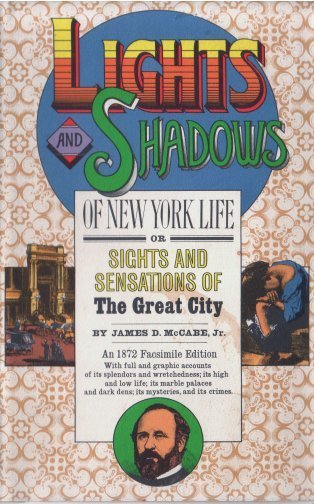
The Project Gutenberg eBook of Lights and Shadows of New York Life
Title: Lights and Shadows of New York Life
Author: James Dabney McCabe
Release date: October 27, 2006 [eBook #19642]
Language: English
Credits: This ebook was transcribed by Les Bowler
This ebook was transcribed by Les Bowler.
LIGHTS AND SHADOWS OF NEW YORK LIFE;
OR, THE SIGHTS AND SENSATIONS OF A GREAT CITY.
BY JAMES D. MCCABE, JR.
LIGHTS AND SHADOWS
OF NEW YORK LIFE;
or, the
SIGHTS AND SENSATIONS
of
THE GREAT CITY.
a work descriptive of
the
city of new york in all its various phases;
with full and graphic accounts of
its splendors and
wretchedness; its high and low life;
its marble palaces and dark dens; its attractions and
dangers; its rings and
frauds; its leading men
and politicians; its
adventurers; its charities;
its mysteries, and its
crimes.
By JAMES D. McCABE, JR.,
author of
“paris by sunlight and gaslight,”
“history of the war between germany and
france,” “great
fortunes,” “the great
republic,” etc., etc.
illustrated with numerous
fine engravings of noted places, life
and scenes in new york.
Issued by subscription only, and not for sale
in the book stores. Residents of any State desiring
a copy should address the Publishers, and an Agent will call upon
them. See page 851.
NATIONAL PUBLISHING COMPANY,
PHILADELPHIA, Pa.; CINCINNATI, Ohio; CHICAGO, Ill.;
ST. LOUIS, Mo.
Entered according to Act of Congress, in the
year 1872, by
J. R. JONES,
In the Office of the Librarian of Congress, at Washington, D.C.
PREFACE.
It is the desire of every American to see New York, the largest and most wonderful city in the Union. To very many the city and its attractions are familiar, and the number of these persons is increased by thousands of new comers every year. A still greater number, however, will know the Great City only by the stories that reach them through their friends and the newspapers. They may never gaze upon its beauties, never enjoy its attractions in person. For their benefit I have written these pages, and I have endeavored to present to them a faithful picture of the “Lights and Shadows” of the life of this City, and to describe its “Sights and Sensations” as they really exist.
This Great City, so wonderful in its beauty, so strange to eyes accustomed only to the smaller towns of the land, is in all respects the most attractive sight in America, and one of the most remarkable places in the world, ranking next to London and Paris in the extent and variety of its attractions. Its magnificence is remarkable, its squalor appalling. Nowhere else in the New World are seen such lavish displays of wealth, and such hideous depths of poverty. It is rich in historical associations and in treasures of art. It presents a wonderful series of combinations as well as contrasts of individual and national characteristics. It is richly worth studying by all classes, for it is totally different from any other city in the world. It is always fresh, always new. It is constantly changing, growing greater and more wonderful in its power and splendors, more worthy of admiration in its higher and nobler life, more generous in its charities, and more mysterious and appalling in its romance and its crimes. It is indeed a wonderful city. Coming fresh from plainer and more practical parts of the land, the visitor is plunged into the midst of so much beauty, magnificence, gayety, mystery, and a thousand other wonders, that he is fairly bewildered. It is hoped that the reader of these pages will be by their perusal better prepared to enjoy the attractions, and to shun the dangers of New York. It has been my effort to bring home to those who cannot see the city for themselves, its pleasures and its dangers, and to enable them to enjoy the former without either the fatigue or expense demanded of an active participant in them, and to appreciate the latter, without incurring the risks attending an exploration of the shadowy side of the Great City.
To those who intend visiting New York, whether they come as strangers, or as persons familiar with it, the writer has a word to say, which he trusts may be heeded. An honest effort has been made in this work to present the reader with a fair description of the dangers to which visitors and citizens are alike exposed. For the purpose of performing this task, the writer made visits, in company with the police officials of the city, to a number of the places described in this work, and he is satisfied that no respectable person can with safety visit them, unless provided with a similar protection. The curiosity of all persons concerning the darker side of city life can be fully satisfied by a perusal of the sketches presented in this volume. It is not safe for a stranger to undertake to explore these places for himself. No matter how clever he may consider himself, no respectable man is a match for the villains and sharpers of New York, and he voluntarily brings upon himself all the consequences that will follow his entrance into the haunts of the criminal and disreputable classes. The city is full of danger. The path of safety which is pointed out in these pages is the only one for either citizen or stranger—an absolute avoidance of the vicinity of sin.
Those who have seen the city will, I am sure, confirm the statements contained herein, and will acknowledge the truthfulness of the picture I have drawn, whatever they may think of the manner in which the work is executed.
J. D. McC., Jr.
New York,
March 21st, 1872
CONTENTS.
LIST OF ILLUSTRATIONS.
I. THE CITY OF NEW YORK
I. HISTORICAL.
On the morning of the 1st of May, 1607, there knelt at the chancel of the old church of St. Ethelburge, in Bishopsgate street, London, to receive the sacrament, a man of noble and commanding presence, with a broad intellectual forehead, short, close hair, and a countenance full of the dignity and courtly bearing of an honorable gentleman. His dress bespoke him a sailor, and such he was. Immediately upon receiving the sacrament, he hastened from the church to the Thames, where a boat was in waiting to convey him to a vessel lying in the stream. But little time was lost after his arrival on board, and soon the ship was gliding down the river. The man was an Englishman by birth and training, a seaman by education, and one of those daring explorers of the time who yearned to win fame by discovering the new route to India. His name was Henry Hudson, and he had been employed by “certain worshipful merchants of London” to go in search of a North-east passage to India, around the Arctic shores of Europe, between Lapland and Nova Zembla, and frozen Spitzbergen. These worthy gentlemen were convinced that since the effort to find a North-west passage had failed, nothing remained but to search for a North-east passage, and they were sure that if human skill or energy could find it, Hudson would succeed in his mission. They were not mistaken in their man, for in two successive voyages he did all that mortal could do to penetrate the ice fields beyond the North Cape, but without success. An impassable barrier of ice held him back, and he was forced to return to London to confess his failure. With unconquerable hope, he suggested new means of overcoming the difficulties; but while his employers praised his zeal and skill, they declined to go to further expense in an undertaking which promised so little, and the “bold Englishman, the expert pilot, and the famous navigator” found himself out of employment. Every effort to secure aid in England failed him, and, thoroughly disheartened, he passed over to Holland, whither his fame had preceded him.
The Dutch, who were more enterprising, and more hopeful than his own countrymen, lent a ready ear to his statement of his plans, and the Dutch East India Company at once employed him, and placed him in command of a yacht of ninety tons, called the Half Moon, manned by a picked crew. On the 25th of March, 1609, Hudson set sail in this vessel from Amsterdam, and steered directly for the coast of Nova Zembla. He succeeded in reaching the meridian of Spitzbergen; but here the ice, the fogs, and the fierce tempests of the North drove him back, and turning to the westward, he sailed past the capes of Greenland, and on the 2nd of July was on the banks of Newfoundland. He passed down the coast as far as Charleston Harbor, vainly hoping to find the North-west passage, and then in despair turned to the northward, discovering Delaware Bay on his voyage. On the 3rd of September he arrived off a large bay to the north of the Delaware, and passing into it, dropped anchor “at two cables’ length from the shore,” within Sandy Hook. Devoting some days to rest, and to the exploration of the bay, he passed through The Narrows on the 11th of September, and then the broad and beautiful “inner bay” burst upon him in all its splendor, and from the deck of his ship he watched the swift current of the mighty river rolling from the north to the sea. He was full of hope now, and the next day continued his progress up the river, and at nightfall cast anchor at Yonkers. During the night the current of the river turned his ship around, placing her head down stream; and this fact, coupled with the assurances of the natives who came out to the Half Moon in their canoes, that the river flowed from far beyond the mountains, convinced him that the stream flowed from ocean to ocean, and that by sailing on he would at length reach India—the golden land of his dreams.
Thus encouraged, he pursued his way up the river, gazing with wondering delight upon its glorious scenery, and listening with gradually fading hope to the stories of the natives who flocked to the water to greet him. The stream narrowed, and the water grew fresh, and long before he anchored below Albany, Hudson had abandoned the belief that he was in the Northwest passage. From the anchorage, a boat’s crew continued the voyage to the mouth of the Mohawk. Hudson was satisfied that he had made a great discovery—one that was worth fully as much as finding the new route to India. He was in a region upon which the white man’s eye had never rested before, and which offered the richest returns to commercial ventures. He hastened back to New York Bay, took possession of the country in the name of Holland, and then set sail for Europe. He put into Dartmouth in England, on his way back, where he told the story of his discovery. King James I. prevented his continuing his voyage, hoping to deprive the Dutch of its fruits; but Hudson took care to send his log-book and all the ship’s papers over to Holland, and thus placed his employers in full possession of the knowledge he had gained. The English at length released the Half Moon, and she continued her voyage to the Texel.
The discovery of Hudson was particularly acceptable to the Dutch, for the new country was rich in fur-bearing animals, and Russia offered a ready market for all the furs that could be sent there. The East India Company, therefore, refitted the Half Moon after her return to Holland, and despatched her to the region discovered by Hudson on a fur trading expedition, which was highly successful. Private persons also embarked in similar enterprises, and within two years a prosperous and important fur trade was established between Holland and the country along the Mauritius, as the great river discovered by Hudson had been named, in honor of the Stadtholder of Holland. No government took any notice of the trade for a while, and all persons were free to engage in it.
Among the adventurers employed in this trade was one Adrian Block, noted as one of the boldest navigators of his time. He made a voyage to Manhattan Island in 1614, then the site of a Dutch trading post, and had secured a cargo of skins with which he was about to return to Holland, when a fire consumed both his vessel and her cargo, and obliged him to pass the winter with his crew on the island. They built them log huts on the site of the present Beaver street, the first houses erected in New York, and during the winter constructed a yacht of sixteen tons, which Block called the Onrust—the “Restless.” In this yacht Block made many voyages of discovery, exploring the coasts of Long Island Sound, and giving his name to the island near the eastern end of the sound. He soon after went back to Europe.
Meanwhile, a small settlement had clustered about the trading post and the huts built by Block’s shipwrecked crew, and had taken the name of New Amsterdam. The inhabitants were well suited to become the ancestors of a great nation. They were mainly Dutch citizens of a European Republic, “composed of seven free, sovereign States”—made so by a struggle with despotism for forty years, and occupying a territory which their ancestors had reclaimed from the ocean and morass by indomitable labor. It was a republic where freedom of conscience, speech, and the press were complete and universal. The effect of this freedom had been the internal development of social beauty and strength, and vast increment of substantial wealth and power by immigration. Wars and despotisms in other parts of Europe sent thousands of intelligent exiles thither, and those free provinces were crowded with ingenious mechanics, and artists, and learned men, because conscience was there undisturbed, and the hand and brain were free to win and use the rewards of their industry and skill. Beautiful cities, towns, and villages were strewn over the whole country, and nowhere in Europe did society present an aspect half as pleasing as that of Holland. Every religious sect there found an asylum from persecution and encouragement to manly effort, by the kind respect of all. And at the very time when the charter of the West India Company was under consideration, that band of English Puritans who afterward set up the ensign of free institutions on the shores of Massachusetts Bay, were being nurtured in the bosom of that republic, and instructed in those principles of civil liberty that became a salutary leaven in the bigotry which they brought with them.
“Such were the people who laid the foundations of the Commonwealth of New York. They were men of expanded views, liberal feelings, and never dreamed of questioning any man’s inalienable right to ‘life, liberty, and the pursuit of happiness’ among them, whether he first inspired the common air in Holland, England, Abyssinia, or Kamtschatka. And as the population increased and became heterogeneous, that very toleration became a reproach; and their Puritan neighbors on the east, and Churchmen and Romanists on the south, called New Amsterdam ‘a cage of unclean birds.’”
The English, now awake to the importance of Hudson’s discoveries, warned the Dutch Government to refrain from making further settlements on “Hudson’s River,” as they called the Mauritius; but the latter, relying upon the justice of their claim, which was based upon Hudson’s discovery, paid no attention to these warnings, and in the spring of 1623 the Dutch West India Company sent over thirty families of Walloons, or 110 persons in all, to found a permanent colony at New Amsterdam, which, until now, had been inhabited only by fur traders. These Walloons were Protestants, from the frontier between France and Flanders, and had fled to Amsterdam to escape religious persecution in France. They were sound, healthy, vigorous, and pious people, and could be relied upon to make homes in the New World. The majority of them settled in New Amsterdam. Others went to Long Island, where Sarah de Rapelje, the first white child born in the province of New Netherlands, saw the light.
In 1626, Peter Minuit, the first regular Governor, was sent over from Holland. He brought with him a Koopman or general commissary, who was also secretary of the province, and a Schout, or sheriff, to assist him in his government. The only laws to which he was subject were the instructions of the West India Company. The colonists, on their part, were to regard his will as their law. He set to work with great vigor to lay the foundations of the colony. He called a council of the Indian chiefs, and purchased the Island of Manhattan from them for presents valued at about twenty dollars, United States coin. He thus secured an equitable title to the island, and won the friendship of the Indians. Under his vigorous administration, the colony prospered; houses were built, farms laid off; the population was largely increased by new arrivals from Europe; and New Amsterdam fairly entered upon its career as one of the most important places in America. It was a happy settlement, as well; the rights of the people were respected, and they were as free as they had been in Holland. Troubles with the Indians marked the close of Minuit’s administration. The latter were provoked by the murder of some of their number by the whites, and by the aid rendered by the commander at Fort Orange (Albany) to the Mohegans, in one of their forays upon the Mohawks. Many of the families at Fort Orange, and from the region between the Hudson and the Delaware, abandoned their settlements, and came to New Amsterdam for safety, thus adding to the population of that place. Minuit was recalled in 1632, and he left the province in a highly prosperous condition. During the last year of his government New Amsterdam sent over $60,000 worth of furs to Holland.
His successor was the redoubtable Wouter Van Twiller, a clerk in the company’s warehouse at Amsterdam, who owed his appointment to his being the husband of the niece of Killian Van Rensselaer, the patroon of Albany. Irving has given us the following admirable portrait of him:
“He was exactly five feet six inches in height, and six feet five inches in circumference. His head was a perfect sphere, and of such stupendous dimensions, that dame Nature, with all her sex’s ingenuity, would have been puzzled to construct a neck capable of supporting it; wherefore she wisely declined the attempt, and settled it firmly on the top of his back bone, just between the shoulders. His body was oblong, and particularly capacious at bottom; which was wisely ordered by Providence, seeing that he was a man of sedentary habits, and very averse to the idle labor of walking. His legs were very short, but sturdy in proportion to the weight they had to sustain: so that, when erect, he had not a little the appearance of a beer barrel on skids. His face, that infallible index of the mind, presented a vast expanse, unfurrowed by any of those lines and angles which disfigure the human countenance with what is termed expression. Two small gray eyes twinkled feebly in the midst, like two stars of lesser magnitude in a hazy firmament; and his full-fed cheeks, which seemed to have taken toll of everything that went into his mouth, were curiously mottled and streaked with dusky red, like a Spitzenberg apple. His habits were as regular as his person. He daily took his four stated meals, appropriating exactly an hour to each; he smoked and doubted eight hours, and he slept the remaining twelve of the four-and-twenty.”
Van Twiller ruled the province seven years, and, in spite of his stupidity, it prospered. In 1633, Adam Roelantsen, the first school-master, arrived—for the fruitful Walloons had opened the way by this time for his labors—and in the same year a wooden church was built in the present Bridge street, and placed in charge of the famous Dominie Everardus Bogardus. In 1635, the fort, which marked the site of the present Bowling Green, and which had been begun in 1614, was finished, and in the same year the first English settlers at New Amsterdam came into the town. The English in New England also began to give the Dutch trouble during this administration, and even sent a ship into “Hudson’s River” to trade with the Indians. Influenced by De Vries, the commander of the fort, the Governor sent an expedition up the river after the audacious English vessel, seized her, brought her back to New York, and sent her to sea with a warning not to repeat her attempt. The disputes between the English and the Dutch about the Connecticut settlements, also began to make trouble for New Amsterdam. Van Twiller possessed no influence in the colony, was laughed at and snubbed on every side, and was at length recalled by the company in 1638. The only memorial of Van Twiller left to us is the Isle of Nuts, which lies in the bay between New York and Brooklyn, and which he purchased as his private domain. It is still called the “Governor’s Island.”
Van Twiller’s successor in the government of the province was William Kieft. He was as energetic as he was spiteful, and as spiteful as he was rapacious. His chief pleasure lay in quarrelling. He and his council made some useful reforms, but as a rule they greatly oppressed the people. During this administration agriculture was encouraged, the growing of fruit was undertaken, and several other things done to increase the material prosperity of the town. The fort was repaired and strengthened, new warehouses were built, and police ordinances were framed and strictly executed. The old wooden church was made a barrack for troops, and a new and larger edifice of stone was constructed by Kuyter and Dam within the walls of the fort. Within the little tower were hung the bells captured from the Spanish by the Dutch at Porto Rico. The church cost $1000, and was considered a grand edifice. In 1642 a stone tavern was built at the head of Coenties Slip, and in the same year, the first “city lots” with valid titles were granted to the settlers.
The latter part of Kieft’s administration was marked by contests with the citizens, who compelled him, in 1641, to grant them a municipal council, composed of twelve of the most prominent residents of New Amsterdam, which council he arbitrarily dissolved at the first opportunity. He also stirred up a war with the Indians, in which he was the principal aggressor. This war brought great loss and suffering upon the province, and came near ruining it. Kieft, alarmed at the results of his folly, appointed a new municipal council of eight members, and this council at once demanded of the States General of Holland the removal of Kieft. Their demand was complied with, and in 1647, Peter Stuyvesant was made Governor of New Netherlands, and reached New Amsterdam in the same year.
Stuyvesant was essentially a strong man. A soldier by education and of long experience, he was accustomed to regard rigid discipline as the one thing needful in every relation of life, and he was not slow to introduce that system into his government of New Amsterdam. He had served gallantly in the wars against the Portuguese, and had lost a leg in one of his numerous encounters with them. He was as vain as a peacock, as fond of display as a child, and thoroughly imbued with the most aristocratic ideas—qualities not exactly the best for a Governor of New Amsterdam. Yet, he was, with all his faults, an honest man, he had deeply at heart the interests of the colony, and his administration was mainly a prosperous one.
He energetically opposed from the first all manifestations in favor of popular government. His will was to be the law of the province. “If any one,” said he, “during my administration shall appeal, I will make him a foot shorter, and send the pieces to Holland, and let him appeal in that way.” He went to work with vigor to reform matters in the colony, extending his efforts to even the morals and domestic affairs of the people. He soon brought about a reign of material prosperity greater than had ever been known before, and exerted himself to check the encroachments of the English, on the East, and the Swedes, on the South. He inaugurated a policy of kindness and justice toward the Indians, and soon changed their enmity to sincere friendship. One thing, however, he dared not do—he could not levy taxes upon the people without their consent, for fear of offending the States General of Holland. This forced him to appoint a council of nine prominent citizens, and, although he endeavored to hedge round their powers by numerous conditions, the nine ever afterwards served as a salutary check upon the action of the Governor. He succeeded, in the autumn of 1650, in settling the boundary disputes with the English in New England, and then turned his attention to the Swedes on the Delaware, whom he conquered in 1654. His politic course towards them had the effect of converting them into warm friends of the Dutch. During his absence on this expedition, the Indians ravaged the Jersey shore and Staten Island, and even made an attack on New Amsterdam itself. They were defeated by the citizens, and Stuyvesant’s speedy return compelled them to make peace. This was the last blow struck by the savages at the infant metropolis.
In 1652, the States General, much to the disgust of Stuyvesant, granted to New Amsterdam a municipal government similar to that of the free cities of Holland. A Schout, or Sheriff, two Burgomasters, and five Schepens, were to constitute a municipal court of justice. The people, however, were denied the selection of these officers, who were appointed by the Governor. In February, 1653, these officers were formally installed. They were, Schout Van Tienhoven, Burgomasters Hattem and Kregier, and Schepens Van der Grist, Van Gheel, Anthony, Beeckman, and Couwenhoven, with Jacob Kip as clerk.
During Stuyvesant’s administration, the colony received large accessions from the English in New England. “Numbers, nay whole towns,” says De Laet, “to escape from the insupportable government of New England, removed to New Netherlands, to enjoy that liberty denied to them by their own countrymen.” They settled in New Amsterdam, on Long Island, and in Westchester county. Being admitted to the rights of citizenship, they exercised considerable influence in the affairs of the colony, and towards the close of his administration gave the Governor considerable trouble by their opposition to his despotic acts.
In 1647, the streets of New Amsterdam were cleared of the shanties and pig-pens which obstructed them. In 1648, every Monday was declared a market-day. In 1650, Dirk Van Schellyne, the first lawyer, “put up his shingle” in New Amsterdam. In 1652, a wall or palisade was erected along the upper boundary of the city, in apprehension of an invasion by the English. This defence ran from river to river, and to it Wall street, which occupies its site east of Trinity Church, owes its name. In 1656, the first survey of the city was made, and seventeen streets were laid down on the map; and, in the same year, the first census showed a “city” of 120 houses, and 1000 inhabitants. In 1657, a terrible blow fell upon New Amsterdam—the public treasury being empty, the salary of the town drummer could not be paid. In that year the average price of the best city lots was $50. In 1658, the custom of “bundling” received its death blow by an edict of the Governor, which forbade men and women to live together until legally married. In that year the streets were first paved with stone, and the first “night watch” was organized and duly provided with rattles. A fire department, supplied with buckets and ladders, was also established, and the first public well was dug in Broadway. In 1660, it was made the duty of the Sheriff to go round the city by night to assure himself of its peace and safety. This worthy official complained that the dogs, having no respect for his august person, attacked him in his rounds, and that certain evil-minded individuals “frightened” him by calling out “Indians” in the darkness, and that even the boys cut Koeckies. The city grew steadily, its suburbs began to smile with boweries, or farms, and in 1658 a palisaded village called New Harlem was founded at the eastern end of Manhattan Island for the purpose of “promoting agriculture, and affording a place of amusement for the citizens of New Amsterdam.” “Homes, genuine, happy Dutch homes, in abundance, were found within and without the city, where uncultured minds and affectionate hearts enjoyed life in dreamy, quiet blissfulness, unknown in these bustling times. The city people then rose at dawn, dined at eleven, and went to bed at sunset, except on extraordinary occasions, such as Christmas Eve, a tea party, or a wedding. Then those who attended the fashionable soirées of the ‘upper ten’ assembled at three o’clock in the afternoon, and went away at six, so that daughter Maritchie might have the pewter plates and delf teapot cleaned and cupboarded in time for evening prayer at seven. Knitting and spinning held the places of whist and flirting in these ‘degenerate days;’ and utility was as plainly stamped on all their pleasures as the maker’s name on our silver spoons.”
But the period of Dutch supremacy on Manhattan was approaching its close. Charles II. had just regained the English throne. In 1664, with characteristic disregard of right and justice, he granted to his brother James, Duke of York and Albany, the whole territory of New Netherlands, including all of Long Island and a part of Connecticut—lands to which he had not the shadow of a claim. In the same year, a force of four ships and 450 soldiers, under the command of Colonel Richard Nicholls, was sent to New Amsterdam to take possession of that city. It arrived at the Narrows about the 29th of August, and on the 30th, Nicholls demanded the surrender of the town. Stuyvesant, who had made preparations for defending the place, endeavored to resist the demand, but the people refused to sustain him, and he was obliged to submit. On the 8th of September, 1664, he withdrew the Dutch garrison from the fort, and embarked at the foot of Beaver street for Holland. The English at once took possession of the town and province, changing the name of both to New York, in honor of the new proprietor.
The English set themselves to work to conciliate the Dutch residents, a task not very difficult, inasmuch as the English settlers already in the province had to a great degree prepared the way for the change. In 1665, the year after the conquest, the city was given a Mayor, a Sheriff, and a board of Aldermen, who were charged with the administration of municipal affairs, and in the same year jury trials were formally established. In July, 1673, the Dutch fleet recaptured the town, drove out the English, and named it New Orange. The peace between Great Britain and Holland, which closed the war, restored the town to the English, November 10th, 1674, and the name of New York was resumed. The Dutch Government was replaced by the English system under a liberal charter, and during the remainder of the seventeenth century the town grew rapidly in population and size. In 1689 there was a brief disturbance known as Leislers’ Rebellion. In 1700 New York contained 750 dwellings and 4500 white and 750 black inhabitants. In 1693 William Bradford established the first printing press in the city. In 1696 Trinity Church was begun, and in 1697, the streets were first lighted, a lamp being hung out upon a pole extending from the window of every seventh house. In 1702 a terrible fever was brought from St. Thomas’, and carried off 600 persons, one-tenth of the whole population. In 1711, a slave market was established. In 1719 the first Presbyterian Church was built; in 1725 the New York Gazette, the fifth of the colonial newspapers, was established; and in 1730 stages ran to Philadelphia once a fortnight, and in 1732 to Boston, the latter journey occupying fourteen days. In 1731 the first public library, the bequest of the Rev. Dr. Wellington, of England, was opened in the city. It contained 1622 volumes. In 1734 a workhouse was erected in the present City Hall Park. In 1735 the people made their first manifestation of hostility to Great Britain, which was drawn forth by the infamous prosecution by the officers of the crown, of Rip Van Dam, who had been the acting Governor of the town. The winter of 1740-41 was memorable for its severity. The Hudson was frozen over at New York, and the snow lay six feet on a level. In 1741, a severe fire in the lower part of the city destroyed among other things the old Dutch Church and fort, and in the same year the yellow fever raged with great violence. The principal event of the year, however, was the so-called negro plot for the destruction of the town. Though the reality of the plot was never proved, the greatest alarm prevailed; the fire in the fort was declared to be the work of the negroes, many of whom were arrested; and upon the sole evidence of a servant girl a number of the poor wretches were convicted and hanged. Several whites were charged with being the accomplices of the negroes. One of these, John Ury, a Roman Catholic priest, and, as is now believed, an innocent man, was hanged, in August. In the space of six months 154 negroes and twenty whites were arrested, twenty negroes were hanged, thirteen were burned at the stake, and seventy-eight were transported. The rest were released. In 1750 a theatre was opened, and in 1755 St. Paul’s Church was erected. In 1754 the “Walton House,” in Pearl street (still standing), was built by William Walton, a merchant. It was long known as the finest private residence in the city. In 1755 the Staten Island ferry, served by means of row boats, was established, and in the same year Peck Slip was opened and paved. In 1756 the first lottery ever seen in the city was opened in behalf of King’s (now Columbia) College.
New York bore a prominent part in the resistance of the colonies to the aggressions of the mother country, and in spite of the efforts of her royalist Governor and the presence of a large number of Tories, responded cordially to the call of the colonies for men and money during the war. On the 14th of April, 1776, the city was occupied by the American army, the British force stationed there being obliged to withdraw. On the 26th of August, 1776, the battle of Long Island having been lost by the Americans, New York was occupied by the British, who held it until the close of the war. It suffered very much at their hands. Nearly all the churches, except the Episcopal, were used by them as prisons, riding schools, and stables; and the schools and colleges were closed. On the 21st of September, 1776, a fire destroyed 493 houses, including Trinity Church—all the west side of Broadway from Whitehall to Barclay street, or about one-eighth of the city; and on the 7th of August 1778, about 300 buildings on East River were burned. The winter of 1779-80 was very severe; there was a beaten track for sleighs and wagons across the Hudson; the ice in that river being strong enough to bear a horse and man as late as the 17th of March; eighty sleighs, with provisions, and a large body of troops, crossed on the ice from the city to Staten Island. On the 25th of November, 1783, the British evacuated the city, which was at once occupied by the American army.
In 1785 the first Federal Congress met in the City Hall, which stood at the corner of Wall and Nassau streets, and on the 30th of April, 1789, George Washington was inaugurated first President of the United States on the same spot. By 1791 New York had spread to the lower end of the present City Hall Park, the site of the new Post Office, and was extending along the Boston road, or Bowery, and Broadway. In 1799, the Manhattan Company for supplying the city with fresh water was chartered. On the 20th of September, 1803, the cornerstone of the City Hall was laid. The city fathers, sagely premising that New York would never pass this limit, ordered the rear wall of the edifice to be constructed of brown stone, to save the expense of marble. Free schools were opened in 1805. In the same year the yellow fever raged with violence, and had the effect of extending the city by driving the population up the island, where many of them located themselves permanently. In 1807, Robert Fulton navigated the first steamboat from New York to Albany.
The war of 1812-15 for a while stopped the growth of the city, but after the return of peace its progress was resumed. In August, 1812, experimental gas lamps were placed in the City Hall Park, though the use of gas for purposes of lighting was not begun until 1825. In 1822 the yellow fever again drove the population up the island, and caused a rapid growth of the city above Canal street. In 1825 the Erie Canal was completed. This great work, by placing the trade of the West in the hands of New York, gave a powerful impetus to the growth of the city, which was at that time spreading at the rate of from 1000 to 1500 houses per year. In 1832 and 1834, the cholera raged severely, carrying off upwards of 4484 persons in the two years. In 1835, the “great fire” occurred. This terrible conflagration broke out on the 16th of December of that year, and swept the First Ward of the city east of Broadway and below Wall street. It laid almost the entire business quarter in ashes, destroyed 648 houses, and inflicted upon the city a loss of over $18,000,000. New York rose from this disaster with wonderful energy and rapidity, but only to meet, in 1837, the most terrible financial crisis that had ever burst upon the country. Even this did not check the growth of the city, the population increasing 110,100 between 1830 and 1840. In 1842 the Croton water was introduced. In 1849 and 1854 the cholera again appeared, killing over 5400 persons. In 1852, the first street railway was built. In 1858, the Central Park was begun.
The Civil War checked the growth and trade of the city, which languished during the entire struggle, but upon the return of peace New York resumed its onward progress. The growth of the city since 1865 has been most marked, especially in the immediate vicinity of the Central Park. Not less marked has been the improvement of the older portions. The city is rapidly increasing in size, population, and magnificence, and is fully maintaining its position as the brilliant metropolis of the New World.
II. DESCRIPTIVE AND STATISTICAL.
The city of New York, the largest and most important in the United States, is situated in New York County, on Manhattan Island, at the mouth of the Hudson River, eighteen miles from the Atlantic Ocean. The city limits comprise the entire county of New York, embracing Manhattan Island, Randall’s, Ward’s, and Blackwell’s Islands, in the East River, and Governor’s, Bedloe’s, and Ellis’ Islands, in the bay. The last three are occupied by the military posts of the United States Government. Manhattan Island is bounded on the north by Spuyten Duyvel Creek and the Harlem River—practically the same stream; on the east by the East River, on the west by the Hudson, and on the south by New York Bay. It is nine miles long on the east side, thirteen and a half miles long on the west side, and two and a half miles wide at its greatest breadth, the average breadth being a mile and a half. It is but a few feet in width at its southern extremity, but spreads out like a fan as it stretches away to the northward. The southern point is but a few inches above the level of the bay, but the island rises rapidly to the northward, its extreme northern portion being occupied by a series of bold, finely wooded heights, which terminate at the junction of the Hudson River and Spuyten Duyvel Creek, in a bold promontory, 130 feet high. These hills, known as Washington Heights, are two or three miles in length. The southern portion of the island is principally a sand-bed, but the remainder is very rocky. The island covers an area of twenty-two square miles, or 14,000 acres. It is built up compactly for about six miles, along the east side, and irregularly to Harlem, three miles farther. Along the west side it is built up compactly to the Central Park, Fifty-ninth street, and irregularly to Manhattanville, One hundred and twenty-fifth street, from which point to Spuyten Duyvel Creek it is covered with country seats, gardens, etc. Three wagon, and two railroad bridges over the Harlem River connect the island with the mainland, and numerous lines of ferries afford communication with Long and Staten Islands, and New Jersey. The island attains its greatest width at Fourteenth and Eighty-seventh streets.
The city is finely built, and presents an aspect of industry and liveliness unsurpassed by any place in the world. Lying in full sight of the ocean, with its magnificent bay to the southward, and the East and Hudson Rivers washing its shores, the city of New York possesses a climate which renders it the most delightful residence in America. In the winter the proximity of the sea moderates the severity of the cold, and in the summer the heat is tempered by the delightful sea breezes which sweep over the island. Snow seldom lies in the streets for more than a few hours, and the intense “heated terms” of the summer are of very brief duration. As a natural consequence, the city is healthy, and the death rate, considering the population, is small.
The southern portion is densely built up. Between the City Hall and Twenty-third street New York is more thickly populated than any city in America. It is in this section that the “tenement houses,” or buildings containing from five to twenty families, are to be found. The greatest mortality is in these over-crowded districts, which the severest police measures cannot keep clean and free from filth. The southern portion of the city is devoted almost exclusively to trade, comparatively few persons residing below the City Hall. Below Canal street the streets are narrow, crooked, and irregular. Above Houston street they are broad and straight, and are laid out at regular intervals. Above Houston street, the streets extending across the island are numbered. The avenues begin in the vicinity of Third street, and extend, or will extend to the northern limit of the island, running parallel with the Hudson River. There are twelve fine avenues at parallel distances apart of about 800 feet. Second and Eighth are the longest, and Fifth, Madison and Lexington the most fashionable. They commence with Avenue D, a short street, near the East River. West of this, and parallel with it, are three avenues somewhat longer, called Avenues C, B, and A, the last being the most westerly. Then begin the long avenues, which are numbered First, Second, and so on, as they increase to the westward. There are two other avenues shorter than those with numbers, viz: Lexington, lying between Third and Fourth, and extending from Fourteenth street on the south to Sixty-ninth street on the north; and Madison, between Fourth and Fifth, and extending from Twenty-third street at Madison Square to Eighty-sixth street. Madison and Lexington are each to be prolonged to the Harlem River. These avenues are all 100 feet wide, except Lexington and Madison, which are seventy-five feet wide, and Fourth avenue, above Thirty-fourth street, which is 140 feet wide. Third avenue is the main street on the east side above the Bowery, of which it is a continuation, and Eighth avenue is the principal highway on the west side. Fifth and Madison avenues are the most fashionable, and are magnificently built up with private residences below the Park. The cross streets connecting them are also handsomely built.
The numerical streets are all sixty feet wide, except Fourteenth, Twenty-third, Thirty-fourth, Forty-second, and eleven others north of these, which are 100 feet wide. The streets of the city are well laid off, and are paved with an excellent quality of stone. The sidewalks generally consist of immense stone “flags.” In the lower part of the city, in the poorer and business sections, the streets are dirty and always out of order. In the upper part they are clean, and are generally kept so by private contributions.
The avenues on the eastern and western extremities of the city are the abodes of poverty and want, and often of vice, hemming in the wealthy and cleanly sections on both sides. Poverty and riches are close neighbors in New York. Only a stone’s throw back of the most sumptuous parts of Broadway and Fifth avenue, want and suffering, vice and crime, hold their courts. Fine ladies can look down from their high casements upon the squalid dens of their unfortunate sisters.
Broadway is the principal thoroughfare. It extends from the Battery to Spuyten Duyvel Creek, a distance of fifteen miles. It is built up compactly for about five miles, is paved and graded for about seven miles, and is lighted with gas along its entire length. There are over 420 miles of streets in the patrol districts, and eleven miles of piers along the water. The sewerage is generally good, but defective in some places. Nearly 400 miles of water-mains have been laid. The streets are lighted by about 19,000 gas lamps, besides lamps set out by private parties. They are paved with the Belgian and wooden pavements, cobble stones being almost a thing of the past. For so large a city, New York is remarkably clean, except in those portions lying close to the river, or given up to paupers.
The city is substantially built. Frame houses are rare. Many of the old quarters are built of brick, but this material is now used to a limited extent only. Broadway and the principal business streets are lined with buildings of iron, marble, granite, brown, Portland, and Ohio stone, palatial in their appearance; and the sections devoted to the residences of the better classes are built up mainly with brown, Portland, and Ohio stone, and in some instances with marble. Thus the city presents an appearance of grandeur and solidity most pleasing to the eye. The public buildings will compare favorably with any in the world, and there is no city on the globe that can boast so many palatial warehouses and stores. Broadway is one of the best built thoroughfares in the world. The stores which line it are generally from five to six stories high above ground, with two cellars below the pavement, and vaults extending to near the middle of the street. The adjacent streets in many instances rival Broadway in their splendors. The stores of the city are famous for their elegance and convenience, and for the magnificence and variety of the goods displayed in them. The streets occupied by private residences are broad, clean and well-paved, and are lined with miles of dwellings inferior to none in the world in convenience and substantial elegance. The amount of wealth and taste concentrated in the dwellings of the better classes of the citizens of New York is very great.