
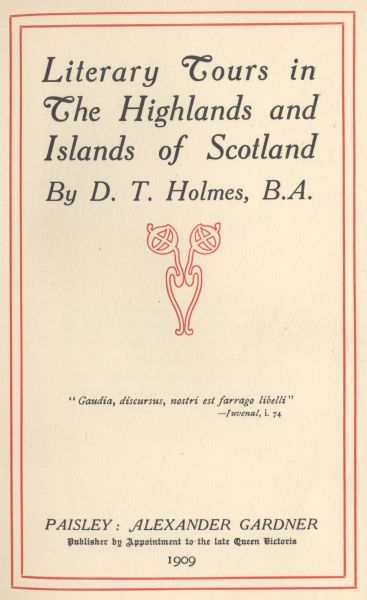
The Project Gutenberg eBook of Literary Tours in The Highlands and Islands of Scotland
Title: Literary Tours in The Highlands and Islands of Scotland
Author: Daniel Turner Holmes
Release date: June 20, 2009 [eBook #29178]
Most recently updated: January 25, 2021
Language: English
Credits: Produced by Susan Skinner and the Online Distributed
Proofreading Team at http://www.pgdp.net
LITERARY TOURS
Literary Tours in
The Highlands and
Islands of Scotland
By D. T. Holmes, B.A.
"Gaudia, discursus, nostri est farrago libelli"
—Juvenal, i. 74
PAISLEY: ALEXANDER GARDNER
Publisher by Appointment to the late Queen Victoria
1909
To
James Coats, Junr., Esq.,
Ferguslie House, Paisley.
Much further north than Aberdeen;
Whose mandate sent my willing feet
To realms of heather, broom, and peat:
Accept this record of my tours
As something less my own than yours.
D. T. HOLMES.
PREFACE.
Of hills with deep and dazzling snow,
And eastward, in a glimmering haze,
Stretch to the Forth the Campsie Braes.
Of smoke that runs across the plain,
And flecks for miles the vivid gleam:
It is the tireless steed of steam.
Daily behold his thunderous path,
That ceases not, until he feels
The breeze of Mallaig cool his wheels.
On many a journey by that track
Of splendour, would, at home, retrace
The charms and lore of every place;
Where all the glens in glamour lie;
And, lightly scorning gust and spray,
Leap o'er the Minch to Stornoway.
Splashed by the foam of racing tides,
Rises in thought: from here to there,
Let Fancy's coinage pay the fare,—
To utmost Thule and home again,
Through mingled din of sea and sky,
Even in the twinkling of an eye.
D. T. H.
CONTENTS.
- PAGE
- CHAPTER I.—Introductory, 9
Village libraries—Difficulties of travel—Literary Societies in the Highlands—Gaelic books—Happiness and geniality of natives—Oban to Gairloch—Winter sailing—A crofting village—Horrors of the Minch—Notes on Lewis—Highland doctors—Hotels and anglers—Recent books—Military—Moray Firth—Among the miners—Handloom weaving—Professor Blackie and the Highlands.
- CHAPTER II.—Music, Speeches, and Literature, 60
Scotch a reading nation—Hardships of students in old days—Homer in Scalloway—When education ends—Objects of chapter—Music—M.P.'s—Rural depopulation—Its causes—Emigration—Village halls—The moon—A lecture in Islay—Mental and material wealth—Real greatness—A Highland laird on literature—Varieties of chairmen—"Coming to the point"—Moral obligation—Compliment to Paisley—Oratory at Salen—Lecture in a dungeon—Surprises—A visit to the Borders—Tarbolton—Scotch language—Choice books—The essayists—A Banff theory—Goldsmith in Gaelic—Biblia abiblia—Favourites for the road—Horace—Shakespeare's Sonnets—Xenophon—French literature and journalism—Romance and Augustanism—Victorian writers—Celt and Saxon.
- CHAPTER III.—Ecclesiastical, 134
Sectarian feeling—Typical anecdotes—Music and religion—Ethical teaching in schools—The Moderates—A savoury book—The Sabbath—"The Men of Skye"—The auldest kirk—The Episcopal Church—An interlude of metre—The Christian Brethren—Drimnin in Morven—Craignish—A model minister—Ministerial trials in olden times—An artful dodger—Some anecdotes from Gigha—Growing popularity of Ruskin.
- CHAPTER IV.—Educational, 180
Some Insular Dominies—Education Act of 1872—Education in the Highlands—Feeding the hungry—Parish Council boarders—Dwindling attendances—Arnisdale—Golspie Technical School—On the Sidlaws—Some surprises—Arran schools—Science and literature—Study of Scott—The old classical dominie—Vogue of Latin in former times—Teachers and examinations—Howlers—Competing subjects.
- CHAPTER V.—A Trip To Shetland, 217
Aberdeen—En route—Lerwick—Past and present saints—Some notes on the islands—A Shetland poet—A visit to Bressay—From Lerwick to Sandwick—Quarff—"That holy man, Noah"—Fladibister—Cunningsburgh—"Keeping off"—The indignant elder—Torquil Halcrow—Philology—A Sandwick gentleman—Local tales—Foulah and Fair Isle—The fishing season.
- CHAPTER VI.—Commercial Travellers and
Their Anecdotes, 255
Trials of commercials—The two-est-faced knave—Mary, the maid of the inn—Anecdotes of the smoking-room: Sonnet to Raleigh—Peelin's below the tree—"She's away!"—A mean house—One of the director's wives—Temperance hotels—A memorial window—The blasted heath—The day for it—The converted drummer—A circular ticket—A compound possessive—Sixteen medals—"She's auld, and she's thin, and she'll keep"—The will o' the dead—Sorry for London—"Raither unceevil"—An unwelcome recitation—A word in season—A Nairn critic—A grand day for it—A pro-Boer—"Falls of Bruar, only, please!"—A bad case of nerves.
- CHAPTER VII.—Legends and Literary Notabilia, 278
Gairloch folk-lore: Prince Olaf and his bride—A laird who had seen a fairy—Tales from Loch Broom: The dance of death—The Kildonan midwife—The magic herring—Taisch—Antiquities of Dunvegan—Miscellaneous terrors—St. Kilda—Lady Grange—Pierless Tiree—Lochbuie in Mull—Inveraray Castle—The sacred isle—Appin—Macdonald's gratitude—Notes on the Trossachs—Lochfyneside: Macivors, Macvicars, and Macallisters—Red Hector—Macphail of Colonsay—Tales from Speyside: Tom Eunan!—Shaws and Grants—The wishing well—Ossian and Macpherson—At the foot o' Bennachie—Harlaw—Lochaber reivers—Reay and Twickenham—Rob Donn—Rev. Mr. Mill of Dunrossness.
- CHAPTER VIII.—Metrical and Supplementary, 340
Arrival of the Mail-train at a Highland Station—Defoe, the Father of Journalism—A Village Toper—A Reverend Hellenist—Antigone—Shadows of the Manse—"My Heart's in the Highlands"—Saddell, Kintyre—Springtime in Perthshire—Dr. George Macdonald's Creed—Abbotsford—Carlyle—Shelley—Picture in an Inn—Rain-storm at Loch Awe—Kinlochewe—General Wade—Sound of Raasay in December—Les Neiges d' Antan—The Islands of the Ness—American Tourist Loquitur—The Miners—In a Country Graveyard—No Place like Home.
- INDEX, 369
LITERARY TOURING.
CHAPTER I.
INTRODUCTORY.
Village libraries—Difficulties of travel—Literary Societies in the Highlands—Gaelic books—Happiness and geniality of natives—Oban to Gairloch—Winter sailing—A crofting village—Horrors of the Minch—Notes on Lewis—Highland doctors—Hotels and anglers—Recent books—Military—Moray Firth—Among the miners—Handloom weaving—Professor Blackie and the Highlands.
VILLAGE LIBRARIES.
At pretty frequent intervals, during the last four years, I have sallied forth from my home in Renfrewshire, north, south, east, and west, to some of the most remote and isolated nooks of insular and provincial Scotland, on a mission so uncommon as to justify the writing of a book of impressions and experiences. The Highlands and Islands of Scotland are, of course, visited every summer by a great host of excursionists, who go thither to fish, play golf, lounge, climb hills, and otherwise picturesquely disport themselves. A few earnest devotees of science spend their holidays botanising in the glens, scanning the geological strata, looking for fossils, measuring the outlines of brochs and prehistoric forts, or collecting relics of Culdee churches. My journeys were undertaken for none of the objects named: they were entirely connected with libraries and lecturing, and, being undertaken mainly in the months of winter and spring, they have given me the opportunity of noting a great many interesting particulars that the summer traveller, bent on recreation or science, cannot be expected to notice.
I do not think any finer gift could be given to a village community than a collection of useful and entertaining books. The libraries with which my work was connected were sent, free of charge, to strath and glen, and nothing was asked in return, except that the volumes should be well housed and delivered to the people to read by some local librarian. You will find these libraries in all the townships of the Hebrides, from Ness in Lewis, down the long chain of islands, to Islay and Jura. About thirty of them are established in the Shetlands, and as many in the Orkneys. Scores of little villages in Aberdeen, Ross, Sutherland, Argyle, Bute, and Perth, have been gratuitously supplied with them. The same is true of many a weather-beaten, quaint, red-tiled little fishing-village along the shores of the Moray Firth. In the barracks of Fort-George, Inverness, and Dingwall, the soldiers can solace their leisure hours by delightful, patriotic, and instructive reading, furnished to them without money and without price. Even in quiet, pastoral Roxburghshire, at a spot near the birthplace of Dandie Dinmont, you will find one of these serviceable collections of books.
It is a pleasure to me to be able to say that I have visited a great number of the districts mentioned, for the purpose of speaking to the people in a familiar and non-academic way on some of the books which have been presented to them. In this way I have spoken to about 40,000 people, the majority of whom had never previously been present at a discourse on a literary topic. Most of them had, of course, been in the habit of attending religious services and election meetings: but neither of these is the very best preparation for a literary evening. Some of my experiences have been intensely amusing, and I do not think any lecturer has ever, as regards rough roads, inclement weather, and amazing votes of thanks, had quite the same joys and sorrows as I have come through. I have often laughed (good-naturedly, I hope) at what came under my notice, but I am not so conceited as to suppose that the hilarity was always on one side.
DIFFICULTIES OF TRAVEL.
It can very easily be seen that he who proposed to visit all the above districts would have some hard and continuous work in prospect. Even on the mainland of Scotland there are many villages of difficult access. The nearest railway station to Durness on Loch Eriboll is Lairg, sixty miles away. Gairloch in Ross-shire is thirty miles distant from the railway station of Achnasheen. In the great county of Aberdeen there are a good many villages that can only be reached by long and tiresome driving in a mail coach. At different parts of the Moray Firth little townships lie huddled at the foot of precipitous cliffs, and, at first sight, seem inaccessible except by sea. To one accustomed to the sumptuous equipment of the Clyde steamers, even the journey to the shrine of Hugh Miller at Cromarty is pleasant only in good weather: a wee, puffing, hard-wrought steam-launch takes a slant course of five miles from Invergordon to Cromarty pier, accomplishing the journey in forty-five minutes. The fare between the two piers is one shilling, and there is no extra charge for the use of the cabin, which is reached by a perpendicular and very slippery ladder, and would be better suited for philosophical reflection in a gale if the crew did not use it as a store-room for engine-grease and old oilskins. In the Outer Islands, Watt's machine is, of course, unknown, and many of the roads which imaginative cartographers have inserted in their maps, will perhaps be finished when the last trump is about to sound.
Railway travelling, too, is attended with some inconveniences in winter. The Glasgow-Inverness train, for example, may, on the coldest night of the year, break down at Dalnaspidal; and in such a case the passengers will have to sit, entertained by howling blasts, till a fresh engine comes up from Blair Atholl. Such an experience was once mine, and I always think of it when I read the ninth ode of Horace's first book. Outside were the great snow-sheeted mountains, and the moon was gazing in blear-eyed compassion through a screen of haze. From end to end of the train resounded the rhythmic beat of cold-footed passengers striving to bring some warmth of blood to the toes.
In Grantown-on-Spey, I got an uncommon surprise one February. There had been some snow in the Lowlands, but at Grantown the fall had been excessive, and the roads were encumbered. On arriving at the station, the travellers saw a sleigh waiting to convey them to the hotel. The conveyance suited the weather admirably, and the horses seemed to be enjoying the fun. No wheeled vehicles were to be seen: even the milkmen sleighed their commodity from door to door. "If we had a brace of grand-dukes and a bomb or two, we could fancy ourselves in Russia," said the facetious hotel-porter. He asserted that it was well for the country when abundant snow came down early in the year. It seems that Grantown is apt to suffer from drought in a hot summer following on a rainless spring. A copious fall of snow early in the year is retained in the mountains, and ensures plenty of moisture during the months of heat. Moisture is needed in summer, for the population is trebled then, and most tourists require a little water, sometimes, to qualify their potations.
It is evident from what I have said, that the pedantic and vexatious system adopted by Euclid in his Elements of Geometry could not be employed in arranging the chapters of this book. The stern consecutiveness of that immortal but unpopular author would be out of place in describing journeys which might have been taken in the reverse order without much difference in the results.
LITERARY SOCIETIES IN THE HIGHLANDS.
Winter with its long nights gives leisure to the remote glensmen and crofters. The distractions of the town are not there to take their minds away from study and meditation. Books may not be abundant, but what literature is available is eagerly fastened on and thoroughly digested. In the Lowlands we skip over our books and know nothing thoroughly. The Highlander, with his limited means and choice, is forced to peruse and re-peruse, even though he has nothing more lively than Boston's Fourfold State, or Hervey's Meditations among the Tombs. But he knows well what he has so often read, and is quite competent to discuss and criticise his little row of volumes. A few of the Highland townships have literary societies in which every variety of subject is debated: the meetings are usually opened with prayer, but not always closed in that way. There is a tiny clachan, some twenty miles distant from Ullapool, on the side of a hill, in view of the grotesque peaks of Suilven, which has a most flourishing literary society—with president, vice-president, rules, minutes, and committees. Not once, but twice a week does this society meet, and when the full moon is propitious for a clear journey home through the morasses, the debates are often unduly prolonged and the chairman's summing-up luxuriantly prolix. How many politicians of note in London have been raked fore and aft in that little schoolroom! What measures and enactments, plausible to the unthinking metropolitans, have been cut and slashed there, while the conscious moon, gleaming in at the window, strove vainly to disperse the loquacious throng! Listen to the chairman's modest remarks: "I do not wish," he says, "to embarrass the Government, but...." Unthinking Asquith, here is a man who does not wish to embarrass you; he could do it, but he is merciful! You may breathe freely, you and your Cabinet, for spite of your slips and blunders, the Ross-shire crofters will not turn round and rend you. They do not wish to embarrass the Government; but have a care: their eyes are on you, and forbearance has its limits. Think not because they live remote from train and telegraph, that you are immune from their censure. Far from it! Round the hill-side at a stated hour every day, in shine or shower, gust or calm, comes the mail-coach of King Edward VII., bringing its pile of letters and newspapers. I see the little throng of village politicians, eager-eyed, peruse the latest parliamentary news. There they get all the needed pabulum for the next political debate. If the answers to Mr. Galloway Weir have been shifty and evasive, it will go hard with the Government to-night in the little schoolroom, and the plaster will fall in showers of dust from the ceiling as the iniquities of our rulers are ruthlessly shown up. I should not like to feel the rough side of that chairman's tongue.
A library of representative English works, presented to a remote provincial society like the one I speak of, is a centre of unspeakable entertainment and instruction. The entertainment, during the long nights of winter, when the natives gather round the ingle and someone reads aloud, is a very palpable addition to the joys of life. The instruction is perhaps slower in coming, but is none the less sure. Only by comparison of books can their relative value as literature be determined. Bigotry and narrow-mindedness in literature and religion are almost always the result of ignorance. In the Highlands it is oftenest the local teacher who is the librarian, and the books are accommodated in the school. The teacher is thus able to make his instruction in literature vivid and interesting to his senior pupils; he can authorise a pupil to take a particular volume home and require an essay to be written on it within a given time; and he can, in school, read aloud typical passages of good prose to supplement the limited extracts of the class text-books. The books have been selected (i.) to form useful reading for adults; (ii.) to supply suitable pabulum for literary societies; (iii.) to aid the schemes of the Education Department in connection with what is called the "Supplementary Course of Instruction in English Literature." The selection of the books for the use of senior scholars has been, as a rule, easy enough. Dictionaries of the French and German languages, good atlases, and works of reference have, in most cases been included.[1]
GAELIC BOOKS.
In selecting the books specially intended for the perusal of the older people, an attempt is made to meet the needs of the various localities. In the bi-lingual districts there is always a shelf of Gaelic books, such as the original texts of Norman Macleod's exquisite sermons, M'Rury's religious compilations, Macleod's clever poetry The Lyre of the Grove, Campbell's Popular Tales of the West Highlands, and Magnus Maclean's manuals of Celtic Literature. There being a distinct dearth of comely Celtic reading that the ordinary native can understand, arrangements have been made for the translation into Gaelic in several volumes by competent scholars, of extracts from Mr. Lang's True Story Book, and from other sources.
The regrettable thing about Gaelic is its hopelessly bewildering spelling. The sounds are pleasing and melodious in a high degree, but they hide themselves behind most peculiar disguisements of print. Most people will admit, I think, that a language which spells Avon, Amhuinn, and Rory, Ruaridh, would benefit greatly by a visit from Pitman. The utility of sane phonetics was brought home to me very forcibly by a story I heard from a gentleman in the west of Skye. This gentleman is an excellent English scholar, can speak Gaelic but is unable to read it. He got a letter once from St. Kilda composed by an islander who spelt Gaelic by ear and not according to the awe-inspiring orthography of the dictionary. The gentleman, who could not have made out the letter had it been spelt correctly, was able to read it as it stood, without the slightest hesitation. If a more rational spelling were generally adopted, an immense number of Lowlanders who are interested in philology, would study the grand old tongue, were it only to understand the numberless place names of Celtic origin that occur in British geography.
What I have said about Gaelic spelling explains the inability of a large percentage of the population to read a book printed in the native idiom. What is the use then, it may be asked, of translating the True Story Book? The answer is obvious to one who knows the Highlands. In the Outer Isles there are many old people who know no English and whose only literary solace comes from listening to others reading. At the evening ceilidh a competent reader of Gaelic can usually be found. Then, again, we are likely to see, in the near future, a notable revival of interest in the old language, consequent on the efforts of the Mod, and on the recognition of Gaelic by the Department as a fit subject of study in the Highland schools. Such a revival, to be lasting in its effects, must be enforced and sustained by a constant supply of pure and interesting Gaelic books, both native and translated. Religious books there are in abundance, thanks to the zeal of the Protestant clergy. Needless to say, the compilations of the Dean of Lismore are as unintelligible to the modern Gael as Cynewulf is to a London cab-driver. I should like to see a round dozen of good English novels put into Gaelic by translators who knew the idiom thoroughly.
The fervour displayed at Highland gatherings, admirable as it is from a sentimental point of view, is apt to grow cold at the prospect of laborious work to be done. It is not creditable that the great majority of Gaelic speakers are unable to read a page of Gaelic print. Nor is it creditable that those who can both read and speak, do so little for the interpretation of the literature. Blackie's books and translations are still among the best, and Blackie was a Lowlander, was born, indeed, in the Saltmarket of Glasgow. My frequent visits to the north and west have convinced me that another difficulty in the way of a possible resurgence of Gaelic is the lack of a recognised standard of colloquial speech. The language is split up into many dialects, each possessing its own special idioms and vocabulary. A Glasgow firm of printers not long ago conceived the idea of printing post-cards with Gaelic greetings: they found that every city Highlander they consulted had either in grammar or turn of phrase some special way of framing the sentences. "Grand Gaelic to-day!" is an exclamation sometimes heard at the door of a Highland church in town, and indicates that the minister who has officiated comes from the same strath as the person speaking.
A moderate amount of encouragement to Gaelic is all that can reasonably be expected from the Government, seeing that the prime duty of the schoolmaster everywhere is to impart a sound knowledge of English.[2]
HAPPINESS AND GENIALITY OF NATIVES.
What has struck me most in my travels by land and sea, is the extraordinary amount of happiness, geniality, and good humour that still exists in the world. There is a substantial amount of felicity in the majority of men. Every one knows the sentence of Emerson: "Give me health and a day, and I will make the pomp of empires ridiculous." I like to give concrete examples of philosophic maxims, and I should particularise Emerson's dictum thus: "Bard Macdonald of Trotternish, Skye, whose only cow came near being impounded by the Congested Districts Board in order to pay for the price of seed-potatoes furnished to him by the said Board, having good health, makes the pomp of empires ridiculous three hundred and sixty-five days every year." Bard Macdonald is a very poor man, yet he has contrived to hitch his waggon on to a fixed star. He lives in one of those low thatch-roofed bothies that, with the accompanying croft, are rented at from £2 to £4 a year. He has a wife and a large family. Yet, tormented as he is by present poverty and past arrears, he eyes the future with serenity. I heard him sing a Gaelic poem of his own composition, containing twenty-five verses of intricate versification, and at the conclusion he was far less exhausted than any of the company. Then, again, Torquil M'Gillivray, schoolmaster of a rainy township on the sea-edge of one of the Skye nishes, has tranquillity of mind as great as any of the Seven Sages ever enjoyed. He is perfectly contented with his lot of rural dominie, and when I, in my presumption, ventured to speak critically of certain social conditions in his beloved island, he rebuked me by crooning tenderly the following lines:
I would see them before I die,
But I'd rather not see any one of the three,
Than be exiled for ever from Skye!"
We all know what a unique poetical gem Wordsworth composed after he heard a Highland girl singing at Inversnaid. I witnessed many fine examples of concentrated joy which might have resulted in metre if I had not had the presence of mind to pull myself up and refrain. One was at Acharacle, where in front of a croft a young fellow was dancing the Highland fling with such whole-souled and consuming zeal that I stood transfixed with wonder and awe. He was alone, and I came suddenly upon him at a sharp bend of the road. He threw his legs about him with such regardless glee, that for a moment I was afraid one of them would get unfixed and come spinning through the air to hit me. I watched him like one fascinated for fully ten minutes. When at length he saw me, the glory flowed suddenly off his legs; he subsided into a country bumpkin, and beat a hasty retreat indoors. "If Greek dances were as artistic as this one," said I, "and if the lines of each chorus had a reference to the diversity of the steps, it is little wonder that God in His providence should have sent us so many commentators to explain the mysteries of ancient scansion."
Another instance of natural and spontaneous bliss came under my notice about two miles along from Kinlochewe, on the banks of Loch Maree. It was a glorious, sun-illumined spring morning, and every crevice in the rough flanks of Ben Slioch was mirrored in the unwrinkled surface of the noble loch. Ben Eay had a bright covering of Nature's whitest, softest lawn. No sounds were heard except the low droning of a vagrant bee, the whizzing of a sea-mew's pinions, or a bark from this croft answered by a bark from that other a mile away. Suddenly the repose of the morning, in which a pedestrian could hear the echo of his own feet, was startled by the voice of a girl singing. For a moment I thought of the Lorelei; but it was soon evident where the notes were coming from. A maiden of ten or twelve was sitting in front of a cottage that faced the lake, combing her long, black hair that glistened in the morning rays, and pouring forth such exquisite trills as might have made Orpheus envious. The whole beauty of ben, loch, and sky seemed to be gathered up in that child's song. I had been wandering along in the sparkling air and feeling that something ought to be done to intimate to Heaven that it was a heavenly morning. The girl felt so happy in the gracious gift of another blue day that her nature responded at once in a spontaneous burst of melody. I was very grateful for her vicarious hymn of praise—
Hath led me to this lonely place.
Joy have I had; and going hence
I bear away my recompense."
OBAN TO GAIRLOCH.
It is impossible for anyone who has a fair supply of the uncurdled milk of human kindness to sail from Oban to Gairloch and not be struck with the heartiness and good humour of the native population. Such a trip is rarely accomplished without some memorable incident or some outstanding impression. The landscape is doubtless magnificent, but the people one sees on the way are infinitely more interesting. No one, I am sure, can fail to observe the well-groomed, fresh, and imperial aspect of the pier policemen. The general polish of their boots and belts, the self-satisfied, Parnassian smile that never comes off, the spotless gloves, the muscular frame, combine to make up a splendid type of impressive Law grounded on Strength. I am ashamed to employ the term "policemen" to a body of officials who command such instantaneous respect. These men are King Edward's Highland satraps, and they both know it and feel it: law in the North is never undignified or unkempt. Then, again, the captain of the steamer is a man whom it is impossible to regard without veneration. All Macbrayne's men are fine fellows; they look well as they stand in stately fashion on the bridge: yet many a scowling sky of torrential rain they have to face, many a time have their beards been shaken by the hurricanes of the Minch. If you speak to a ship-captain, you are certain to get the utmost civility and politeness. It is true that most of them have several sets of vocabularies: to passengers they are urbane and choice of speech; but they have, within easy reach, another set of phrases, which they find of service in addressing delinquent mariners.
A student of Virgil in making the trip I have alluded to above, would run the risk of recalling the passage in which the poet suggests that the big island of Sicily was at one time connected with the mainland, but that some huge convulsion of nature disjoined the twain and allowed the Mediterranean to come roaring in a channel between. The scenery of Western Scotland stirs the imagination to suppose that some similar catastrophe permitted the sea to mangle the fair uniformity of a prehistoric coast, submerge the low-lying lands, and leave a great number of islands lying in lonely fashion out in the watery waste. Heavy weather, truly, it must have been ere Coll, Tiree, Rum, and Eigg were sundered from the mainland by the Atlantic flow.
All the islands I mention (save Tiree) can be seen from the deck of the Gael during the earlier part of the daily passage of that boat from Oban in the summer season. Tiree is off the main tourist track, but a few antiquarians are now finding it worth their while to go and dig there for relics of byegone civilisation. A friend of mine, a zealous and erudite F.S.A., has spent many a pleasant holiday in Tiree, and has come back with loaded trunks of valuable prehistoric remains. Certain artists go out to the island regularly in order to transfer to canvas some of Nature's most impressive aspects of cloud, wave, and crag. Nor let me forget the doughty members of the Faith Mission, who evangelise this and others of the outer isles, and sing such sweet melodies to the natives as would melt any "Wee Free" heart, let alone an ordinary heart of stone. Tiree has long been famous for its schools and for its intelligent inhabitants; as a consequence, the libraries have been enthusiastically welcomed in its townships, and are regarded by the teachers there as a new and valuable adjunct of education. I have often heard it said that Tiree produces more ministers than any other district, of like population, in the Celtic part of Scotland. The Duke of Argyll does not allow any licensed house on the island, but he has not as yet suppressed the Fingal and the parcels post. Should His Grace ever unbend so far as to permit the temperance hotels to obtain the licence, learned men might flock in greater numbers to Tiree, and dazzle themselves and the world with further antiquarian finds.[3]
Rum has not been dowered with a Paisley library, and I regret to say that the natives have the reputation of not keeping the Sunday with ostentatious strictness. Eigg, the little island contiguous, is a little heaven below. The missionary there well deserves a word of commendation: the island of Muck is under his spiritual supervision, and with a sandwich and a sermon in his pocket, he often sets sail, scorning gust and current, to preach to his parishioners in that tiny islet.
WINTER SAILING.
The summer tourist knows Skye very imperfectly, for he goes there in a commodious steamer and traverses the island at a season when the days are long and the weather benign. No one should vaunt of knowing Skye unless he has seen it in winter also. It is the small Lochiel that, in the dark days of December, bears the passengers along the chilly Sound of Sleat, and through the narrows of Raasay, into the haven of Portree. At such a time there is something fearsome and weird in the aspect of the coast, as seen from the cabin window of the brave little boat as she battles and plunges along in the teeth of the north-eastern gale. Her progress is slow, for when passengers are few Macbrayne wisely economises his coal. The long-stretching hills of Raasay (on the highest of which Boswell danced a jig) are white from head to foot, and gleam through the darkness of the afternoon, vivid and ghostly. As Raasay House, with its lamp-lit windows shining in a snowy recess, is approached, the engines slow down, and through the howl of the wind can be heard the plashing of oars. The broad waves swirl and seethe cruelly around the ferry-boat and toss it about at all angles, up and down, on crest and in trough, till you fear it will end its struggles keel upwards, and send the mail-bags down among the mackerel. But the boatmen know their trade, and so do the dripping, top-booted seamen of the Lochiel. Amid much running and shuffling and casting of ropes and animated bandying of (I fear) strong expressions in Gaelic sung out upon the night, the ship's ladder is cast down and the boat tied thereto. In a few minutes the transfer of mails is over, the ladder up, and the small boat leaping back to land. (I speak of December 22, 1904). A new passenger has come on board and is seen to descend the cabin stairs to unfreeze his fingers over the tiny stove. Half-an-hour's heaving still remains before Portree. A lady who has been on the border-line of squeamishness for the last hour, hurriedly leaves the cabin, probably to see if her luggage is all right. Good news at last for all! Portree is visible, and its lights are twinkling on the height. The moon comes graciously out, silvering the snowy shoulders of Essie Hill. What a contrast is this moonlit haven, with its background of terraced lights, to the rough surges outside. Glad indeed is everyone to set foot on the pier and trudge through disregarded slush to the warmth of home or hotel. We are told by our island friends that all Skye is under snow and that the roads are impassable. No mail-coach has ventured to Dunvegan for two days and in other directions, the postmen, turned cavaliers, have gone off on horseback with their letters. (Let me say in passing, that a red-bearded Highland postman, clad in post-office livery and seated on a sheltie, is a sight which any artist would go a hundred miles to see.)
Winter sailing may at times be as pleasant as a cruise in June. At 8 A.M. in the snug cabin, the breakfast-table, with its tea, ham, eggs, and sausages, is a welcome piece of scenery, and the genial talk of the captain and his colleagues is far better than pepsine as a digestive. After breakfast, a pipe on deck is a necessity. Who that has once seen Ben-na-ceallich all white to the feet and softly veiled with airy mists, but wishes he were a Turner to paint, or a Shelley to sing? The sail from Broadford to Kyle on a calm, cold, snow-dazzling morning is (if one is wrapped and coated well) absolutely majestic. The sun pours, if not warmth, at least light and heat on the hundred bens of the mainland and the breeze aiding, wakens a multitudinous smile on the glittering face of the cold waters.
I never take this trip without thinking of such books as The Brave Sons of Skye, which gives a record of the brave men born in the misty island who have come south and distinguished themselves in many a different walk in life. It is a most inspiring thing to reflect on the dauntless way in which genius treads the stony road that leads from poverty to glory. There is not a district in Skye but has its great man, who forms the subject of conversation round the peat fire when the winter winds are blowing down the strath. "From Log Cabin to White House" is the American way of putting it: in Scotland we might say "From Crofter's Cot to Professor's Chair."
A CROFTING VILLAGE.
The sight of a crofting village is at first rather surprising to one accustomed to large towns. The low roofs are not far from the ground. Often, while driving, if you turn a corner swiftly, you run the risk of being thrown out of the trap on to one of the chimneys. It does not take much imagination, especially in the dim dusk, to transform a low-thatched cot into some weird animal that might begin to walk along the hill-side at any moment. So irregularly grouped are the townships, dropped here and there, as it were, that you might fancy the houses had begun at one time to run a race with each other, and in the middle of it had suddenly stopped. Dr. Johnson complained that the windows were fixed into the walls and could not, in consequence, be opened to let in the air. That fault exists to some extent still: I have been told, however, that peat reek is very purifying, and that its thick fumes make short work of any noxious germs that might lodge about the nooks of the interior. Great changes are gradually coming over many of the clachans, changes not loved by an artist or a devotee of the picturesque. Instead of thatch, held down by ropes weighted with heavy stones, there is often to be seen a roofing of tarred cloth or corrugated iron. Romance might attach itself to a roof of thatch, but corrugated iron, with its distressing parallelism, could never awaken a genuine lyric note. Further, it does not make a very comfortable seat, whereas thatch is soft. Now, children in the Highlands are rather fond of sitting and even playing on the roof: thatch is less cruel on bare feet than iron is.
HORRORS OF THE MINCH.
I have alluded to the distresses of winter voyaging to Skye. But there are other routes worse, notably that from Tarbert in Harris to Lochmaddy, which is a perfect Tartar of a trip. When the wind is high and contrary, the traveller (if he can stay on deck and maintain an interest in the scenery), beholds a sight of extreme grandeur. The waves are to be seen all along the Harris coast leaping up to a terrific extent with an unbroken line of foam extending for miles. So much does the boat romp and dance, however, that most passengers forsake the deck and retire inelegantly below. When a man lies in a stuffy cabin wishing himself wedged into it to prevent the perpetual rolling to this side and to that, and hearing the desperate thud of the Minch flinging itself against the port-hole, a series of vivid panoramic pictures pass before his mental eye. Home appears so lovely and reposeful: faces of friends on shore arise, transfigured by the glow of love: the squeamishness and retching he endures seem to the sufferer a special and direct judgment on him for impiously endeavouring to find pleasure otherwise than by the practice of the domestic virtues. Disquieting memories of bursting boilers surge up to the surface of the mind, and old catches like the weird ballad of Sir Patrick Spens lilt themselves to the clank of the staggering ship's machinery—