
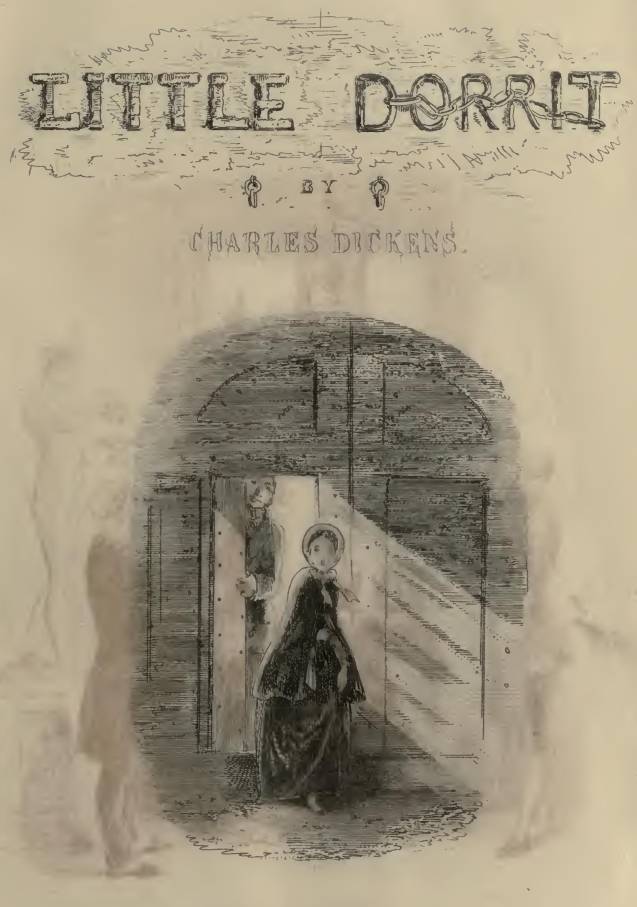
Original
‘Do not reject the hope, the certainty, this kind man offers you,’ said Clennam in a low emphatic voice. ‘Turn to the friends you have not forgotten. Think once more!’
‘I won’t! Miss Wade,’ said the girl, with her bosom swelling high, and speaking with her hand held to her throat, ‘take me away!’
‘Tattycoram,’ said Mr Meagles. ‘Once more yet! The only thing I ask of you in the world, my child! Count five-and-twenty!’
She put her hands tightly over her ears, confusedly tumbling down her bright black hair in the vehemence of the action, and turned her face resolutely to the wall. Miss Wade, who had watched her under this final appeal with that strange attentive smile, and that repressing hand upon her own bosom with which she had watched her in her struggle at Marseilles, then put her arm about her waist as if she took possession of her for evermore.
And there was a visible triumph in her face when she turned it to dismiss the visitors.
‘As it is the last time I shall have the honour,’ she said, ‘and as you have spoken of not knowing what I am, and also of the foundation of my influence here, you may now know that it is founded in a common cause. What your broken plaything is as to birth, I am. She has no name, I have no name. Her wrong is my wrong. I have nothing more to say to you.’
This was addressed to Mr Meagles, who sorrowfully went out. As Clennam followed, she said to him, with the same external composure and in the same level voice, but with a smile that is only seen on cruel faces: a very faint smile, lifting the nostril, scarcely touching the lips, and not breaking away gradually, but instantly dismissed when done with:
‘I hope the wife of your dear friend Mr Gowan, may be happy in the contrast of her extraction to this girl’s and mine, and in the high good fortune that awaits her.’
CHAPTER 28. Nobody’s Disappearance
Not resting satisfied with the endeavours he had made to recover his lost charge, Mr Meagles addressed a letter of remonstrance, breathing nothing but goodwill, not only to her, but to Miss Wade too. No answer coming to these epistles, or to another written to the stubborn girl by the hand of her late young mistress, which might have melted her if anything could (all three letters were returned weeks afterwards as having been refused at the house-door), he deputed Mrs Meagles to make the experiment of a personal interview. That worthy lady being unable to obtain one, and being steadfastly denied admission, Mr Meagles besought Arthur to essay once more what he could do. All that came of his compliance was, his discovery that the empty house was left in charge of the old woman, that Miss Wade was gone, that the waifs and strays of furniture were gone, and that the old woman would accept any number of half-crowns and thank the donor kindly, but had no information whatever to exchange for those coins, beyond constantly offering for perusal a memorandum relative to fixtures, which the house-agent’s young man had left in the hall.
Unwilling, even under this discomfiture, to resign the ingrate and leave her hopeless, in case of her better dispositions obtaining the mastery over the darker side of her character, Mr Meagles, for six successive days, published a discreetly covert advertisement in the morning papers, to the effect that if a certain young person who had lately left home without reflection, would at any time apply to his address at Twickenham, everything would be as it had been before, and no reproaches need be apprehended. The unexpected consequences of this notification suggested to the dismayed Mr Meagles for the first time that some hundreds of young persons must be leaving their homes without reflection every day; for shoals of wrong young people came down to Twickenham, who, not finding themselves received with enthusiasm, generally demanded compensation by way of damages, in addition to coach-hire there and back. Nor were these the only uninvited clients whom the advertisement produced. The swarm of begging-letter writers, who would seem to be always watching eagerly for any hook, however small, to hang a letter upon, wrote to say that having seen the advertisement, they were induced to apply with confidence for various sums, ranging from ten shillings to fifty pounds: not because they knew anything about the young person, but because they felt that to part with those donations would greatly relieve the advertiser’s mind. Several projectors, likewise, availed themselves of the same opportunity to correspond with Mr Meagles; as, for example, to apprise him that their attention having been called to the advertisement by a friend, they begged to state that if they should ever hear anything of the young person, they would not fail to make it known to him immediately, and that in the meantime if he would oblige them with the funds necessary for bringing to perfection a certain entirely novel description of Pump, the happiest results would ensue to mankind.
Mr Meagles and his family, under these combined discouragements, had begun reluctantly to give up Tattycoram as irrecoverable, when the new and active firm of Doyce and Clennam, in their private capacities, went down on a Saturday to stay at the cottage until Monday. The senior partner took the coach, and the junior partner took his walking-stick.
A tranquil summer sunset shone upon him as he approached the end of his walk, and passed through the meadows by the river side. He had that sense of peace, and of being lightened of a weight of care, which country quiet awakens in the breasts of dwellers in towns. Everything within his view was lovely and placid. The rich foliage of the trees, the luxuriant grass diversified with wild flowers, the little green islands in the river, the beds of rushes, the water-lilies floating on the surface of the stream, the distant voices in boats borne musically towards him on the ripple of the water and the evening air, were all expressive of rest. In the occasional leap of a fish, or dip of an oar, or twittering of a bird not yet at roost, or distant barking of a dog, or lowing of a cow—in all such sounds, there was the prevailing breath of rest, which seemed to encompass him in every scent that sweetened the fragrant air. The long lines of red and gold in the sky, and the glorious track of the descending sun, were all divinely calm. Upon the purple tree-tops far away, and on the green height near at hand up which the shades were slowly creeping, there was an equal hush. Between the real landscape and its shadow in the water, there was no division; both were so untroubled and clear, and, while so fraught with solemn mystery of life and death, so hopefully reassuring to the gazer’s soothed heart, because so tenderly and mercifully beautiful.
Clennam had stopped, not for the first time by many times, to look about him and suffer what he saw to sink into his soul, as the shadows, looked at, seemed to sink deeper and deeper into the water. He was slowly resuming his way, when he saw a figure in the path before him which he had, perhaps, already associated with the evening and its impressions.
Minnie was there, alone. She had some roses in her hand, and seemed to have stood still on seeing him, waiting for him. Her face was towards him, and she appeared to have been coming from the opposite direction. There was a flutter in her manner, which Clennam had never seen in it before; and as he came near her, it entered his mind all at once that she was there of a set purpose to speak to him.
She gave him her hand, and said, ‘You wonder to see me here by myself? But the evening is so lovely, I have strolled further than I meant at first. I thought it likely I might meet you, and that made me more confident. You always come this way, do you not?’
As Clennam said that it was his favourite way, he felt her hand falter on his arm, and saw the roses shake.
‘Will you let me give you one, Mr Clennam? I gathered them as I came out of the garden. Indeed, I almost gathered them for you, thinking it so likely I might meet you. Mr Doyce arrived more than an hour ago, and told us you were walking down.’
His own hand shook, as he accepted a rose or two from hers and thanked her. They were now by an avenue of trees. Whether they turned into it on his movement or on hers matters little. He never knew how that was.
‘It is very grave here,’ said Clennam, ‘but very pleasant at this hour. Passing along this deep shade, and out at that arch of light at the other end, we come upon the ferry and the cottage by the best approach, I think.’
In her simple garden-hat and her light summer dress, with her rich brown hair naturally clustering about her, and her wonderful eyes raised to his for a moment with a look in which regard for him and trustfulness in him were strikingly blended with a kind of timid sorrow for him, she was so beautiful that it was well for his peace—or ill for his peace, he did not quite know which—that he had made that vigorous resolution he had so often thought about.
She broke a momentary silence by inquiring if he knew that papa had been thinking of another tour abroad? He said he had heard it mentioned. She broke another momentary silence by adding, with some hesitation, that papa had abandoned the idea.
At this, he thought directly, ‘they are to be married.’
‘Mr Clennam,’ she said, hesitating more timidly yet, and speaking so low that he bent his head to hear her. ‘I should very much like to give you my confidence, if you would not mind having the goodness to receive it. I should have very much liked to have given it to you long ago, because—I felt that you were becoming so much our friend.’
‘How can I be otherwise than proud of it at any time! Pray give it to me. Pray trust me.’
‘I could never have been afraid of trusting you,’ she returned, raising her eyes frankly to his face. ‘I think I would have done so some time ago, if I had known how. But I scarcely know how, even now.’
‘Mr Gowan,’ said Arthur Clennam, ‘has reason to be very happy. God bless his wife and him!’
She wept, as she tried to thank him. He reassured her, took her hand as it lay with the trembling roses in it on his arm, took the remaining roses from it, and put it to his lips. At that time, it seemed to him, he first finally resigned the dying hope that had flickered in nobody’s heart so much to its pain and trouble; and from that time he became in his own eyes, as to any similar hope or prospect, a very much older man who had done with that part of life.
He put the roses in his breast and they walked on for a little while, slowly and silently, under the umbrageous trees. Then he asked her, in a voice of cheerful kindness, was there anything else that she would say to him as her friend and her father’s friend, many years older than herself; was there any trust she would repose in him, any service she would ask of him, any little aid to her happiness that she could give him the lasting gratification of believing it was in his power to render?
She was going to answer, when she was so touched by some little hidden sorrow or sympathy—what could it have been?—that she said, bursting into tears again: ‘O Mr Clennam! Good, generous, Mr Clennam, pray tell me you do not blame me.’
‘I blame you?’ said Clennam. ‘My dearest girl! I blame you? No!’
After clasping both her hands upon his arm, and looking confidentially up into his face, with some hurried words to the effect that she thanked him from her heart (as she did, if it be the source of earnestness), she gradually composed herself, with now and then a word of encouragement from him, as they walked on slowly and almost silently under the darkening trees.
‘And, now, Minnie Gowan,’ at length said Clennam, smiling; ‘will you ask me nothing?’
‘Oh! I have very much to ask of you.’
‘That’s well! I hope so; I am not disappointed.’
‘You know how I am loved at home, and how I love home. You can hardly think it perhaps, dear Mr Clennam,’ she spoke with great agitation, ‘seeing me going from it of my own free will and choice, but I do so dearly love it!’
‘I am sure of that,’ said Clennam. ‘Can you suppose I doubt it?’
‘No, no. But it is strange, even to me, that loving it so much and being so much beloved in it, I can bear to cast it away. It seems so neglectful of it, so unthankful.’
‘My dear girl,’ said Clennam, ‘it is in the natural progress and change of time. All homes are left so.’
‘Yes, I know; but all homes are not left with such a blank in them as there will be in mine when I am gone. Not that there is any scarcity of far better and more endearing and more accomplished girls than I am; not that I am much, but that they have made so much of me!’
Pet’s affectionate heart was overcharged, and she sobbed while she pictured what would happen.
‘I know what a change papa will feel at first, and I know that at first I cannot be to him anything like what I have been these many years. And it is then, Mr Clennam, then more than at any time, that I beg and entreat you to remember him, and sometimes to keep him company when you can spare a little while; and to tell him that you know I was fonder of him when I left him, than I ever was in all my life. For there is nobody—he told me so himself when he talked to me this very day—there is nobody he likes so well as you, or trusts so much.’
A clue to what had passed between the father and daughter dropped like a heavy stone into the well of Clennam’s heart, and swelled the water to his eyes. He said, cheerily, but not quite so cheerily as he tried to say, that it should be done—that he gave her his faithful promise.
‘If I do not speak of mama,’ said Pet, more moved by, and more pretty in, her innocent grief, than Clennam could trust himself even to consider—for which reason he counted the trees between them and the fading light as they slowly diminished in number—‘it is because mama will understand me better in this action, and will feel my loss in a different way, and will look forward in a different manner. But you know what a dear, devoted mother she is, and you will remember her too; will you not?’
Let Minnie trust him, Clennam said, let Minnie trust him to do all she wished.
‘And, dear Mr Clennam,’ said Minnie, ‘because papa and one whom I need not name, do not fully appreciate and understand one another yet, as they will by-and-by; and because it will be the duty, and the pride, and pleasure of my new life, to draw them to a better knowledge of one another, and to be a happiness to one another, and to be proud of one another, and to love one another, both loving me so dearly; oh, as you are a kind, true man! when I am first separated from home (I am going a long distance away), try to reconcile papa to him a little more, and use your great influence to keep him before papa’s mind free from prejudice and in his real form. Will you do this for me, as you are a noble-hearted friend?’
Poor Pet! Self-deceived, mistaken child! When were such changes ever made in men’s natural relations to one another: when was such reconcilement of ingrain differences ever effected! It has been tried many times by other daughters, Minnie; it has never succeeded; nothing has ever come of it but failure.
So Clennam thought. So he did not say; it was too late. He bound himself to do all she asked, and she knew full well that he would do it.
They were now at the last tree in the avenue. She stopped, and withdrew her arm. Speaking to him with her eyes lifted up to his, and with the hand that had lately rested on his sleeve trembling by touching one of the roses in his breast as an additional appeal to him, she said:
‘Dear Mr Clennam, in my happiness—for I am happy, though you have seen me crying—I cannot bear to leave any cloud between us. If you have anything to forgive me (not anything that I have wilfully done, but any trouble I may have caused you without meaning it, or having it in my power to help it), forgive me to-night out of your noble heart!’
He stooped to meet the guileless face that met his without shrinking. He kissed it, and answered, Heaven knew that he had nothing to forgive. As he stooped to meet the innocent face once again, she whispered, ‘Good-bye!’ and he repeated it. It was taking leave of all his old hopes—all nobody’s old restless doubts. They came out of the avenue next moment, arm-in-arm as they had entered it: and the trees seemed to close up behind them in the darkness, like their own perspective of the past.
The voices of Mr and Mrs Meagles and Doyce were audible directly, speaking near the garden gate. Hearing Pet’s name among them, Clennam called out, ‘She is here, with me.’ There was some little wondering and laughing until they came up; but as soon as they had all come together, it ceased, and Pet glided away.
Mr Meagles, Doyce, and Clennam, without speaking, walked up and down on the brink of the river, in the light of the rising moon, for a few minutes; and then Doyce lingered behind, and went into the house. Mr Meagles and Clennam walked up and down together for a few minutes more without speaking, until at length the former broke silence.
‘Arthur,’ said he, using that familiar address for the first time in their communication, ‘do you remember my telling you, as we walked up and down one hot morning, looking over the harbour at Marseilles, that Pet’s baby sister who was dead seemed to Mother and me to have grown as she had grown, and changed as she had changed?’
‘Very well.’
‘You remember my saying that our thoughts had never been able to separate those twin sisters, and that, in our fancy, whatever Pet was, the other was?’
‘Yes, very well.’
‘Arthur,’ said Mr Meagles, much subdued, ‘I carry that fancy further to-night. I feel to-night, my dear fellow, as if you had loved my dead child very tenderly, and had lost her when she was like what Pet is now.’
‘Thank you!’ murmured Clennam, ‘thank you!’ And pressed his hand.
‘Will you come in?’ said Mr Meagles, presently.
‘In a little while.’
Original
Mr Meagles fell away, and he was left alone. When he had walked on the river’s brink in the peaceful moonlight for some half an hour, he put his hand in his breast and tenderly took out the handful of roses. Perhaps he put them to his heart, perhaps he put them to his lips, but certainly he bent down on the shore and gently launched them on the flowing river. Pale and unreal in the moonlight, the river floated them away.
The lights were bright within doors when he entered, and the faces on which they shone, his own face not excepted, were soon quietly cheerful. They talked of many subjects (his partner never had had such a ready store to draw upon for the beguiling of the time), and so to bed, and to sleep. While the flowers, pale and unreal in the moonlight, floated away upon the river; and thus do greater things that once were in our breasts, and near our hearts, flow from us to the eternal seas.
CHAPTER 29. Mrs Flintwinch goes on Dreaming
The house in the city preserved its heavy dulness through all these transactions, and the invalid within it turned the same unvarying round of life. Morning, noon, and night, morning, noon, and night, each recurring with its accompanying monotony, always the same reluctant return of the same sequences of machinery, like a dragging piece of clockwork.
The wheeled chair had its associated remembrances and reveries, one may suppose, as every place that is made the station of a human being has. Pictures of demolished streets and altered houses, as they formerly were when the occupant of the chair was familiar with them, images of people as they too used to be, with little or no allowance made for the lapse of time since they were seen; of these, there must have been many in the long routine of gloomy days. To stop the clock of busy existence at the hour when we were personally sequestered from it, to suppose mankind stricken motionless when we were brought to a stand-still, to be unable to measure the changes beyond our view by any larger standard than the shrunken one of our own uniform and contracted existence, is the infirmity of many invalids, and the mental unhealthiness of almost all recluses.
What scenes and actors the stern woman most reviewed, as she sat from season to season in her one dark room, none knew but herself. Mr Flintwinch, with his wry presence brought to bear upon her daily like some eccentric mechanical force, would perhaps have screwed it out of her, if there had been less resistance in her; but she was too strong for him. So far as Mistress Affery was concerned, to regard her liege-lord and her disabled mistress with a face of blank wonder, to go about the house after dark with her apron over her head, always to listen for the strange noises and sometimes to hear them, and never to emerge from her ghostly, dreamy, sleep-waking state, was occupation enough for her.
There was a fair stroke of business doing, as Mistress Affery made out, for her husband had abundant occupation in his little office, and saw more people than had been used to come there for some years. This might easily be, the house having been long deserted; but he did receive letters, and comers, and keep books, and correspond. Moreover, he went about to other counting-houses, and to wharves, and docks, and to the Custom House, and to Garraway’s Coffee House, and the Jerusalem Coffee House, and on ‘Change; so that he was much in and out. He began, too, sometimes of an evening, when Mrs Clennam expressed no particular wish for his society, to resort to a tavern in the neighbourhood to look at the shipping news and closing prices in the evening paper, and even to exchange small socialities with mercantile Sea Captains who frequented that establishment. At some period of every day, he and Mrs Clennam held a council on matters of business; and it appeared to Affery, who was always groping about, listening and watching, that the two clever ones were making money.
The state of mind into which Mr Flintwinch’s dazed lady had fallen, had now begun to be so expressed in all her looks and actions that she was held in very low account by the two clever ones, as a person, never of strong intellect, who was becoming foolish. Perhaps because her appearance was not of a commercial cast, or perhaps because it occurred to him that his having taken her to wife might expose his judgment to doubt in the minds of customers, Mr Flintwinch laid his commands upon her that she should hold her peace on the subject of her conjugal relations, and should no longer call him Jeremiah out of the domestic trio. Her frequent forgetfulness of this admonition intensified her startled manner, since Mr Flintwinch’s habit of avenging himself on her remissness by making springs after her on the staircase, and shaking her, occasioned her to be always nervously uncertain when she might be thus waylaid next.
Little Dorrit had finished a long day’s work in Mrs Clennam’s room, and was neatly gathering up her shreds and odds and ends before going home. Mr Pancks, whom Affery had just shown in, was addressing an inquiry to Mrs Clennam on the subject of her health, coupled with the remark that, ‘happening to find himself in that direction,’ he had looked in to inquire, on behalf of his proprietor, how she found herself. Mrs Clennam, with a deep contraction of her brows, was looking at him.
‘Mr Casby knows,’ said she, ‘that I am not subject to changes. The change that I await here is the great change.’
‘Indeed, ma’am?’ returned Mr Pancks, with a wandering eye towards the figure of the little seamstress on her knee picking threads and fraying of her work from the carpet. ‘You look nicely, ma’am.’
‘I bear what I have to bear,’ she answered. ‘Do you what you have to do.’
‘Thank you, ma’am,’ said Mr Pancks, ‘such is my endeavour.’
‘You are often in this direction, are you not?’ asked Mrs Clennam.
‘Why, yes, ma’am,’ said Pancks, ‘rather so lately; I have lately been round this way a good deal, owing to one thing and another.’
‘Beg Mr Casby and his daughter not to trouble themselves, by deputy, about me. When they wish to see me, they know I am here to see them. They have no need to trouble themselves to send. You have no need to trouble yourself to come.’
‘Not the least trouble, ma’am,’ said Mr Pancks. ‘You really are looking uncommonly nicely, ma’am.’
‘Thank you. Good evening.’
The dismissal, and its accompanying finger pointed straight at the door, was so curt and direct that Mr Pancks did not see his way to prolong his visit. He stirred up his hair with his sprightliest expression, glanced at the little figure again, said ‘Good evening, ma ‘am; don’t come down, Mrs Affery, I know the road to the door,’ and steamed out. Mrs Clennam, her chin resting on her hand, followed him with attentive and darkly distrustful eyes; and Affery stood looking at her as if she were spell-bound.
Slowly and thoughtfully, Mrs Clennam’s eyes turned from the door by which Pancks had gone out, to Little Dorrit, rising from the carpet. With her chin drooping more heavily on her hand, and her eyes vigilant and lowering, the sick woman sat looking at her until she attracted her attention. Little Dorrit coloured under such a gaze, and looked down. Mrs Clennam still sat intent.
‘Little Dorrit,’ she said, when she at last broke silence, ‘what do you know of that man?’
‘I don’t know anything of him, ma’am, except that I have seen him about, and that he has spoken to me.’
‘What has he said to you?’
‘I don’t understand what he has said, he is so strange. But nothing rough or disagreeable.’
‘Why does he come here to see you?’
‘I don’t know, ma’am,’ said Little Dorrit, with perfect frankness.
‘You know that he does come here to see you?’
‘I have fancied so,’ said Little Dorrit. ‘But why he should come here or anywhere for that, ma’am, I can’t think.’
Mrs Clennam cast her eyes towards the ground, and with her strong, set face, as intent upon a subject in her mind as it had lately been upon the form that seemed to pass out of her view, sat absorbed. Some minutes elapsed before she came out of this thoughtfulness, and resumed her hard composure.
Little Dorrit in the meanwhile had been waiting to go, but afraid to disturb her by moving. She now ventured to leave the spot where she had been standing since she had risen, and to pass gently round by the wheeled chair. She stopped at its side to say ‘Good night, ma’am.’
Mrs Clennam put out her hand, and laid it on her arm. Little Dorrit, confused under the touch, stood faltering. Perhaps some momentary recollection of the story of the Princess may have been in her mind.
‘Tell me, Little Dorrit,’ said Mrs Clennam, ‘have you many friends now?’
‘Very few, ma’am. Besides you, only Miss Flora and—one more.’
‘Meaning,’ said Mrs Clennam, with her unbent finger again pointing to the door, ‘that man?’
‘Oh no, ma’am!’
‘Some friend of his, perhaps?’
‘No ma’am.’ Little Dorrit earnestly shook her head. ‘Oh no! No one at all like him, or belonging to him.’
‘Well!’ said Mrs Clennam, almost smiling. ‘It is no affair of mine. I ask, because I take an interest in you; and because I believe I was your friend when you had no other who could serve you. Is that so?’
‘Yes, ma’am; indeed it is. I have been here many a time when, but for you and the work you gave me, we should have wanted everything.’
‘We,’ repeated Mrs Clennam, looking towards the watch, once her dead husband’s, which always lay upon her table. ‘Are there many of you?’
‘Only father and I, now. I mean, only father and I to keep regularly out of what we get.’
‘Have you undergone many privations? You and your father and who else there may be of you?’ asked Mrs Clennam, speaking deliberately, and meditatively turning the watch over and over.
‘Sometimes it has been rather hard to live,’ said Little Dorrit, in her soft voice, and timid uncomplaining way; ‘but I think not harder—as to that—than many people find it.’
‘That’s well said!’ Mrs Clennam quickly returned. ‘That’s the truth! You are a good, thoughtful girl. You are a grateful girl too, or I much mistake you.’
‘It is only natural to be that. There is no merit in being that,’ said Little Dorrit. ‘I am indeed.’
Mrs Clennam, with a gentleness of which the dreaming Affery had never dreamed her to be capable, drew down the face of her little seamstress, and kissed her on the forehead.
‘Now go, Little Dorrit,’ said she, ‘or you will be late, poor child!’
In all the dreams Mistress Affery had been piling up since she first became devoted to the pursuit, she had dreamed nothing more astonishing than this. Her head ached with the idea that she would find the other clever one kissing Little Dorrit next, and then the two clever ones embracing each other and dissolving into tears of tenderness for all mankind. The idea quite stunned her, as she attended the light footsteps down the stairs, that the house door might be safely shut.
On opening it to let Little Dorrit out, she found Mr Pancks, instead of having gone his way, as in any less wonderful place and among less wonderful phenomena he might have been reasonably expected to do, fluttering up and down the court outside the house. The moment he saw Little Dorrit, he passed her briskly, said with his finger to his nose (as Mrs Affery distinctly heard), ‘Pancks the gipsy, fortune-telling,’ and went away. ‘Lord save us, here’s a gipsy and a fortune-teller in it now!’ cried Mistress Affery. ‘What next!’
She stood at the open door, staggering herself with this enigma, on a rainy, thundery evening. The clouds were flying fast, and the wind was coming up in gusts, banging some neighbouring shutters that had broken loose, twirling the rusty chimney-cowls and weather-cocks, and rushing round and round a confined adjacent churchyard as if it had a mind to blow the dead citizens out of their graves. The low thunder, muttering in all quarters of the sky at once, seemed to threaten vengeance for this attempted desecration, and to mutter, ‘Let them rest! Let them rest!’
Mistress Affery, whose fear of thunder and lightning was only to be equalled by her dread of the haunted house with a premature and preternatural darkness in it, stood undecided whether to go in or not, until the question was settled for her by the door blowing upon her in a violent gust of wind and shutting her out. ‘What’s to be done now, what’s to be done now!’ cried Mistress Affery, wringing her hands in this last uneasy dream of all; ‘when she’s all alone by herself inside, and can no more come down to open it than the churchyard dead themselves!’
In this dilemma, Mistress Affery, with her apron as a hood to keep the rain off, ran crying up and down the solitary paved enclosure several times. Why she should then stoop down and look in at the keyhole of the door as if an eye would open it, it would be difficult to say; but it is none the less what most people would have done in the same situation, and it is what she did.
From this posture she started up suddenly, with a half scream, feeling something on her shoulder. It was the touch of a hand; of a man’s hand.
The man was dressed like a traveller, in a foraging cap with fur about it, and a heap of cloak. He looked like a foreigner. He had a quantity of hair and moustache—jet black, except at the shaggy ends, where it had a tinge of red—and a high hook nose. He laughed at Mistress Affery’s start and cry; and as he laughed, his moustache went up under his nose, and his nose came down over his moustache.
‘What’s the matter?’ he asked in plain English. ‘What are you frightened at?’
‘At you,’ panted Affery.
‘Me, madam?’
‘And the dismal evening, and—and everything,’ said Affery. ‘And here! The wind has been and blown the door to, and I can’t get in.’
‘Hah!’ said the gentleman, who took that very coolly. ‘Indeed! Do you know such a name as Clennam about here?’
‘Lord bless us, I should think I did, I should think I did!’ cried Affery, exasperated into a new wringing of hands by the inquiry.
‘Where about here?’
‘Where!’ cried Affery, goaded into another inspection of the keyhole. ‘Where but here in this house? And she’s all alone in her room, and lost the use of her limbs and can’t stir to help herself or me, and t’other clever one’s out, and Lord forgive me!’ cried Affery, driven into a frantic dance by these accumulated considerations, ‘if I ain’t a-going headlong out of my mind!’
Taking a warmer view of the matter now that it concerned himself, the gentleman stepped back to glance at the house, and his eye soon rested on the long narrow window of the little room near the hall-door.
‘Where may the lady be who has lost the use of her limbs, madam?’ he inquired, with that peculiar smile which Mistress Affery could not choose but keep her eyes upon.
‘Up there!’ said Affery. ‘Them two windows.’
‘Hah! I am of a fair size, but could not have the honour of presenting myself in that room without a ladder. Now, madam, frankly—frankness is a part of my character—shall I open the door for you?’
‘Yes, bless you, sir, for a dear creetur, and do it at once,’ cried Affery, ‘for she may be a-calling to me at this very present minute, or may be setting herself a fire and burning herself to death, or there’s no knowing what may be happening to her, and me a-going out of my mind at thinking of it!’
‘Stay, my good madam!’ He restrained her impatience with a smooth white hand. ‘Business-hours, I apprehend, are over for the day?’
‘Yes, yes, yes,’ cried Affery. ‘Long ago.’
‘Let me make, then, a fair proposal. Fairness is a part of my character. I am just landed from the packet-boat, as you may see.’ He showed her that his cloak was very wet, and that his boots were saturated with water; she had previously observed that he was dishevelled and sallow, as if from a rough voyage, and so chilled that he could not keep his teeth from chattering. ‘I am just landed from the packet-boat, madam, and have been delayed by the weather: the infernal weather! In consequence of this, madam, some necessary business that I should otherwise have transacted here within the regular hours (necessary business because money-business), still remains to be done. Now, if you will fetch any authorised neighbouring somebody to do it in return for my opening the door, I’ll open the door. If this arrangement should be objectionable, I’ll—’ and with the same smile he made a significant feint of backing away.
Mistress Affery, heartily glad to effect the proposed compromise, gave in her willing adhesion to it. The gentleman at once requested her to do him the favour of holding his cloak, took a short run at the narrow window, made a leap at the sill, clung his way up the bricks, and in a moment had his hand at the sash, raising it. His eyes looked so very sinister, as he put his leg into the room and glanced round at Mistress Affery, that she thought with a sudden coldness, if he were to go straight up-stairs to murder the invalid, what could she do to prevent him?
Happily he had no such purpose; for he reappeared, in a moment, at the house door. ‘Now, my dear madam,’ he said, as he took back his cloak and threw it on, ‘if you have the goodness to—what the Devil’s that!’
The strangest of sounds. Evidently close at hand from the peculiar shock it communicated to the air, yet subdued as if it were far off. A tremble, a rumble, and a fall of some light dry matter.
‘What the Devil is it?’
‘I don’t know what it is, but I’ve heard the like of it over and over again,’ said Affery, who had caught his arm.
He could hardly be a very brave man, even she thought in her dreamy start and fright, for his trembling lips had turned colourless. After listening a few moments, he made light of it.
‘Bah! Nothing! Now, my dear madam, I think you spoke of some clever personage. Will you be so good as to confront me with that genius?’ He held the door in his hand, as though he were quite ready to shut her out again if she failed.
‘Don’t you say anything about the door and me, then,’ whispered Affery.
‘Not a word.’
‘And don’t you stir from here, or speak if she calls, while I run round the corner.’
‘Madam, I am a statue.’
Affery had so vivid a fear of his going stealthily up-stairs the moment her back was turned, that after hurrying out of sight, she returned to the gateway to peep at him. Seeing him still on the threshold, more out of the house than in it, as if he had no love for darkness and no desire to probe its mysteries, she flew into the next street, and sent a message into the tavern to Mr Flintwinch, who came out directly. The two returning together—the lady in advance, and Mr Flintwinch coming up briskly behind, animated with the hope of shaking her before she could get housed—saw the gentleman standing in the same place in the dark, and heard the strong voice of Mrs Clennam calling from her room, ‘Who is it? What is it? Why does no one answer? Who is that, down there?’
CHAPTER 30. The Word of a Gentleman
When Mr and Mrs Flintwinch panted up to the door of the old house in the twilight, Jeremiah within a second of Affery, the stranger started back. ‘Death of my soul!’ he exclaimed. ‘Why, how did you get here?’
Mr Flintwinch, to whom these words were spoken, repaid the stranger’s wonder in full. He gazed at him with blank astonishment; he looked over his own shoulder, as expecting to see some one he had not been aware of standing behind him; he gazed at the stranger again, speechlessly, at a loss to know what he meant; he looked to his wife for explanation; receiving none, he pounced upon her, and shook her with such heartiness that he shook her cap off her head, saying between his teeth, with grim raillery, as he did it, ‘Affery, my woman, you must have a dose, my woman! This is some of your tricks! You have been dreaming again, mistress. What’s it about? Who is it? What does it mean! Speak out or be choked! It’s the only choice I’ll give you.’
Original
Supposing Mistress Affery to have any power of election at the moment, her choice was decidedly to be choked; for she answered not a syllable to this adjuration, but, with her bare head wagging violently backwards and forwards, resigned herself to her punishment. The stranger, however, picking up her cap with an air of gallantry, interposed.
‘Permit me,’ said he, laying his hand on the shoulder of Jeremiah, who stopped and released his victim. ‘Thank you. Excuse me. Husband and wife I know, from this playfulness. Haha! Always agreeable to see that relation playfully maintained. Listen! May I suggest that somebody up-stairs, in the dark, is becoming energetically curious to know what is going on here?’
This reference to Mrs Clennam’s voice reminded Mr Flintwinch to step into the hall and call up the staircase. ‘It’s all right, I am here, Affery is coming with your light.’ Then he said to the latter flustered woman, who was putting her cap on, ‘Get out with you, and get up-stairs!’ and then turned to the stranger and said to him, ‘Now, sir, what might you please to want?’
‘I am afraid,’ said the stranger, ‘I must be so troublesome as to propose a candle.’
‘True,’ assented Jeremiah. ‘I was going to do so. Please to stand where you are while I get one.’
The visitor was standing in the doorway, but turned a little into the gloom of the house as Mr Flintwinch turned, and pursued him with his eyes into the little room, where he groped about for a phosphorus box. When he found it, it was damp, or otherwise out of order; and match after match that he struck into it lighted sufficiently to throw a dull glare about his groping face, and to sprinkle his hands with pale little spots of fire, but not sufficiently to light the candle. The stranger, taking advantage of this fitful illumination of his visage, looked intently and wonderingly at him. Jeremiah, when he at last lighted the candle, knew he had been doing this, by seeing the last shade of a lowering watchfulness clear away from his face, as it broke into the doubtful smile that was a large ingredient in its expression.
‘Be so good,’ said Jeremiah, closing the house door, and taking a pretty sharp survey of the smiling visitor in his turn, ‘as to step into my counting-house.—It’s all right, I tell you!’ petulantly breaking off to answer the voice up-stairs, still unsatisfied, though Affery was there, speaking in persuasive tones. ‘Don’t I tell you it’s all right? Preserve the woman, has she no reason at all in her!’
‘Timorous,’ remarked the stranger.
‘Timorous?’ said Mr Flintwinch, turning his head to retort, as he went before with the candle. ‘More courageous than ninety men in a hundred, sir, let me tell you.’
‘Though an invalid?’
‘Many years an invalid. Mrs Clennam. The only one of that name left in the House now. My partner.’
Saying something apologetically as he crossed the hall, to the effect that at that time of night they were not in the habit of receiving any one, and were always shut up, Mr Flintwinch led the way into his own office, which presented a sufficiently business-like appearance. Here he put the light on his desk, and said to the stranger, with his wryest twist upon him, ‘Your commands.’
‘My name is Blandois.’
‘Blandois. I don’t know it,’ said Jeremiah.
‘I thought it possible,’ resumed the other, ‘that you might have been advised from Paris—’
‘We have had no advice from Paris respecting anybody of the name of Blandois,’ said Jeremiah.
‘No?’
‘No.’
Jeremiah stood in his favourite attitude. The smiling Mr Blandois, opening his cloak to get his hand to a breast-pocket, paused to say, with a laugh in his glittering eyes, which it occurred to Mr Flintwinch were too near together:
‘You are so like a friend of mine! Not so identically the same as I supposed when I really did for the moment take you to be the same in the dusk—for which I ought to apologise; permit me to do so; a readiness to confess my errors is, I hope, a part of the frankness of my character—still, however, uncommonly like.’
‘Indeed?’ said Jeremiah, perversely. ‘But I have not received any letter of advice from anywhere respecting anybody of the name of Blandois.’
‘Just so,’ said the stranger.
‘Just so,’ said Jeremiah.
Mr Blandois, not at all put out by this omission on the part of the correspondents of the house of Clennam and Co., took his pocket-book from his breast-pocket, selected a letter from that receptacle, and handed it to Mr Flintwinch. ‘No doubt you are well acquainted with the writing. Perhaps the letter speaks for itself, and requires no advice. You are a far more competent judge of such affairs than I am. It is my misfortune to be, not so much a man of business, as what the world calls (arbitrarily) a gentleman.’
Mr Flintwinch took the letter, and read, under date of Paris, ‘We have to present to you, on behalf of a highly esteemed correspondent of our Firm, M. Blandois, of this city,’ &c. &c. ‘Such facilities as he may require and such attentions as may lie in your power,’ &c. &c. ‘Also have to add that if you will honour M. Blandois’ drafts at sight to the extent of, say Fifty Pounds sterling (50l.),’ &c. &c.
‘Very good, sir,’ said Mr Flintwinch. ‘Take a chair. To the extent of anything that our House can do—we are in a retired, old-fashioned, steady way of business, sir—we shall be happy to render you our best assistance. I observe, from the date of this, that we could not yet be advised of it. Probably you came over with the delayed mail that brings the advice.’
‘That I came over with the delayed mail, sir,’ returned Mr Blandois, passing his white hand down his high-hooked nose, ‘I know to the cost of my head and stomach: the detestable and intolerable weather having racked them both. You see me in the plight in which I came out of the packet within this half-hour. I ought to have been here hours ago, and then I should not have to apologise—permit me to apologise—for presenting myself so unreasonably, and frightening—no, by-the-bye, you said not frightening; permit me to apologise again—the esteemed lady, Mrs Clennam, in her invalid chamber above stairs.’
Swagger and an air of authorised condescension do so much, that Mr Flintwinch had already begun to think this a highly gentlemanly personage. Not the less unyielding with him on that account, he scraped his chin and said, what could he have the honour of doing for Mr Blandois to-night, out of business hours?
‘Faith!’ returned that gentleman, shrugging his cloaked shoulders, ‘I must change, and eat and drink, and be lodged somewhere. Have the kindness to advise me, a total stranger, where, and money is a matter of perfect indifference until to-morrow. The nearer the place, the better. Next door, if that’s all.’
Mr Flintwinch was slowly beginning, ‘For a gentleman of your habits, there is not in this immediate neighbourhood any hotel—’ when Mr Blandois took him up.
‘So much for my habits! my dear sir,’ snapping his fingers. ‘A citizen of the world has no habits. That I am, in my poor way, a gentleman, by Heaven! I will not deny, but I have no unaccommodating prejudiced habits. A clean room, a hot dish for dinner, and a bottle of not absolutely poisonous wine, are all I want tonight. But I want that much without the trouble of going one unnecessary inch to get it.’
‘There is,’ said Mr Flintwinch, with more than his usual deliberation, as he met, for a moment, Mr Blandois’ shining eyes, which were restless; ‘there is a coffee-house and tavern close here, which, so far, I can recommend; but there’s no style about it.’
‘I dispense with style!’ said Mr Blandois, waving his hand. ‘Do me the honour to show me the house, and introduce me there (if I am not too troublesome), and I shall be infinitely obliged.’
Mr Flintwinch, upon this, looked up his hat, and lighted Mr Blandois across the hall again. As he put the candle on a bracket, where the dark old panelling almost served as an extinguisher for it, he bethought himself of going up to tell the invalid that he would not be absent five minutes.
‘Oblige me,’ said the visitor, on his saying so, ‘by presenting my card of visit. Do me the favour to add that I shall be happy to wait on Mrs Clennam, to offer my personal compliments, and to apologise for having occasioned any agitation in this tranquil corner, if it should suit her convenience to endure the presence of a stranger for a few minutes, after he shall have changed his wet clothes and fortified himself with something to eat and drink.’
Jeremiah made all despatch, and said, on his return, ‘She’ll be glad to see you, sir; but, being conscious that her sick room has no attractions, wishes me to say that she won’t hold you to your offer, in case you should think better of it.’
‘To think better of it,’ returned the gallant Blandois, ‘would be to slight a lady; to slight a lady would be to be deficient in chivalry towards the sex; and chivalry towards the sex is a part of my character!’ Thus expressing himself, he threw the draggled skirt of his cloak over his shoulder, and accompanied Mr Flintwinch to the tavern; taking up on the road a porter who was waiting with his portmanteau on the outer side of the gateway.
The house was kept in a homely manner, and the condescension of Mr Blandois was infinite. It seemed to fill to inconvenience the little bar in which the widow landlady and her two daughters received him; it was much too big for the narrow wainscoted room with a bagatelle-board in it, that was first proposed for his reception; it perfectly swamped the little private holiday sitting-room of the family, which was finally given up to him. Here, in dry clothes and scented linen, with sleeked hair, a great ring on each forefinger and a massive show of watch-chain, Mr Blandois waiting for his dinner, lolling on a window-seat with his knees drawn up, looked (for all the difference in the setting of the jewel) fearfully and wonderfully like a certain Monsieur Rigaud who had once so waited for his breakfast, lying on the stone ledge of the iron grating of a cell in a villainous dungeon at Marseilles.
His greed at dinner, too, was closely in keeping with the greed of Monsieur Rigaud at breakfast. His avaricious manner of collecting all the eatables about him, and devouring some with his eyes while devouring others with his jaws, was the same manner. His utter disregard of other people, as shown in his way of tossing the little womanly toys of furniture about, flinging favourite cushions under his boots for a softer rest, and crushing delicate coverings with his big body and his great black head, had the same brute selfishness at the bottom of it. The softly moving hands that were so busy among the dishes had the old wicked facility of the hands that had clung to the bars. And when he could eat no more, and sat sucking his delicate fingers one by one and wiping them on a cloth, there wanted nothing but the substitution of vine-leaves to finish the picture.
On this man, with his moustache going up and his nose coming down in that most evil of smiles, and with his surface eyes looking as if they belonged to his dyed hair, and had had their natural power of reflecting light stopped by some similar process, Nature, always true, and never working in vain, had set the mark, Beware! It was not her fault, if the warning were fruitless. She is never to blame in any such instance.
Mr Blandois, having finished his repast and cleaned his fingers, took a cigar from his pocket, and, lying on the window-seat again, smoked it out at his leisure, occasionally apostrophising the smoke as it parted from his thin lips in a thin stream:
‘Blandois, you shall turn the tables on society, my little child. Haha! Holy blue, you have begun well, Blandois! At a pinch, an excellent master in English or French; a man for the bosom of families! You have a quick perception, you have humour, you have ease, you have insinuating manners, you have a good appearance; in effect, you are a gentleman! A gentleman you shall live, my small boy, and a gentleman you shall die. You shall win, however the game goes. They shall all confess your merit, Blandois. You shall subdue the society which has grievously wronged you, to your own high spirit. Death of my soul! You are high spirited by right and by nature, my Blandois!’
To such soothing murmurs did this gentleman smoke out his cigar and drink out his bottle of wine. Both being finished, he shook himself into a sitting attitude; and with the concluding serious apostrophe, ‘Hold, then! Blandois, you ingenious one, have all your wits about you!’ arose and went back to the house of Clennam and Co.
He was received at the door by Mistress Affery, who, under instructions from her lord, had lighted up two candles in the hall and a third on the staircase, and who conducted him to Mrs Clennam’s room. Tea was prepared there, and such little company arrangements had been made as usually attended the reception of expected visitors. They were slight on the greatest occasion, never extending beyond the production of the China tea-service, and the covering of the bed with a sober and sad drapery. For the rest, there was the bier-like sofa with the block upon it, and the figure in the widow’s dress, as if attired for execution; the fire topped by the mound of damped ashes; the grate with its second little mound of ashes; the kettle and the smell of black dye; all as they had been for fifteen years.
Mr Flintwinch presented the gentleman commended to the consideration of Clennam and Co. Mrs Clennam, who had the letter lying before her, bent her head and requested him to sit. They looked very closely at one another. That was but natural curiosity.
‘I thank you, sir, for thinking of a disabled woman like me. Few who come here on business have any remembrance to bestow on one so removed from observation. It would be idle to expect that they should have. Out of sight, out of mind. While I am grateful for the exception, I don’t complain of the rule.’
Mr Blandois, in his most gentlemanly manner, was afraid he had disturbed her by unhappily presenting himself at such an unconscionable time. For which he had already offered his best apologies to Mr—he begged pardon—but by name had not the distinguished honour—
‘Mr Flintwinch has been connected with the House many years.’
Mr Blandois was Mr Flintwinch’s most obedient humble servant. He entreated Mr Flintwinch to receive the assurance of his profoundest consideration.
‘My husband being dead,’ said Mrs Clennam, ‘and my son preferring another pursuit, our old House has no other representative in these days than Mr Flintwinch.’
‘What do you call yourself?’ was the surly demand of that gentleman. ‘You have the head of two men.’
‘My sex disqualifies me,’ she proceeded with merely a slight turn of her eyes in Jeremiah’s direction, ‘from taking a responsible part in the business, even if I had the ability; and therefore Mr Flintwinch combines my interest with his own, and conducts it. It is not what it used to be; but some of our old friends (principally the writers of this letter) have the kindness not to forget us, and we retain the power of doing what they entrust to us as efficiently as we ever did. This however is not interesting to you. You are English, sir?’
‘Faith, madam, no; I am neither born nor bred in England. In effect, I am of no country,’ said Mr Blandois, stretching out his leg and smiting it: ‘I descend from half-a-dozen countries.’
‘You have been much about the world?’
‘It is true. By Heaven, madam, I have been here and there and everywhere!’
‘You have no ties, probably. Are not married?’
‘Madam,’ said Mr Blandois, with an ugly fall of his eyebrows, ‘I adore your sex, but I am not married—never was.’
Mistress Affery, who stood at the table near him, pouring out the tea, happened in her dreamy state to look at him as he said these words, and to fancy that she caught an expression in his eyes which attracted her own eyes so that she could not get them away. The effect of this fancy was to keep her staring at him with the tea-pot in her hand, not only to her own great uneasiness, but manifestly to his, too; and, through them both, to Mrs Clennam’s and Mr Flintwinch’s. Thus a few ghostly moments supervened, when they were all confusedly staring without knowing why.
‘Affery,’ her mistress was the first to say, ‘what is the matter with you?’
‘I don’t know,’ said Mistress Affery, with her disengaged left hand extended towards the visitor. ‘It ain’t me. It’s him!’
‘What does this good woman mean?’ cried Mr Blandois, turning white, hot, and slowly rising with a look of such deadly wrath that it contrasted surprisingly with the slight force of his words. ‘How is it possible to understand this good creature?’
‘It’s not possible,’ said Mr Flintwinch, screwing himself rapidly in that direction. ‘She don’t know what she means. She’s an idiot, a wanderer in her mind. She shall have a dose, she shall have such a dose! Get along with you, my woman,’ he added in her ear, ‘get along with you, while you know you’re Affery, and before you’re shaken to yeast.’
Mistress Affery, sensible of the danger in which her identity stood, relinquished the tea-pot as her husband seized it, put her apron over her head, and in a twinkling vanished. The visitor gradually broke into a smile, and sat down again.
‘You’ll excuse her, Mr Blandois,’ said Jeremiah, pouring out the tea himself, ‘she’s failing and breaking up; that’s what she’s about. Do you take sugar, sir?’
‘Thank you, no tea for me.—Pardon my observing it, but that’s a very remarkable watch!’
The tea-table was drawn up near the sofa, with a small interval between it and Mrs Clennam’s own particular table. Mr Blandois in his gallantry had risen to hand that lady her tea (her dish of toast was already there), and it was in placing the cup conveniently within her reach that the watch, lying before her as it always did, attracted his attention. Mrs Clennam looked suddenly up at him.
‘May I be permitted? Thank you. A fine old-fashioned watch,’ he said, taking it in his hand. ‘Heavy for use, but massive and genuine. I have a partiality for everything genuine. Such as I am, I am genuine myself. Hah! A gentleman’s watch with two cases in the old fashion. May I remove it from the outer case? Thank you. Aye? An old silk watch-lining, worked with beads! I have often seen these among old Dutch people and Belgians. Quaint things!’
‘They are old-fashioned, too,’ said Mrs Clennam.
‘Very. But this is not so old as the watch, I think?’
‘I think not.’
‘Extraordinary how they used to complicate these cyphers!’ remarked Mr Blandois, glancing up with his own smile again. ‘Now is this D. N. F.? It might be almost anything.’
‘Those are the letters.’
Mr Flintwinch, who had been observantly pausing all this time with a cup of tea in his hand, and his mouth open ready to swallow the contents, began to do so: always entirely filling his mouth before he emptied it at a gulp; and always deliberating again before he refilled it.
‘D. N. F. was some tender, lovely, fascinating fair-creature, I make no doubt,’ observed Mr Blandois, as he snapped on the case again. ‘I adore her memory on the assumption. Unfortunately for my peace of mind, I adore but too readily. It may be a vice, it may be a virtue, but adoration of female beauty and merit constitutes three parts of my character, madam.’
Mr Flintwinch had by this time poured himself out another cup of tea, which he was swallowing in gulps as before, with his eyes directed to the invalid.
‘You may be heart-free here, sir,’ she returned to Mr Blandois. ‘Those letters are not intended, I believe, for the initials of any name.’
‘Of a motto, perhaps,’ said Mr Blandois, casually.
‘Of a sentence. They have always stood, I believe, for Do Not Forget!’
‘And naturally,’ said Mr Blandois, replacing the watch and stepping backward to his former chair, ‘you do not forget.’
Mr Flintwinch, finishing his tea, not only took a longer gulp than he had taken yet, but made his succeeding pause under new circumstances: that is to say, with his head thrown back and his cup held still at his lips, while his eyes were still directed at the invalid. She had that force of face, and that concentrated air of collecting her firmness or obstinacy, which represented in her case what would have been gesture and action in another, as she replied with her deliberate strength of speech:
‘No, sir, I do not forget. To lead a life as monotonous as mine has been during many years, is not the way to forget. To lead a life of self-correction is not the way to forget. To be sensible of having (as we all have, every one of us, all the children of Adam!) offences to expiate and peace to make, does not justify the desire to forget. Therefore I have long dismissed it, and I neither forget nor wish to forget.’
Mr Flintwinch, who had latterly been shaking the sediment at the bottom of his tea-cup, round and round, here gulped it down, and putting the cup in the tea-tray, as done with, turned his eyes upon Mr Blandois as if to ask him what he thought of that?
‘All expressed, madam,’ said Mr Blandois, with his smoothest bow and his white hand on his breast, ‘by the word “naturally,” which I am proud to have had sufficient apprehension and appreciation (but without appreciation I could not be Blandois) to employ.’
‘Pardon me, sir,’ she returned, ‘if I doubt the likelihood of a gentleman of pleasure, and change, and politeness, accustomed to court and to be courted—’
‘Oh madam! By Heaven!’
‘—If I doubt the likelihood of such a character quite comprehending what belongs to mine in my circumstances. Not to obtrude doctrine upon you,’ she looked at the rigid pile of hard pale books before her, ‘(for you go your own way, and the consequences are on your own head), I will say this much: that I shape my course by pilots, strictly by proved and tried pilots, under whom I cannot be shipwrecked—can not be—and that if I were unmindful of the admonition conveyed in those three letters, I should not be half as chastened as I am.’
It was curious how she seized the occasion to argue with some invisible opponent. Perhaps with her own better sense, always turning upon herself and her own deception.
‘If I forgot my ignorances in my life of health and freedom, I might complain of the life to which I am now condemned. I never do; I never have done. If I forgot that this scene, the Earth, is expressly meant to be a scene of gloom, and hardship, and dark trial, for the creatures who are made out of its dust, I might have some tenderness for its vanities. But I have no such tenderness. If I did not know that we are, every one, the subject (most justly the subject) of a wrath that must be satisfied, and against which mere actions are nothing, I might repine at the difference between me, imprisoned here, and the people who pass that gateway yonder. But I take it as a grace and favour to be elected to make the satisfaction I am making here, to know what I know for certain here, and to work out what I have worked out here. My affliction might otherwise have had no meaning to me. Hence I would forget, and I do forget, nothing. Hence I am contented, and say it is better with me than with millions.’
As she spoke these words, she put her hand upon the watch, and restored it to the precise spot on her little table which it always occupied. With her touch lingering upon it, she sat for some moments afterwards, looking at it steadily and half-defiantly.