
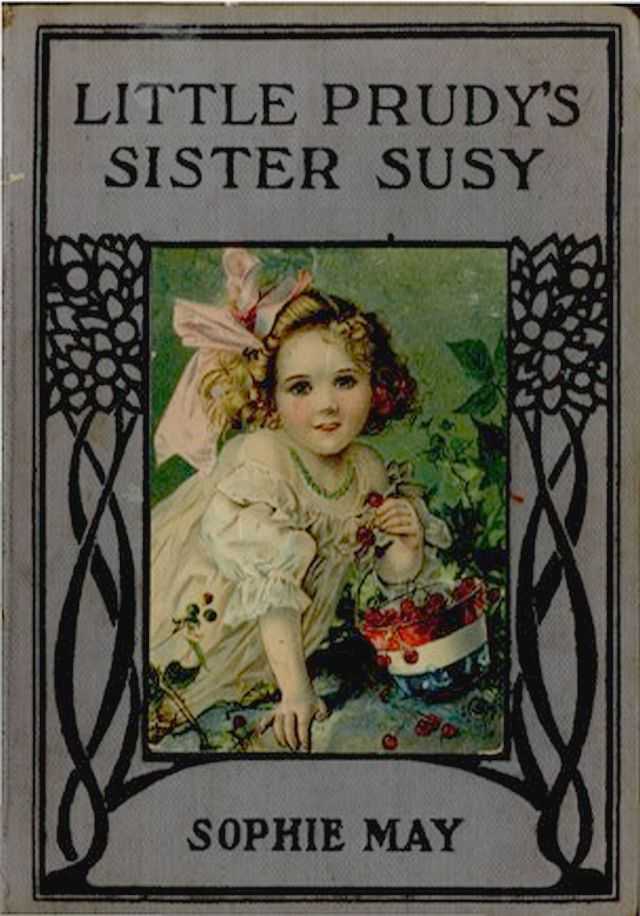
The Project Gutenberg eBook of Little Prudy's Sister Susy
Title: Little Prudy's Sister Susy
Author: Sophie May
Release date: November 29, 2004 [eBook #14202]
Most recently updated: October 28, 2024
Language: English
Credits: E-text prepared by Juliet Sutherland, Melissa Er-Raqabi, and the Project Gutenberg Online Distributed Proofreading Team
The Project Gutenberg eBook, Little Prudy's Sister Susy, by Sophie May
LITTLE PRUDY'S
SISTER SUSY
By
SOPHIE MAY
New York
Hurst & Company
Publishers
TO MY
LITTLE NIECE
Katie Clarke
THIS BOOK IS FOR YOU, KATIE,
WITH THE LOVE OF YOUR AUNTIE.
CONTENTS.
| PREFACE | |
| I. | KEEPING SECRETS |
| II. | BEFORE DAYLIGHT |
| III. | SUSY'S CHRISTMAS |
| IV. | SUSY'S WINGS |
| V. | PRUDY'S TROUBLE |
| VI. | ROSY FRANCES EASTMAN MARY |
| VII. | LITTLE TROUBLES |
| VIII. | ANNIE LOVEJOY |
| IX. | MORAL COURAGE |
| X. | RUTHIE TURNER |
| XI. | SUSY'S BIRTHDAY |
| XII. | FAREWELL |
PREFACE.
Here is a story about the oldest of the three little Parlin girls, "sister Susy;" though so many things are always happening to Prudy that it is not possible to keep her out of the book.
I hope my dear little friends will see how kind it was in God to send the "slow winter" and the long nights of pain to little Prudy.
If trouble should come to us, let us grow gentle, and patient, and lovely.
Little friends, be sure of one thing—our dear Father in heaven sends us something hard to bear only because he loves us.
CHAPTER I.
KEEPING SECRETS.
We might begin this story of Susy Parlin on a New Year's day, only it is so hard to skip over Christmas. There is such a charm about Christmas! It makes you think at once of a fir tree shining with little candles and sparkling with toys, or of a droll Santa Claus with a pack full of presents, or of a waxen angel called the Christ-child.
And it is just as well to date from the twenty-fifth of December, because, as "Christ was born on Christmas day," that is really the "Happy New Year."
For a long while the three little Parlin girls had been thinking and dreaming of presents. Susy's wise head was like a beehive, full of little plans and little fancies, which were flying about like bees, and buzzing in everybody's ears.
But it may be as well to give you a short description of the Parlin family.
Susy's eyes were of an "evening blue," the very color of the sky in a summer night; good eyes, for they were as clear as a well which has the "truth" lying at the bottom of it. She was almost as nimble as a squirrel, and could face a northern snow storm like an engineer. Her hair was dark brown, and as smooth and straight as pine-needles; while Prudy's fair hair rippled like a brook running over pebbles. Prudy's face was sunny, and her mouth not much larger than a button-hole.
The youngest sister was named Alice, but the family usually called her Dotty, or Dotty Dimple, for she was about as round as a period, and had a cunning little dimple in each cheek. She had bright eyes, long curls, and a very short tongue; that is, she did not talk much. She was two years and a half old before she could be prevailed upon to say anything at all. Her father declared that Dotty thought there were people enough in the world to do the talking, and she would keep still; or perhaps she was tired of hearing Prudy say so much.
However, she had a way of nodding her curly head, and shaking her plump little forefinger; so everybody knew very well what she meant. She had learned the use of signs from a little deaf and dumb boy of whom we shall hear more by and by; but all at once, when she was ready she began to talk with all her might, and soon made up for lost time.
The other members of the family were only grown people: Mr. and Mrs. Parlin, the children's excellent parents; Mrs. Read, their kind Quaker grandmother; and the Irish servant girl, Norah.
Just now Mrs. Margaret Parlin, their "aunt Madge," was visiting them, and the little girls felt quite easy about Christmas, for they gave it all up to her; and when they wanted to know how to spend their small stock of money, or how much this or that pretty toy would cost, Prudy always settled it by saying, "Let's go ask auntie: she'll know, for she's been through the Rithmetic."
Prudy spoke these words with awe. She thought "going through the Rithmetic" was next thing to going round the world.
"O Auntie, I'm so glad you came," said Susy, "for I didn't see how I was ever going to finish my Christmas presents: I go to school, you know, and it takes me all the rest of the time to slide!"
The children were busy making wonderful things "all secret;" or they would have been secret if Prudy hadn't told.
For one thing, she wondered very much what Susy could be doing with four pins stuck in a spool. She watched the nimble fingers as they passed the worsted thread over the pin-heads, making stitches as fast as Susy could wink.
"It looks like a tiny snake all sticked through the hole in the spool," said Prudy, eager with curiosity. "If you ain't a-goin' to speak, I don't know what I shall do, Susy Parlin!"
When poor Susy could not pretend any longer not to hear, she answered Prudy, half vexed, half laughing, "O, dear, I s'pose you'll tease and tease till you find out. Won't you never say a word to anybody, never?"
"Never in my world," replied the little one, with a solemn shake of her head.
"Well, it's a lamp-mat for auntie. It's going to be blue, and red, and all colors; and when it's done, mother'll sew it into a round, and put fringe on: won't it be splendid? But remember, you promised not to tell!"
Now, the very next time Prudy sat in her auntie's lap she whispered in her ear,—
"You don't know what we're making for you, all secret, out of worsted, and I shan't tell!"
"Mittens?" said aunt Madge, kissing Prudy's lips, which were pressed together over her sweet little secret like a pair of sugar-tongs clinching a lump of sugar.
"Mittens? No, indeed! Better'n that! There'll be fringe all over it; it's in a round; it's to put something on,—to put the lamp on!"
"Not a lamp-mat, of course?"
"Why, yes it is! O, there, now you've been and guessed all in a minute! Susy's gone an' told! I didn't s'pose she'd tell. I wouldn't for nothin' in my world!"
Was it strange that Susy felt vexed when she found that her nice little surprise was all spoiled?
"Try to be patient," said Mrs. Parlin, gently. "Remember how young and thoughtless your sister is. She never means any harm."
"O, but, mamma," replied Susy, "she keeps me being patient all the whole time, and it's hard work."
So Susy, in her vexation, said to Prudy, rather sternly, "You little naughty thing, to go and tell when you promised not to! You're almost as bad as Dotty. "What makes you act so?"
"Why, Susy," said the child, looking up through her tears, "have I acted? I didn't know I'd acted! If you loved me, you wouldn't look that way to me. You wrinkle up your face just like Nanny when she says she'll shake the naughty out of me, Miss Prudy."
Then what could Susy do but forgive the sweet sister, who kissed her so coaxingly, and looked as innocent as a poor little kitty that has been stealing cream without knowing it is a sin?
It was plain that it would not do to trust Prudy with secrets. Her brain could not hold them, any more than a sieve can hold water. So Mrs. Parlin took pity upon Susy, and allowed her and her cousin Florence Eastman to lock themselves into her chamber at certain hours, and work at their presents without interruption.
While the little girls sat together busily employed with book-marks and pin-cushions, the time flew very swiftly, and they were as happy as bees in a honeysuckle.
Mrs. Parlin said she believed nothing less than Christmas presents would ever make Susy willing to use a needle and thread; for she disliked sewing, and declared she wished the man who made the needles had to swallow them all.
The family were to celebrate Christmas evening; for Mr. Parlin was away, and might not reach home in season for Christmas eve.
For a wonder they were not to have a Tree, but a Santa Claus, "just for a change."
"Not a truly Santa Claus, that comes puffin' down the chimney," explained Prudy, who knew very well it would be only cousin Percy under a mask and white wig.
CHAPTER II.
BEFORE DAYLIGHT.
On Christmas morning, at three o'clock, there was a great bustle and pattering of little feet, and buzzing of little voices trying to speak in whispers. Susy and Prudy were awake and astir.
"Where do you s'pose the stockings are?" buzzed Prudy, in a very loud whisper.
"Right by the bed-post, Prudy Parlin; and if you don't take care we'll wake everybody up.—'Sh! 'Sh!"
"Mine's pinned on," said Prudy; "and I've pricked my fingers. O deary me!"
"Well, of course you've waked 'em all now," exclaimed Susy, indignantly: "I might have pricked my fingers to pieces, but I wouldn't have said a word."
Mr. and Mrs. Parlin, who were in the next room, were wide awake by this time; but they said nothing, only listened to the whispers of the children, which grew fainter, being smothered and kept down by mouthfuls of candy, lozenges, and peanuts.
The little girls longed for daybreak. The sun, however, seemed to be in no haste, and it was a long while before there was a peep of light. Susy and Prudy waited, wondering whether the sun would really forget to show his face; but all the while they waited they were eating candy; so it was neither dull nor lonely. As for closing their eyes again, they would have scorned the idea. It would be a pity indeed to fall asleep, and lose the pleasure of saying "Merry Christmas" to everybody. Norah, the Irish servant, had said she should be up very early to attend High Mass: they must certainly waylay her on the stairs. How astonished she would be, when she supposed they were both soundly asleep!
"Let me do it myself," said Susy: "you stay here, Prudy, for you'll be sure to make a noise."
"I'll go on my tippy toes," pleaded Prudy, her mouth half filled with chocolate drops.
So through their mother's room they stole softly, only throwing over one chair, and hitting Dotty's crib a little in their haste. Dotty made a sleepy sound of alarm, and Prudy could not help laughing, but only "in her sleeve," that is, in her "nightie" sleeve, which she put up to her mouth to smother the noise.
When they had reached the back-stairs Susy whispered, "O, Norah is up and gone down. I hear her in the kitchen. 'Sh! 'Sh!"
Susy thought there was no time to be lost, and she would have rushed down stairs, two steps at a time, but her little sister was exactly in the way.
"Somebody has been and tugged my little chair up here," said Prudy, "and I must tug it back again."
So in the dim light the two children groped their way down stairs, Prudy going first with the chair.
"O, what a little snail! Hurry—can't you?" said Susy, impatiently; "Norah'll be gone! What's the use of our waking up in the night if we can't say Merry Christmas to anybody?"
"Well, ain't I a-hurryin' now?" exclaimed Prudy, plunging forward and falling, chair and all, the whole length of the stairs.
All the house was awake now, for Prudy screamed lustily. Grandma Read called out from the passage-way,—
"O, little Prudence, has thee broken thy neck?"
Mrs. Parlin rushed out, too frightened to speak, and Mr. Parlin ran down stairs, and took Prudy up in his arms.
"It was—you—did it—Susy Parlin," sobbed the child. "I shouldn't—have—fell, if you—hadn't—have—screamed."
The poor little girl spoke slowly and with difficulty, as if she dropped a bucket into her full heart, and drew up the words one at a time.
"O, mother, I know it was me," said Susy meekly; "and I was careless, and it was all in the dark. I'm sure I hope Prudy'll forgive me."
"No, it wasn't you, neither," said Prudy, whose good humor was restored the moment Susy had made what she considered due confession. "You never touched me, Susy! It was the chair; and I love you just as dearly as ever I did."
Prudy lay on the sofa for some time, looking quite pale by the gas-light, while her mother rubbed her side, and the rest of the family stood looking at her with anxious faces.
It was quite an important occasion for Prudy, who always liked to be the centre of attraction.
"O, mamma," said she, closing her eyes languidly, "when the room makes believe whirl round, does it truly whirl round?"
The truth was, she felt faint and dizzy, though only for a short time.
"I wish," said she, "it had been somebody else that fell down stairs, and not me, for I didn't go down easy! The prongs of the chair pushed right into my side."
But it did not appear that Prudy was much injured, after all. In a few minutes she was skipping about the room almost as nimbly as ever, only stopping to groan every now and then, when she happened to think of it.
"It is a wonder," said Mr. Parlin, "that more children are not lamed for life by such accidents."
"I have often thought of it," said aunt Madge. "Some little ones seem to be making hair-breadth escapes almost every day of their lives. I believe Prudy would have been in her grave long ago, if it had not been for her guardian angel."
The long-expected Christmas had come at last, and Prudy had stumbled into it, as she stumbled into everything else. But it is an ill wind which blows no good to anybody; and it so happened that in all this confusion Susy was able to "wish a Merry Christmas" to Norah, and to the whole family besides.
When Mrs. Parlin found that the children were too thoroughly awake to go to sleep again that morning, she told them they might dress themselves in the parlor if they would keep as quiet as possible, and let the rest of the household take another nap.
It all seemed very strange and delightful to the little girls. It was like another sort of life, this new arrangement of stealing about the house in the silent hours before daybreak. Susy thought she should like to sit up all night, and sleep all day, if the mayor would only hush the streets; it would be so odd!
"O, how dark the clouds are!" said Prudy, peeping out of the window; "it fogs so I can't see a single thing. Susy, I'm going to keep at watch of the sky. Don't you s'pose, though, 'twill be Christmas all the same, if there's a snow storm?"
"There's been snow," said Susy, "all in the night. Look down at the pavement. Don't you wish that was frosted cake?"
"O, the snow came in the night, so not to wake us up," cried Prudy, clapping her hands; "but it wouldn't have waked us, you know, even in the night, for it came so still."
"But why don't the clouds go off?" she added, sadly.
"I don't know," replied Susy; "perhaps they are waiting till the sun comes and smiles them away."
Such happy children as these were, as they sat peeping out of the window at the dull gray sky!
They did not know that a great mischief was begun that morning—a mischief which was no larger yet than "a midge's wing." They were watching the clouds for a snow storm; but they never dreamed of such things as clouds of trouble, which grow darker and darker, and which even the beautiful Christmas sun cannot "smile away."
CHAPTER III.
SUSY'S CHRISTMAS.
It was bright and beautiful all day, and then, when no one could possibly wait any longer, it was Christmas evening. The coal glowed in the grate with a splendid blaze: all the gas-burners were lighted, and so were everybody's eyes. If one had listened, one might have heard, from out of doors, a joyful tinkling of sleigh-bells; yet I fancy nobody could have told whether the streets were still or noisy, or whether the sky had a moon in it or not; for nobody was quiet long enough to notice.
But by and by, when the right time had come, the folding-doors were opened, just like the two covers to a Christmas fairy book. Then, in a second, it was so still you might have heard a pin drop.
Such a funny little old gentleman had arrived: his face alive with dimples, and smiles, and wrinkles. His cheeks were as red and round as winter apples, and where there wasn't a wrinkle there was a dimple; and no doubt there was a dimple in his chin, and his chin maybe was double, only you couldn't tell, for it was hidden ever so deep under a beard as white as a snow-drift.
He walked along, tottering under the weight of a huge pack full of presents. He extended his small arms towards the audience most affectionately, and you could see that his antiquated coat-sleeves were bristling with toys and glistening with ornaments. His eyes twinkled with fun, and his mouth, which seemed nearly worn out with laughing, grew bigger every minute.
It took the dear old gentleman some time to clear his throat; but when he had found his voice, which at first was as fine as a knitting-needle, and all of a tremble, he made
THE SPEECH OF SANTA CLAUS.
"How do, my darlings? How do, all round? Bless your little hearts, how do you all do? Did they tell ye Santa wasn't a-comin', my dears? Did your grandpas and grandmas say, 'Humph! there isn't any such a person.' My love to the good old people. I know they mean all right; but tell them they'll have to give it up now!"
(Here Santa Claus made a low bow. Everybody laughed and clapped; but Prudy whispered, "O, don't he look old all over? What has he done with his teeth? O, dear, has anybody pulled 'em out?")
"Yes, my dears," continued the old gentleman, encouraged by the applause,—"yes, my dears, here I am, as jolly as ever! But bless your sweet little hearts, I've had a terrible time getting here! The wind has been blowin' me up as fierce as you please, and I've been shook round as if I wasn't of more account than a kernel of corn in a popper!
"O, O, I've been ducked up to the chin in some awful deep snow-drifts, up there by the North Pole! This is the very first time the storms have come so heavy as to cover over the end of the North Pole! But this year they had to dig three days before they could find it. O, ho!
"I was a-wanderin' round all last night; a real shivery night, too! Got so broke up, there's nothing left of me but small pieces. O, hum!
"Such a time as I had in some of those chimneys, you haven't any idee! Why, if you'll believe me, over there in Iceland somebody forgot to clear out the chimney, and there I stuck fast, like a fish-bone in your throat; couldn't be picked out, couldn't be swallowed!
"The funniest time that was! How I laughed! And then the children's mother woke up, and, 'O, dear,' said she; 'hear the wind sigh down the chimney!' 'Only me,' says I; 'and I've caught you napping this time!' She helped me out, and when I had caught my breath, I climbed out the window; but, deary me, I shouldn't wonder if that very woman went to sleep again, and thought it was all a dream! Heigh-ho! that's the way they always treat poor Santa Claus nowadays."
(Here the children laughed, and Susy said, "I guess he must have bumped his nose against that chimney: see what a hump!")
"O, O, don't you make sport of me, children! My nose is big, to be sure, but I'm going to keep it and make the best of it! If you love Santa as he loves you, you wouldn't mind the looks. I was going to change my coat and dickey; but then, thinks I, I'll come just as I am! I patted myself on the shoulder, and says I, 'Santa Claus, don't you fret if you are growin' old! You may look a little dried up, but your heart isn't wrinkled; O no!' You see father Adam and me was very near of an age, but somehow I never growed up! I always thought big folks did very well in their place; but for my part, give me the children. Hurrah for the children!"
(Great clapping and laughing.)
"I tell you, darlings, I haven't forgot a single one of you. My pockets are running over. I've been preparing presents for you ever since last fall, when the birds broke up housekeeping.
"Here's a tippet for the Prudy girl, and she may have it for nothing; and they are cheaper 'n that, if you take 'em by the quantity.
"I'm a walkin' book-case. Why, I've brought stories and histories enough to set up a store! I've got more nuts than you can shake a hammer at; but I think there's more bark to 'em than there is bite. O, O, I find I can't crack 'em with my teeth, as I used to a hundred years ago!
"But my dear, sweet, cunning little hearers, I must be a-goin'. Queen Victoria, said she to me, said she, 'Now, Santa, my love, do you hurry back to fill my children's stockings before the clock strikes twelve.' Queen Vic is an excellent woman, and is left a poor widow; so I can't disappoint her, poor soul!
"I must be a-goin'! Would like to hug and kiss you all round, but can't stop. (Kisses his hand and bows.) A Merry Christmas to you all, and a Happy New Year."
So saying, Santa Claus suddenly disappeared at the hall door, dropping his heavy pack upon the table.
In another minute the lively old gentleman was in the front parlor without any mask, and of course it was nobody but cousin Percy "with his face off."
Then they all fell to work sorting out presents. Prudy seized her fur tippet, and put it on at once.
"O, how pretty I look," said she; "just like a little cat! Ain't I cunning?"
But nobody could pause to attend to Prudy, though she chatted very fast, without commas or periods, and held up to view a large wax doll which "would be alive if it could talk." They all had gifts as well as Prudy, and wished to talk rather than to listen. They asked questions without waiting for answers, and did not mind interrupting one another, and talking all at once, like a party of school children.
All this was hardly polite, it is true; but people are sometimes surprised out of their good manners on Christmas evenings, and must be forgiven for it, as such a good time happens but once a year.
Percy broke in with an old song, and went through with a whole stanza of it, although no one listened to a word:—
And long life let us sing,
For he doeth more good unto the poor
Than many a crownéd king."
"My beautiful books!" cried aunt Madge; "Russia morocco."
"My writing-desk,—has any one looked at it?" said Mrs. Parlin; "rose-wood, inlaid with brass."
"My skates!" broke in Susy, at the top of her voice.
"Hush!" screamed cousin Percy; "won't anybody please notice my drum? If you won't look, then look out for a drum in each ear!"
And as nobody would look or pay the slightest attention, they all had to hear "Dixie" pounded out in true martial style, till they held on to their ears.
"Rattlety bang!" went the drum. "Tweet, tweet," whistled the little musical instruments which the children were blowing.
"Have pity on us!" cried aunt Madge; "I am bewildered; my head is floating like a Chinese garden."
"Order!" shouted Mr. Parlin, laughing.
"O, yes, sir," said Percy, seizing Susy and whirling her round. "Children, why don't you try to preserve order? My nerves are strung up like violin-strings! I've got a pound of headache to every ounce of brains. Susy Parlin, do try to keep still!"
"Thee needn't pretend it is all Susan," said grandma Read, smiling. "Thee and little Prudence are the noisiest of the whole!"
In fact, they raised such a din, that after a while poor grandma Read smoothed the Quaker cap over her smiling face, and stole off into her own chamber, where she could "settle down into quietness." Much noise always confused grandma Read.
But in a very few moments, when the excitement began to die out, there was a season of overwhelming gratitude. Everybody had to thank everybody else; and Mr. Parlin, who had a beautiful dressing-gown to be grateful for, nevertheless found time to tell Susy, over and over again, how delighted he was with her book-mark, made, by her own fingers, of three wide strips of velvet ribbon; on the ends of which were fastened a cross, a star, and an anchor, of card-board.
"Papa, one ribbon is to keep your place in the Old Testament," said Susy; "one is to stay in the middle, at the births and marriages; and the other one is for our chapter in the New Testament, you know."
"I think my lamp-mat is very pretty," said aunt Madge, kissing Susy; "every bit as pretty as if Prudy hadn't 'been and told.'"
Prudy had bought a shawl-pin for her mother, a fierce little wooden soldier for aunt Madge, and something for everybody else but Susy. Not that she forgot Susy. O, no! but one's money does not always hold out, even at Christmas time.
"Why," said Mr. Parlin, "what is this sticking fast to the sole of my new slipper? Molasses candy, I do believe."
"Yes sir; that's for Susy," cried Prudy, suddenly remembering how she had tucked it in at the last moment, when she could not stop to find any wrapping-paper. "It isn't so big as it was, but it's the biggest piece I had in this world. I saved it last night. Susy likes 'lasses candy, and I couldn't think of nothin' else."
It was a wonder that Prudy's candy had not spoiled some of the nice presents.
Susy received several pretty things; and though she did not talk quite so much as Prudy, she was just as happy. For one thing, she had what she had not dreamed was possible for a little girl—a bottle of otto of rose; "just like a young lady."
This was a real delight to Susy: but Prudy, sniffing at it, said, coolly, "O, ho! it smells 's if it didn't cost more'n a cent! 'Tisn't half so sweet as pep'mint!"
Before Dotty could be put to bed, she had contrived to break several toys, all of which happened to be Susy's—a sugar temple, a glass pitcher, and a small vase.
This was an evening long to be remembered; but the most remarkable event of all was to come.
"Susy, my daughter," said Mr. Parlin, "have you been wondering why you don't see a present from me?"
Susy blushed. She had certainly expected something handsome this year from her father.
"I haven't forgotten you, my dear; but the present I have chosen wouldn't sit very well on the shoulders of such a little fellow as Santa Claus."
Percy laughed. "Wouldn't it have been a load, uncle?"
"Hush!" whispered aunt Madge; "she isn't to know till morning."
"But, papa," said Susy, her eyes shining with excitement, "why couldn't you bring it in here now?"
"It is better off out of doors. Indeed, to tell the truth, my child, it is hardly suitable for the parlor."
"Now, Miss Susy," said Percy, measuring off his words on the tips of his fingers, "I'm authorized to tell you it's something you mustn't take in your lap, mustn't hang on a nail; if you do, you'll lose it. I'm sure 'twill please you, Susy, because it's a mute, and can't speak. You—"
"O, hush talking about dumb people! I shouldn't think you'd make sport of Freddy Jackson! If you was a little deaf-and-dumber than you are now, I'd like you better!
"O, dear, dear!" cried she, dancing about the room; "what can it be? I can't wait!"
"Only think; all night before I'll know," thought she, as she touched her pillow. "O, Prudy, to-morrow morning! Only think of to-morrow morning I All my other presents are just nothing at all. Anything is so much nicer when you don't know what it is!"
CHAPTER IV.
SUSY'S WINGS.
Susy awoke next morning very much surprised to find the sun so high. Prudy was lying beside her, talking to herself.
"I don't feel very well," said the child; "but I'm pleasant; I mean to be good all day."
"Why didn't you speak to me?" cried Susy, springing out of bed, "when you knew how I couldn't wait to see my present?"
"I would have woke you up, Susy, but I ain't well; I'm sick in my knees."
And Prudy limped about the room to show her sister how lame she was. But Susy was in too great a hurry to pay much attention to her, or to help her dress.
"Good morning, papa!" she exclaimed, the moment she entered the parlor; "now may I see the present?"
"Do you suppose you could wait till after breakfast, Susy?"
Aunt Madge smiled as she looked at the little eager face.
"I see you are going on with your lessons," said she.
"What lessons, auntie? Why, it is the holidays!"
"Lessons in patience, my dear. Isn't something always happening which you have to be patient about?"
Susy thought of Prudy's habit of disclosing secrets, Dotty's trying way of destroying playthings; and now this long delay about her present. She began to think there were a great many vexations in the world, and that she bore them remarkably well for such a little girl.
"Yes, thee must let patience have her perfect work, Susan," said grandma Read, after the "silent blessing" had been asked at the table.
"Mayn't I go, too?" said Prudy, when she saw her father, her auntie, and Susy leaving the house just after breakfast.
And she went, as a matter of course; but the pavements were a little slippery from sleet; and Prudy, who was never a famous walker, had as much as she could do, even with the help of her father's hand, to keep from falling.
"Why, Prudy," said Mr. Parlin, "what ails you this morning? You limp so much that I believe you need crutches."
"I'm sick in my knee," replied Prudy, delighted to see that her lameness was observed. "If you had my knee, and it hurt, you'd know how it feels!"
By this time they had reached a livery stable; and, to Susy's surprise, her father stopped short, and said to a man who stood by the door, "Mr. Hill, my daughter has come to look at her pony."
Prudy was in a great fright at sight of so many horses, and needed all her auntie's attention; but Susy had no fear, and Mr. Parlin led her along to a stall where stood a beautiful black pony, as gentle-looking as a Newfoundland dog.
"How do you like him, Susy? Stroke his face, and talk to him."
"But, O, papa, you don't mean, you can't mean, he's my very own! A whole pony all to myself!"
"See what you think of his saddle, miss," said Mr. Hill, laughing at Susy's eagerness; and he led pony out, and threw over his back a handsome side-saddle.
"Why, it seems as if I could just jump on without anybody touching me," cried Susy.
"Not afraid a bit?" said Mr. Hill, as Mr. Parlin seated Susy in the saddle, and gave her the reins. "Ponies throw people, sometimes."
"O, but my papa would never give me a bad pony," answered Susy, with perfect confidence.
Mr. Hill laughed again. He was a rough man; but he thought a child's faith in a parent was a beautiful thing.
He did not know many passages of Scripture, but thought he had read somewhere, "And if he ask bread, will he give him a stone?" No; fathers are glad to give their "best gifts," and the little ones trust them.
"It's like sailing in a boat," cried Susy, riding back and forth about the yard in great excitement; "why, it's just as easy as the swing in the oilnut-tree at grandma Parlin's! O, papa, to think I should forget to thank you!"
But perhaps Mr. Parlin regarded glowing cheeks and shining eyes as the very best of thanks.
Prudy thought the pony a beautiful "baby horse;" wanted to ride, and didn't want to; was afraid, and wasn't afraid, and, as her father said, "had as many minds as some politicians who are said to 'stand on the fence.'" By and by, after some coaxing, the timid little thing consented to sit behind Susy, and cling round her waist, if her father would walk beside her to make sure she didn't fall off. In this way they went home.
"I like to sit so I can hug my sister, while she drives the horse," said Prudy; "besides, it hurts me to walk."
Mr. Parlin and aunt Madge smiled at the child's speeches, but gave no more heed to this lameness of which she complained, than they did to any of the rest of her little freaks.
Prudy liked to be pitied for every small hurt; and when Susy had a sore throat, and wore a compress, she looked upon her with envy, and felt it almost as a personal slight that her throat could not be wrapped in a compress too.
On their way they met "lame Jessie," a little girl with crooked spine and very high shoulders, who hobbled along on crutches.
"She's lamer than me," said Prudy. "Good morning, Jessie."
"I know what I've thought of," said Susy, who could talk of nothing which was not in some way connected with her pony. "I'm going to give that girl some rides. How happy she will be, poor little Jessie!"
"When you get your sleigh," said Mr. Parlin.
"My sleigh, papa? How many more presents are coming?"
"It is hard to tell, Susy; one gift makes way for another, you see. First comes the pony; but how can he live without a stable, and a groom to feed him? Then what is a pony worth without a saddle? And, as one does not wish always to ride pony-back, a sleigh is the next thing."
"But, papa, you know in the summer!"
"Yes, my dear, in the summer, if we all live, there must be a light carriage made on purpose for you."
"There is one thing more that pony needs," said aunt Madge, stroking his eyebrows, "and that is, a name."
"O, I never thought of that," said Susy; "help me find a name, auntie."
"Let me think. I should call him something good and pleasant. Think of something good and pleasant Think of something you like very much."
"O, Frosted Cake," cried Prudy: "wouldn't that be pleasant? Susy loves that."
"I should like to name him for the American Eagle," said Susy, who had heard some patriotic speeches from her cousin Percy; "only you couldn't pet that name, could you?"
"You might call him Don Carlos, or Don Pedro," suggested Mr. Parlin.
"No, papa; only think of Donny: that is like Donkey! You haven't any long ears, have you, pony? If you had, I'd call you Little Pitcher, for 'little pitchers have great ears.' That makes me think of Mr. Allen, auntie. How big his ears are, you know? Is it because his teacher pulled them so?"
"O, call him 'Gustus,'" cried Prudy.
"But that would soon be Gusty," said aunt Madge, "and would sound too much like the east wind."
"Dear me," sighed Susy; "who'd ever think it was such hard work to find names?"
"O, look," said Prudy, as they passed a jaded old horse; "there is a pony just exactly like this! Only it's twice as big, you know, and not a bit such a color!"
"Well, there, Prudy," said Susy, disdainfully, "I thought, when you began to speak, you was going to tell something! Why don't you wait till you have something to say? Please give me a list of names, papa."
"There's Speedwell, Lightfoot, Zephyr, Prince, Will-o'-the-wisp—"
"I might call him Wispy," broke in Susy. "Zephyr is good, only it makes you think of worsteds."
"Now, listen," said aunt Madge; "you might call him Elephant, just for sport, because he is in reality so very little. Or, on the other hand, you might find the least speck of a name, like Firefly, or Midge."
"I don't like any of those," replied Susy, still dissatisfied.
"I see," said aunt Madge, laughing, "nothing will please you but a great name. What say to Pegasus, a flying horse, which poets are said to ride? It might be shortened to Peggy."
"Now, auntie, you wouldn't have this beautiful pony called Peggy; you know you wouldn't! the one my father bought on purpose for me! But was there such a horse, truly?"
"O, no; there is an old fable, which, as we say, is 'as true now as it ever was,' of a glorious creature with wings, and whoever mounts him gets a flying ride into the clouds. But the trouble is to catch him!"
"O, I wish my pony could fly," said Susy, gazing dreamily at his black mane and sleek sides. "The first place I'd go to would be the moon; and there I'd stay till I built a castle as big as a city. I'd come home every night, so mother wouldn't be frightened, and fly up in the morning, and—and—"
"See here," said Prudy, who had for some time been trying to speak; "call him Wings!"
"So I will," answered Susy, quickly, "and I'll make believe he flies in the air like a bird. Now, auntie, what do you think of Wings?"
"Odd enough, I'm sure, my dear."
"Well, I like it," returned Susy, with a positive shake of the head. "It's of no use to keep fussing so long over a name, and I feel a great deal easier, now I've made up my mind! Dear little Wings, you prick up your ears, and I know you like it, too. I wish you had a soul, so you could be taken to church, and christened like a baby."
Just here Susy was startled by a sudden laugh from cousin Percy, who had for some moments been walking behind the pony unobserved.
"You're enough to frighten any one to death," she screamed, "creeping about like a cat."
Susy had a foolish dread of being laughed at.
"Creeping like a cat," echoed Percy, "while you creep like a snail! What will you take for your pony, that can fly in the air like a bird, but can't walk on the ground any better than a goose?"
"I don't know what you're talking about," said Susy, quite excited: "if you want to see anybody ride fast, just look here." And she started the pony at full speed, regardless of Prudy, who was so frightened, that she seized poor Wings by his flowing mane, and called out for her sister to stop. But Susy dashed on at a flying pace, and Percy cried after her, "O, Susy, cousin Susy, what think of your Christmas present? Will you remember not to eat it, and not to hang it on a nail? Susy, Susy?"
There was hardly a happier child living than Susy, during those delightful holidays. She said to herself, sometimes, that this was such a beautiful world, she couldn't think of a single thing that wasn't as splendid as it could be.