
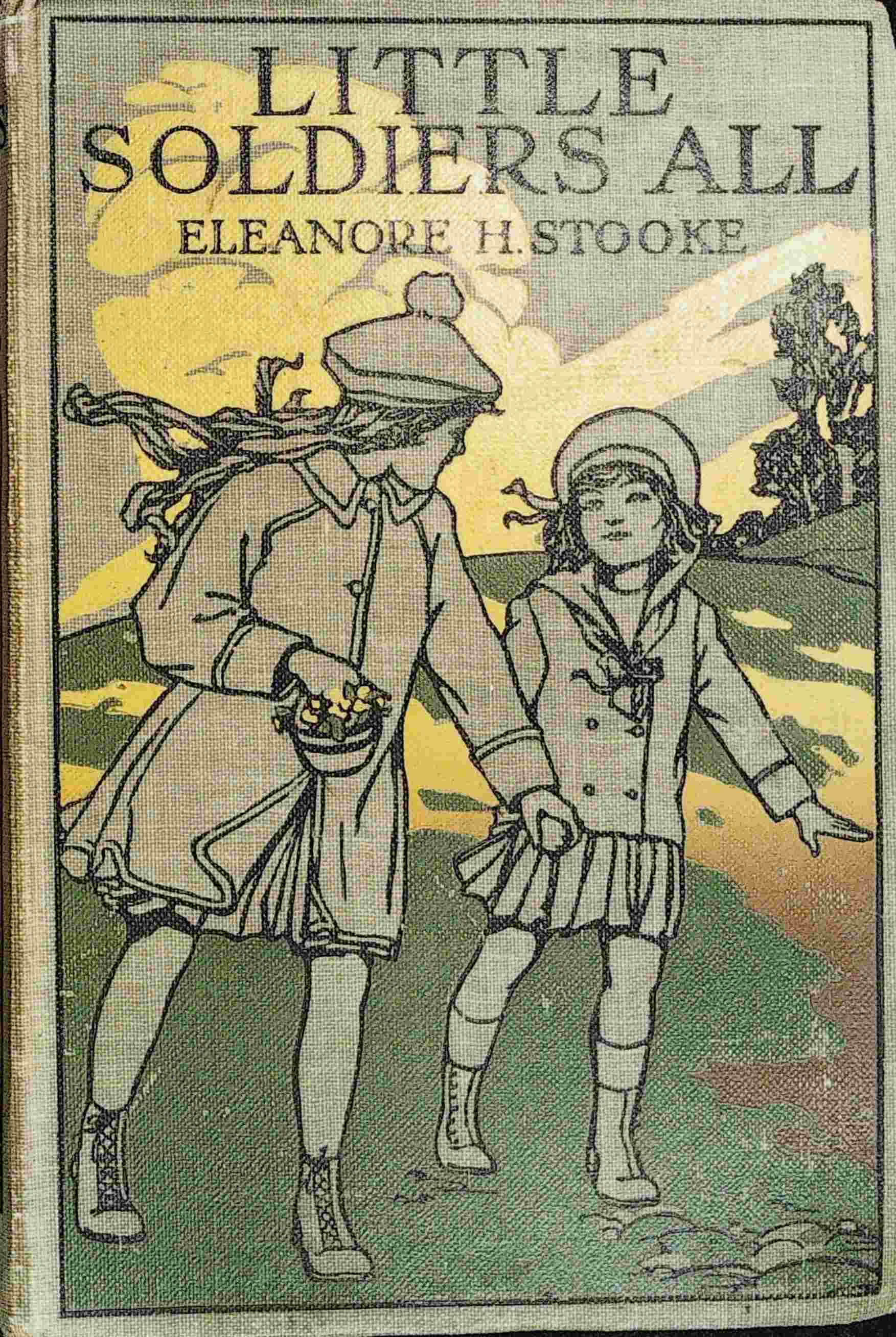
The Project Gutenberg eBook of Little soldiers all
Title: Little soldiers all
Author: Eleanora H. Stooke
Release date: April 20, 2023 [eBook #70607]
Language: English
Original publication: United Kingdom: The Religious Tract Society, 1916
Transcriber's note: Unusual and inconsistent spelling is as printed.
WOULD THE BULL SEE THEM?
Little Soldiers All
By
ELEANORA H. STOOKE
Author of 'Little Maid Marigold,'
'Angel's Brother,' 'Prosperity's Child,'
'The Bottom of the Bread Pan,' etc., etc.
London:
THE RELIGIOUS TRACT SOCIETY
4 Bouverie Street and 65 St. Paul's Churchyard E.C.
CONTENTS
CHAPTER II. JOSEPHINE'S ARRIVAL
CHAPTER III. JOSEPHINE'S GIFTS
CHAPTER IV. SUNDAY AT THE GLEN
CHAPTER V. DICK RUMBELOW ENLISTS
CHAPTER VII. HIS BRAVE LITTLE DAUGHTER
CHAPTER VIII. "A REAL PLUCKY LITTLE MAID"
CHAPTER XI. KEEPING A BRAVE HEART
LITTLE SOLDIERS ALL
CHAPTER I
NEWS FROM INDIA
"DEAR me!" exclaimed Miss Basset; "oh, dear me! I was saying only yesterday that the whole world seemed topsy-turvy as the result of the war, but I never thought that this might happen! Oh, dear me!"
She was a gentle-faced maiden lady of nearly seventy, with soft brown eyes and silvery hair. As she spoke she glanced across the breakfast-table, at which she was presiding, at her brother, and then at the young folks—a girl and boy—who were seated facing each other. Having assured herself she had every one's attention, she proceeded—
"Really it is most upsetting! Though we have often said we should like to see Paul's little daughter, haven't we, John? It will be a great responsibility for us to have charge of her, but under the circumstances—"
"Had you not better let me know the contents of Paul's letter, my dear Ann?" interposed Mr. Basset, smiling.
He was a tall thin man, with stooping shoulders which made him look older than his sister, who was his senior by several years. Being of a retiring disposition, he lived a quiet life, spending most of his days in the pursuits he loved—the study of flowers and insects. The gardens surrounding his home—the Glen, a modern red brick residence, situated near the west country town of Midbury—were full of the choicest plants; and he was the possessor of one of the finest collections of moths and butterflies in England.
Miss Basset had kept house for her brother for many years, during which they had been very happy together. They were good, kind people, always ready to help any charitable cause which was brought to their notice; but they lived rather narrow lives, and made few new acquaintances.
Six years previously Mr. Basset had been left trustee to two orphan children—May and Donald Rae—who had then come to live at the Glen. They were twins, twelve years of age, and were being educated by a daily governess.
Donald had been to a boarding-school at Exeter for some months; but, unfortunately, whilst playing football he had seriously injured his right knee. He had been laid up for weeks, and was still obliged to walk with a crutch. The doctors advised that he should be kept at home for the present, and had expressed the opinion that he would most likely be lame all his life.
Miss Basset passed the letter she had been reading to her brother. It was from their nephew, Paul Basset, their dead brother's only son, who was an officer in an Indian regiment. He was a widower, his young wife having died eighteen months after their marriage, leaving him with a baby girl whom he had kept with him in India. She was now eleven years of age.
"I see! I see!" murmured Mr. Basset, as, having read his nephew's letter, he folded it carefully, placed it in its envelope, and returned it to his sister. "Well, I suppose having Josephine here will not make much difference anyway, Ann?"
"I don't know about that," Miss Basset answered doubtfully; "it will depend upon what she is like, of course. An Indian-born child, accustomed to native servants, may not settle down comfortably in an English home. Dear me, I was saying only yesterday that we had no relative at the front, little thinking how soon our nearest and dearest would be there! Oh, dear me!"
"Is Captain Basset going to the front then?" asked Donald eagerly. He and his sister had been listening to their elders with growing curiosity.
Miss Basset assented, her eyes filling with tears as she did so; she wiped them hastily.
"And he is sending his little daughter to us in charge of a brother officer's wife who is going to Exeter," she explained; "he wants us to keep her till the end of the war. I do think—" turning to her brother— "that he should have consulted us, though, before making his plans."
"My dear Ann, don't you realize he had no time for anything but to act? His regiment was ordered immediately to the front, and he had to decide what to do with Josephine at once. He has paid us a compliment, I consider, in sending the child to us. It shows he realizes we shall do our best for her and try to make her happy. You noticed, I suppose, that he remarked she would probably be with us almost as soon as her letter? So we may expect her any time now."
"Then I must see about having a bedroom prepared for her," Miss Basset said, rising; "she shall have the one next mine, for it faces south and is very warm and cosy. If she is a nice child it will be pleasant for May. Poor little soul, I dare say she's in dreadful trouble about her father—because he's gone to the war, I mean. She may never see him again."
"Or he may live to win the Victoria Cross!" cried Donald, his eyes sparkling. Then, as Miss Basset left the room, he continued: "Oh, how I wish I was a man and able to enlist in the army! When I think of those poor Belgians fighting so bravely I long to be a few years older—but, there, my knee will prevent my ever being a soldier now, I suppose!"
"Never mind!" said May; "never mind, dear!"
"But I do mind!" the boy answered sharply, "so what's the good of your talking like that? Never mind, indeed!"
Mr. Basset had gone to the window, and was looking out into the garden where autumn flowers still lingered. He was paying no attention to the children, and presently he opened the window and stepped out into the October sunshine. There was silence in the breakfast-room for some minutes after he had gone. May felt snubbed, but she showed no resentment. She was naturally sweet-tempered and allowed Donald to treat her as he pleased. It would have been better for both of them, perhaps, if she had not. During the time he had been ill with his injured knee she had been his willing slave, and when he had vented his irritability upon her she had borne it without complaint.
"I wonder what Josephine will be like," she remarked presently, "and if we shall get on with her?"
"What's the good of wondering? I wish it was a boy who was coming instead of a girl!"
"I dare say you do. For your sake I wish so, too, dear."
"And I wish you wouldn't keep on calling me dear!" Donald exclaimed complainingly; "you have such an old-fashioned way of speaking, May, as though you were your own grandmother!"
May laughed, but she was secretly hurt. She moved to the window and watched her guardian pacing the garden paths. In a minute she cried—
"I hear a band! I believe the soldiers are coming! Let us go to the gate and watch them pass!"
There were several hundred recruits billeted in Midbury, and nearly every day they went for a long march. This morning, as they came to the big iron gate leading into the shrubbery which hid the Glen and its gardens from the high road, they found an elderly gentleman there with a pretty, fair-haired, blue-eyed little girl, and a boy leaning on a crutch. They saluted them as they passed by.
"I seem to know the faces of some of them," remarked Mr. Basset, as the last line of khaki-clad figures disappeared from view.
"A lot of them are Midbury men," Donald answered. "How well they are marching!—much better than they did a week ago! Did you notice young Dicker, May?"
May nodded. Her face was flushed, and her eyes sparkling. She could not think why it was that the sounds of a military band and marching feet should always bring a lump into her throat.
"What Dicker is that?" inquired Mr. Basset. "Not the blacksmith's son? Yes? Why, he is an only child! I wonder his father let him join!"
"His father wouldn't have been very pleased if he hadn't," Donald answered quickly; "I managed to get as far as the blacksmith's yesterday, and had a talk with old Dicker. He was so proud to tell me that his boy had been the first man in Midbury to obey the call to arms. He says that after our duty to God comes our duty to our king and country. He's right, isn't he?"
"Yes, yes!" agreed Mr. Basset. "Old Dicker is a very fine fellow, straight as a line, and honest as the day, but I should have thought he was too peace-loving to have consented to his son being a soldier. I thought he hated war as much as I do."
"But you don't think it wrong to fight in a good cause?" questioned Donald eagerly.
"Certainly not, certainly not! It's the right thing to do—only people don't always do it."
"Then they're cowards!" declared the boy hotly.
Mr. Basset did not gainsay it. Hitherto the shadow of the war had not come very near him. He had subscribed to the hospital which was shortly to be opened in Midbury for wounded soldiers, as had his sister, and to various war funds; but until that morning it had not occurred to him, any more than it had to Miss Basset, that it might effect them personally. Now it seemed as if it might, for their dead brother's son was very dear to them.
"Oh, Donald, don't you wish there was something you and I could do for our country?" cried May. "If I was a little older I might be a Red Cross nurse—"
Donald interrupted her with a laugh. "I like that!" he cried; "you a Red Cross nurse indeed! Why, you haven't the pluck of a mouse! I shan't forget how you wept over that dead rabbit we found in a snare the other day!"
"That was because it had suffered," May answered; "you know it had been caught by the leg, not killed outright. If it had been living I should have loved to care for it till it was well."
Donald made no reply to this. He had suddenly remembered the hours his sister had devoted to him during his late illness, and felt ashamed that he had laughed at her tender-heartedness. He did not tell her so, however, and they went back to the house without speaking to each other again.
Punctually at ten o'clock Miss Cummings, the governess, arrived. She lived at Midbury with her widowed mother, and had held her present situation for years. She was a clever teacher, and a strict disciplinarian. May and Donald had a great respect but no affection for her. She was a tall, gaunt young woman, with a sallow complexion, grey eyes, and tightly-braided brown hair.
"Oh, Miss Cummings, have you heard the news?" May questioned, as the governess entered the schoolroom where she and Donald were waiting for her. "Captain Basset is sending his little girl to England—"
"So Miss Basset has informed me," Miss Cummings interrupted; "I met her in the hall. But no talking now, children! It's time for work to begin."
As a rule work ceased at half-past twelve o'clock. This morning May and Donald were inattentive, not wilfully, but because they found it impossible to keep their thoughts from wandering to the expected visitor, and the result was that it was nearly one o'clock before they had finished writing the impositions their governess gave them. By that time they were both feeling very ill-used.
The family at the Glen, who were simple living people, dined at half-past one. After dinner, if the weather was fine, Miss Cummings generally took May for a walk. She did so to-day.
"Where are we going?" May inquired, as, on closing the big iron gate behind them, the governess paused, looking undecided. "May I choose the way?"
"Yes, if you like," Miss Cummings replied.
So May chose the road towards Midbury, which led past the blacksmith's house and shop. Old Dicker, a vigorous man of sixty, with grizzled hair, was at work in the shop, and his wife, a little, plump, rosy-cheeked, brown-eyed woman, stood in the doorway knitting. May nodded smilingly to the blacksmith, and spoke to Mrs. Dicker.
"I saw your son march past the Glen this morning," she informed her.
"Ah, yes!" said the woman. "He was on his way to Kilber Down with the other recruits. They're going to be taught trench-digging there."
"How interesting!" exclaimed Miss Cummings.
"Ah, there's a lot for them to learn," said Mrs. Dicker, "and they've got to be sharp about it."
"Did you want your son to be a soldier?" asked May curiously.
"Not at first," Mrs. Dicker admitted, "but when I'd thought about it more I did, and felt ashamed I hadn't bid him go and do his duty. God's calling us all to-day, as plain as plain can be to show ourselves Christian soldiers."
"But women can't be soldiers," said May; "they don't fight battles."
"They have sometimes the hardest battles of all to fight," Mrs. Dicker answered gravely, "and so you'll find, miss. I wanted to keep my boy. That was selfishness, and I had to fight it. It wasn't easy."
"But you won!" smiled Miss Cummings.
At this minute a cab appeared, coming towards them from the direction of Midbury. As it passed by May clutched her governess excitedly by the arm.
"Did you see?" she cried— "see all the luggage I mean? And the lady and little girl? Oh, let us go home, please, Miss Cummings! I feel sure that little girl is Josephine Basset!"
CHAPTER II
JOSEPHINE'S ARRIVAL
"I SUPPOSE, my dear, you are very glad to be at your journey's end?"
The speaker was Miss Basset. Half an hour since she had been disturbed in her afternoon nap by the arrival of Josephine, and Mrs. Ford, the lady with whom Josephine had travelled to England. Having delivered her charge into the keeping of Miss Basset, Mrs. Ford had declined to remain longer, and had left in the cab which had brought her and Josephine from Exeter; and now Miss Basset and her niece were alone in the pretty, comfortable bedroom which had been prepared for the latter only just in time.
Josephine Basset was a tall girl for her age, and very thin. She had a pale face, dark eyes with well-marked brows, and wavy dark hair. She was not pretty, but her expression was attractive—frank and good-humoured.
"Yes, very glad," she answered, "though, of course, I was sorry to say 'good-bye' to Mrs. Ford. But if she remains at Exeter, perhaps I shall see her again. She is staying there with friends at present, but she may take a furnished house later."
"I liked her appearance very much," remarked Miss Basset; "she looked such a motherly woman. She has children of her own, I suppose?"
"No. But her husband, Colonel Ford, calls her the mother of the regiment, because if people are in trouble she helps them—mothers them, you know."
"I understand. How good of her! No wonder you were sorry to say 'good-bye' to her, my dear! But I hope you will be happy with us, Josephine—as happy as it is possible for you to be under the circumstances."
Josephine was standing by the window, looking out. Her face was composed, but her voice sounded slightly tremulous as she answered—
"You are very kind, Aunt Ann. I promised father to try to be happy, and of course I shall keep my word. I hope it hasn't put you out very much, my coming so suddenly? Father really didn't know where else to send me, and he thought you wouldn't mind. Everything was such a rush, you know."
"Yes, yes! I am very glad you have come! John and I have often said how much we should like to see you—our dear nephew's little girl! Your uncle will be disappointed that he was not here to welcome you. He went out directly after dinner, and there's no knowing where he's gone—he takes such long walks looking for rare insects and flowers. You have heard of the Raes, I suppose—the children who live with us?"
"Oh, yes! Uncle John is their guardian, isn't he? I expect that was the Rae boy I saw looking over the balusters when we arrived? You wrote and told father about his accident. Is he still lame?"
"Yes, and we fear he always will be. His sister has gone for a walk with her governess."
"I think they are coming up the carriage drive now, Aunt Ann."
"Then we will go downstairs, and we will have tea early—"
"Oh, please don't have it earlier for me!" interposed Josephine. "I had lunch before I left Exeter, not so very long ago."
"We dine at midday," explained Miss Basset, "and have a laid tea at five o'clock, and supper at half-past eight as a rule. Come along, my dear!"
She led the way downstairs. In the hall they found May and her governess in conversation with Donald, and Josephine was introduced to them.
"I want you to give the young folks a holiday to-morrow, please, Miss Cummings," said Miss Basset, "so that they may get to know Josephine."
"Certainly!" Miss Cummings answered.
"Oh, thank you!" cried Josephine.
It being now four o'clock, the hour at which the governess usually left the Glen, she said "good afternoon" and took her departure. As soon as she had gone May ran upstairs to take off her hat and jacket, whilst the others went into the dining-room, where Jane, the parlour-maid, was laying the table for tea.
"I thought perhaps you would want tea early, ma'am," the girl said to Miss Basset, with a glance at Josephine.
"Quite right, Jane," Miss Basset answered; "as soon as it is ready, please. We shall not wait till Mr. Basset returns."
Five minutes later the old lady and the three young people—May had soon returned—were seated at the table. It had a big bowl of chrysanthemums in the centre, most beautiful blooms. Josephine's face lighted up with a smile when she saw the old-fashioned bronze urn set before Miss Basset and heard it singing.
"Oh!" she exclaimed, "everything's exactly as father said it would be!—exactly as it was when he was a boy and used to spend his holidays here, Aunt Ann. He has always remembered—oh, everything! And how kind you were to him, too! Lots of times we've talked of coming home together, and—"
She paused abruptly, for Miss Basset was wiping her eyes, then added quickly—
"Oh, please don't cry! I didn't mean to make you cry!"
"I'm very foolish," murmured Miss Basset, "but when I think of your poor father—oh, dear me!"
Josephine was silent. Her pale face had become a little paler, but she showed no other sign of emotion. After a minute she said quietly: "Father is all right, Aunt Ann."
Miss Basset was so surprised at this remark that she could only stare at Josephine in amazement. May and Donald stared at her too; they thought she certainly must be rather heartless.
"You mustn't trouble about his having been ordered to the front, if that's what you're crying about," Josephine continued; "I don't mean to—more than I can help. Of course—" her voice trembling slightly— "I can't help being anxious; but I'm a soldier's daughter, and I don't want to be a coward as though I couldn't trust God to take care of father—wherever he is—whatever happens. Oh," springing to her feet, "is this Uncle John?"
Mr. Basset had entered the room in quite a state of excitement, for he had been told by the gardener of Josephine's arrival.
"Yes, it's Uncle John, who's heartily glad to see you, my dear," he said. "Why, what a tall girl you are! And very like your father! His eyes, I see! Ann, have you noticed?"
Miss Basset assented. Having kissed Josephine, Mr. Basset seated himself at the table by her side, and, for a time, gave her all his attention, asking her many questions about her father, which she answered cheerfully.
"Does he think the war will last long?" he inquired by and by.
"He is afraid it will," Josephine replied gravely; "but he says no one can really tell."
"True!" agreed Mr. Basset. "Ann, did you know some Belgian refugees were expected at Midbury to-day?" he asked, turning to his sister.
"I didn't know when they were expected," she answered, "but I knew they were coming. Some one called here this afternoon for a subscription to a fund for providing for them. I promised a guinea a month, and said no doubt you would give something, too."
"Very willingly. I was passing the railway station when the Belgians arrived, and waited to have a look at them. There were twenty—mostly women and children; they had lost everything except the clothes they were wearing, so I was told."
"Oh, how sad!" cried May pitifully.
"It must be terrible to be homeless," remarked Miss Basset; "heart-breaking, I call it."
Mr. Basset agreed. "Yet most of them appeared cheerful," he said; "that seemed marvellous to me."
"They know they've not been to blame in anyway, and that makes them brave, don't you think?" suggested Josephine. "I heard a lot about the Belgians in Exeter—you know I spent last night there with Mrs. Ford; her friends are busy making clothes for them. Oh, I wish I could sew!"
"Can't you?" asked May.
"No," Josephine replied regretfully; "I suppose you can? Oh, I do wish you'd teach me! You will? Now, that's kind of you. Can you knit?"
May shook her head. "Can you?" she questioned.
"Yes. Mrs. Ford taught me because I wanted to knit socks for father. I knitted him two silk pairs for his last birthday. I'm knitting him wool ones now. I'll tell you what: I'll teach you to knit, May, in return for your teaching me to sew, shall I?"
May flushed with pleasure.
"Oh, please!" she cried. "I should like that! I want to make things for the soldiers. Miss Cummings says nearly every one she knows is doing something for them. But there didn't seem to be anything I could do."
After tea Josephine, accompanied by May, was shown over the house. In the schoolroom the little girls found Donald, who was occupying the one easy chair the room possessed, drawn close to the fire. He was lying back with his hands clasped behind his head, a gloomy expression in his blue eyes.
"Does your knee hurt you much now?" Josephine inquired, looking at him sympathetically.
"No," he replied, "not much—thank you."
"The doctor says he will be able to do without his crutch very soon," remarked May.
"But I shall always be lame," the boy said; "and I call that jolly hard lines for a fellow who'd made up his mind to be a soldier!"
"Yes," agreed Josephine, adding: "Perhaps you won't mind so much by and by—you'll think of something else you'd like to be."
"Oh, that's how May talks!—it maddens me. I've got the fighting spirit—I'm not a milksop! How would your father feel if he couldn't do anything for his king and country?—couldn't fight for them any more?"
Josephine considered a minute, looking thoughtful, then she said—
"I expect he'd feel—oh, dreadfully sorry, but he'd know it was God's will and he'd try not to make a trouble of it—it wouldn't be fighting the good fight to do that."
"The good fight?" questioned Donald, looking puzzled.
"The good fight of faith, you know," answered Josephine. "Oh, don't you understand what I mean? It's the hardest fight of all, father says, but we've all got to fight it if we're Christians. It's for truth, and honour, and love, and everything that's good against all that's false and selfish and bad. It's just being on the side of Jesus—being soldiers of the Cross, you know!"
She looked from the brother to the sister as she spoke. May met her dark eyes with an eager expression in her blue ones; her thoughts had flown to Mrs. Dicker, who had said she had had to fight selfishness and it hadn't been easy.
"I think you are a very extraordinary girl," said Donald, "and very old for your age."
"I didn't know I was extraordinary," Josephine replied, her pale cheeks flushing slightly, "but I dare say I am old for my age—I've never seen much of other children, you know."
The conversation then turned to her life in India, and, after a while, to the war. May and Donald were interested in all Josephine could tell them concerning military matters, and found her an entertaining companion. They were surprised when the supper gong sounded; the evening seemed to have flown.
"Josephine is a nice, well-mannered child," Miss Basset remarked to her brother later, after the young people had gone to bed, "but I do not think she has very acute feelings. She could talk of her father without even shedding a tear."
The old lady stole noiselessly into her little niece's room the last thing before she went to bed herself, and heard, by her regular breathing, that she was sleeping. Shading the lighted candle she was carrying with her hand, she bent over her.
Josephine moved her head uneasily, and began to talk in her sleep.
"Good-bye, daddy, good-bye!" she murmured. "Yes, yes, I promise! I will be brave, I will!"
"Poor, dear child!" murmured Miss Basset; "I believe I've done her an injustice—I dare say she feels more than she shows."
She stole away noiselessly as she had come. Every night since war had been declared she had prayed for the soldiers and sailors serving their country, but never so earnestly as she did that night. Josephine's arrival seemed, somehow, to have brought the war near—very near home.
CHAPTER III
JOSEPHINE'S GIFTS
THE day after Josephine's arrival at the Glen was Friday—market day at Midbury. Miss Basset was in the habit of attending the market to buy butter, and eggs, and poultry. She drove a little phaeton, drawn by a fat pony called Tommy, and was generally accompanied by an elderly groom, Barnes but this morning when she inquired, at the breakfast-table, how the young people were going to spend the day, May cried—
"Oh, Aunt Ann, do take us to market with you!"
Although the twins were not related to Miss Basset and her brother, they always called them aunt and uncle, and loved them as though they were.
"What, all of you?" said Miss Basset, smiling indulgently.
"Yes, please," May answered. "Donald could have the seat beside you, and Josephine and I could sit opposite. We'd walk the hill, wouldn't we, Josephine?"
"Oh, yes!" Josephine agreed readily.
She had risen feeling sad and depressed, but when, on coming downstairs, her aunt and uncle had kissed her affectionately, her heart had warmed towards them, whilst her spirits had risen immediately.
"Donald could remain in the carriage and look after Tommy whilst we were in the market," remarked Miss Basset, "then we shouldn't want Barnes. Well, dears, I've no objection to your accompanying me."
So it was arranged. After breakfast Mr. Basset took Josephine to look at his chrysanthemums, which were in full bloom. Then he showed her what he called his "winter garden" —the green house where grew primulas, cyclamens, heaths, and other plants which flower about Christmas under glass. And all the while he talked to her of her father, telling her stories of his boyhood, and assuring her that Paul had always been a very dear boy, hearing which, she felt that already she loved Uncle John very much. She left him reluctantly when it was time for her to go to get ready for the drive to Midbury; for his talk had cheered her, and soothed the heartache which, though she never spoke of it, had not left her since she and her father had been separated.
Miss Basset always started for market at eleven o clock; so ten minutes after that hour found her, accompanied by the three children, driving along the road towards the town.
"We must not hurry Tommy, for he has a heavier load than he's accustomed to," she remarked; "let him take his time."
Tommy's pace, on the outward journey, was not much faster than a man would walk, and when he came to the hill May had mentioned he stopped of his own accord. The little girls got out and walked the hill, arriving at the top as soon as the carriage. There a halt was made for a few minutes so that Josephine should look at the view—a beautifully wooded valley in the midst of which lay the town.
"This is Tor Hill," said Miss Basset, "and that thatched house nearly at the foot of the hill is the blacksmith's—between that and the town there is only one other dwelling—Vine Cottage—"
"Oh, such a funny old woman lives there, Josephine!" May interposed; "she's called Mrs. Rumbelow, and she's bent almost two-double! She lives quite by herself, I believe."
"Look, Josephine," said Miss Basset, "you can see the tower of the parish church—it's almost in the centre of the town. But that's not the church we attend as a rule. There's a church much nearer where we generally go. Come, dears!"
Josephine and May took their seats in the carriage again. Tommy descended the hill carefully, passed the blacksmith's, and, a few minutes later, Vine Cottage; then, on reaching the town, suddenly began to trot. He trotted along the principal street, Fore Street, and, turning down a side street, arrived at a large square space on one side of which were the market buildings. There, close to the entrance of the butter market, he pulled up.
"He knows exactly where to stop," Miss Basset remarked, as she handed the reins to Donald and got out of the carriage followed by the two little girls. "We shall not be long, I expect, Donald."
"Oh, don't hurry, Aunt Ann!" the boy answered; "I like watching the people."
Josephine had never before seen anything like the busy scene inside the butter market. It was a spacious, airy building, filled with row after row of stalls laden with baskets full of dairy produce. Directly inside the chief entrance was a huge crate, in charge of two boy scouts, and inside the crate were rabbits, poultry, vegetables, and various parcels, whilst in one corner was a big basket containing a dozen or so of eggs.
"Oh!" exclaimed Miss Basset, addressing one of the boys, "these are gifts for the Voluntary Aid Hospital, I suppose?"
"Yes, ma'am," he answered, adding: "The first lot of wounded arrived last night."
"Oh, dear me!" exclaimed the old lady, "oh, dear me!"
"Aunt Ann," said Josephine, "I should like to give something to the hospital. What can I buy?"
"Eggs?" suggested Miss Basset. "Really, though, there's no necessity for you to give anything. I will speak to your uncle and get him to send a present of apples and vegetables from the garden."
"But I want to give something myself," Josephine answered; "I will buy some eggs."
She bought a dozen, and placed them in the egg basket inside the crate. Then Miss Basset made her purchases, which her young companions carried for her to the carriage; they told Donald about the crate of gifts for the soldiers' hospital.
"Josephine has bought some eggs and given," May told her brother, "but I've no money. I spent my last week's pocket-money in chocolates; I shan't do that again."
"I've only threepence," Donald admitted. "Shall we ask Aunt Ann to buy us something, and—"
"No, no!" his sister broke in, "it wouldn't be our present at all then."
The twins received their pocket-money every Monday, but they were generally penniless by the end of the week. Hitherto they had always spent their money on themselves; it had never occurred to them to do otherwise.
From the butter market Josephine was taken into the adjoining building, where there were stalls laden with goods of all sorts, including second-hand clothing and books, stationery, and flowers and ferns in pots. Then there was the fruit and vegetable market to be seen, and after that a cheap jack selling umbrellas. He had a wonderful flow of language, and pressed his goods so cleverly that he sold them at a surprisingly quick rate.
Josephine was greatly interested in all she saw and heard, and was sorry when Miss Basset at length said it was time to go home. They were all in the carriage and about to start, when Donald exclaimed: "Oh, there's Dr. Farrant!" and the owner of the name—a pleasant-faced man of about fifty—came to Miss Basset's side and spoke to her.
"How do you do?" the old lady said cordially. "You're quite a stranger! You haven't been to the Glen for a fortnight or more."
"Because I have been more than usually busy," he replied, "and I knew my patient could do without me." He smiled at Donald as he spoke.
"I hear you are to give your services at the Voluntary Aid Hospital," Miss Basset remarked.
He assented.
"Have you been over it?" he inquired. "No? Oh, you should! We have some patients now—they will be pleased to receive visitors. Bring your young folks to see them, they will help cheer them up."
"This is our great niece from India," Miss Basset said, indicating Josephine; "she only arrived yesterday. Her father's regiment has been ordered to the front, and she is going to remain with us till the war is over. Oh, this terrible war!" The old lady shuddered.
"Yes, it is indeed a terrible war," Dr. Farrant agreed; "but we can face it bravely, knowing we're fighting for truth, and honour, and right against might. Ah, your pony's in a hurry to be off, I see!"
Tommy had made a sudden start forward with an impatient shake of his head, and now, as the doctor moved back, he began to turn of his own accord, and two minutes later he had started for home. It was evident he intended returning faster than he had come, for it was as much as his mistress could do to check his pace until he was out of the town.
"You see, he can go well when he likes, my dear," Miss Basset said, smiling at Josephine. "He is a bad starter, but he will soon take us home."
It was one o'clock when the Glen was reached.
Tommy waited to be given a slice of bread, then was led away by Barnes to the stable, whilst Miss Basset and the young people went to get ready for dinner.
"What are we going to do this afternoon?" May inquired during dinner. "What would you like to do, Josephine?"
"I should like to write to father," Josephine answered; "I've such a lot to tell him."
"But, my dear, you don't know where to write to him, do you?" questioned Mr. Basset.
"No, Uncle John. He said probably he would reach England almost as soon as I should, but he would most likely go straight across to France. I mayn't hear from him for a little while, but I should like to begin a letter to him—I can finish it later on."
Mr. Basset nodded.
"You can write in my study," he said; "you will be undisturbed, for I shall be out. If it's fine I always go for a walk in the afternoon."
Mr. Basset's study was a large room, with a round table in the centre on which stood his microscope. The walls were lined with shelves—some filled with books, others with jars and bottles—and cabinets holding many treasured possessions. In front of the window, which looked into a fruit garden, was a writing-table, which Mr. Basset told his niece she was at liberty to use.
Josephine commenced her letter, but before she had been writing long she began to feel the atmosphere very oppressive. There was a big fire in the grate, and the weather was mild for the time of the year. Rising, she opened the low French window to let in some air, and, as she did so, she heard a voice in the garden say—
"Oh, cook, it's pitiful! I feel like crying only thinking about it! Poor little fatherless lamb!"
Josephine stepped through the open window and looked for the speaker, who proved to be the parlour-maid. The girl had been speaking to the cook through the front kitchen window which faced the fruit garden. Her eyes—very kind eyes they were—were full of tears.
"What is the matter?" Josephine asked.
"There's nothing the matter, miss," Jane replied; "cook and I've only been talking of the Belgians."
"Was it a Belgian you called a poor little fatherless lamb?"
Jane nodded.
"There was a Belgian baby born at Midbury last night," she explained; "the mother's a widow—her husband's been killed in the war."
"Oh, poor woman!" murmured Josephine, her cheeks paling.
"Aye, poor woman indeed!" agreed Jane. "Cook hears—the milkman told her—that no preparations had been made for the baby's arrival, the mother having fled from Belgium without any belongings and being without money. I've been saying to cook I wish I had a nice warm shawl to give the poor infant, but I haven't."
"I have!" Josephine cried eagerly, "a beautiful one made of white Shetland wool! Oh, I'd so like the baby to have it! Could it be managed, Jane?"
"Why, yes, miss. It's my evening out, and if you'd trust the shawl to me I'd leave it at the house where the Belgians are living. But perhaps you'd better speak to your aunt about it, miss."
"Oh, yes!" agreed Josephine, "I will!"
Miss Basset, when consulted, at first rather objected to Josephine's parting with the shawl, which was almost new, but when she saw her niece's heart was set on giving it, she said—
"Well, dear, do as you like. I only thought one less valuable might do. I am sure in my wardrobe there must be an old shawl I could do without."
"Oh, no, thank you, Aunt Ann!" Josephine broke in quickly, "I would rather give my own."
"Very well, dear. It is a beauty. The baby will be quite grand."
"Mrs. Ford made the shawl for me on the voyage; she thought I might feel the cold and be glad to wrap it around me in the night," Josephine explained. "I shall tell her what I have done with it."
"She will not be hurt at your parting with her present?" asked Miss Basset.
"I am sure she will not! Oh, Aunt Ann, think of that poor little baby with no father—" Josephine broke down suddenly, and burst into tears.
CHAPTER IV
SUNDAY AT THE GLEN
"DONALD, you haven't told me yet what you think of Josephine. Do you like her?"
May was the speaker. It was the afternoon of Josephine's first Sunday at the Glen, a wet afternoon with a chill wind blowing; and the twins, who had the drawing-room to themselves, were seated one on either side of the fire. Donald had been reading, but he flung aside his book as his sister spoke, and answered—
"Don't know—haven't made up my mind."
"She isn't a bit like what Aunt Ann and Uncle John expected. They both imagined she'd be very sad and unhappy, thinking of her father, you know, and being all amongst strangers; but she isn't, is she? This morning I said to her, I wondered where her father was and what he was doing, and she said, 'Yes, I wonder!' but she didn't seem to be troubling about him. And do you know, she told me when we got back from church that she'd had a most enjoyable morning!"
Miss Basset had driven to church, as she usually did, but May and Josephine had walked with Mr. Basset. Donald had not been to church at all since his accident; he might have accompanied Miss Basset had he cared to do so.
"I don't know, I'm sure, why it should have been so enjoyable," May continued, "for we had a heavy shower on our way to church, and, as you know, the rain came on in torrents on our way home, so that we were simply drenched. By the by, there were a lot of soldiers in church, and we had a sermon all about fighting."
"What about it?" asked Donald, with sudden interest. "What was the text?"
"I can't tell you; I didn't listen. You had better ask Josephine. She was very attentive; I believe she heard every word."
"Where is she now?"
"In her bedroom. I heard voices as I passed the door—hers and Jane's. Oh, here she is! Take this chair by the fire, Josephine."
Josephine obeyed. There was a faint flush on her pale cheeks, and her eyes were very bright.
"I've been talking to Jane," she said; "she's been telling me about her aunt who lives in that cottage near the town—"
"What, Mrs. Rumbelow?" interrupted May. "Oh, I didn't know she was Jane's aunt! What does Jane say about her?"
"She says she suffers badly from rheumatism—that's what makes her so bent. Sometimes she can scarcely move for days together, and the pain is dreadful. Yet she never complains. I think that's so brave of her, don't you?"
The twins agreed, and Josephine continued—
"Jane says her aunt has had a lot of trouble in her life. Her husband died, after years of sickness during which she had to work hard as a charwoman to support him; and then her son, her only child, turned out badly—she thinks he's in Canada now, but she hasn't heard from him for ever so long. Oh, isn't it cruel of him not to write to her?"
"Perhaps he's dead," suggested Donald.
"That's what Jane says. His mother doesn't think so, though; she feels sure she'll hear from him some day."
"Poor old woman!" May exclaimed, her sympathy aroused. "Does Jane often go to see her, I wonder?"
"Very often," Josephine answered. "She called to see her on her way to Midbury on Friday evening, and told her where she was taking my shawl. Mrs. Rumbelow asked her lots of questions about the Belgians, and said how sorry she felt for them. She was beginning to say she wished it was in her power to help them when she stopped suddenly, and looked so thoughtful that Jane wondered what she was thinking about; then she asked Jane to wait a bit and went upstairs and brought down a bundle of—guess what!"
The twins shook their heads. Josephine continued—
"Why, baby clothes! She told Jane she had never meant to part with them because they'd been her son's, and every time she looked at them, which was very often, she thought of her son as he'd been when he wore them, a little innocent creature who'd never done anything wrong, and that was how she liked to picture him. 'It makes my heart ache to give them away,' she said, 'but the gift isn't worth much which costs nothing, so take them, my dear.' And Jane took them."
"But it didn't cost Mrs. Rumbelow anything—" Donald was beginning when Josephine broke in—
"Oh, don't you understand? Money wouldn't have bought those baby clothes from her, Jane says; she valued them so much as that. So it must have cost her something to give them away!"
"Yes," agreed May gravely, "of course it did—looking at it like that." She paused momentarily, then added: "Doesn't it say somewhere in the Bible, 'Naked, and ye clothed Me'?"
Josephine nodded. "Those were Christ's own words," she said softly. "I thought of them, too, when Jane told me what her aunt had done."
"Do you remember the text of the sermon this morning?" May inquired. "Donald asked me what it was, but I couldn't tell him."
"It was, 'I have fought a good fight,'" Josephine answered promptly.
"And the sermon was about fighting?" Donald questioned.
Josephine assented. "It was about our all being soldiers," she said, "soldiers of the Cross. I liked the preacher."
"I don't know his name," May said, "but I heard some one say as we were coming out of church that he's an army chaplain, a friend of the Vicar's, who is going to France next week."
"Oh, to the front!" Josephine exclaimed. She was silent a minute, then continued: "He said that we must try to live so that when God calls us to Himself we may each one of us be able to say as Paul did, 'I have fought the good fight.' I enjoyed his sermon. And I liked the hymn afterwards, for it's father's favourite. I expect you know it, Donald. It begins 'Fight the good fight with all thy might.'"
"I don't think I ever heard it," Donald replied.
"Shall we sing it to him, May?" suggested Josephine.
"I don't know the words," May answered. "Besides, who's going to play the accompaniment? I can't."
"Nor can I," Josephine admitted. "But I can sing it without an accompaniment, I think. I'll try."
She rose, and stood with clasped hands, whilst she sung in a voice which, though not powerful, was clear and sweet as a silver bell—
"Fight the good fight with all thy might,
Christ is thy Strength, and Christ thy Right;
Lay hold on life, and it shall be
Thy joy and crown eternally."
"Run the straight race through God's good grace,
Lift up thine eyes, and seek His face;
Life with its way before us lies,
Christ is the path, and Christ the prize."
"Cast care aside, lean on thy Guide;
His boundless mercy will provide;
Lean, and the trusting soul shall prove
Christ is its life, and Christ its love."
"Faint not, nor fear, His arms are near,
He changeth not, and thou art dear;
Only believe, and thou shalt see
That Christ is all in all to thee."
"Thank you, my dear! There's a truly martial ring about that hymn—a call to battle. And the battle-cry is faith."
The speaker was Mr. Basset, who had entered the room unnoticed by the children. He joined them by the fire, looking with interest at his little niece who had flushed and smiled at his remark.
"I've been telling May and Donald that that's father's favourite hymn," she said; "he thinks it's fine, and so do I. Oh, Uncle John, I do wonder when we shall hear from father! I suppose we might get a letter from him any day—there's no knowing. He said he thought I should have to go to school, but do you know what I should like? Why, to do lessons with May and Donald—if they would not mind."
"Mind!" cried May; "oh, we should be delighted! More the merrier!"
"Miss Cummings doesn't give us a very merry time," remarked Donald dryly.
May laughed.
"She is a very serious sort of person," she explained to Josephine, "even out of school hours."
"But she is a most excellent teacher," Mr. Basset said, "and that is the main thing to be considered. You had a governess in India, had you not, Josephine?"
"Yes, Uncle John," Josephine answered, "Miss Ford. She was a niece of Mrs. Ford's. Last June, though, she was married, and since then I've had a holiday—father thought it would do me no harm. Miss Ford and I were great friends."
"I don't think I could ever be very friendly with Miss Cummings," observed May. "Those Fords must be very nice people," she added.
"They are dears—all of them!" Josephine declared. "Colonel Ford is a splendid soldier; I believe his men would die for him."
"Do you mean the Indian soldiers?" asked Donald.
"Yes, of course. Father says they love and honour him because he's so just, and at the same time so kind. He's such a popular officer. And his wife—oh, I can't tell you all she's been to me! She was my mother's friend, and I think she has always loved me for my mother's sake."
There was a brief silence, which was broken by May, who told Mr. Basset about Mrs. Rumbelow's present to the Belgians.
"Poor old soul," he said pityingly, after he had listened to her tale; "I remember her son—a ne'er-do-well. I hope I shall not forget to send a hamper of fruit and vegetables to the Belgians to-morrow—I meant to do so yesterday, but I forgot."
"Shall we remind you, Uncle John?" asked Josephine eagerly.
"I wish you would, my dear," he replied; "I've a shockingly bad memory. Dear me, listen to the wind! It's going to be a wild night!"
"How wretched it will be for our soldiers in the trenches!" exclaimed May. "Poor fellows, I do pity them. Oh, by the way, Donald, I didn't tell you that the recruits are learning trench making on Kilber Down."
"How do you know?" inquired Donald.
"Mrs. Dicker told me," May replied. "I mean to go and see what they're doing," she continued; "I dare say Miss Cummings will take Josephine and me to Kilber Down one afternoon. I wish you could come too, Donald."
"What's the good of wishing it when you know I can't?" said Donald sharply. Then, meeting a surprised glance from Josephine's eyes, he added: "Perhaps I may get Aunt Ann to drive me there."
"Is your knee hurting you to-day, Donald?" inquired Josephine.
"Not at all, thank you," the boy answered. "What made you ask?"
"Because of the way you spoke," was the frank response; "I know if some people are in pain they get touchy and cross."
Donald grew very red at this remark; but he let it pass, much as he longed to retort. May looked at him anxiously, and was relieved when he did not speak.
The rain was too heavy for any one to think of leaving the house again that day. At tea time Mr. Basset told his sister of Josephine's wish to be taught by Miss Cummings, and Miss Basset agreed with him that it would be an excellent plan if it could be arranged. Mr. Basset then retired to his study, and Miss Basset and the children spent the evening in the drawing-room. It was a very dull evening; for the old lady fell asleep in her chair by the fire, and the young folks did not like to talk for fear of disturbing her.
No one was sorry when the supper gong sounded. The household at the Glen always met for family prayer in the dining-room after supper. Mr. Basset read the prayers from a well-worn book; but on this Sunday night for the first time he added a prayer for "all those who are serving our country on land and sea," concluding with a verse of that beautiful hymn for absent friends—
Jesus Saviour, let Thy presence
Be their light and guide.
Keep, oh, keep them, in their weakness
At Thy side.
Josephine had been fighting against depression all the evening, but when she rose from her knees that peace which passes understanding filled her heart. She knew that wherever her beloved father was he was in God's keeping. Jesus was at his side.
CHAPTER V
DICK RUMBELOW ENLISTS
THE Raes' young governess was very glad to teach Josephine, for the arrangement meant a considerable increase to her salary. Mrs. Cummings had a small annuity, so small indeed that it was only with the greatest care and aided by her daughter's earnings that it was possible to make both ends meet; therefore some extra money was most acceptable.
Mrs. Cummings was a sad-faced woman, who always spoke and looked as though life had served her badly, the truth being that she remembered her sorrows and forgot her blessings. She did most of the work of the little house which she and her daughter occupied at Midbury, but she did not do it uncomplainingly. She was a trying woman to live with, for she persistently looked on the dark side of things. Thus it was that when, one chilly afternoon, she and her daughter sat taking their tea together in their cosy little parlour and she heard that Josephine Basset had received a letter from Captain Basset, from France, she shook her head mournfully and said—
"Ah, poor child, poor child! To think that that letter may be his last!"
"We won't think anything of the kind, mother," was the quick rejoinder; "it's wrong to anticipate trouble."
"If any one belonging to me was at the front, I shouldn't have a minute's peace of mind, Margaret!" Mrs. Cummings declared solemnly.
Margaret Cummings knew this was true. Her mother's fretting, worrying disposition had always been something to contend against.
"Fortunately Josephine is not like you, mother," she answered; "although I have not seen a great deal of her yet, I have discovered that she has a very brave spirit. She has been taught to be fearless. I think her father must be a very fine character, judging from what she has told me of him—she likes nothing better than to talk of him, I find."
"You are evidently pleased with your new pupil," remarked Mrs. Cummings. "How does she get on with the Raes?"
"She and May are good friends, but I am not sure that Donald altogether likes her. She is too outspoken to please him, I fancy. You know he has been accustomed to tyrannize over his sister, and Josephine shows her disapproval of that very plainly. The other day he made May cry—he often does—and then Josephine gave him to understand what she thought of his conduct."
"What did he say?"
"Not a word at first. He grew crimson and glared at her, but was too angry to answer. May dried her eyes quickly, and said, 'Oh, he didn't mean to be unkind!' 'What did he mean then?' Josephine asked indignantly; 'it was cowardly of him to make you cry!' At that Donald found his voice. 'I'm not a coward,' he said, 'and I dare you to say it!' 'I dare say anything that's true,' Josephine replied, 'and I shouldn't see any one bully another without interfering, I hope!'
"I thought I ought to interfere then; so I told them not to wrangle, and no more was said. But I am sure Donald has not forgiven Josephine for standing up for his sister, and I believe May is secretly vexed with her for having spoken to Donald as she did."
There was a brief silence, then the young governess continued—
"Josephine is teaching May to knit. They have suggested that on wet afternoons when we cannot go for walks we should work for the soldiers, and I have agreed to the plan. Miss Basset has offered to supply us with whatever materials we want. Yesterday, by the way, she and Donald drove into the town and paid a visit to the wounded at the hospital."
"She did not go empty-handed, I expect?"
"Oh, no! She took a large basket filled with dainties; and after her visit she went and bought some good warm blankets and had them sent to the hospital—the matron had said they were wanted."
"How nice it must be to be well off so as to be able to make gifts like that!" exclaimed Mrs. Cummings. "When I read in the newspapers all our poor soldiers have gone through I long to be in the position to do something for them. But you and I have no money to spend, Margaret."
"Very little, anyway," her daughter replied.
"I looked through my wardrobe to-day to see if there was anything I could spare for the Belgians," Mrs. Cummings said, sighing, "but really, most of my dresses are threadbare."
"I know, I know!" the young governess interposed hurriedly. "Never mind, dear! Don't make a trouble of that!"
The next afternoon she returned from the Glen with a big parcel in her arms, and an unusually bright expression on her face.
"I've brought home some wool," she said, as her mother looked at her inquiringly, "Miss Basset said I might—she has bought such a lot. I told her you and I would be very glad to have some work to do for the soldiers during the winter evenings, and she said she would gladly supply the wool for us to use. See, here's some for making scarves! Isn't it beautifully soft and warm? Now, are you pleased I have brought it or not?"
"Pleased, of course!" Mrs. Cummings answered promptly. She felt the wool, and expressed herself satisfied with the quality. "We'll wind it the first thing after tea," she said, "and set to work at once."
This they did whilst they talked of the war and of all those in whom they were interested who were serving their country; and Mrs. Cummings forgot her own grievances and plied her knitting needles faster and faster as she discussed the gravity of the situation in France and Flanders.
Meanwhile, at the Glen, Donald, in his favourite chair by the schoolroom fire, was discontentedly watching his sister and Josephine, who, having finished their lessons for the morrow, had taken up their knitting.
"I wonder how long it will be before you two will tire of being so industrious," he remarked disagreeably by and by; then, receiving no answer, he added: "They're knitting in the kitchen, too."
May nodded. "Aunt Ann has told the servants she'll keep them supplied with wool," she said, "they're ever so pleased!"
"I've told father what we're all doing," said Josephine, "I've written him such a long letter in answer to his."
"I suppose you've told him about everything and every one?" Donald suggested.
"Oh, yes!" Josephine assented. She smiled at the boy as she spoke, then looked grave as she added: "I've told him how greatly disappointed you are that you won't be able to be a soldier when you're a man."
"Humph!" grunted Donald.
"You don't mind my having told him, do you?" asked Josephine.
"No," the boy answered. "But what else did you say about me?" he inquired suspiciously.
"Oh, nothing much!"
"I thought you might have said you considered me a coward!"
Josephine flushed.
"No," she replied, "I did not."
She paused a minute, then continued: "I see you are thinking of what I said the other day when you were so unkind to May, but—"
"Oh, don't go back to that!" broke in May. "Why need you have done so, Donald? I'm sure Josephine didn't mean what she said."
Josephine glanced at her in astonishment.
"I did mean it," she declared; "it was true."
There was an uncomfortable silence for a few minutes, then the door opened to admit Mr. Basset.
"Josephine," he said, "I promised to show you my moths; would you like to see them this evening?"
"Oh, please!" Josephine cried, putting down her work and springing to her feet.
She followed her uncle downstairs to his study, where he placed her in a chair before the cabinet, the shallow drawers of which held every species of English moth. It was a wonderful collection, the result of much patience and labour, for Mr. Basset had found each specimen himself.
"I never guessed that there were so many different sorts of butterflies," Josephine said, as she bent over the last drawer, "and, oh, how beautiful most of them are! Look at those tiny ones! What a lovely colour!—the palest lilac!"
"They are not uncommon in this district," Mr. Basset answered; "you may see them on any fine summer's day on Kilber Down, hovering around flowers which are so like them in size and colour that you have to look closely to distinguish between butterflies and flowers."
"How wonderful!—wonderful that they should be so like the flowers, I mean."
"A wise provision of Nature for their protection," smiled Mr. Basset. Then, as Josephine was silent, he asked: "Of what are you thinking?"
"Of how much God cares for everything He has made," she answered gravely; "I shall keep a look out for those pretty lilac butterflies when summer comes, if all's well."
Mr. Basset put back the last drawer into its place and locked the cabinet. That done, he sat down and began to talk of his nephew; he had heard from him, too.
"I was pleased with the tone of his letter, my dear," he remarked, "it was so cheerful. Yes, it was the letter of a brave man. I must not read it to you, for it was of a private nature, but I should like to tell you one thing he said which impressed me very much, and that was that we must remember that whatever happened to him it was all right. We must try to feel that."
Josephine nodded, but her eyes filled with tears. Mr. Basset put a kind arm around her, and kissed her affectionately.
"Your father must be very proud of his brave little daughter!" he said.
"I'm not half so brave as you think!" Josephine told him; "sometimes I'm so—so frightened for father. Not always, only sometimes. I can't help it. A sort of panic comes over me. I want to fight, the good fight of faith! It's seemed easy till lately, but now, oh, it's so difficult! And yet I know God is watching over father—that He loves him—oh, a hundred times better than I do, and knows what's best for him, but—but—oh, Uncle John, this wicked, terrible war! Why does God allow it?"
Mr. Basset shook his head. "That is a mystery which we cannot solve," he said; "perhaps it will be plain to us when we no longer see through a glass darkly, but in the clear light of the world to come. We cannot judge now what the effects of the war will be—"
He broke off suddenly as the door opened and May entered, her pretty face aglow with excitement.
"Oh, Josephine!" she cried, "here's news you'll be interested in! What do you think has happened? Mrs. Rumbelow has heard from her son! He's come back to England from Canada with the Canadian contingent, and now he's in training on Salisbury Plain!"
"How do you know?" asked Josephine. "Did you hear from Jane?"
"Yes. She's been to see her aunt this evening, and has just got back. Young Rumbelow has written to his mother, saying how sorry he is for all the trouble he's caused her, and that he'd have written to her before if he hadn't been ashamed to. Jane has read the letter. In it he said, 'I've come back to turn over a new leaf, and try to blot out the past.' Jane says she hopes he means it. Anyway, it's a great joy to poor old Mrs. Rumbelow to have heard from him at last."