
Advertisements
New Series,
No. 8.
2, White Hart Street,
Paternoster Square,
London, E.C.
WHITTAKER AND CO.’S
NEW PUBLICATIONS.
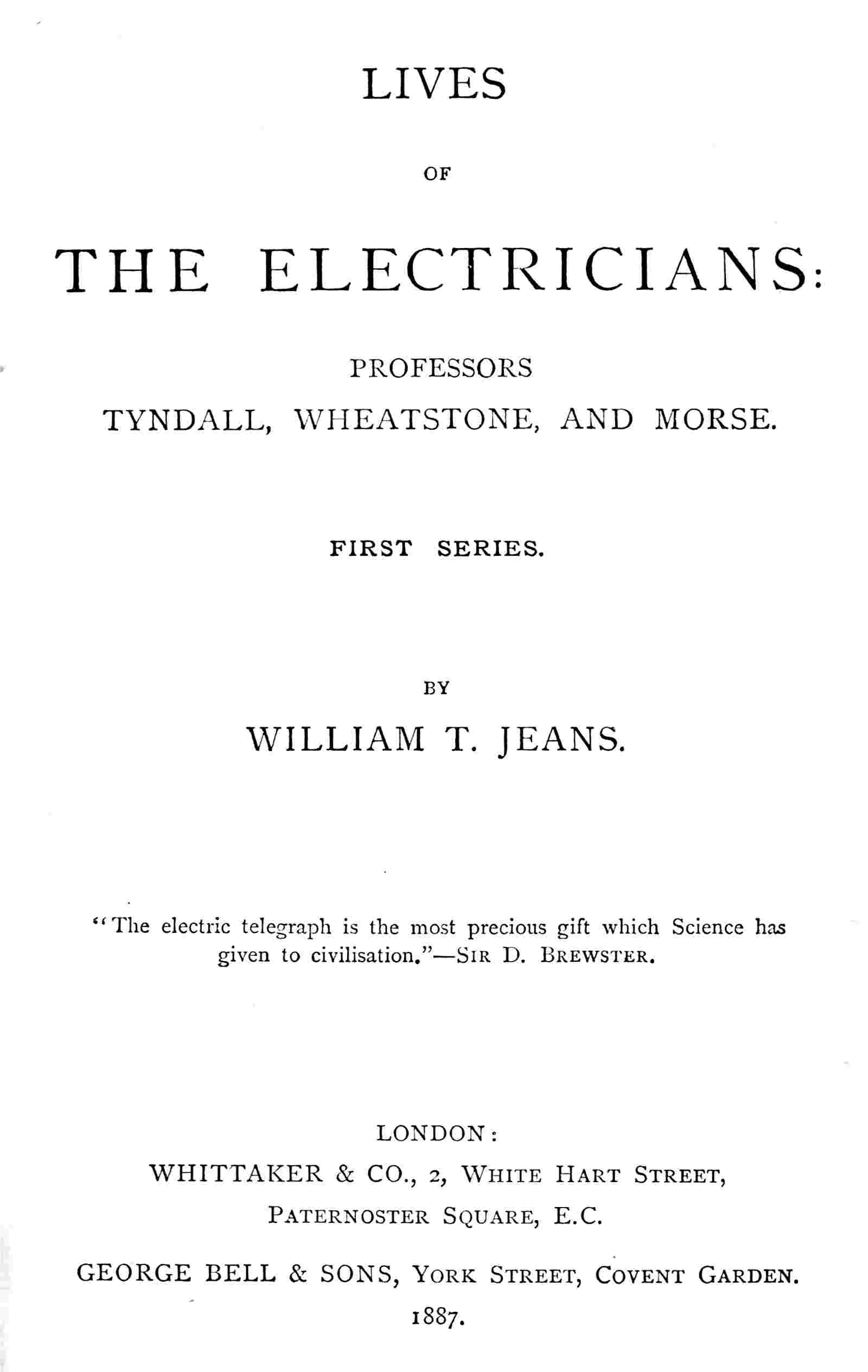
LIVES OF THE ELECTRICIANS.
First Series.
Professors TYNDALL, WHEATSTONE, AND MORSE.
BY
WILLIAM T. JEANS.
Crown 8vo. 6s.
The first volume of a series of Lives of the Electricians. It will contain popular biographies of Professors Tyndall, Wheatstone, and Morse, telling incidentally the story of the progress of the electric telegraph from its origin in 1837 to the present time. Next year will be the jubilee of the electric telegraph in England.
“THE SPECIALISTS’ SERIES.”
New Volume, Just Published:—
Heat.
ON THE CONVERSION OF HEAT INTO WORK. A Practical Handbook on Heat-Engines. By William Anderson, M.Inst.C.E. With 55 Illustrations. Crown 8vo, pp. viii-252, 6s. cloth.
The object of this work is to popularize the doctrine that, in heat-engines, the work given out is due to the conversion of the molecular motion of heat into the visible motion which it is desired to produce; and further to illustrate, by numerous practical examples, the applicability of the doctrine of Sadi Carnot to defining the limits within which improvement in the economical working of heat-engines is possible.
THE TELEPHONE AND ITS PRACTICAL APPLICATIONS.
By W. H. Preece, F.R.S., and J. Maier, Ph.D.
[Ready shortly.