
LIST OF ILLUSTRATIONS.
| PAGE | ||
|---|---|---|
| I. | View of the Garden-Front of Old Montagu House, the first ‘British Museum;’ as it appeared at the opening of the Institution to the Public in 1759 | Frontispiece. |
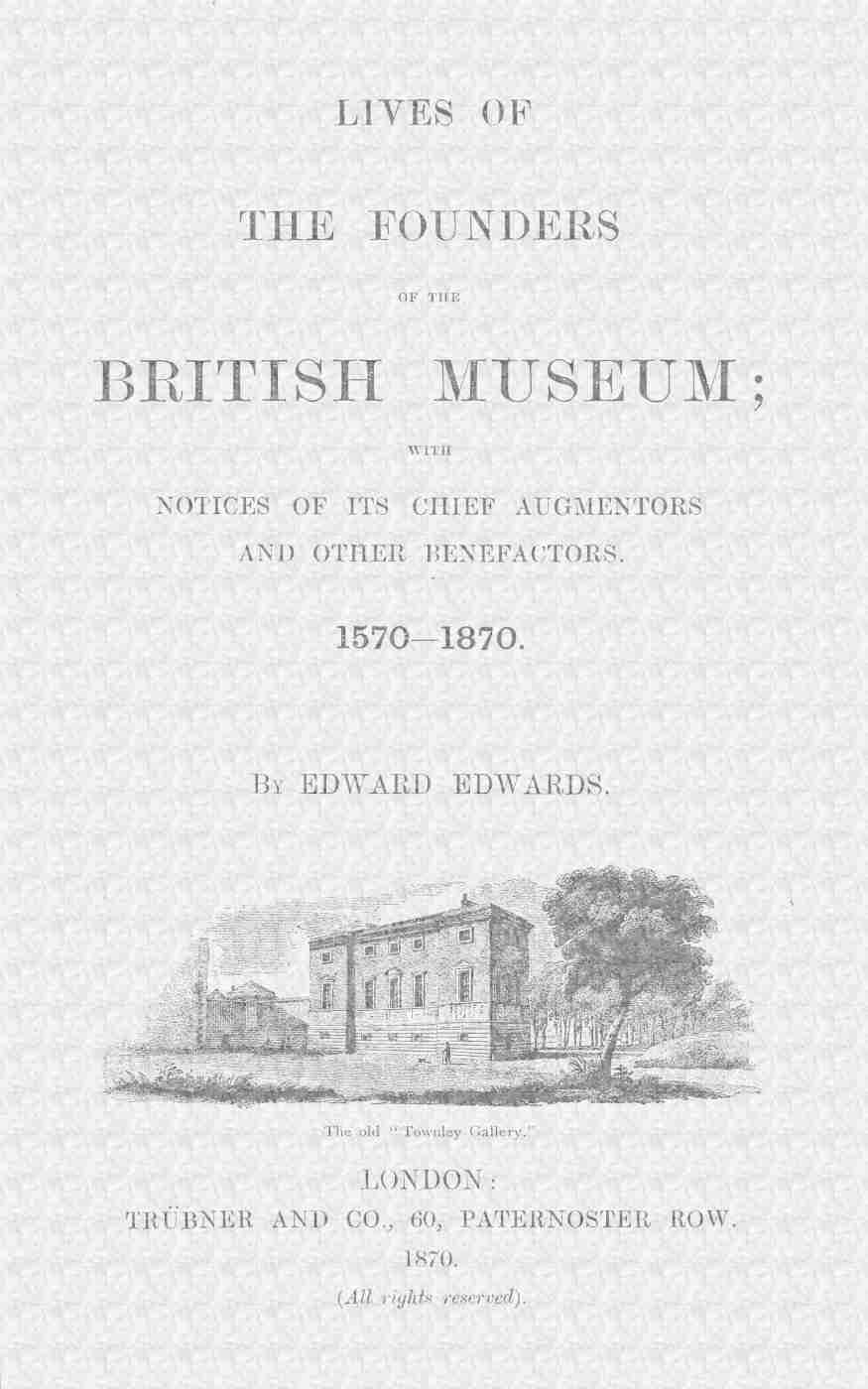
| II. | View of the old Towneley Gallery (built for the reception of the Towneleian Marbles in 1805, and pulled down on the erection of the existing Museum) | Vignette on Title-page. |
| III. | Ground-Plan of the Principal Floor of the original British Museum of 1759 | 325 |
| IV. | Ground-Plan of the Secondary Floor of the same | 327 |
| V. | Suggestions made in 1847 for the Enlargement of the Library of the British Museum; being the facsimile of a Plan inserted in a Pamphlet (written in 1846) entitled ‘Public Libraries in London and Paris’ | To face p. 556 |
| VI. | Reduced copy of Benjamin Delessert’s ‘Projet d’une Bibliothèque Circulaire,’ 1835 | 587 |
| VII. | General Block-Plan of the British Museum, as it was in 1857 | 589 |
| VIII. | Ground-Plan of the New or ‘Panizzi’ Reading-Room, and of the adjacent Galleries, 1857 | 590 |
| IX. | Interior View of the New Reading-Room, 1857 | 591 |
| X. | Coloured Plan of the Ground-Floor of the British Museum, as it was in 1862. Copied from the Parliamentary Return, No. 97 of Session 1862 | To face p. 750 |
| XI. | Coloured Plan of the Ground-Floor &c., (as above); together with the Alterations proposed to the Lords of the Treasury by the Trustees of the British Museum; in their Minutes of December, 1861, and January 21st, 1862, and in their Letter to the Treasury of 11th February, 1862. Copied from the same Return | To face p. 752 |
| XII. | Coloured Plan of the Upper Floor of the British Museum, as it was in 1862. Copied from the same Return | To face p. 754 |
| XIII. | Coloured Plan of the Upper Floor, &c. (as above); together with the Alterations proposed to the Treasury by the Trustees; in their Minutes of December, 1861, and January, 1862, and in their Letter of 11th February, 1862. Copied from the same Return | To face p. 756 |
BOOK THE FIRST.
EARLY COLLECTORS:—THE GATHERERS OF THE FOUNDATION COLLECTIONS.
CONTENTS OF BOOK I.
- Chapter I.
- Introduction.
- II.
- The Founder of the Cottonian Library.
- III.
- The Collectors and Augmentors of the Old Royal and Public Library at St. James’.
- IV.
- The Collector of the Arundelian MSS.
- V.
- The Collector of the Harleian Manuscripts.
- VI.
- The Founders of the Sloane Museum.
... “The reverence and respect your Petitioners bear to the memory of the most learned Sir Robert Cotton are too great not to mention, in particular, that from the liberal use of his Library sprang (chiefly) most of the learned works of his time, for ever highly to be valued. The great men of that age constantly resorted to and consulted it to shew the errors and mistakes in government about that period. And, as this inestimable Library hath since been generously given and dedicated to the Public use for ever, to be a National Benefit, your Petitioners presume that no expression of gratitude can be too great for so valuable a treasure, or for doing honour to the Memory and Family of Sir Robert Cotton.”—‘Petition to the Honourable House of Commons from the Cottonian Trustees’ (drawn up antecedently to the Foundation Act of the British Museum); 1752.
CHAPTER I.
INTRODUCTION.
Chronological Epochs in the Formation of the British Museum.
In two particulars, more especially, our great National Museum stands distinguished among institutions of its kind. The collections which compose it extend over a wider range than that covered by any other public establishment having a like purpose. And, if we take them as a whole, those collections are also far more conspicuously indebted to the liberality of individual benefactors. |The Public debt to private Collectors.| In a degree of which there is elsewhere no example, the British Museum has been gradually built up by the munificence of open-handed Collectors, rather than by the public means of the Nation, as administered by Parliament, or by the Governments of the day.
The real founders of our British Museum have been neither our British monarchs nor our British legislators, as such. They have been, commonly, individual and private British subjects; men loyal both to the Crown and to the People. Often, they have been men standing in direct lineal descent from the great Barons who dictated the Charter of our liberties, in the meadow near Windsor, and from those who led English knights and English bowmen to victory, on the wooded slopes near Poitiers. Sometimes, they have been men of very lowly birth; such as could point to no ancestral names appended to Magna Charta, or to the famous letter written from Lincoln to Boniface the Eighth; such as may, indeed, very well have had ancestors who gave their lives, or their limbs, for England at Poitiers or at Cressy, but who certainly could point to no heraldic memorials of feats of arms done on those bloody fields of France. Not a few of them, perhaps, would have been vainly asked to tell the names of their grandfathers. One boast, however, is common to both of these groups of our public benefactors. They were men who had alike a strong sense of gratitude to those who had gone before them, and a strong sense of duty to those who were to come after them. To nearly all of the men whose lives will be told in this volume are applicable, in a special sense, some words of Julius Hare:—‘They wrought in a magnanimous spirit of rivalry with Nature, or in kindly fellowship with her.... |J. & A. Hare, Guesses at Truth, vol. ii, p. 18.| When they planted, they chose out the trees of longest life—the Oak, the Chestnut, the Yew, the Elm,—trees which it does us good to behold, while we muse on the many generations of our Forefathers, whose eyes have reposed within the same leafy bays.’ They were men whose large impulses and deep insight led them to work, less for themselves than for their successors. It is by dint of what men of that stamp did—and did, not under the leading of the Gospel according to Adam Smith, but of a Gospel very much older than it—that upon us, whose day is now passing, Posterity, so to speak, ‘has cast her shadow before; and we are, at this moment, reposing beneath it.’ Of Public Benefactions, such as those which this volume very inadequately commemorates, it is true, with more than ordinary truth, that we owe them, mainly, to a generous conviction in the hearts of certain worthies of old days that they owed suit and service to Posterity. This may, indeed, be said of public foresight, when evidenced in material works and in provisions to smooth some of the asperities of common life and of manual toil. But it may be said, more appropriately still, of another and a higher kind of public foresight;—of that evidenced in educational institutions, and in the various appliances for raising and vivifying the common intellect; for enlarging its faculties; diffusing its enjoyments; and broadening its public domain. As it has been said (by the same acute thinker who has just been quoted) in better words than any of mine:—‘The great works that were wrought by men of former times; the great fabrics that were raised by them; their mounds and embankments against the powers of evil; their drains to carry off mischief; the wide fields they redeemed from the overflowings of barbarism; the countless fields they enclosed and husbanded for good to grow and thrive in; ... all this they [mainly] achieved for Posterity.... |J. & A. Hare, Guesses at Truth, vol. ii, p. 13.| Except for Posterity; except for the vital magnetic consciousness that while men perish, Man survives, the only principle of prudent conduct must have been, “Let us eat and drink, for to-morrow we die.”’
The pages which follow have been written in the belief that they afford—whatever the defects of their Writer—useful illustrations of this great and pregnant truth. To him it has not been given to work ‘for Posterity,’ otherwise than as a Chronicler of some of the workings of other men. But he owns to a special delight in that humble function. Its charm,—to his mind,—is enhanced, on the present occasion, by the very fact that so much of the work now about to be narrated is the work of men who only rarely have been labouring with other means, or with other implements, than those which were personal to themselves, as individuals.
In the chief countries of the Continent of Europe—on the other hand—great national Museums have, commonly, had their origin in the liberality and wise foresight either of some sovereign or other, or of some powerful minister whose mind was large enough to combine with the cares of State a care for Learning. In Britain, our chief public collection of literature and of science originated simply in the public spirit of private persons.
The British Museum was founded precisely at that period of our history when the distinctively national, or governmental, care for the interests of literature and of science was at its lowest, or almost its lowest, point. As regards the monarchs, it would be hard to fix on any, since the dawn of the Revival of Learning, who evinced less concern for the progress and diffusion of learning than did the first and second princes of the House of Hanover. As regards Parliament, the tardy and languid acceptance of the boon proffered, posthumously, by Sir Hans Sloane, constitutes just the one exceptional act of encouragement that serves to give saliency to the utter indifference which formed the ordinary rule.
Long before Sloane’s time (as we shall see hereafter), there had been zealous and repeated efforts to arouse the attention of the Government as well to the political importance as to the educational value of public museums. Many thinkers had already perceived that such collections were a positive increase of public wealth and of national greatness, as well as a powerful instrument of popular education. It had been shewn, over and over again, that for lack of public care precious monuments and treasures of learning had been lost; sometimes by their removal to far-off countries; sometimes by their utter destruction. Until the appeal made to Parliament by the Executors of Sir Hans Sloane, in the middle of the eighteenth century, all those efforts had uniformly failed.
But Sir Hans Sloane cannot claim to be regarded, individually or very specially, as the Founder of the British Museum. His last Will, indeed, gave an opportunity for the foundation. Strictly speaking, he was not even the Founder of his own Collection, as it stood in his lifetime. The Founder of the Sloane Museum was William Courten, the last of a line of wealthy Flemish refugees, whose history, in their adopted country, is a series of romantic adventures.
Parliament had previously accepted the gift of the Cottonian Library, at the hands of Sir John Cotton, third in descent from its Founder, and its acceptance of that gift had been followed by almost unbroken neglect, although the gift was a noble one. |(T. Carte to Sir Thomas Hanmer, Speaker of the House of Commons; Hanmer Corresp., p. 226.)| Sir John, when conversing, on one occasion, with Thomas Carte, told the historian that he had been offered £60,000 of English money, together with a carte blanche for some honorary mark of royal favour, on the part of Lewis the Fourteenth, for the Library which he afterwards settled upon the British nation. It has been estimated that Sloane expended (from first to last) upon his various collections about £50,000; so that, even from the mercantile point of view, the Cotton family may be said to have been larger voluntary contributors towards our eventual National Museum than was Sir Hans Sloane himself. That point of view, however, would be a very false, because very narrow, one.
Whether estimated by mere money value, or by a truer standard, the third, in order of time, of the Foundation-Collections, that of the ‘Harleian Manuscripts,’—was a much less important acquisition for the Nation than was the Museum of Sloane, or the Library of Cotton; but its literary value, as all students of our history and literature know, is, nevertheless, considerable. Its first Collector, Robert Harley, the Minister of Queen Anne and the first of the Harleian Earls of Oxford, is fairly entitled to rank, after Cotton, Courten, and Sloane, among the virtual or eventual co-founders of the British Museum.
Chronologically, then, Sir Robert Cotton, William Courten, Hans Sloane, and Robert Harley, rank first as Founders; so long as we estimate their relative position in accordance with the successive steps by which the British Museum was eventually organized. But there is another synchronism by which greater accuracy is attainable. Although four years had elapsed between the passing—in 1753—of ‘An Act for the purchase of the Museum or Collection of Sir Hans Sloane, and of the Harleian Collection of Manuscripts, and for providing one general repository for the better reception and more convenient use of the said Collection, and of the Cottonian Library and of the additions thereto,’ and the gift—in 1757—to the Trustees of those already united |The Old Royal Library, formed by Prince Henry (son of James I) at St. James’.| Collections by King George the Second, of the Old Royal Library of the Kings his predecessors, yet that royal collection itself had been (in a restricted sense of the words) a Public and National possession soon after the days of the first real and central Founder of the present Museum, Sir Robert Cotton. But, despite its title, that Royal Library, also, was—in the main—the creation of subjects, not of Sovereigns or Governments. Its virtual founder was Henry, Prince of Wales. It was acquired, out of his privy purse, as a subject, not as a Prince. He, therefore, has a title to be placed among the individual Collectors whose united efforts resulted—after long intervals of time—in the creation, eventually, of a public institution second to none, of its kind, in the world.
Prince Henry’s story is not the least curious of the many life-stories which these pages have to tell. That small span of barely eighteen years was eventful, as well as full of promise. And it may very fitly be told next, in order, after that of Cotton, who was not only his contemporary but his friend.
As the Royal Library was, in a certain degree, a Public Collection before the foundation of the Museum, so also was the Arundelian Library of Manuscripts. It did not become part of the British Museum until nearly eighty years after the amalgamation of the Cottonian, Harleian, Sloanian, and Royal Collections into one integral body. But the munificent Earl who formed it had often made it public, for the use of scholars, in his own lifetime. One or two of his descendants allowed it to fall into neglect. Before it left old Arundel House, in the Strand, it was exposed, more than once, to loss by petty thefts. But when, by another descendant, the injury was repaired, and the still choice collection given—at the earnest entreaty of another of our English worthies, John Evelyn—to the Royal Society, the Arundelian MSS., like the Library at Saint James’ Palace, became (so far as a circle of literary men and of the cultivators of scientific inquiry were concerned) a public possession. Many of the Arundelian marbles had also become—by other acts of munificence worthy of the time-honoured name of Howard—to the Public at large, and without restriction, ‘things of beauty,’ and ‘joys for ever.’ Others of them, indeed, are—even in these days—shut up at Wilton with somewhat of a narrow jealousy of the undistinguished multitude. But, by the liberality of the Dukes of Marlborough, the choice gems gathered by the Earl of Arundel during his long travels on the Continent, and his widespread researches throughout the world, have long been made available to public enjoyment, in more ways than one. The varied narrative of that famous Collector’s life may, perhaps, not unfitly be placed next after that of the best of the Stuart princes. Arundel, like Henry, was the friend of Sir Robert Cotton, and was proud of that distinction.
Undoubtedly, there is more than one point of view from which we may regard the preponderating share borne by private collectors in the ultimate creation of our national repository as matter of satisfaction, rather than matter of shame. It testifies to the strength amongst us—even at times deeply tinged with civil discord—of public and patriotic feeling. Nor is this all. It testifies, negatively, but not less strongly, to a conscientious sense of responsibility, on the part of those who have administered British rule in conquered countries, and in remote dependencies of the Crown. Few readers of such a book as this are likely to be altogether unacquainted with national museums and national libraries which have been largely enriched by the strong hand of the spoiler. Into some such collections it is impossible for portions of the people at whose aggregate expense they are maintained to enter, without occasional feelings of disgust and humiliation. There are, it is true, a few trophies of successful war in our own Museum. But there is nothing in its vast stores which, to any visitor of any nationality whatever, can bring back memories of ruthless and insolent spoliation.
That narrowness of conception, however, which has made some publicists to regard the slenderness of the contributions of the Nation at large, when contrasted with the extent of those of individuals, as if it were a cause for boasting, is visibly, and very happily, on the decline. It is coming to be recognised, more implicitly with every year that passes, that whatever can be done by the action of Parliament, or of the Government, for the real promotion of public civilisation,—in the amplest and deepest meaning of that word,—is but the doing of the People themselves, by the use of the most effective machinery they have at hand; rather than the acceptance of a boon conferred upon them, extraneously and from above.
If that salient characteristic in the past history of our British Museum is very far from affording any legitimate cause of boasting to the publicist, it affords an undeniable advantage to the narrator of the history itself. It not only broadens the range of his subject, by placing at its threshold the narrative of several careers which will be found to combine, at times, romantic adventure and political intrigue with public service of a high order; but it binds up, inseparably, the story of the quiet growth of an institution in London with occasional glimpses at the progress, from age to age, of geographical and scientific discovery, of archæological exploration, and of the most varied labours for the growth of human learning, throughout the world.
As an organized establishment, the British Museum is but little more than a century old. The history of its component parts extends over three centuries. That history embraces a series of systematic researches,—scientific, literary, and archæological,—the account of which (whatsoever the needful brevity of its treatment in these pages) must be told clumsily, indeed, if it be found to lack a very wide and general interest for all classes of readers—one class only excepted.
Even the least thoughtful among those visitors who can be said to frequent the Museum—as distinguished from the mere holiday guests, who come only in crowds, little favourable to vision; to say nothing of thought—will occasionally have had some faint impression or other of the great diversity and wonderful combination of effort which must have been employed in bringing together the Collections they look upon. Every part and almost every age of the world has contributed something; and that something includes the most characteristic productions and choicest possessions of every part. Almost every man of British birth who,—during many centuries,—has won conspicuous fame as a traveller, as an archæologist, or as a discoverer, has helped, in one way or other, to enrich those collections. They bear their own peculiar testimony to nearly every step which has been taken either in the maritime and colonial enterprise, or in the political growth, of the British empire. Nor is their testimony a whit less cogent to the power of that feeling of international brotherhood, in matters of learning and science, which grows with their growth, and waxes stronger with their strength.
To the remarkable career of the first of those four primary Collectors, whose lifelong pursuits converged, eventually, in the foundation of an institution, of the full scope of which only one of the four had even a mental glimpse—and Sloane’s glimpse was obviously but a very dim one—the attention of the reader has now to be turned. Sir Robert Cotton’s employments in political life (unofficial as they were), and the powerful influence which he exerted upon statesmen much abler than himself, will be found, it is hoped, to give not a little of historical interest to his biography, quite additional to that which belongs to his pursuits as a studious Collector, and as the most famous of all the literary antiquaries who occur throughout our English story.
To the conspicuous merits which belong to Sir Robert Cotton as a politician of no mean acumen, and as,—in the event,—the real Founder of the British Museum, are added the still higher distinctions of an eminently generous spirit and a faithful heart. His openhandedness in giving was constant and princely. His firmness in friendship is testified by the fact that although (in a certain point of view) he was the courtier both of James the First and of Charles the First, he nevertheless stood persistently and unflinchingly by the side of Eliot, and of the men who worked with Eliot, in the period of their deepest court disgrace. By the best of the Parliamentarian leaders he was both reverenced and loved. And he reciprocated their feeling.
My personal pleasure in the task of writing the life of such a man as he was is much enhanced by a strong conviction that certain recent attacks upon his memory are based upon fallacious evidence, shallow presumptions, and hasty judgments. It is my hope to be able to shew to the Reader, conclusively, that Cotton was worthy of the cordial regard and the high esteem in which he was uniformly held by men who stood free of all bias from political and party connexion—such, for example, as William Camden, who spoke of him, almost with dying lips, as ‘the dearest of all my friends,’—as well as by those great Parliamentarian leaders whose estimate of him may, perhaps, be thought—by hasty readers—to rest partly, if not mainly, on the eminent political service which he was able to render them.
When these pages shall come from the Press just three hundred years will have elapsed since Sir Robert Cotton’s birth. Our English proto-collector was born in the year 1570. The year 1870 will, in all probability, witness the definite solution of a knotty problem as to the future of the great institution of which he was the primary and central founder.
Cotton may be regarded as the English ‘proto-collector,’ in a point of view other than that which concerns the British Museum. No Library in the United Kingdom can, I think, shew an integral ‘Collection,’ still extant, the formation of which—as a Collection—can be traced to an earlier date than that of the collection of the Cottonian Manuscripts.
Whether the British Museum shall continue to be the great national repository for Science, as well as for Literature and Antiquities, is a question which is fast ripening for decision; and it is one which ought to be interesting to all Britons. It is also, and very eminently, one of those questions of which it is literally—and not sarcastically—to be affirmed that ‘there is much to be said on both sides.’
Personally I have a very strong conviction on that subject. But in treating of it—in the ‘Postscript’ which closes the present volume—it has been my single and earnest aim to state, with the utmost impartiality I am able to attain, the leading arguments for maintaining the Museum in its full integrity; and also the leading arguments for severing the great Natural History Collections from the rapidly growing Libraries and from the vast Galleries of marbles, bronzes, pottery, medals, and prints. It is the business of writers to state and marshal the evidence. It is the business of Parliament to pronounce the judgment.
The main epochs in the History of the British Museum afford what may be looked upon almost as a ‘table of contents’ to the present volume. And they may be brought under the Reader’s eye in a way which will much facilitate the correct apprehension of the author’s plan. I exhibit them thus:—
| Chronological List of the Dates, Founders, and Character, of the Component Collections, out of which the BRITISH MUSEUM has been formed or enlarged:— | |
|---|---|
| Class I.—Foundation Collections, 1570–1762. | Incorporated by the Act (A.D. 1753) 26 Geo. II, c. 22, entitled, ‘An Act for the Purchase of the Museum or Collection of Sir Hans Sloane and of the Harleian Collection of MSS.; and for providing one General Repository ... for the said Collections and for the Cottonian Library and additions thereto;’ Opened, for Public Use, on Monday the 15th January, 1759; and subsequently AUGMENTED, from time to time, by numerous additional Collections; and, MORE PARTICULARLY, by the following— |
| I. Cottonian Manuscripts, Coins, Medals, and other Antiquities. | |
| Collected by Sir Robert Cotton, Baronet (born in the year 1570; died 6 May, 1631). Given to the Nation by Sir John Cotton in 1700. Augmented during the Collector’s lifetime by the gifts of Arthur Agarde (1615), William Camden (1623), John Dee (1608), William Lambarde (1601), and others; and, after his death, by the acquisitions of Sir Thomas Cotton and Sir John Cotton, his descendants; and also by the Printed Library of Major Arthur Edwards, given in 1738. | |
| II. Old ‘Royal Library.’ | |
| Re-founded, or restored, by Henry, Prince of Wales (born in 1594; died 6 November, 1612). [See Class II, § 1.] | |
| III. Arundelian Manuscripts. | |
| Collected by Thomas Howard, Earl of Arundel and of Norfolk; Earl Marshal of England; K.G. (Born in 1586; succeeded as XXIIIrd Earl of Arundel in 1603; died 4 October, 1646.) [See Class II, § 33.] | |
| IV. Thomason Tracts (Printed and Manuscript). [See Class II, § 3.] | |
| V. Harleian Manuscripts. | |
| Collected by Robert Harley, Earl Of Oxford (born in 1661; died 21 May, 1724). Augmented by incorporation, at various times, of the Collections, severally, or of considerable portions of the Collections of Sir Humphrey Gilbert (died 1584), John Foxe (1581), Daniel Rogers (1590), John Stowe (1605), Sir Henry Savile (1622), Sampson Lennard (1633), Sir Henry Spelman (1641), Sir Symonds D’Ewes (1650), Sir James Ware (1666), William Sancroft, Archbishop of Canterbury (1693), Peter Séguier, Chancellor of France (1696), John Bagford (1716); and others. [See Book I, c. 5.] | |
| VI. ‘Sloane Museum’ of Natural History and of Antiquities; and Library of Manuscripts and Printed Books. | |
| Collected by William Courten [known during part of his life as ‘William Charleton’] (born in 1642; died 26 March, 1702); continued by Sir Hans Sloane, Baronet (born in 1660; died 11 January, 1752); bequeathed, by the Continuator, to the British Nation,—conditionally on the payment to his executors, by authority of Parliament, of the sum of £20,000,—in order that those his Collections—to use the words of his last Will—being things ‘tending many ways to the Manifestation of the Glory of God, the Confutation of Atheism and its consequences, the Use and Improvement of the Arts and Sciences, and benefit of Mankind, may remain together and not be separated, and that chiefly in or about the City of London, where they may by the great confluence of people be of most use.’... [See Book I, c. 6.] | |
Class II.—Primary Accession Collections.
1757–1831:—
(I)
1757. Old ‘Royal Library.’
Restored, by Henry, Prince of Wales, in the year 1609, by the purchase—and incorporation with the remnants of an ancient collection—of the Library of John de Lumley, Lord Lumley (Born circa 1530; Restored in blood, as VIth Baron Lumley, in 1547: Died 1609); Continued by Charles I and Charles II, Kings of England, &c., from 1627 to 1683; Given to the Nation by King George the Second in 1757.
This Old Royal Library, although, as above mentioned, it still contains fragments of the more ancient Collection of the Kings of England—and among them books which undoubtedly belonged to King Henry the Sixth, if not to earlier Plantagenet kings—may fairly be regarded as of Prince Henry’s foundation in the main. Lord Lumley’s Library (which the Prince bought in bulk) contained that of his father-in-law, Henry Fitzalan, Earl of Arundel, into which had passed a part of Archbishop Cranmer’s Library. But this conjoined Collection has not wholly passed to the British Museum. It suffered some losses after Prince Henry’s death. On the other hand, it had acquired the collection of MSS. formed by the Theyers (John and Charles), in which was included another part of the Library of Cranmer; as I shall shew hereafter.
(II)
1759. Hebrew Library (Printed and Manuscript) of Da Costa.
Collected by Solomon Da Costa, formerly of Amsterdam, and chiefly between the years 1720 and 1727; Given by the Collector, in 1759, to the Trustees of the British Museum ‘for inspection and service of the Public, as a small token of my esteem, reverence, love, and gratitude to this magnanimous Nation, and as a thanksgiving offering ... for numberless blessings which I have enjoyed under it.’ (From Da Costa’s Letter to the Trustees.)
A collection, small in extent, but of great intrinsic worth; and very memorable, both as the generous gift of a good man; and as instancing the co-operation (at the very outset) of the love of learning in a foreigner—and a Jew—with a like love in Britons, for a common object; national, indeed, but also much more than national.
(III)
1762. The Thomason Collection of English Books and Tracts, Printed and Manuscript.
Collected by George Thomason (Died 1666); Purchased by King George the Third, in 1762, for presentation to the British Museum.
This Collection—the interest of which is specially but by no means exclusively political and historical—was formed between the years 1641 and 1663 inclusive, and it contains everything printed in England during the whole of that period which a man of great enterprise and energy could bring together by daily watchfulness and large outlay. It also contains many publications, and many private impressions, from printing-presses in Scotland, Ireland, and the Continent of Europe, relating to or illustrating the affairs of the United Kingdom and of the Commonwealth. In his lifetime, the Collector refused £4000 for his library, as insufficient to reimburse his costs, charges, and labour. His heirs and their assigns kept it for a century and then sold it to King George III for £300. It includes many political MSS., which no printer dared to put to press.
(IV)
1766. The Solander Fossils.
Collected by Daniel Charles Solander (Died 16 May, 1782); Purchased by Gustavus Brander and by him presented to the Museum (of which he was one of the first Trustees) in 1766.
The ‘Solander Fossils’—so called from the name of the eminent naturalist who found and described them—formed the primary Collection on which by gradual accessions the present magnificent collection of fossils has been built up.
(V)
1766. The Birch Library of Printed Books and Manuscripts.
Collected by Thomas Birch, D.D., a Trustee of the British Museum (Died 1766), and bequeathed by the Collector.
(VI)
1772. The Hamilton Vases, Antiquities, and Drawings.
Collected by Sir William Hamilton (Died 6 April, 1803); Purchased by Parliament from the Collector in 1772 for £8400.
(VII)
1790–1799. The Musgrave Library.
Collected by Sir William Musgrave, a Trustee (Died 1799); Acquired, partly by gift in 1790; partly by bequest in 1799.
(VIII)
1799. The Cracherode Library and Museum.
Collected by the Reverend Clayton Mordaunt Cracherode, a Trustee of the British Museum (Died 1799), and bequeathed by the Collector.
(IX)
1799. The Hatchett Minerals.
Collected by Charles Hatchett, and purchased for £700.
(X)
1802. The Alexandrian Collection of Egyptian Antiquities.
Collected by the French Institute of Egypt in 1800; Transferred to the Crown of England by the terms of the Capitulation of Alexandria in 1801; Given to the Museum in 1802 by King George the Third.
(XI)
1802. The Tyssen Anglo-Saxon Coins.
Collected by Samuel Tyssen; Purchased by the Trustees (for £620).
(XII)
1805–1814. The Townley Marbles, Coins, and Drawings.
Collected by the Townley Family, and chiefly by Charles Townley, of Townley in Lancashire; and acquired by Parliament, by successive purchases, in the years 1805 and 1814, for the aggregate sum of £28,200.
(XIII)
1807. The Lansdowne Manuscripts.
Collected by William Petty Fitzmaurice, Marquess of Lansdowne (Died 1805), who incorporated in it from time to time parts of the Libraries and Manuscript Collections of William Cecil, Lord Burghley (Died 1598); of Sir Julius Cæsar (Died 1636); of White Kennet, Bishop of Peterborough (Died 1728); of John Strype (Died 1737); of Philip Carteret Webb (Died 1770); and of James West (Died 1772). Purchased by Parliament for the sum of £4925.