
The Project Gutenberg eBook of Living Fountains or Broken Cisterns: An Educational Problem for Protestants
Title: Living Fountains or Broken Cisterns: An Educational Problem for Protestants
Author: E. A. Sutherland
Release date: March 20, 2020 [eBook #61640]
Most recently updated: October 17, 2024
Language: English
Credits: E-text prepared by Brian Wilson and the Online Distributed Proofreading Team (http://www.pgdp.net) from page images generously made available by Internet Archive (https://archive.org)
The Project Gutenberg eBook, Living Fountains or Broken Cisterns, by E. A. (Edward Alexander) Sutherland
| Note: | Images of the original pages are available through Internet Archive. See https://archive.org/details/livingfountains00suth |
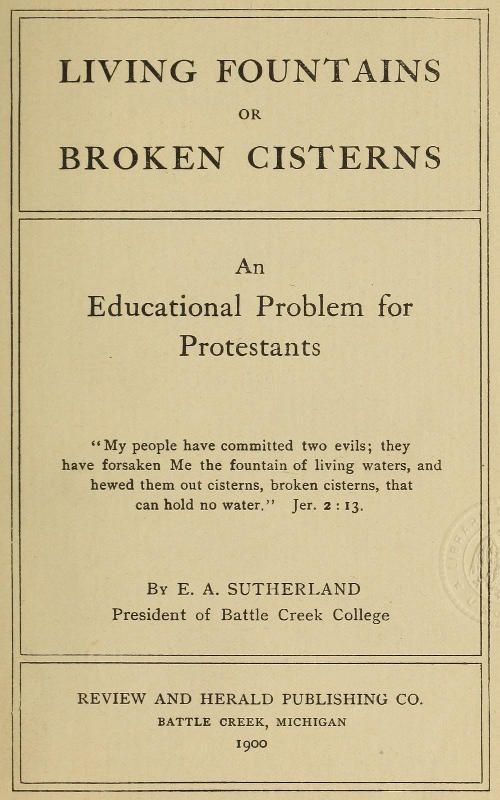
LIVING FOUNTAINS
OR
BROKEN CISTERNS
An
Educational Problem for
Protestants
“My people have committed two evils; they
have forsaken Me the fountain of living waters, and
hewed them out cisterns, broken cisterns, that
can hold no water.” Jer. 2:13.
By E. A. SUTHERLAND
President of Battle Creek College
REVIEW AND HERALD PUBLISHING CO.
BATTLE CREEK, MICHIGAN
1900
Copyright, 1900,
By E. A. Sutherland
PREFACE
There are few books which treat of the history of education, and fewer which attempt to show the part that the educational work has ever borne in the upbuilding of nations. That religion is inseparably connected with, and upheld by, the system of education maintained by its advocates, has been recognized by many historians in a casual way; but, to the author’s knowledge, no one has hitherto made this thought the subject of a volume.
In teaching the history of education and the growth of Protestantism, the close relationship ever existing between the latter and true methods of education led to a careful study of the educational system of the nations of the earth, especially of those nations which have exerted a lasting influence upon the world’s history. The present volume is the result of that study.
D’Aubigné says that in the Reformation “the school was early placed beside the church; and these two great institutions, so powerful to regenerate the nations, were equally reanimated by it. It was by a close alliance with learning that the Reformation entered into the world.”
True education, Protestantism, and republicanism form a threefold union which defies the powers of earth to overthrow; but to-day the Protestant churches are growing weak, and the boasted freedom of America’s democracy is being exchanged for monarchical principles of government.
This weakness is rightly attributed by some to the want of proper education. The same cause of degeneracy would doubtless be assigned by many others, were effects traced to their source.
The author has attempted, by a generous use of historical quotations, to so arrange facts that the reader will see that the hope of Protestantism and the hope of republicanism lies in the proper education of the youth; and that this true education is found in the principles delivered by Jehovah to his chosen people, the Jews; that it was afterward more fully demonstrated by the Master Teacher, Christ; that the Reformation witnessed a revival of these principles; and that Protestants to-day, if true to their faith, will educate their children in accordance with these same principles.
Due credit is given to the authors quoted, a list of whose names appears at the end of the volume. A complete index renders this work easy of reference.
E. A. S.
CONTENTS
| Chapter | Page | |
| I | God the Source of Wisdom | 9 |
| II | The Heavenly School | 15 |
| III | The Edenic School | 22 |
| IV | The History of Fifteen Centuries | 42 |
| V | The School of Abraham | 54 |
| VI | Education in Israel | 68 |
| VII | The Educational System of the Pagan World | 92 |
| VIII | Christ the Educator of Educators | 117 |
| IX | Education in the Early Church | 139 |
| X | The Papacy—An Educational Problem | 156 |
| XI | Education of the Middle Ages | 184 |
| XII | The Sixteenth-Century Reformation an Educational Reform | 214 |
| XIII | The Reaction after the Educational Reformation | 248 |
| XIV | America and the Educational Problem | 288 |
| XV | America and the Educational Problem (Continued) | 316 |
| XVI | Christian Education | 339 |
| XVII | Christian Education (Continued) | 380 |
I
INTRODUCTORY: GOD THE SOURCE OF WISDOM
“Surely there is a vein for the silver, and a place for gold where they fine it. Iron is taken out of the earth, and brass is molten out of the stone.... As for the earth, out of it cometh bread; and under it is turned up as it were fire. The stones of it are the place of sapphires; and it hath dust of gold. There is a path which no fowl knoweth, and which the vulture’s eye hath not seen. The lion’s whelps have not trodden it, nor the fierce lion passed by it....
“But where shall wisdom be found? And where is the place of understanding? Man knoweth not the price thereof; neither is it found in the land of the living. The depth saith, It is not in me; and the sea saith, It is not with me. It can not be gotten for gold, neither shall silver be weighed for the price thereof.... The gold and the crystal can not equal it; and the exchange of it shall not be for jewels of fine gold.... Whence then cometh wisdom? And where is the place of understanding?... God understandeth the way thereof, and He knoweth the place thereof.”[1]
Man sometimes feels that he understands the way of wisdom, and boasts that he knows the place thereof. He may indeed understand it in a measure, and he may ascertain its abiding place; but that knowledge comes in one way, and only one. He who understandeth the way thereof and knoweth the place thereof, opens a channel which connects earth with that fountain of life.
In the creation of the universe that wisdom was manifested. “When He made a decree for the rain, and a way for the lightning of the thunder; then did He see it, and declare it; He prepared it, yea, and searched it out.” Written on the face of creation is the wisdom of the eternal. “And unto man He said, Behold, the fear of the Lord, that is wisdom; and to depart from evil is understanding.” In other words, when man lives in harmony with God,—that is, when physically he acts in accordance with the laws of the universe; when mentally his thoughts are those of the Father; and when spiritually his soul responds to the drawing power of love, that power which controls creation,—then has he entered the royal road which leads direct to wisdom.
Where is the wise? There is implanted in each human heart a longing to come in touch with wisdom. God, by the abundance of life, is as a great magnet, drawing humanity to Himself. So close is the union that in Christ are hidden all the treasures of wisdom and knowledge. In one man—a man made of flesh and blood like all men now living—there dwelt the spirit of wisdom. More than this, in Him are “hid all the treasures of wisdom;” and hence the life of Immanuel stands a constant witness that the wisdom of the ages is accessible to man. And the record adds, “Ye are complete in Him.”
This wisdom brings eternal life; for in Him are “hid all the treasures of wisdom,” “and ye are complete in Him.” “This is life eternal, that they might know Thee the only true God.”
Christ, at Jacob’s well, explained to the woman of Samaria, and through her to you and me, the means of gaining wisdom. The well of living water, from the depths of which the patriarch had drawn for himself, his children, and his cattle, and which he bequeathed as a rich legacy to generations following, who drank, and blessed his name, symbolized worldly wisdom. Men to-day mistake this for that wisdom described in Job, of which God understandeth the way and knoweth the place. Christ spoke of this latter when He said, “If thou knewest the gift of God, and who it is that saith to thee, Give me to drink; thou wouldst have asked of Him, and He would have given thee living water.” “If any man thirst, let him come unto Me, and drink.”
Why, then, if wisdom may be had for the asking, if that spiritual drink may be had for the taking, are not all filled? The fountain flows free; why are not all satisfied? Only one reason can be given: men in their search accept falsehood in place of truth. This blunts their sensibilities, until the false seems true and the true false.
“Where is the wise?... hath not God made foolish the wisdom of this world?” “Howbeit we speak wisdom among the perfect (full-grown): yet a wisdom not of this world, nor of the rulers of this age which are coming to naught: but we speak God’s wisdom in a mystery, even the wisdom that hath been hidden, ... which none of the rulers of this world knoweth.”[2]
There is, then, a distinction between the wisdom of God and that of this world. How, then, can we attain unto the higher life,—to the real, the true wisdom? There are things which eye hath not seen nor ear heard, which eyes should see and ears hear, and these “God hath revealed unto us by His Spirit: for the Spirit searcheth all things, yea, the deep things of God.”
To man, then, if born of the Spirit, is given a spiritual eyesight which pierces infinitude, and enables the soul to commune with the Author of all things. No wonder the realization of such possibilities within himself led the psalmist to exclaim, “Such knowledge is too wonderful for me; it is high, I can not attain unto it.” And Paul himself exclaimed, “O the depth of the riches both of the wisdom and knowledge of God!... For who hath known the mind of the Lord?” “The things of God knoweth no man, but the Spirit of God.” And “we have received, not the spirit of the world, but the Spirit which is of God; that we might know the things that are freely given to us of God.” Hence to us is given the power to commune with Him and to search into the mysteries of the otherwise unfathomable.
Dealing with wisdom is education. If it be the wisdom of the world, then it is worldly education; if, on the other hand, it is a search for the wisdom of God, it is Christian Education.
Over these two questions the controversy between good and evil is waging. The final triumph of truth will place the advocates of Christian education in the kingdom of God. “God is a Spirit: and they that worship Him must worship in spirit and in truth.”
That education which links man with God, the source of wisdom, and the author and finisher of our faith, is a spiritual education, and prepares the heart for that kingdom which is within.
II
THE HEAVENLY SCHOOL
God’s throne, the center around which circled the worlds which had gone forth from the hand of the Creator, was the school of the universe. The Upholder of the worlds was Himself the great Teacher, and His character, love, was the theme of contemplation. Every lesson was a manifestation of His power. To illustrate the workings of the laws of His nature, this Teacher had but to speak, and before the attentive multitudes there stood the living thing. “He spake, and it was; He commanded, and it stood fast.”[3]
Angels, and the beings of other worlds in countless numbers, were the students. The course was to extend through eternity; observations were carried on through limitless space, and included everything from the smallest to the mightiest force, from the formation of the dewdrop to the building of the worlds, and the growth of the mind. To finish the course, if such an expression is permissible, meant to reach the perfection of the Creator Himself.
To the angelic host was given a work. The inhabitants of worlds were on probation. It was the joy of angels to minister to and teach other creatures of the universe. The law of love was everywhere written; it was the constant study of the heavenly beings. Each thought of God was taken by them; and as they saw the workings of His plans, they fell before the King of kings, crying, “Holy, holy, holy.” Eternity was all too short to reveal His love.
The Father and Son were often in council. Wrapped together in that glory, the universe awaited the expression of Their one will. As one of the covering cherubim, Lucifer stood the first in power and majesty of all the angelic host. His eye beheld, his ear heard, he knew of all except the deep counsels which the Father, from all eternity, had purposed in the Son. “Christ the Word, the only begotten of God, was one with the eternal Father,—one in nature, in character, in purpose,—the only being that could enter into all the counsels and purposes of God.... The Father wrought by His Son in the creation of all heavenly beings. ‘By Him were all things created, ... whether they be thrones, or dominions, or principalities, or powers. All things were created by Him, and for Him.’ Angels are God’s ministers, radiant with the light ever flowing from His presence, and speeding on rapid wing to execute His will. But the Son, the anointed of God, the ‘express image of His person,’ the ‘brightness of his glory,’ ‘upholding all things by the word of His power,’ holds supremacy over them all.” Lucifer, “son of the morning,” who “sealest up the sum, full of wisdom, and perfect in beauty, ... every precious stone was thy covering.” “Thou art the anointed cherub that covereth; I have set thee so; thou wast upon the holy mountain of God; thou hast walked up and down in the midst of the stones of fire.”[4] He who had hovered over the throne of God, who had stood on the mount of the congregation in the sides of the north, and walked up and down among those living stones, each flashing with electric brightness the glory of reflected light, looked upon the council, and envied the position of the Son.
Hitherto all eyes had turned instinctively toward the center of light. A cloud, the first one known, darkened the glory of the covering cherub. Turning his eyes inward, he reasoned that he was wronged. Had not he, Lucifer, been the bearer of light and joy to worlds beyond? Why should not his might be recognized? “Thou wast perfect in thy ways from the day that thou wast created till iniquity was found in thee.” “Thine heart was lifted up because of thy beauty, thou hast corrupted thy wisdom by reason of thy brightness.”[5] “Thou hast said in thine heart, I will ascend into heaven, I will exalt my throne above the stars of God: I will sit also upon the mount of the congregation, in the sides of the north: I will ascend above the heights of the clouds: I will be like the Most High.”[6]
While Lucifer thus reasoned, Christ, wrapped within the glory of the Father, was offering His life for the world at its creation. Sin had not yet entered, the world was not yet created; but as the plans were laid, the Son had said, “Should sin enter, I am, from this time, one with those We now create, and their fall will mean My life on earth. Never has My heart gone out for any creation as I put it into this. Man in his earthly home shall have the highest expression of Our love, and for him My love demands that I lay My life beside his in his very creation.” O wondrous gift! O unselfish love! How could that covering cherub, at the moment when the Son of God laid down His life, plan on his own exaltation? Sorrow, the first sorrow that was ever known, filled heaven. The angel choir was silent; the living stones withheld their shining. The stillness was felt throughout the universe.
An offer was made to return, but pride now closed the channel. Pity and admiration for the leader of the hosts led many to feel that God was unjustly severe. The universe was on trial. “Satan and his sympathizers were striving to reform the government of God. They wished to look into His unsearchable wisdom, and ascertain His purpose in exalting Jesus, and endowing Him with such unlimited power and command.” Those who before, inspired by love, took God at His word, and found their highest pleasure in watching the revealings of His love, now put their own minds in place of God’s word, and reasoned that all was wrong. The unfoldings of His love, which had meant their very life, now looked but darkness and despair. God’s wisdom, darkened by placing self between the throne and them, became foolishness. “All the heavenly host were summoned to appear before the Father to have each case decided.” “About the throne gathered the holy angels, a vast, unnumbered throng,—‘ten thousand times ten thousand, and thousands of thousands,’—the most exalted angels, as ministers and subjects, rejoicing in the light that fell upon them from the presence of the Deity.”
The principles of God’s government were now laid bare: it was nothing but a great, broad system of educational development, and angelic hosts then and there decided whether faith in His word would be the standard of their obedience, or whether finite reason would bear sway. Even Satan himself was almost won, as the notes of praise resounded through the domes of heaven; but again pride ruled. Here was born the rival system,—supreme selfishness facing the utter self-forgetfulness of Christ, reason over against faith. After long pleadings, and amidst deep mourning, heaven’s portals opened to close forever upon the one who, with his followers, turned from light into the darkness of despair.
A new era was ushered in; a controversy was begun. High heaven, with its eternal principles of love, life, progress, was challenged by a subtle foe, the father of lies. Deep as is the misery attending the step, yet coexistent with the downward move was formulated the plan which, after the lapse of ages, will prove in a greater degree, and manifest eternally the truth, that “God is love.” The pathway is the way of the cross. It is a retracing of the mental degradation occasioned by the fall, but the process is according to the law of the school of heaven,—“according to your faith.” If ye believe, all things are possible.
III
THE EDENIC SCHOOL
“He spake, and it was; He commanded, and it stood fast.”[7] Forth from the throne of the Infinite passed the decree, and life flashing out into space, a world stood forth. Myriads of other worlds, held in their orbits by the ceaseless power of love, made their circuit about the throne of God. But one space in the universe had been reserved for the highest expression of His love, where was to be manifested the depths of this divine attribute. “And the earth was waste and void; and darkness was upon the face of the deep.”[8] But even into the darkness His presence penetrated; and as “the Spirit of God was brooding upon the waters,” He said, “Let there be light,” and darkness scattered before the word. The light, reflective of His own being, pleased Him; and He willed that it should be ever present, accompanying every form of life. The first day’s work was done,—a day such as the future man would know, and which, even in his fallen state, would measure off his years.
The second day heard the mandate for the water to separate; and a third gathered the waters into seas, with the dry land appearing. And then “God said, Let the earth put forth grass,”—the lowly blade covering the earth’s nakedness with a robe of living green, itself so humble, yet a part of His life; for his life-breath formed it, and it partook of that life. Then came the herbs and lofty trees, each bearing seed,—self-productive,—for life is reproductive; and as the living coal kindles a sacred fire, so each tree bore within itself the power to reproduce its kind. “And God saw that it was good.” Then, that His own light might ever be the cause of growth, He placed luminaries in the heavens, each being the reflection of His own countenance. By this should life be sustained.
Into the moving waters passed the power of life. “God said, Let the waters swarm with swarms of living creatures, and let fowl fly above the earth in the open firmament of heaven.”[9] At His word an abundance of life filled earth and sky and sea. Every drop of water sustained life; every square inch of air supported its myriads. And from the mighty leviathan that sported in the waters to the mote that floated in the air, all life proclaimed the love of God; and the Creator, viewing with satisfaction the work of His hand, pronounced each form of life perfect in its sphere. Each held within its own body the breath of life; each in its every movement sang hallelujahs to the Maker of the heavens and the earth.
But the work was not yet complete. A mind controlled the universe; and its powers could be appreciated, its heart-love returned in the fullest sense, only by mind,—by beings made in the image of God Himself. And so “God said, Let Us make man in Our image, after Our likeness.” He can then hold dominion over the lower orders of creation, and standing to them as We do to the universe, all nature will see Our power in him. “So God created man in His own image, in the image of God created He him; male and female created He them.”[10]
As if the moment of supreme endeavor had been reached even by God, He molded the form of clay,—one, only one, in the image of Himself. He breathed into its nostrils His own breath,—that breath which, vocalized, moved the worlds; before which angels bowed in adoration. That all-pervading element of life surged through the mighty frame, the organs performed their functions, the brain worked; the man Adam stood forth, strong and perfect; and instead of the piercing wail which now announces the beginning of a new life, his lips parted, and a song of praise ascended to the Creator.
Standing by his side was his Elder Brother, Christ, the King of heaven. Adam felt the thrill of unity and harmony; and while for a “little time inferior,” yet within him lay the possibilities of attaining greater heights than angels held. He was to be the companion of God, the perfect reflection of His light and glory; there was no thought of God that might not have access to the brain of man. The universe spread out in panoramic view before him. The earth, newborn, presented untold beauties. By his side stood his companion, the other half of his own nature, the two forming a perfect whole. The harmony of thought brought strength and life; and, as a result of this unity, new beings like themselves would be brought into existence, until the earth was peopled.
God planted a garden eastward in Eden, and from the beauties of the earth chose the most beautiful spot for the home of the new pair. In the midst of the garden stood the tree of life, the fruit of which afforded man a perfect physical food. Beneath its spreading branches God Himself visited them, and, talking with them face to face, revealed to them the way of immortality. As they ate of the fruit of the tree of life, and found every physical want supplied, they were constantly reminded of the need of the spiritual meat which was gained by open converse with the Light from heaven. The glory of God surrounded the tree, and enwrapped in this halo, Adam and Eve spent much time in communing with the heavenly visitors. According to the divine system of teaching, they were here to study the laws of God and learn of his character. They “were not only His children, but students receiving instruction from the all-wise Creator.”
Angels, beholding the wonders of the new creation, delighted to fly earthward; and two from the heavenly host, by special appointment, became the instructors of the holy ones. “They were full of vigor imparted by the tree of life, and their intellectual power was but little less than that of the angels. The mysteries of the visible universe—‘the wondrous works of Him who is perfect in knowledge,’—afforded them an exhaustless source of instruction and delight. The laws and operations of nature, which have engaged men’s study for six thousand years, were opened to their minds by the infinite Framer and Upholder of the universe.
“They held converse with leaf and flower and tree, gathering from each the secrets of its life. With every living creature, from the mighty leviathan that playeth among the waters to the insect mote that floats in the sunbeam, Adam was familiar. He had given to each its name, and he was acquainted with the nature and habits of all. God’s glory in the heavens, the innumerable worlds in their orderly revolutions, ‘the balancing of the clouds,’ the mysteries of light and sound, of day and night,—all were open to the study of our first parents. On every leaf of the forest or stone of the mountains, in every shining star, in earth and air and sky, God’s name was written. The order and harmony of creation spoke to them of infinite wisdom and power. They were ever discovering some attraction that filled their hearts with deeper love, and called forth fresh expressions of gratitude.”
As new beauties came to their attention, they were filled with wonder. Each visit of the heavenly teachers elicited from the earthly students scores of questions which it was the delight of the angels to answer; and they in turn opened to the minds of Adam and Eve principles of living truth which sent them forth to their daily tasks of pleasure full of wondering curiosity, ready to use every God-given sense to discover illustrations of the wisdom of heaven. “As long as they remained loyal to the divine law, their capacity to know, to enjoy, and to love would continually increase. They would be constantly gaining new treasures of knowledge, discovering fresh springs of happiness, and obtaining clearer and yet clearer conceptions of the immeasurable, unfailing love of God.”
The divine method of teaching is here revealed,—God’s way of dealing with minds which are loyal to him. The governing laws of the universe were expounded. Man, as if looking into a picture, found in earth, sky, and sea, in the animate and inanimate world, the exemplification of those laws. He believed, and with a heavenly light, which is the reward of faith, he approached each new subject of investigation. Divine truths unfolded continually. Life, power, happiness,—these subjects grew with his growth. The angels stimulated the desire to question, and again led their students to search for answers to their own questions. At his work of dressing the garden, Adam learned truths which only work could reveal. As the tree of life gave food to the flesh, and reminded constantly of the mental and spiritual food necessary, so manual training added light to the mental discipline. The laws of the physical, mental, and spiritual world were enunciated; man’s threefold nature received attention. This was education, perfect and complete.
The magnetic power about the tree of life held man, filling his senses with a thrill of delight. Adam and Eve lived by that power, and the human mind was an open channel for the flow of God’s thought. Rapidly the character of the Edenic pair was being formed, but strength could not come from mere automatic action. Freedom to choose God’s company and spirit was given; and while He wooed them with His tenderest love, He had placed in the midst of the garden a tree of another sort.
To the man He said, “Of the tree of the knowledge of good and evil, thou shalt not eat of it; for in the day that thou eatest thereof thou shalt surely die.”[11] What was the meaning of this command? As the angel teachers heard the question from man’s lips, a cloud seemed to dim the brightness of their glory. Did not Adam feel a strange sensation, as if the fullness of divine thought was suddenly checked in its course through his brain? He was preparing himself to accept teachings of a different character. Then was told the story of the one sorrow heaven had known,—of the fall of Lucifer, and the darkness it brought to him; that while he lived, the decree of God was that he could no longer remain within the walls of Paradise. In low tones it was told how some could not see the justice of this; that Lucifer had been given the earth as his present home; that he would use his arts to capture them; but that light and power had been placed about the tree of life, and remaining true to the teaching given within the circle of its rays, no evil could overtake them. “Faith, have faith in God’s word,” said the angel, as he winged his flight toward heaven.
The word “death” sounded unnatural to human ears, and as they sat together talking of the angel’s words, a longing to understand filled their hearts. Fear?—they knew no such word. Was not their Maker love? Eve, wandering from her husband’s side, found, before she knew it, that she was nearing the tree of the knowledge of good and evil. She stood gazing from a distance, when from the rich verdure came a voice of sweetest music:—
“Beautiful woman, made in God’s own image, what can mar thy perfect beauty? What can stop that life now coursing through thy veins? ‘Hath God said, Ye shall not eat of every tree of the garden?... Ye shall not surely die: for God doth know that in the day ye eat thereof, then your eyes shall be opened, and ye shall be as gods knowing good and evil.’” Speaking, he plucked and ate. Was this the deceiver? Had she not been promised a knowledge of all things? Was she not to be with God? Perhaps this was some new revelation of his goodness. She felt no danger. He ate, why should not she?
Her curiosity was aroused, and she was flattered by the words of the serpent. Instead of fleeing, she argued with him, and attempted to decide in her own mind between right and wrong. But God had told her what was right. That moment of indecision, of doubting, was the devil’s opportunity.
Unable to reach the soul of man by direct means, Satan approached it through those outer channels, the senses. He had everything to win, and proceeded cautiously. If man’s mind could be gained, his great work would be accomplished. To do this he used a process of reasoning—a method the reverse of that used by the Father in his instruction at the tree of life. The mind of Eve was strong, and quickly drew conclusions; hence, when her new teacher said, “If ye eat, ‘ye shall be as gods,’” in the mind of Eve arose the thought, God has immortality. “Therefore,” said Satan, “if ye eat, ‘ye shall not surely die.’” The conclusion was logically drawn, and the world, from the days of Eve to the present time, has based its religious belief on that syllogism, the major premise of which, as did Eve, they fail to recognize as false. Why?—Because they use the mind to decide the truth instead of taking a direct statement from the Author of wisdom. From this one false premise comes the doctrine of the natural immortality of man, with its endless variations, some modern names of which are theosophy, Spiritualism, reincarnation, and evolution. The sons and daughters of Eve condemn her for the mistake made six thousand years ago, while they themselves repeat it without question. It is preached from the pulpit, it is taught in the schoolroom, and its spirit pervades the thought of every book written whose author is not in perfect harmony with God and truth. Now began the study of “dialectics,” so destructive to the Christian’s faith.
Having accepted the logic of the serpent, and having transferred her faith from the word of God to the tree of knowledge at Satan’s suggestion, the woman could easily be led to test the truth of all his statements by her senses. A theory had been advanced; the experimental process now began. That is the way men now gain their knowledge, but their wisdom comes otherwise. She looked upon the forbidden fruit, but no physical change was perceptible as the result of the misuse of this sense. This led her to feel more sure that the argument used had been correct. Her ears were attentive to the words of the serpent, but she perceived no change as a result of the perverted use of the sense of hearing. This, to the changing mind of the woman, was still more conclusive proof that the words of Christ and angels did not mean what she had at first thought they meant. The senses of touch, smell, and taste were in turn used, and each corroborated the conclusion drawn by the devil. The woman was deceived, and through the deception her mind was changed. This same change of mind may be wrought either by deception or as a result of false reasoning.
Eve approached Adam with the fruit in her hand. Instead of answering in the oft-repeated words of Christ, “In the day that thou eatest thereof thou shalt surely die,” he took up the logic of the serpent. Having eaten, his mind was also changed. He who from creation had thought the thoughts of God, was yielding to the mind of the enemy. The exactness with which he had once understood the mind of God was exemplified when he named the animals; for the thought of God which formed the animal passed through the mind of Adam, and “whatsoever Adam called every living creature, that was the name thereof.”
The completeness of the change which took place is seen in the argument used when God walked in the garden in the cool of the evening. Said Adam, “The woman gave me to eat. Thou gavest me the woman. Therefore Thou art to blame.” This was another decidedly logical conclusion, from the standpoint of the wisdom of the serpent, and it was repeated by Eve, who laid the blame first on the serpent, and finally on God himself. Self-justification, self-exaltation, self-worship,—here was the human origin of the papacy, that power which “opposeth and exalteth itself above all that is called God.”
The spiritual death which followed the perversion of the senses was attended, in time, by physical death. Indeed, the fruit had scarcely been eaten when the attention of the man and his wife was turned toward externals. The soul, which had enveloped the physical man as a shroud of light, withdrew, and the physical man appeared. A sense of their nakedness now appalled them. Something was lacking; and with all the glory they had known, with all the truths which had been revealed, there was nothing to take the place of the departed spiritual nature. “Dying, thou shalt die,” was the decree; and had not the Saviour at this moment made known to Adam the plan of the cross, eternal death would have been inevitable.
God, through His instruction, had taught that the result of faith would be immortal life. Satan taught, and attempted to prove his logic by a direct appeal to the senses, that there was immortal life in the wisdom that comes as the result of human reason. The method employed by Satan is that which men to-day call the natural method, but in the mind of God the wisdom of the world is foolishness. The method which to the godly mind, to the spiritual nature, seems natural, is foolishness to the world.