
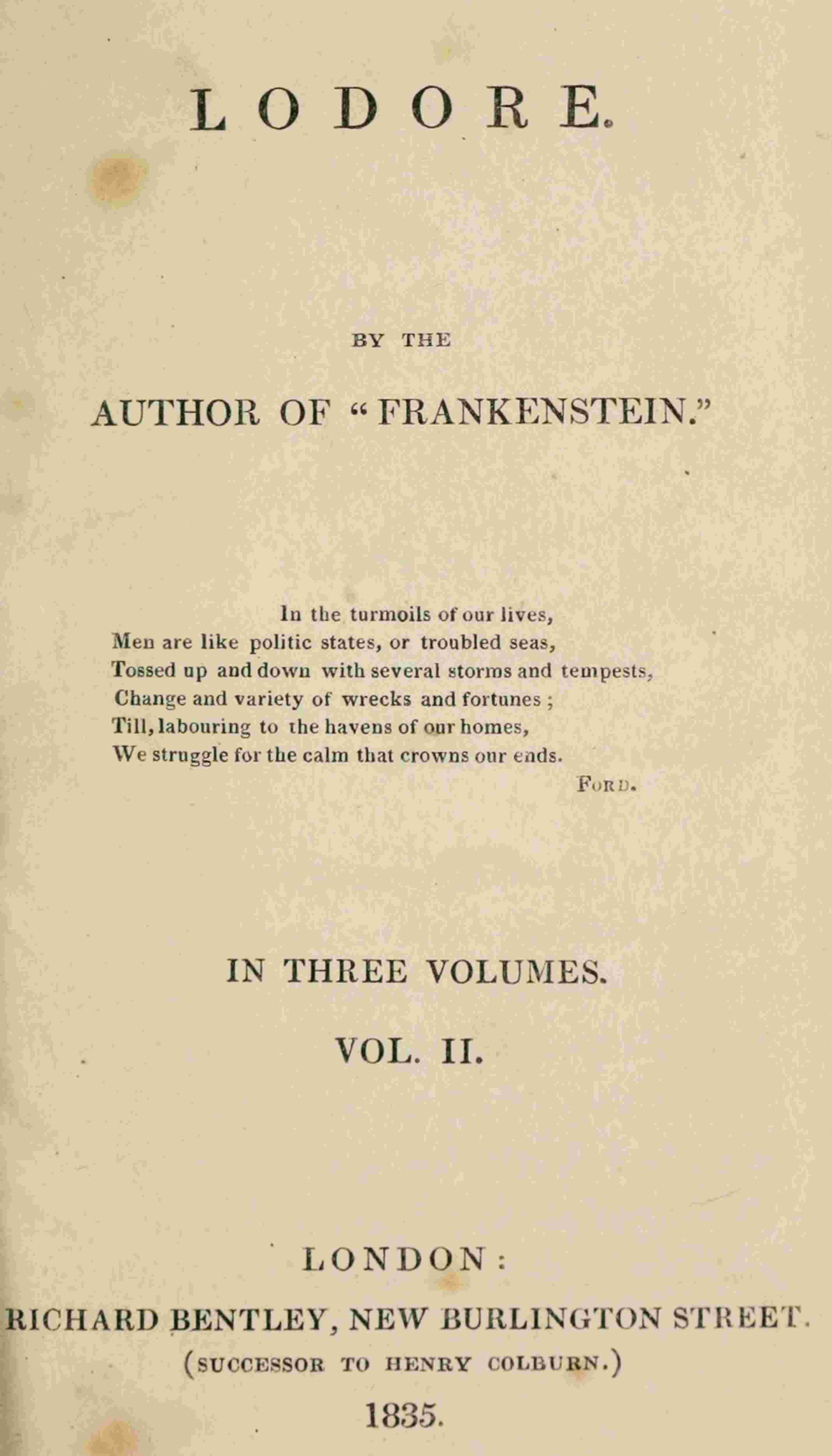
The Project Gutenberg eBook of Lodore, Vol. 2 (of 3)
Title: Lodore, Vol. 2 (of 3)
Author: Mary Wollstonecraft Shelley
Release date: February 14, 2021 [eBook #64556]
Most recently updated: October 18, 2024
Language: English
Credits: Laura Natal Rodrigues at Free Literature (Images generously made available by Hathi Trust Digital Library.)
LODORE.
BY THE
AUTHOR OF "FRANKENSTEIN."
Men are like politic states, or troubled seas.
Tossed up and down with several storms and tempests,
Change and variety of wrecks and fortunes;
Till, labouring to the havens of our homes,
We struggle for the calm that crowns our ends.
FORD.
IN THREE VOLUMES.
VOL. II.
LONDON:
RICHARD BENTLEY, NEW BURLINGTON STREET
(SUCCESSOR TO HENRY COLBURN.)
1835.
CONTENTS
CHAPTER I
CHAPTER II
CHAPTER III
CHAPTER IV
CHAPTER V
CHAPTER VI
CHAPTER VII
CHAPTER VIII
CHAPTER IX
CHAPTER X
CHAPTER XI
CHAPTER XII
CHAPTER XIII
CHAPTER XIV
CHAPTER XV
CHAPTER XVI
CHAPTER XVII
CHAPTER XVIII
LODORE
CHAPTER I
Even sorrow lovely!
BEAUMONT AND FLETCHER.
Mr. Villiers now became the constant visitor of Mrs. Elizabeth and her niece; and all discontent, all sadness, all listlessness, vanished in his presence. There was in his mind a constant spring of vivacity, which did not display itself in mere gaiety, but in being perfectly alive at every moment, and continually ready to lend himself to the comfort and solace of his companions. Sitting in their dingy London house, the spirit of dulness had drawn a curtain between them and the sun; and neither thought nor event had penetrated the fortification of silence and neglect which environed them. Edward Villiers came; and as mist flies before the wind, so did all Ethel's depression disappear when his voice only met her ear: his step on the stairs announced happiness; and when he was indeed before her, light and day displaced every remnant of cheerless obscurity.
The abstracted, wounded, yet lofty spirit of Lodore was totally dissimilar to the airy brightness of Villiers' disposition. Lodore had outlived a storm, and shown himself majestic in ruin. No ill had tarnished the nature of Villiers: he enjoyed life, he was in good-humour with the world, and thought well of mankind. Lodore had endangered his peace from the violence of passion, and reaped misery from the pride of his soul. Villiers was imprudent from his belief in the goodness of his fellow-creatures, and imparted happiness from the store that his warm heart insured to himself. The one had never been a boy—the other had not yet learned to be a man.
Ethel's heart had been filled by her father; and all affection, all interest, borrowed their force from his memory. She did not think of love; and while Villiers was growing into a part of her life, becoming knit to her existence by daily habit, and a thousand thoughts expended on him, she entertained his idea chiefly as having been the friend of Lodore. "He is certainly the kindest-hearted creature in the world." This was the third time that, when laying her gentle head on the pillow, this feeling came like a blessing to her closing eyes. She heard his voice in the silence of night, even more distinctly than when it was addressed to her outward sense during the day. For the first time after the lapse of months, she found one to whom she could spontaneously utter every thought, as it rose in her mind. A fond, elder brother, if such ever existed, cherishing the confidence and tenderness of a beloved sister, might fill the place which her new friend assumed for Ethel. She thought of him with overflowing affection; and the name of "Mr. Villiers" sometimes fell from her lips in solitude, and hung upon her ear like sweetest music. In early life there is a moment—perhaps of all the enchantments of love it is the one which is never renewed—when passion, unacknowledged to ourselves, imparts greater delight than any after-stage of that ever-progressive sentiment. We neither wish nor expect. A new joy has risen, like the sun, upon our lives; and we rejoice in the radiance of morning, without adverting to the noon and twilight that is to follow. Ethel stood on the threshold of womanhood: the door of life had been closed before her;—again it was thrown open—and the sudden splendour that manifested itself blinded her to the forms of the objects of menace or injury, which a more experienced eye would have discerned within the brightness of her new-found day.
Ethel expressed a wish to visit Eton. In talking of the past, Lord Lodore had never adverted to any events except those which had occurred during his boyish days. His youthful pleasures and exploits had often made a part of their conversation. He had traced for her a plan of Eton college, and the surrounding scenery; spoken of the trembling delight he had felt in escaping from bounds; and told how he and Derham had passed happy hours beside the clear streams, and beneath the copses, of that rural country. There was one fountain which he delighted to celebrate; and the ivied ruins of an old monastery, now become a part of a farm-yard, which had been to these friends the bodily image of many imaginary scenes. Among the sketches of Whitelock, were several taken in the vicinity of Windsor; and there were, in his portfolio, studies of trees, cottages, and also of this same abbey, which Lodore instantly recognized. To many he had some appending anecdote, some school-boy association. He had purchased the whole collection from Whitelock. Ethel had copied a few; and these, together with various sketches made in the Illinois, formed her dearest treasure, more precious in her eyes than diamonds and rubies.
We are most jealous of what sits nearest to our hearts; and we must love fondly before we can let another into the secret of those trivial, but cherished emotions, which form the dearest portion of our solitary meditations. Ethel had several times been on the point of proposing a visit to Eton, to her aunt; but there was an awful sacredness in the very name, which acted like a spell upon her imagination. When first it fell from her lips, the word seemed echoed by unearthly whisperings, and she fled from the idea of going thither,—as it is the feminine disposition often to do, from the full accomplishment of its wishes, as if disaster must necessarily be linked to the consummation of their desires. But a word was enough for Villiers: he eagerly solicited permission to escort them thither, as, being an Etonian himself, his guidance would be of great advantage. Ethel faltered her consent; and the struggle of delight and sensibility made that project appear painful, which was indeed the darling of her thoughts.
On a bright day in the first week of May, they made this excursion. They repaired to one of the inns at Salt Hill, and prolonged their walks and drives about the country. In some of the former, where old walls were to be scrambled up, and rivulets overleaped, Mrs. Elizabeth remained at the hotel, and Ethel and Villiers pursued their rambles together. Ethel's whole soul was given up to the deep filial love that had induced the journey. Every green field was a stage on which her father had played a part; each majestic tree, or humble streamlet, was hallowed by being associated with his image. The pleasant, verdant beauty of the landscape, clad in all the brightness of early summer; the sunny, balmy day—the clouds which pranked the heavens with bright and floating shapes—each hedgerow and each cottage, with its trim garden—each embowered nook—had a voice which was music to her soul. From the college of Eton, they sought the dame's house where Lodore and Derham had lived; then crossing the bridge, they entered Windsor, and prolonged their walk into the forest. Ethel knew even the rustic names of the spots she most desired to visit, and to these Villiers led her in succession. Day declined before they got home, and found Mrs. Elizabeth, and their repast, waiting them; and the evening was enlivened by many a tale of boyish pranks, achieved by Villiers, in these scenes. The following morning they set forth again; and three days were spent in these delightful wanderings. Ethel would willingly never have quitted this spot: it appeared to her as if, seeing all, still much remained to be seen—as if she could never exhaust the variety of sentiments and deep interest which endeared every foot of this to her so holy ground. Nor were her emotions silent, and the softness of her voice, and the flowing eloquence with which she expressed herself, formed a new charm for her companion.
Sometimes her heart was too full to admit of expression, and grief for her father's loss was renewed in all its pristine bitterness. One day, on feeling herself thus overcome, she quitted her companions, and sought the shady walks of the garden of the hotel, to indulge in a gush of sorrow which she could not repress. There was something in her gesture and manner as she left them, that reminded Villiers of Lady Lodore. It was one of those mysterious family resemblances, which are so striking and powerful, and yet which it is impossible to point out to a stranger. A bligh (as this indescribable resemblance is called in some parts of England) of her mother-struck Villiers forcibly, and he suddenly asked Mrs. Elizabeth, "If Miss Fitzhenry had never expressed a desire to see Lady Lodore."
"God forbid!" exclaimed the old lady; "it was my brother's dying wish, that she should never hear Lady Lodore's name, and I have religiously observed it. Ethel only knows that she was the cause of her father's misfortunes, that she deserted every duty, and is unworthy of the name she bears."
Villiers was astonished at this tirade falling from the lips of the unusually placid maiden, whose heightened colour bespoke implacable resentment. "Do not mention that woman's name, Mr. Villiers," she continued, "I am convinced that I should die on the spot if I saw her; she is as much a murderess, as if she had stabbed her husband to the heart with a dagger. Her letter to me that I sent to my poor brother in America, was more the cause of his death, I am sure, than all the duels in the world. Lady Lodore! I often wonder a thunderbolt from heaven does not fall on and kill her!"
Mrs. Elizabeth's violence was checked by seeing Ethel cross the road to return. "Promise not to mention her name to my niece," she cried.
"For the present be assured that I will not," Villiers answered. He had been struck most painfully by some of Mrs. Elizabeth's expressions, they implied so much more of misconduct on Lady Lodore's part, than he had ever suspected—but she must know best; and it seemed to him, indeed, the probable interpretation of the mystery that enveloped her separation from her husband. The account spread by Lady Santerre, and current in the world, appeared inadequate and improbable; Lodore would not have dared to take her child from her, but on heavier grounds; it was then true, that a dark and disgraceful secret was hidden in her heart, and that her propriety, her good reputation, her seeming pride of innocence, were but the mask to cover the reality that divided her from her daughter for ever.
Villiers was well acquainted with Lady Lodore; circumstances had caused him to take a deep interest in her—these were now at an end: but the singular coincidences that had brought him in contact with her daughter, renewed many forgotten images, and caused him to dwell on the past with mixed curiosity and uneasiness. Mrs. Elizabeth's expressions added to the perplexity of his ideas; their chief effect was to tarnish to his mind the name of Lady Lodore, and to make him rejoice at the termination that had been put to their more intimate connexion.
CHAPTER II
As light and wind within some delicate cloud,
That fades amid the blue noon's burning sky.
Genius and youth contended.
SHELLEY.
The party returned to town, and on the following evening they went to the Italian Opera. For the first time since her father's death, Ethel threw aside her mourning attire: for the first time also, she made one of the audience at the King's Theatre. She went to hear the music, and to spend the evening with the only person in the world who was drawn towards her by feelings of kindness and sympathy—the only person—but that sufficed. His being near her, was the occasion of more delight than if she had been made the associate of regal splendour. Yet it was no defined or disturbing sentiment, that sat so lightly on her bosom and shone in her eyes. Her's was the first gentle opening of a girl's heart, who does not busy herself with the future, and reposes on the serene present with unquestioning confidence. She looked round on the gay world assembled, and thought, "All are as happy as I am." She listened to the music with a subdued but charmed spirit, and turned now and then to her companions with a glad smile, expressive of her delight. Fewer words were spoken in their little box, probably than in any in the house; but in none were congregated three hearts so guileless, and so perfectly satisfied with the portion allotted to them.
At length both opera and ballêt were over, and, leaning on the arm of Villiers, the ladies entered the round-room. The house had been very full and the crowd was great. A seat was obtained for Aunt Bessy on one of the sofas near the door, which opened on the principal staircase. Villiers and Ethel stood near her. When the crowd had thinned a little, Villiers went to look for the servant, and Ethel remained surveying the moving numbers with curiosity, wondering at her own fate, that while every one seemed familiar one to the other, she knew, and was known by, none. She did not repine at this; Villiers had dissipated the sense of desertion which before haunted her, and she was much entertained, as she heard the remarks and interchange of compliments going on about her. Her attention was particularly attracted by a very beautiful woman, or rather girl she seemed, standing on the other side of the room, conversing with a very tall personage, to whom she, being not above the middle size, looked up as she talked; which action, perhaps, added to her youthful appearance. There was an ease in her manners that bespoke a matron as to station. She was dressed very simply in white, without any ornament; her cloak hung carelessly from her shoulders, and gave to view her round symmetrical figure; her silky, chesnut-coloured hair, fell in thick ringlets round her face, and was gathered with inimitable elegance in large knots on the top of her head. There was something bewitching in her animated smile, and sensibility beamed from her long and dark grey eyes; her simple gesture as she placed her little hand on her cloak, her attitude as she stood, were wholly unpretending, but graceful beyond measure. Ethel watched her unobserved, with admiration and interest, so that she almost forgot where she was, until the voice of Villiers recalled her. "Your carriage is up—will you come?" The lady turned as he spoke, and recognized him with a cordial and most sweet smile. They moved on, while Ethel turned back to look again, as her carriage was loudly called, and Mrs. Elizabeth seizing her arm, whispered out of breath, "O my dear, do make haste!" She hurried on, therefore, and her glance was momentary; but she saw with wonder, that the lady was looking with eagerness at the party; she caught Ethel's eye, blushed and turned away, while the folding doors closed, and with a kind of nervous trepidation her companions descended the stairs. In a moment the ladies were in their carriage, which drove off, while Mrs. Elizabeth exclaimed in the tone of one aghast, "Thank God, we got away! O, Ethel, that was Lady Lodore!"
"My mother!—impossible!"
"O, that we had never come to town," continued her aunt. "Long have I prayed that I might never see her again;—and she looking as if nothing had happened, and that Lodore had not died through her means! Wicked, wicked woman! I will not stay in London a day longer!"
Ethel did not interrupt her ravings: she remembered Captain Markham, and could not believe but that her aunt laboured under some similar mistake; it was ridiculous to imagine, that this girlish-looking, lovely being, had been the wife of her father, whom she remembered with his high forehead rather bare of hair, his deep marked countenance, his look that bespoke more than mature age. Her aunt was mistaken, she felt sure; and yet when she closed her eyes, the beautiful figure she had seen stole, according to the Arabian image, beneath her lids, and smiled sweetly, and again started forward to look after her. This little act seemed to confirm what Mrs. Elizabeth said; and yet, again, it was impossible! "Had she been named my sister, there were something in it—but my mother,—impossible!"
Yet strange as it seemed, it was so; in this instance, Mrs. Elizabeth had not deceived herself; and thus it was that two so near of kin as mother and daughter, met, it might be said, for the first time. Villiers was inexpressibly shocked; and believing that Lady Lodore must suffer keenly from so strange and unnatural an incident, his first kindly impulse was to seek to see her on the following morning. During her absence, the violent attack of her sister-in-law had weighed with him, but her look at once dissipated his uneasy doubts. There was that in this lady, which no man could resist; she had joined to her beauty, the charm of engaging manners, made up of natural grace, vivacity, intuitive tact, and soft sensibility, which infused a kind of idolatry into the admiration with which she was universally regarded. But it was not the beauty and fashion of Lady Lodore which caused Villiers to take a deep interest in her. His intercourse with her had been of long standing, and the object of his very voyage to America was intimately connected with her.
Edward Villiers was the son of a man of fortune. His father had been left a widower young in life, with this only child, who, thus single and solitary in his paternal home, became almost adopted into the family of his mother's brother, Viscount Maristow. This nobleman being rich, married, and blessed with a numerous progeny, the presence of little Edward was not felt as a burthen, and he was brought up with his cousins like one of them. Among these it would have been hard if Villiers could not have found an especial friend: this was not the elder son, who, much his senior, looked down upon him with friendly regard; it was the second, who was likewise several years older. Horatio Saville was a being fashioned for every virtue and distinguished by every excellence; to know that a thing was right to be done, was enough to impel Horatio to go through fire and water to do it; he was one of those who seem not to belong to this world, yet who adorn it most; conscientious, upright, and often cold in seeming, because he could always master his passions; good over-much, he might be called, but that there was no pedantry nor harshness in his nature. Resolute, aspiring, and true, his noble purposes and studious soul, demanded a frame of iron, and he had one of the frailest mechanism. It was not that he was not tall, well-shaped, with earnest eyes, a brow built up high to receive and entertain a capacious mind; but he was thin and shadowy, a hectic flushed his cheek, and his voice was broken and mournful. At school he held the topmost place, at college he was distinguished by the energy with which he pursued his studies; and these, so opposite from what might have been expected to be the pursuits of his ardent mind, were abstruse metaphysics—the highest and most theoretical mathematics, and cross-grained argument, based upon hair-fine logic; to these he addicted himself. His desire was knowledge; his passion truth; his eager and never-sleeping endeavour was to inform and to satisfy his understanding. Villiers waited on him, as an inferior spirit may attend on an archangel, and gathered from him the crumbs of his knowledge, with gladness and content. He could not force his boyish mind to similar exertions, nor feel that keen thirst for knowledge that kept alive his cousin's application, though he could admire and love these with fervour, when exhibited in another. It was indeed a singular fact, that this constant contemplation of so superior a being, added to his careless turn of mind. Not to be like Horatio was to be nothing—to be like him was impossible. So he was content to remain one of the half-ignorant, uninformed creatures most men are, and to found his pride upon his affection for his cousin, who, being several years older, might well be advanced even beyond his emulation. Horatio himself did not desire to be imitated by the light-hearted Edward; he was too familiar with the exhaustion, the sadness, the disappointment of his pursuits; he could not be otherwise himself, but he thought all that he aspired after, was well exchanged for the sparkling eyes, exhaustless spirits, and buoyant step of Villiers. We none of us wish to exchange our identity for that of another; yet we are never satisfied with ourselves. The unknown has always a charm, and unless blinded by miserable vanity, we know ourselves too well to appreciate our especial characteristics at a very high rate. When Horace, after deep midnight study, felt his brain still working like a thousand millwheels, that cannot be stopped; when sleep fled from him, and yet his exhausted mind could no longer continue its labours—he envied the light slumbers of his cousin, which followed exercise and amusement. Villiers loved and revered him; and he felt drawn closer to him than towards any of his brothers, and strove to refine his taste and regulate his conduct through his admonitions and example, while he abstained from following him in the steep and thorny path he had selected.
Horatio quitted college; he was no longer a youth, and his manhood became as studious as his younger days. He had no desire but for knowledge, no thought but for the nobler creations of the soul, and the discernment of the sublime laws of God and nature. He nourished the ambition of showing to these latter days what scholars of old had been, though this feeling was subservient to his instinctive love of learning, and his wish to adorn his mind with the indefeasible attributes of truth. He was universally respected and loved, though little understood. His young cousin Edward only was aware of the earnestness of his affections, and the sensibility that nestled itself in his warm heart. He was outwardly mild, placid, and forbearing, and thus obtained the reputation of being cold—though those who study human nature ought to make it their first maxim, that those who are tolerant of the follies of their fellows—who sympathize with, and assist their wishes, and who apparently forget their own desires, as they devote themselves to the accomplishment of those of their friends, must have the quickest feelings to make them enter into and understand those of others, and the warmest affections to be able to conquer their wayward humours, so that they can divest themselves of selfishness, and incorporate in their own being the pleasures and pains of those around them.
The sparkling eye, the languid step, and flushed cheek of Horatio Saville, were all tokens that there burnt within him a spirit too strong for his frame; but he never complained; or if he ever poured out his pent-up emotions, it was in the ear of Edward only; who but partly understood him, but who loved him entirely. What that thirst for knowledge was that preyed on him, and for ever urged him to drink of the purest streams of wisdom, and yet which ever left him unsatisfied, fevered, and mournful, the gay spirit of Edward Villiers could not guess: often he besought his cousin to close his musty books, to mount a rapid horse, to give his studies to the winds, and deliver his soul to nature. But Horace pointed to some unexplained passage in Plato the divine, or some undiscovered problem in the higher sciences, and turned his eyes from the sun; or if indeed he yielded, and accompanied his youthful friend, some appearance of earth or air would awaken his curiosity, rouze his slumbering mind again to inquire, and making his study of the wide cope of heaven, he gave himself up to abstruse meditation, while nominally seeking for relaxation from his heavier toils.
Horatio Saville was nine-and-twenty when he first met Lady Lodore, who was nearly the same age. He had begun to feel that his health was shaken, and he tried to forget for a time his devouring avocations. He changed the scene, and went on a visit to a friend, who had a country house not far from Hastings. Lady Lodore was expected as a guest, together with her mother. She was much talked of, having become an object of interest or curiosity to the many. A mystery hung over her fate; but her reputation was cloudless, and she was warmly supported by the leaders of fashion. Saville heard of her beauty and her sufferings; the injustice with which she had been treated—of her magnanimity and desolate condition; he heard of her talents, her powers of conversation, her fashion. He figured to himself (as we are apt to incarnate to our imagination the various qualities of a human being, of whom we hear much) a woman, brilliant, but rather masculine, majestic in figure, with wild dark eyes, and a very determined manner. Lady Lodore came: she entered the room where he was sitting, and the fabric of his fancy was at once destroyed. He saw a sweet-looking woman; serene, fair, and with a countenance expressive of contented happiness. He found that her manners were winning, from their softness; her conversation was delightful, from its total want of pretension or impertinence.
What the power was that from the first moment they met, drew Horatio Saville and Lady Lodore together is one of those natural secrets which it is impossible to explain. Though a student, Saville was a gentleman, with the manners and appearance of the better specimens of our aristocracy. There might be something in his look of ill health, which demanded sympathy; something in his superiority to the rest of the persons about her, in the genius that sat on his brow, and the eloquence that flowed from his lips; something in the contrast he presented to every one else she had ever seen—neither entering into their gossiping slanders, nor understanding their empty self-sufficiency, that possessed a charm for one satiated with the world's common scene. It was less of wonder that Cornelia pleased the student. There were no rough corners, no harshness about her; she won her way into any heart by her cheerful smiles and kind tones; and she listened to Saville when he talked of what other women would have lent a languid ear to, with such an air of interest, that he found no pleasure so great as that of talking on.
Saville was accustomed to find the men of his acquaintance ignorant. All the knowledge of worldlings was as a point in comparison with his vast acquirements. He did not seek Lady Lodore's society either to learn or to teach, but to forget thought, and to feel himself occupied and diverted from the sense of listlessness that haunted him in society, without having recourse to the, to him dangerous, attraction of his books.
Lady Lodore had, in the very brightness of her earliest youth, selected a proud and independent position. She had refused to bend to her husband's will, or to submit to the tyranny, as she named it, which he had attempted to exercise. Youth is bold and fearless. The forked tongue of scandal, the thousand ills with which woman is threatened in society, without a guide or a protector—all the worldly considerations which might lead her to unite herself again to her husband, she had rejected with unbounded disdain. Her mother was there to stand between her and the shafts of envy and calumny, and she conceived no mistrust of herself; she believed that she could hold her course with taintless feelings and security of soul, through a thousand dangers. At first she had been somewhat annoyed by ill-natured observations, but Lady Santerre poured the balm of flattery on her wounds, and a few tears shed in her presence dissipated the gathering cloud.
Cornelia had every motive a woman could have for guarding her conduct from reproach. She lived in the midst of polished society, and was thoroughly imbued with its maxims and laws. She witnessed the downfall of several, as young and lovely as herself, and heard the sarcasms and beheld the sneers which were heaped as a tomb above their buried fame. She had vowed to herself never to become one of these. She was applauded for her pride, and held up as a pattern. No one feared her. She was no coquette, though she strove universally to please. She formed no intimate friendships, though every man felt honoured by her notice. She had no prudery on her lips, but her conduct was as open and as fair as day. Here lay her defence against her husband; and she preserved even the outposts of such bulwarks with scrupulous yet unobtrusive exactitude.
Her spirits, as well as her spirit, held her up through many a year. More than ten years had passed since her separation from Lodore—a long time to tell of; but it had glided away, she scarcely knew how—taking little from her loveliness, adding to the elegance of her appearance, and the grace of her manners. Season after season came, and went, and she had no motive for counting them anxiously. She was sought after and admired; it was a holiday life for her, and she wondered what people meant when they spoke of the delusions of this world, and the dangers of our own hearts. She saw a gay reality about her, and felt the existence of no internal enemy. Nothing ever moved her to sorrow, except the reflection that now and then came across, that she had a child—divorced for ever from her maternal bosom. The sight of a baby cradled in its mother's arms, or stretching out its little hands to her, had not unoften caused her to turn abruptly away, to hide her tears; and once or twice she had been obliged to quit a theatre to conceal her emotion, when such sentiments were brought too vividly before her. But when her eyes were drowned in tears, and her bosom heaved with sad emotion, pride came to check the torrent, and hatred of her oppressor gave a new impulse to her swelling heart.
She had rather avoided female friendships, and had been warned from them by the treachery of one, and the misconduct of another, of her more intimate acquaintances. Lady Lodore renounced friendship, but the world began to grow a little dull. The frivolity of one, the hard-heartedness of another, disgusted. She saw each occupied by themselves and their families, and she was alone. Balls and assemblies palled upon her—country pleasures were stupid—she had began to think all things "stale and unprofitable," when she became acquainted with Horatio Saville. She was glad again to feel animated with a sense of living enjoyment; she congratulated herself on the idea that she could take interest in some one thing or person among the empty shapes that surrounded her; and without a thought beyond the amusement of the present moment, most of her hours were spent in his company.
CHAPTER III
Now, while ye still can think and still can smile.
* * *
So did they think
Only with graver thoughts, and smiles reduced.
LEIGH HUNT.
A month stole away as if it had been a day, and Lady Lodore was engaged to pass some weeks with another friend in a distant county. It was easily contrived, without contrivance, by Saville, that he should visit a relation who lived within a morning's ride of her new abode. The restriction placed upon their intercourse while residing under different roofs contrasted painfully with the perfect freedom they had enjoyed while inhabiting the same. Their attachment was too young and too unacknowledged to need the zest of difficulty. It required indeed the facility of an unobstructed path for it to proceed to the accustomed bourne; and a straw thrown across was sufficient to check its course for ever.
The impatience and restlessness which Cornelia experienced during her journey; the rush of transport that thrilled through her when she heard of Saville's arrival at a neighbouring mansion, awoke her in an instant to a knowledge of the true state of her heart. Her pride was, happily for herself, united to presence of mind and fortitude. She felt the invasion of the enemy, and she lost not a moment in repelling the dangers that menaced her. She resolved to be true to the line of conduct she had marked out for herself—she determined not to love. She did not alter her manner nor her actions. She met Horatio with the same sweet smile—she conversed with the same kind interest; but she did not indulge in one dream, one thought—one reverie (sweet food of love) during his absence, and guarded over herself that no indication of any sentiment less general than the friendship of society might appear. Though she was invariably kind, yet his feelings told him that she was changed, without his being able to discover where the alteration lay; the line of demarcation, which she took care never to pass, was too finely traced, for any but feminine tact to discern, though it obstructed him as if it had been as high and massive as a city wall. Now and then his speaking eye rested on her with a pleading glance, while she answered his look with a frank smile, that spoke a heart at ease, and perfect self-possession. Indeed, while they remained near each other, in despite of all her self-denying resolves, Cornelia was happy. She felt that there was one being in the world who took a deep and present interest in her, whose thoughts hovered round her and whose mind she could influence to the conception of any act or feeling she might desire. That tranquillity yet animation of spirit—that gratitude on closing her eyes at night—that glad anticipation of the morrow's sun—that absence of every harsh and jarring emotion, which is the disposition of the human soul the nearest that we can conceive to perfect happiness, and which now and then visits sad humanity, to teach us of what unmeasured and pure joy our fragile nature is capable, attended her existence, and made each hour of the day a new-born blessing.
This state of things could not last. An accident revealed to Saville the true state of his heart; he became aware that he loved Cornelia, deeply and fervently, and from that moment he resolved to exile himself for ever from her dear presence. Misery is the child of love when happiness is not; this Horatio felt, but he did not shrink from the endurance. All abstracted and lofty as his speculations were, still his place had been in the hot-bed of patrician society, and he was familiar with the repetition of domestic revolutions, too frequent there. For worlds he would not have Cornelia's name become a byeword and mark for scandal—that name which she had so long kept bright and unreachable. His natural modesty prevented him from entertaining the idea that he could indeed destroy her peace; but he knew how many and easy are the paths which lead to the loss of honour in the world's eyes. That it could be observed and surmised that one man had approached Lady Lodore with any but sentiments of reverence, was an evil to be avoided at any cost. Saville was firm as rock in his resolves—he neither doubted nor procrastinated. He left the neighbourhood where she resided, and, returning to his father's house, tried to acquire strength to bear the severe pain which he could not master.
His gentle and generous nature, ever thoughtful for others, and prodigal of self, was not however satisfied with this mere negative act of justice towards one who honoured him, he felt conscious, with her friendship and kindest thoughts. He was miserable in the idea that he could not further serve her. He revolved a thousand plans in his mind, tending to her advantage. In fancy he entered the solitude of her meditations, and tried to divine what her sorrows or desires were, that he might minister to their solace or accomplishment. Their previous intercourse had been very unreserved, and though Cornelia spoke but distantly and coldly of Lodore, she frequently mentioned her child, and lamented, with much emotion, the deprivation of all those joys which maternal love bestows. Often had Saville said, "Why not appeal more strongly to Lord Lodore? or, if he be inflexible, why calmly endure an outrage shocking to humanity? The laws of your country may assist you."
"They would not," said Cornelia, "for his reply would be so fraught with seeming justice, that the blame would fall back on me. He asks but the trivial sacrifice of my duty to my mother—my poor mother! who, since I was born, has lived with me and for me, and who has no existence except through me. I am to tear away, and to trample upon the first of human ties, to render myself worthy of the guardianship of my child! I cannot do it—I should hold myself a parricide. Do not let us talk more of these things; endurance is the fate of woman, and if I have more than my share, let us hope that some other poor creature, less able to bear, has her portion lightened in consequence. I should be glad if once indeed I were permitted to see my cherub girl, though it were only while she slept; but an ocean rolls between us, and patience must be my comforter."
The soft sweetness of her look and voice, the angelic grace that animated every tone and glance, rendered these maternal complaints mournful, yet enchanting music to the ear of Saville. He could have listened for ever. But when exiled from her, they assumed another form. He began to think whether it were not possible to convince Lord Lodore of the inexcusable cruelty of his conduct; and again and again, he imaged the exultation of heart he should feel, if he could succeed in placing her lost babe in the mother's arms.
Saville was the frankest of human beings. Finding his cousin Edward on a visit at Maristow castle, he imparted his project to him, of making a voyage to America, seeking out Lord Lodore, and using every argument and persuasion to induce him to restore her daughter to his wife. Villiers was startled at the mention of this chivalrous intent. What could have rouzed the studious Horace to such sudden energy? By one of those strange caprices of the human mind, which bring forth discord instead of harmony, Edward had never liked Lady Lodore—he held her to be false and dangerous. Circumstances had brought him more in contact with her mother than herself, and the two were associated and confounded in his mind, till he heard Lady Santerre's falsetto voice in the sweet one of Cornelia, and saw her deceitful vulgar devices in the engaging manners of her daughter. He was struck with horror when he discovered that Saville loved, nay, idolized this beauteous piece of mischief, as he would have named her. He saw madness and folly in his Quixotic expedition, and argued against it with all his might. It would not do; Horatio was resolved to dedicate himself to the happiness of her he loved; and since this must be done in absence and distance, what better plan than to restore to her the precious treasure of which she had been robbed?
Saville resolved to cross the Atlantic, and, though opposed to his scheme, Villiers offered to accompany him. A voyage to America was but a trip to an active and unoccupied young man; the society of his cousin would render the journey delightful; he preferred it at all times to the commoner pleasures of life, and besides, on this occasion, he was animated with the hope of being useful to him. There was nothing effeminate in Saville. His energy of purpose and depth of thought forbade the idea. Still there was something that appeared to require kindness and support. His delicate health, of which he took no care, demanded feminine attentions; his careless reliance upon the uprightness of others, and total self-oblivion, often hurried him to the brink of dangers; and though fearlessness and integrity were at hand to extricate him, Edward, who knew his keen sensibility and repressed quickness of temper, was not without fear, that on so delicate a mission his ardent feelings might carry him beyond the mark, and that, in endeavouring to serve a woman whom he loved with enthusiastic adoration, he might rouze the angry passions of her husband.
With such feelings the cousins crossed the Atlantic and arrived at New York. Thence they proceeded to the west of America, and passing and his daughter on the road without knowing it, arrived at the Illinois after their departure. They were astonished to find that Mr. Fitzhenry, as he was named to them, had broken up his establishment, sold his farm, and departed with the intention of returning to Europe. What this change might portend they could not guess. Whether it were the result of any communication with Lady Lodore—whether a reconciliation was under discussion, or whether it were occasioned by caprice merely they could not tell; at any rate, it seemed to put an end to Saville's mediation. If Lodore returned to England, it was probable that Cornelia would herself make an exertion to have her child restored to her. Whether he could be of any use was problematical, but untimely interference was to be deprecated; events must be left to take their own course: Saville was scarcely himself aware how glad he was to escape any kind of intercourse with the husband of Cornelia.
This feeling, however unacknowledged, became paramount with him. Now that Lodore was about to leave America, he wished to linger in it; he planned a long tour through the various states, he studied their laws and customs, he endeavoured to form a just estimate of the institutions of the New World, and their influence on those governed by them.
Edward had little sympathy in these pursuits; he was eager to return to London, and felt more inclined to take his gun and shoot in the forests, than to mingle in the society of the various towns. This difference of taste caused the cousins at various times to separate. Saville was at Washington when Villiers made a journey to the borders of Canada, to the falls of the Niagara, and returned by New York; a portion of the United States which his cousin avoided visiting, until Lodore should have quitted it.
Thus it was that a strange combination of circumstances brought Villiers into contact with this unfortunate nobleman, and made him a witness of and a participator in the closing scene of his disastrous and wasted life. Villiers did not sympathize in his cousin's admiration of Cornelia, and was easily won to take a deep interest in the fortunes of her husband. The very aspect of Lodore commanded attention; his voice entered the soul: ill-starred, and struck by calamity, he rose majestically from the ruin around him, and seemed to defy fate. The first thought that struck Villiers was, how could Lady Lodore desert such a man; how pitifully degraded must she be, who preferred the throng of fools to the society of so matchless a being! The gallantry with which he rushed to his fate, his exultation in the prospect of redeeming his honour, his melting tenderness towards his daughter, filled Villiers with respect and compassion. It was all over now. Lodore was dead: his passions, his wrongs, his errors slept with him in the grave. He had departed from the busy stage, never to be forgotten—yet to be seen no more.
Lodore was dead, and Cornelia was free. Her husband had alluded to the gladness with which she would welcome liberty; and Villiers knew that there was another, also, whose heart would rejoice, and open itself at once to the charming visitation of permitted love. Villiers sighed to think that Saville would marry the beautiful widow; but he did not doubt that this event would take place.
Having seen that Ethel was in kind hands, and learnt the satisfactory arrangements made for her return to England, he hastened to join his cousin, and to convey the astounding intelligence. Saville's generous disposition prevented exultation, and subdued joy. Still the prospect of future happiness became familiar to him, shadowed only by the fear of not obtaining the affections of her he so fervently loved. For, strange to say, Saville was diffident to a fault: he could not imagine any qualities in himself to attract a beautiful and fashionable woman. His hopes were slight; his thoughts timid: the pain of eternal division was replaced by the gentler anxieties of love; and he returned to England, scarcely daring to expect that crown to his desires, which seemed too high an honour, too dear a blessing, for earthly love to merit.