
The Project Gutenberg eBook of Lodore, Vol. 3 (of 3)
Title: Lodore, Vol. 3 (of 3)
Author: Mary Wollstonecraft Shelley
Release date: February 14, 2021 [eBook #64557]
Most recently updated: October 18, 2024
Language: English
Credits: Laura Natal Rodrigues at Free Literature (Images generously made available by Hathi Trust Digital Library.)
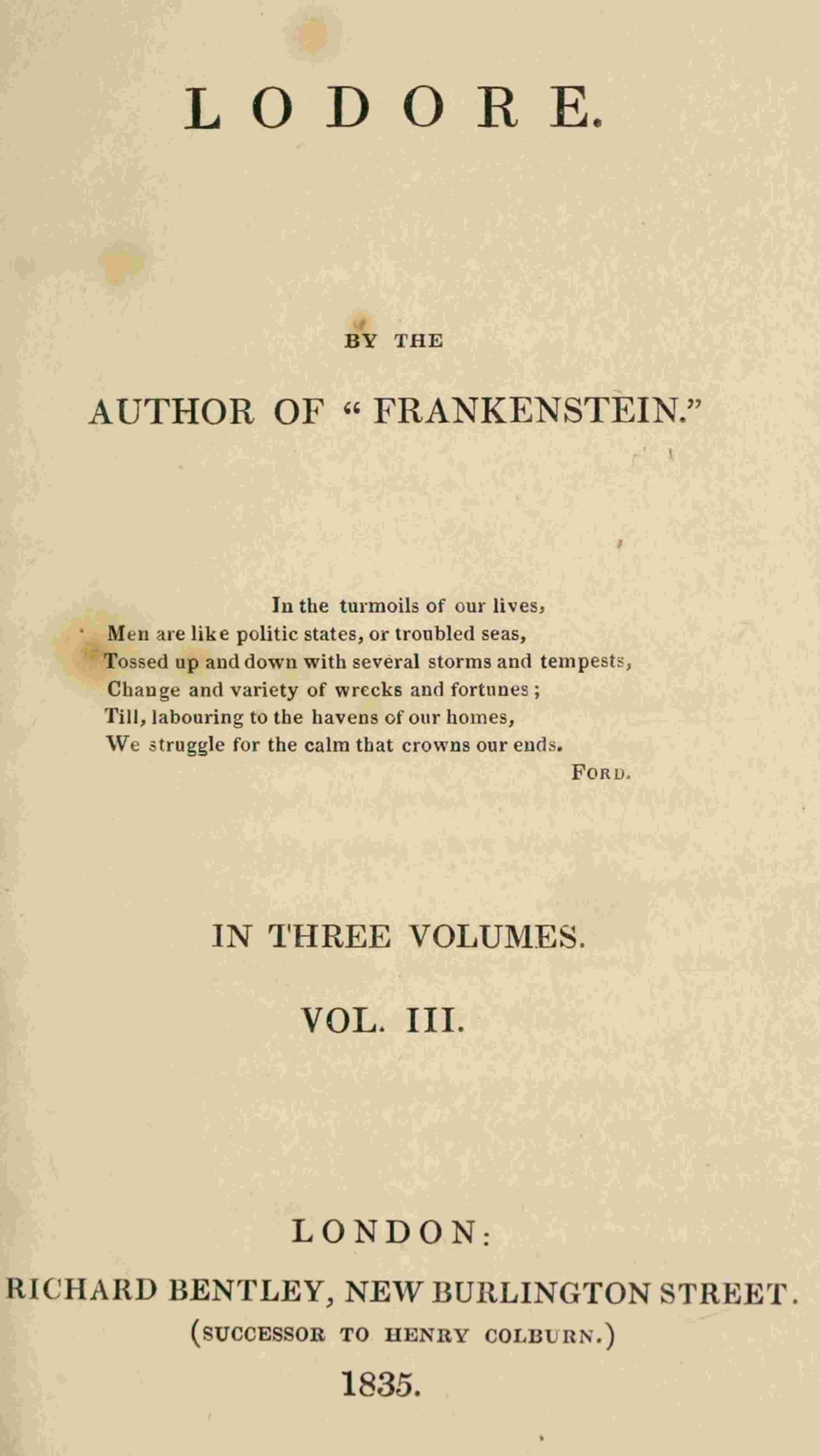
LODORE.
BY THE
AUTHOR OF "FRANKENSTEIN."
Men are like politic states, or troubled seas.
Tossed up and down with several storms and tempests,
Change and variety of wrecks and fortunes;
Till, labouring to the havens of our homes,
We struggle for the calm that crowns our ends.
FORD.
IN THREE VOLUMES.
VOL. III.
LONDON:
RICHARD BENTLEY, NEW BURLINGTON STREET
(SUCCESSOR TO HENRY COLBURN.)
1835.
CONTENTS
CHAPTER I
CHAPTER II
CHAPTER III
CHAPTER IV
CHAPTER V
CHAPTER VI
CHAPTER VII
CHAPTER VIII
CHAPTER IX
CHAPTER X
CHAPTER XI
CHAPTER XII
CHAPTER XIII
CHAPTER XIV
CHAPTER XV
CHAPTER XVI
CHAPTER XVII
CHAPTER XVIII
CONCLUSION
LODORE
CHAPTER I
Injurious distance should not stop my way;
For then, despite of space, I would be brought,
From limits far remote, where thou dost stay.
SHAKSPEARE.
The still hours of darkness passed silently away, and morning dawned, when
Who shaped us to his ends, and not our own.
Ethel had slept peacefully through the livelong night; nor woke till a knock at her door roused her. A rush of fear—a sense of ill, made her heart palpitate as she opened her eyes to the light of day. While she was striving to recall her thoughts, and to remember what the evil was with which she was threatened, again the servant tapped at her door, to say that Saunders had returned, and to deliver the letter he had brought. She looked at her watch: it was past ten o'clock. She felt glad that it had grown so late, and she not disturbed: yet as she took the letter brought to her from her husband, all her tremor returned; and she read it with agitation, as if it contained the announcement of her final doom.
"You send me disagreeable tidings, my sweet Ethel," wrote Villiers,—"I hope unfounded; but caution is necessary: I shall not, therefore, come to Duke Street. Send me a few lines, by Saunders, to tell me if any thing has happened. If what he apprehended has really taken place, you must bear, my love, the separation of a day. You do not understand these things, and will wonder when I tell you, that when the clock strikes twelve on Saturday night, the magic spells and potent charms of Saunders's friends cease to have power: at that hour I shall be restored to you. Wait till then—and then we will consult for the future. Have patience, dearest love: you have wedded poverty, hardship, and annoyance; but, joined to these, is the fondest, the most faithful heart in the world;—a heart you deign to prize, so I will not repine at ill fortune. Adieu, till this evening;—and then, as Belvidera says, 'Remember twelve!'
"Saturday Morning."
After reading these lines, Ethel dressed herself hastily. Fanny Derham had already asked permission to see her; and she found her waiting in her sitting-room. It was an unspeakable comfort to have one as intelligent and kind as Fanny, to communicate with, during Edward's absence. The soft, pleading eyes of Ethel asked her for comfort and counsel; and, in spite of her extreme youth, the benignant and intelligent expression of Fanny's countenance promised both.
"I am sorry to say," she said, "that Saunders's prognostics are too true. Such men as he describes have been here this morning. They were tolerably civil, and I convinced them, with greater ease than I had hoped, that Mr. Villiers was absent from the house; and I assured them, that after this visit of theirs, he was not likely to return."
"And do you really believe that they were"—Ethel faltered.
"Bailiffs? Assuredly," replied Fanny: "they told me that they had the power to search the house; but if they were 'strong,' they were also 'merciful.' And now, what do you do? Saunders tells me he is waiting to take back a letter to Mr. Villiers, at the London Coffee House. Write quickly, while I make your breakfast."
Ethel gladly obeyed. She wrote a few words to her husband. That it was already Saturday, cheered her: twelve at night would soon come.
After her note was dispatched, she addressed Fanny. "What trouble I give," she said: "what will your mother think of such degrading proceedings?"
"My mother," said Fanny, "is the kindest-hearted woman in the world. We have never exactly suffered this disaster; but we are in a rank of life which causes us to be brought into contact with such among our friends and relations; and she is familiar with trouble in almost all shapes. You are a great favourite of hers; and now that she can claim a sort of acquaintance, she will be heart and soul your friend."
"It is odd," observed Ethel, "that she never mentioned you to me. Had the name of Fanny been mentioned, I should have recollected who Mrs. Derham was."
"Perhaps not," said Fanny; "it would have required a great effort of the imagination to have fancied Mrs. Derham the wife of my father. You never knew him; but Lord Lodore made you familiar with his qualities: the most shrinking susceptibility to the world's scorn, joined to the most entire abstraction from all that is vulgar; a morbid sensibility and delicate health placed him in glaring contrast with my mother. They never in the least assimilated; and her character has gained in excellence since his loss. Before she was fretted and galled by his finer feelings—now she can be good in her own way. Nothing reminds her of his exalted sentiments, except myself; and she is willing enough to forget me."
"And you do not repine?" asked her friend.
"I do not: she is happy in and with Sarah. I should spoil their notions of comfort, did I mingle with them;—they would torture and destroy me, did they interfere with me. I lost my guide, preserver, my guardian angel, when my father died. Nothing remains but the philosophy which he taught me—the disdain of low-thoughted care which he sedulously cultivated: this, joined to my cherished independence, which my disposition renders necessary to me."
"And thus you foster sorrow, and waste your life in vain regrets?"
"Pardon me! I do not waste my life," replied Fanny, with her sunny smile;—"nor am I unhappy—far otherwise. An ardent thirst for knowledge, is as the air I breathe; and the acquisition of it, is pure and unalloyed happiness. I aspire to be useful to my fellow-creatures: but that is a consideration for the future, when fortune shall smile on me; now I have but one passion; it swallows up every other; it dwells with my darling books, and is fed by the treasures of beauty and wisdom which they contain."
Ethel could not understand. Fanny continued:—"I aspire to be useful;—sometimes I think I am—once I know I was. I was my father's almoner.
"We lived in a district where there was a great deal of distress, and a great deal of oppression. We had no money to give, but I soon found that determination and earnestness will do much. It was my father's lesson, that I should never fear any thing but myself. He taught me to penetrate, to anatomize, to purify my motives; but once assured of my own integrity, to be afraid of nothing. Words have more power than any one can guess; it is by words that the world's great fight, now in these civilized times, is carried on; I never hesitated to use them, when I fought any battle for the miserable and oppressed. People are so afraid to speak, it would seem as if half our fellow-creatures were born with deficient organs; like parrots they can repeat a lesson, but their voice fails them, when that alone is wanting to make the tyrant quail."
As Fanny spoke, her blue eyes brightened, and a smile irradiated her face; these were all the tokens of enthusiasm she displayed, yet her words moved Ethel strangely, and she looked on her with wonder as a superior being. Her youth gave grace to her sentiments, and were an assurance of their sincerity. She continued:—
"I am becoming flightly, as my mother calls it; but, as I spoke, many scenes of cottage distress passed through my memory, when, holding my father's hand, I witnessed his endeavours to relieve the poor. That is all over now—he is gone, and I have but one consolation—that of endeavouring to render myself worthy to rejoin him in a better world. It is this hope that impels me continually and without any flagging of spirit, to cultivate my understanding and to refine it. O what has this life to give, as worldlings describe it, worth one of those glorious emotions, which raise me from this petty sphere, into the sun-bright regions of mind, which my father inhabits! I am rewarded even here by the elevated feelings which the authors, whom I love so passionately, inspire; while I converse each day with Plato, and Cicero, and Epictetus, the world, as it is, passes from before me like a vain shadow."
These enthusiastic words were spoken with so calm a manner, and in so equable a voice, that there seemed nothing strange nor exaggerated in them. It is vanity and affectation that shock, or any manifestation of feeling not in accordance with the real character. But while we follow our natural bent, and only speak that which our minds spontaneously inspire, there is a harmony, which, however novel, is never grating. Fanny Derham spoke of things, which, to use her own expression, were to her as the air she breathed, and the simplicity of her manner entirely obviated the wonder which the energy of her expressions might occasion.
Such a woman as Fanny was more made to be loved by her own sex than by the opposite one. Superiority of intellect, joined to acquisitions beyond those usual even to men; and both announced with frankness, though without pretension, forms a kind of anomaly little in accord with masculine taste. Fanny could not be the rival of women, and, therefore, all her merits were appreciated by them. They love to look up to a superior being, to rest on a firmer support than their own minds can afford; and they are glad to find such in one of their own sex, and thus destitute of those dangers which usually attend any services conferred by men.
From talk like this, they diverged to subjects nearer to the heart of Ethel. They spoke of Lord Lodore, and her father's name soothed her agitation even more than the consolatory arguments of her friend. She remembered how often he had talked of the trials to which the constancy of her temper and the truth of her affection might be put, and she felt her courage rise to encounter those now before her, without discontent, or rather with that cheerful fortitude, which sheds grace over the rugged form of adversity.
CHAPTER II
Robin. What a week?
Was that so long?
Marian. How long are lovers' weeks,
Do you think, Robin, when they are asunder?
Are they not pris'ners' years?
BEN JONSON.
The day passed on more lightly than Ethel could have hoped; much of it indeed was gone before she opened her eyes to greet it. Night soon closed in, and she busied herself with arrangements for the welcome of her husband. Fanny loved solitude too well herself not to believe that others shared her taste. She retired therefore when evening commenced. No sooner was Ethel alone, than every image except Edward's passed out of her mind. Her heart was bursting with affection. Every other idea and thought, to use a chemical expression, was held in solution by that powerful feeling, which mingled and united with every particle of her soul. She could not write nor read; if she attempted, before she had finished the shortest sentence, she found that her understanding was wandering, and she re-read it with no better success. It was as if a spring, a gush from the fountain of love poured itself in, bearing away every object which she strove to throw upon the stream of thought, till its own sweet waters alone filled the channel through which it flowed. She gave herself up to the bewildering influence, and almost forgot to count the hours till Edward's expected arrival. At last it was ten o'clock, and then the sting of impatience and uncertainty was felt. It appeared to her as if a whole age had passed since she had seen or heard of him—as if countless events and incalculable changes might have taken place. She read again and again his note, to assure herself that she might really expect him: the minutes meanwhile stood still, or were told heavily by the distinct beating of her heart. The east wind bore to her ear the sound of the quarters of hours, as they chimed from various churches. At length eleven, half-past eleven was passed, and the hand of her watch began to climb slowly upwards toward the zenith, which she desired so ardently that it should reach. She gazed on the dial-plate, till she fancied that the pointers did not move; she placed her hands before her eyes resolutely, and would not look for a long long time; three minutes had not been travelled over when again she viewed it; she tried to count her pulse, as a measurement of time; her trembling fingers refused to press the fluttering artery. At length another quarter of an hour elapsed, and then the succeeding one hurried on more speedily. Clock after clock struck; they mingled their various tones, as the hour of twelve was tolled throughout London. It seemed as if they would never end. Silence came at last—a brief silence succeeded by a firm quick step in the street below, and a knock at the door. "Is he not too soon?" poor fearful Ethel asked herself. But no; and in a moment after, he was with her, safe in her glad embrace.
Perhaps of the two, Villiers showed himself the most enraptured at this meeting. He gazed on his sweet wife, followed every motion, and hung upon her voice, with all the delight of an exile, restored to his long-lost home. "What a transporting change," he said, "to find myself with you—to see you in the same room with me—to know again that, lovely and dear as you are, that you are mine—that I am again myself—not the miserable dog that has been wandering about all day—a body without a soul! For a few short hours, at least, Ethel will call me hers."
"Indeed, indeed, love," she replied, "we will not be separated again."
"We will not even think about that tonight," said Villiers. "The future is dark and blank, the present as radiant as your own sweet self can make it."
On the following day—and the following day did come, in spite of Ethel's wishes, which would have held back the progress of time: it came and passed away; hour after hour stealing along, till it dwindled to a mere point. On the following day, they consulted earnestly on what was to be done. Villiers was greatly averse to Ethel's leaving her present abode, where every one was so very kind and attentive to her, and he was sanguine in his hopes of obtaining in the course of the week, just commenced, a sum, sufficient to carry them to Paris or Brussels, were they could remain till his affairs were finally arranged, and the payment of his debts regulated in a way to satisfy his creditors. One week of absence; Villiers used all his persuasion to induce Ethel to submit to it. "Where you can be, I can be also," was her answer; and she listened unconvinced to the detail of the inconveniences which Villiers pointed out: at last he almost got angry. "I could call you unkind, Ethel," he said, "not to yield to me."
"I will yield to you," said Ethel, "but you are wrong to ask me."
"Never mind that," replied her husband, "do concede this point, dearest; if not because it is best that you should, then because I wish it, and ask it of you. You say that your first desire is to make me happy, and you pain me exceedingly by your—I had almost said perverseness."
Thus, not convinced, but obedient, Ethel agreed to allow him to depart alone. She bargained that she should be permitted to come each day in a hackney coach to a place where he might meet her, and they could spend an hour or two together. Edward did not like this plan at all, but there was no remedy. "You are at least resolved," he said, "to spur my endeavours; I will not rest day or night, till I am enabled to get away from this vast dungeon."
The hours stole on. Even Edward's buoyant spirits could not bear up against the sadness of watching the fleeting moments till the one should come, which must separate him from his wife. "This nice, dear room," he said, "I am sure I beg its pardon for having despised it so much formerly—it is not as lofty as a church, nor as grand as a palace, but it is very snug; and now you are in it, I discern even elegance in its exceedingly queer tables and chairs. When our carriage broke down on the Apennines, how glad we should have been if a room like this had risen, 'like an exhalation' for our shelter! Do you remember the barn of a place we got into there, and our droll bed of the leaves of Indian corn, which crackled all night long, and awoke us twenty times with the fear of robbers? Then, indeed, twelve o'clock was not to separate us!"
As he said this he sighed; the hour of eleven was indicated by Ethel's watch, and still he lingered; but she grew frightened for him, and forced him to go away, while he besought the delay of but a few minutes.
Ethel exerted herself to endure as well as she could the separation of the ensuing week. She was not of a repining disposition, yet she found it very hard to bear. The discomfort to which Villiers was exposed annoyed her, and the idea that she was not permitted to alleviate it added to her painful feelings. In her prospect of life every evil was neutralized when shared—now they were doubled, because the pain of absence from each other was superadded. She did not yield to her husband, in her opinion that this was wrong. She was willing to go anywhere with him, and where he was, she also could be. There could be no degradation in a wife waiting on the fallen fortunes of her husband. No debasement can arise from any services dictated by love. It is despicable to submit to hardship for unworthy and worldly objects, but every thing that is suffered for the sake of affection, is hallowed by the disinterested sentiment, and affords triumph and delight to the willing victim. Sometimes she tried in speech or on paper to express these feelings, and so by the force of irresistible reasoning to persuade Edward to permit her to join him; but all argument was weak; there was something beyond, that no words could express, which was stronger than any reason in her heart. Who can express the power of faithful and single-hearted love? As well attempt to define the laws of life, which occasions a continuity of feeling from the brain to the extremity of the frame, as try to explain how love can so unite two souls, as to make each feel maimed and half alive, while divided. A powerful impulse was perpetually urging Ethel to go—to place herself near Villiers—to refuse to depart. It was with the most violent struggles that she overcame the instigation.
She never could forget herself while away from him, or find the slightest alleviation to her disquietude, except while conversing with Fanny Derham, or rather while drawing her out, and listening to her, and wondering at a mechanism of mind so different from her own. Each had been the favourite daughter of men of superior qualities of mind. They had been educated by their several fathers with the most sedulous care, and nothing could be more opposite than the result, except that, indeed, both made duty the master motive of their actions. Ethel had received, so to speak, a sexual education. Lord Lodore had formed his ideal of what a woman ought to be, of what he had wished to find his wife, and sought to mould his daughter accordingly. Mr. Derham contemplated the duties and objects befitting an immortal soul, and had educated his child for the performance of them. The one fashioned his offspring to be the wife of a frail human being, and instructed her to be yielding, and to make it her duty to devote herself to his happiness, and to obey his will. The other sought to guard his from all weakness, to make her complete in herself, and to render her independent and self-sufficing. Born to poverty as Fanny was, it was thus only that she could find happiness in rising above her sphere; and, besides, a sense of pride, surviving his sense of injury, caused him to wish that his child should set her heart on higher things, than the distinctions and advantages of riches or rank; so that if ever brought into collision with his own family, she could look down with calm superiority on the "low ambition" of the wealthy. While Ethel made it her happiness and duty to give herself away with unreserved prodigality to him, whom she thought had every claim to her entire devotion; Fanny zealously guarded her individuality, and would have scorned herself could she have been brought to place the treasures of her soul at the disposal of any power, except those moral laws which it was her earnest endeavour never to transgress. Religion, reason, and justice—these were the landmarks of her life. She was kind-hearted, generous, and true—so also was Ethel; but the one was guided by the tenderness of her heart, while the other consulted her understanding, and would have died rather than have acted contrary to its dictates.
To guard Ethel from every contamination, Lord Lodore had secluded her from all society, and forestalled every circumstance that might bring her into conjunction with her fellow-creatures. He was equally careful to prevent her fostering any pride, except that of sex; and never spoke to her as if she were of an elevated rank: and the communication, however small, which she necessarily had with the Americans, made such ideas foreign to her mind. But she was excedingly shy; tremblingly alive to the slightest repulse; and never perfectly fearless, (morally so, that is), except when under the shelter of another's care. Fanny's first principle was, that what she ought to do, that she could do, without hesitation or regard for obstacles. She had something Quixotic in her nature; or rather she would have had, if a clear head and some experience, even young as she was, had not stood in the way of her making any glaring mistakes; so that her enterprises were never ridiculous; and being usually successful, could not be called extravagant. For herself, she needed but her liberty and her books;—for others, she had her time, her thoughts, her decided and resolute modes of action, all at their command, whenever she was convinced that they had a just claim upon them.
It was singular that the resolute and unshrinking Fanny should be the daughter of Francis Derham; and the timid, retiring Ethel, of his bold and daring protector. But this is no uncommon case. We feel the evil results of our own faults, and endeavour to guard our children from them; forgetful that the opposite extreme has also its peculiar dangers. Lord Lodore attributed his early misfortunes to the too great freedom he had enjoyed, or rather to the unlimited scope given to his will, from his birth. Mr. Derham saw the unhappiness that had sprung from his own yielding and undecided disposition. The one brought up his child to dependence; the other taught his to disdain every support, except the applause of her own conscience. Lodore fostered all the sensibility, all the softness, of Ethel's feminine and delicat nature; while Fanny's father strove to harden and confirm a character, in itself singularly stedfast and upright.
In spite of the great contrast thus exhibited between Ethel and Fanny, one quality created a good deal of similarity between them. There was in both a total absence of every factitious sentiment. They acted from their own hearts—from their own sense of right, without the intervention of worldly considerations. A feeling of duty ruled all their actions; and, however excellent a person's dispositions may be, it yet requires considerable elevation of character never to deviate from the strict line of honour and integrity.
Fanny's society a little relieved Ethel's solitude: yet that did not weigh on her; and had she not been the child of her father's earliest friend, and the companion of past days, she would have been disinclined, at this period, to cultivate an intimacy with her. She needed no companion except the thought of Edward, which was never absent from her mind. But amidst all her affection for her husband, which gained strength, and, as it were, covered each day a larger portion of her being, any one associated with the name of Lodore—of her beloved father, had a magic power to call forth her warmest feelings of interest. Both ladies repeated to each other what they had heard from their several parents. Mr. Derham had, among his many lessons of usefulness, descanted on the generosity and boldness of Fitzhenry, as offering an example to be followed. And during the last months of Lodore's life, he had recurred, with passionate fondness, to the memory of his early years, and painted in glowing colours the delicacy of feeling, the deep sense of gratitude, and the latent but fervid enthusiasm, which adorned the character of Francis Derham.
CHAPTER III
Our loves and loving souls have been so used
To one household in us.
BEAUMONT AND FLETCHER.
The week passed on. It was the month of January, and very cold. A black frost bound up every thing with ice, and the piercing air congealed the very blood. Each day Ethel went to see her husband;—each day she had to encounter Mrs. Derham's intreaties not to go, and the reproaches of Villiers for coming. Both were unavailing to prevent the daily pilgrimage. Mrs. Derham sighed heavily when she saw her enter the ricketty hackney-coach, whose damp lining, gaping windows, and miserable straw, made it a cold-bed for catarrh—a very temple for the spirit of winter. Villiers each day besought her to have horses put to their chariot, if she must come; but Ethel remembered all he had ever said of expense, and his prognostications of how ill she would be able to endure the petty, yet galling annoyances of poverty; and she resolved to prove, that she could cheerfully bear every thing except separation from him. With this laudable motive to incite her, she tasked her strength too far. She kept up her spirits to meet him with a cheerful countenance; and she contrived to conceal the sufferings she endured while they were together. They got out and walked now and then; and this tended to keep up the vital warmth. Their course was generally taken over Blackfriars Bridge; and it was on their return across the river, on whose surface large masses of ice floated, while a bitter north-east wind swept up, bearing on its blasts the unthawed breath of the German Ocean, that she felt the cold enter her heart, and make her head feel dizzy. Still she could smile, and ask Villiers why he objected to her taking an exercise even necessary for her health; and repeat again and again, that, bred in America, an English winter was but a faint reflex of what she had encountered there, and insist upon being permitted to come on the following day. These were precious moments in her eyes, worth all the pain they occasioned,—well worth the struggle she made for the repetition. Edward's endearing attentions—the knowledge she had that she was loved—the swelling and earnest affection that warmed her own heart,—hallowed these hard-earned minutes, and gave her the sweet pleasure of knowing that she demonstrated, in some slight degree, the profound and all engrossing attachment which pervaded her entire being. They parted; and often she arrived nearly senseless at Duke Street, and once or twice fainted on entering the warm room: but it was not pain she felt then—the emotions of the soul conquered the sensation of her body, and pleasure, the intense pleasure of affection, was predominant through all.
Sunday came again, and brought Villiers to her home. Mrs. Derham took the opportunity to represent to him the injury that Ethel was doing herself; and begged him, as he cared for her health, to forbid her exposing herself to the inclement weather.
"You hear this, Ethel," said Villiers; "and yet you are obstinate. It this right? What can I urge, what can I do, to prevent this wrong-headed pertinacity?"
"You use such very hard words," replied Ethel, smiling, "that you frighten me into believing myself criminal. But so far am I from conceding, that you only give me courage to say, that I cannot any longer endure the sad and separate life we lead. It must be changed, dearest; we must be together."
Villiers was pacing the room impatiently: with an exclamation almost approaching to anger, he stopped before his wife, to remonstrate and to reproach. But as he gazed upon her upturned face, fixed so beseechingly and fondly on him, he fancied that he saw the hues of ill-health stealing across her cheeks, and thinness displacing the roundness of her form. A strange emotion flashed across him; a new fear, too terrible even to be acknowledged to himself, which passed, like the shadow of a storm, across his anticipations, and filled him with inquietude. His reprehension was changed to a caress, as he said, "You are right, my love, quite right; we must not live thus. You are unable to take care of yourself; and I am very wrong to give up my dearest privilege, of watching day and night over the welfare of my only treasure. We will be together, Ethel; if the worst come, it cannot be very bad, while we are true to each other."
Tears filled the poor girl's eyes—tears of joy and tenderness—at hearing Edward echo the sentiments she cherished as the most sacred in the world. For a few minutes, they forgot every thing in the affectionate kiss, which ratified, as it were, this new law; and then Edward considered how best he could carry it into effect.
"Gayland," he said, (he was his solicitor,) "has appointed to see me on Thursday morning, and has good hopes of definitively arranging the conditions for the loan of the five hundred pounds, which is to enable us to wait for better things. On Thursday evening, we will leave town. We will go to some pretty country inn, to wait till I have signed these papers; and trust to Providence that no ill will arise. We must not be more than fifteen or twenty miles from London; so that when I am obliged to go up, I can return again in a few hours. Tell me, sweet, does this scheme please you?"
Ethel expressed her warmest gratitude; and then Villiers insinuated his condition, that she should not come to see him in the interval, but remain, taking care of herself, till, on Thursday afternoon, at six o'clock, she came, with their chariot, to the northern side of St. Paul's Churchyard, where he would immediately join her. They might write, meanwhile: he promised letters as long as if they were to go to India; and soothed her annoyance with every expression of thankfulness at her giving up this point. She did give it up, with all the readiness she could muster; and this increased, as he dwelt upon the enjoyment they would share, in exchanging foggy, smoky London, for the ever-pleasing aspect of nature, which, even during frost and snow, possesses her own charms—her own wonders; and can gratify our senses by a thousand forms of beauty, which have no existence in a dingy metropolis.
When the evening hour came for the young pair to separate, their hearts were cheered by the near prospect of re-union; and a belief that the, to them, trivial privations of poverty were the only ones they would have to endure. The thrill of fear which had crossed the mind of Villiers, as to the health and preservation of his wife, had served to dissipate the lingering sense of shame and degradation inspired by the penury of their situation. He felt that there was something better than wealth, and the attendance of his fellow-creatures; something worse than poverty, and the world's scorn. Within the fragile form of Ethel, there beat a heart of more worth than a king's ransom; and its pulsations were ruled by him. To lose her! What would all that earth can afford, of power or splendour, appear without her? He pressed her to his bosom, and knew that his arms encircled all life's worth for him. Never again could he forget the deep-felt appreciation of her value, which then took root in his mind; while she, become conscious, by force of sympathy, of the kind of revolution that was made in his sentiments, felt that the foundations of her life grew strong, and that her hopes in this world became stedfast and enduring. Before, a wall of separation, however slight, had divided them; they had followed a system of conduct independent of each other, and passed their censure upon the ideas of either. This was over now—they were one—one sense of right—one feeling of happiness; and when they parted that night, each felt that they truly possessed the other; and that by mingling every hope and wish, they had confirmed the marriage of their hearts.
CHAPTER IV
Now you can go; what you can do to live;
How near you have barred all ports to your own
succour.
Except this one that here I open, love.
BEAUMONT AND FLETCHER.
The most pleasing thoughts shed their balmy influence on Ethel's repose that night. Edward's scheme of a country inn, where the very freedom would make them more entirely dependent upon each other, was absolutely enchanting. Where we establish ourselves, and look forward to the passage of a long interval of time, we form ties with, and assume duties towards, many of our fellow-creatures, each of which must diminish the singleness of the soul's devotion towards the selected one. No doubt this is the fitting position for human beings to place themselves in, as affording a greater scope for utility: but for a brief space, to have no occupation but that of contributing to the happiness of him to whom her life was consecrated, appeared to Ethel a very heaven upon earth. It was not that she was narrow-hearted: so much affection demands a spacious mansion for its abode; but in their present position of struggle and difficulty, there was no possibility of extending her sphere of benevolence, and she gladly concentrated her endeavours in the one object whose happiness was in her hands.
All night, even in sleep, a peculiar sense of calm enjoyment soothed the mind of Ethel, and she awoke in the morning with buoyant spirits, and a soul all alive to its own pleasurable existence. She sat at her little solitary breakfast table, musing with still renewed delight upon the prospect opened before her, when suddenly she was startled by the vision of an empty purse. What could Villiers intend? She felt assured that his stock was very nearly exhausted, and for herself two sovereigns, which were not sufficient to meet the demands of the last week, was all that she possessed. She tried to recollect if Edward had said any thing that denoted any expectation of receiving money; on the contrary—diving into the recesses of her memory, she called to mind that he had said, "We shall receive your poor little dividend of a hundred pounds, in less than a fortnight, so we shall be able to live, even if Gayland should delay getting the other money—I suppose we have enough to get on till then."
He had said this inquiringly, and she knew that she had made a sign of assent, though at the time, she had no thought of the real purport of his question or of her answer. What was to be done? The obvious consequence of her reflections was at once to destroy the cherished scheme of going out of town with Villiers. This was a misfortune too great to bear, and she at last decided upon having again recourse to her aunt. Unused to every money transaction, she had not that terror of obligation, nor dislike of asking, which is so necessary to preserve our independence, and even our sense of justice, through life. Money had always been placed like counters in her hand; she had never known whence it came, and until her marriage, she had never disposed of more than very small sums. Subsequently Villiers had been the director of their expenses. This was the faulty part of her father's system of education. But Lodore's domestic habits were for a great part founded on experience in foreign countries, and he forgot that an English wife is usually the cashier—the sole controller of the disbursements of her family. It seemed as easy a thing for Ethel to ask for money from Mrs. Fitzhenry, as she knew it would be easy for her to give. In compliance, however, with Villiers's notions, she limited her request to ten pounds, and tried to word her letter so as to create no suspicion in her aunt's mind with regard to their resources. This task achieved, she dismissed every annoying thought, and when Fanny came to express her hope, that, bleak and snowy as was the day, she did not intend to make her accustomed pilgrimage, with a countenance beaming with delight, she dilated on their plan, and spoke as if on the much-desired Thursday, the gates of Elysium were to be thrown open for her.
There would have appeared something childish in her gladness to the abstracted and philosophic mind of Fanny, but that the real evils of her situation, and the fortitude, touching in its unconscious simplicity, with which she encountered them, commanded respect. Ethel, as well as her friend, was elevated above the common place of life; she also fostered a state of mind, "lofty and magnificent, fitted rather to command than to obey, not only suffering patiently, but even making light of all human cares; a grand and dignified self-possession, which fears nothing, yields to no one, and remains for ever unvanquished." When Fanny, in one of their conversations, while describing the uses of philosophy, had translated this eulogium of its effects from Cicero, Ethel had exclaimed, "This is love—it is love alone that divides us from sordid earthborn thoughts, and causes us to walk alone, girt by its own beauty and power."
Fanny smiled; yet while she saw slavery rather than a proud independence in the creed of Ethel, she admired the warmth of heart which could endow with so much brilliancy a state of privation and solitude. At the present moment, when Mrs. Villiers was rapturously announcing their scheme for leaving London, an expression of pain mantled over Fanny's features; her clear blue eyes became suffused, a large tear gathered on her lashes. "What is the matter?" asked Ethel anxiously.
"That I am a fool—but pardon me, for the folly is already passed away. For the first time you have made it hard for me to keep my soul firm in its own single existence. I have been debarred from all intercourse with those whose ideas rise above the soil on which they tread, except in my dear books, and I thought I should never be attached to any thing but them. Yet do not think me selfish, Mr. Villiers is quite right—it is much better that you should not be apart—I am delighted with his plan."
"Away or near, dear Fanny," said Ethel, in a caressing tone, "I never can forget your kindness—never cease to feel the warmest friendship for you. Remember, our fathers were friends, and their children ought to inherit the same faithful attachment."
Fanny smiled faintly. "You must not seduce me from my resolves," she said. "I know my fate in this world, and I am determined to be true to myself to the end. Yet I am not ungrateful to you, even while I declare, that I shall do my best to forget this brief interval, during which, I have no longer, like Demogorgon, lived alone in my own world, but become aware that there are ties of sympathy between me and my fellow-creatures, in whose existence I did not believe before."
Fanny's language, drawn from her books, not because she tried to imitate, but because conversing perpetually with them, it was natural that she should adopt their style, was always energetic and imaginative; but her quiet manner destroyed every idea of exaggeration of sentiment: it was necessary to hear her soft and low, but very distinct voice utter her lofty sentiments, to be conscious that the calm of deep waters was the element in which she dwelt—not the fretful breakers that spend themselves in sound.
The day seemed rather long to Ethel, who counted the hours until Thursday. Gladly she laid her head on the pillow at night, and bade adieu to the foregone hours. The first thing that awoke her in the morning, was the postman's knock; it brought, as she had been promised, a long, long letter from Edward. He had never before written with so much affection or with such an overflowing of tenderness, that made her the centre of his world—the calm fair lake to receive into its bosom the streams of thought and feeling which flowed from him, and yet which, after all, had their primal source in her. "I am a very happy girl," thought Ethel, as she kissed the beloved papers, and gazed on them in ecstasy; "more happy than I thought it was ever given us to be in this world."
She rose and began to dress; she delayed reading more than a line or two, that she might enjoy her dearest pleasure for a longer time—then again, unable to controul her impatience, she sat half dressed, and finished all—and was begining anew, when there was a tap at her door. It was Fanny. She looked disturbed and anxious, and Ethel's fears were in a moment awake.
"Something annoying has occurred," she said; "yet I do not think that there is any thing to dread, though there is a danger to prevent."
"Speak quickly," cried Ethel, "do not keep me in suspense."
"Be calm—it is nothing sudden, it is only a repetition of the old story. A boy has just been here—a boy you gave a sovereign to—do you remember?—the night of your arrival. It seems that he has vowed himself to your service ever since. Those two odious men, who were here once, are often at his master's place-an alehouse, you know. Well, yesterday night, he overheard them saying, that Mr. Villiers's resort at the London coffee-house, was discovered, or at least suspected, and that a writ was to be taken out against him in the city."
"What does that mean?" cried Ethel.
"That Mr. Villiers will probably be arrested to-day, or to-morrow, if he remains where he is."
"I will go directly to him," cried Ethel; "we must leave town at once. God grant that I am not too late!"
Seeing her extreme agitation, Fanny remained with her—forced her to take some breakfast, and then, fearing that if any thing had really taken place, she would be quite bewildered, asked her permission to accompany her. "Will you indeed come with me?" Ethel exclaimed, "How dear, how good you are! O yes, do come—I can never go through it all alone; I shall die, if I do not find him."
A hackney coach had been called, and they hastened with what speed they might, to their destination. A kind of panic seized upon Ethel, a tremor shook her limbs, so that when they at last stopped, she was unable to speak. Fanny was about to ask for Mr. Villiers, when an exclamation of joy from Ethel stopped her; Edward had seen them, and was at the coach door. The snow lay thick around on the roofs of the houses, and on every atom of vantage ground it could obtain; it was then snowing, and as the chilly fleece dropped through or was driven about in the dark atmosphere, it spread a most disconsolate appearance over every thing; and nothing could look more dreary than poor Ethel's jumbling vehicle, with its drooping animals, and the half-frozen driver. Villiers had made up his mind that he should never be mortified by seeing her again in this sort of equipage, and he hurried down, the words of reproach already on his lips, "Is this your promise?" he asked.
"Yes, dearest, it is. Come in, there is danger here.—Come in—we must go directly."
Seeing Fanny, Villiers became aware that there was some absolute cause for their journey, so he obeyed and quickly heard the danger that threatened him. "It would have been better," he said, "that you had come in the carriage, and that we had instantly left town."
"Impossible!" cried Ethel; "till to-morrow—that is quite impossible. We have no money until to-morrow."
"Well, my love, since it is so, we must arrange as well as we can. Do you return home immediately—this cold will kill you. I will take care of myself, and you can come for me on Thursday evening, as we proposed."
"Do not ask it of me, Edward," said Ethel; "I cannot leave you. I could never live through these two days away from you—you must not desire it—you will kill me."
Edward kissed her pale cheek. "You tremble," he said; "how violently you tremble! Good God! what can we do? What would you have me do?"
"Any thing, so that we remain together. It is of so little consequence where we pass the next twenty-four hours, so that we are together. There are many hotels in town."
"I must not venture to any of these; and then to take you in this miserable manner, without servants, or any thing to command attendance. But you shall have your own way; having deprived you of every other luxury, at least, you shall have your will; which, you know, compensates for every thing with your obstinate sex."
Ethel smiled, rejoicing to find him in so good and accommodating a humour. "Yes, pretty one," he continued, marking her feelings, "you shall be as wretched and uncomfortable as your heart can desire. We will play the incognito in such a style, that if our adventures were printed, they would compete with those of Don Quixote and the fair Dulcinea. But Miss Derham must not be admitted into our vagabondizing—we will not detain her."
"Yet she must know whither we are going, to bring us the letters that will confer freedom on us."
Villiers wrote hastily an address on a card. "You will find us there," he said. "Do not mention names when you come. We shall remain, I suppose, till Thursday."
"But we shall see you some time to-morrow, dear Fanny?" asked Ethel. Already she looked bright and happy; she esteemed herself fortunate to have gained so easily a point she had feared she must struggle for—or perhaps give up altogether. Fanny left them, and the coachman having received his directions, drove slowly on through the deep snow, which fell thickly on the road; while they, nestling close to each other, were so engrossed by the gladness of re-union, that had Cinderella's godmother transmuted their crazy vehicle for a golden coach, redolent of the perfumes of fairy land, they had scarcely been aware of the change. Their own hearts formed a more real fairy land, which accompanied them whithersoever they went, and could as easily spread its enchantments over the shattered machine in which they now jumbled along, as amidst the cloth of gold and marbles of an eastern palace.