
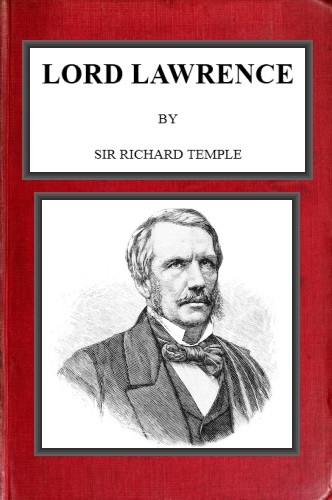
The Project Gutenberg eBook of Lord Lawrence
Title: Lord Lawrence
Author: Sir Richard Carnac Temple
Release date: October 14, 2016 [eBook #53278]
Most recently updated: October 23, 2024
Language: English
Credits: Produced by Chuck Greif, MWS and the Online Distributed
Proofreading Team at http://www.pgdp.net (This file was
produced from images generously made available by The
Internet Archive)
English Men of Action
LORD LAWRENCE
LORD LAWRENCE
BY
SIR RICHARD TEMPLE
London
MACMILLAN AND CO.
AND NEW YORK
1889
The right of translation and reproduction is reserved
CONTENTS
| PAGE | |
| CHAPTER I | |
|---|---|
| Introduction | 1 |
| CHAPTER II | |
| Early Life, 1811-1829 | 7 |
| CHAPTER III | |
| The Delhi Territory, 1829-1846 | 15 |
| CHAPTER IV | |
| The Trans-Sutlej States, 1846-1849 | 27 |
| CHAPTER V | |
| Punjab Board of Administration, 1849-1853 | 45 |
| CHAPTER VI | |
| Chief Commissioner of the Punjab, 1853-1857 | 69 |
| CHAPTER VII | |
| War of the Mutinies, 1857-1859 | 92 |
| CHAPTER VIII | |
| Sojourn in England, 1859-1863 | 137 |
| CHAPTER IX | |
| The Government of India, 1864-1869 | 148 |
| CHAPTER X | |
| Conclusion, 1869-1879 | 190 |
CHAPTER I
INTRODUCTION
John Laird Mair Lawrence was born in 1811 and died in 1879, being sixty-eight years of age. Within that time he entered the Civil Service of the East India Company, governed the Punjab then the most difficult province in India, took a very prominent part in the War of the Mutinies, was by many called the saviour of the Indian empire, and became Viceroy of India. By reason of his conduct in these capacities he is regarded as a man of heroic simplicity, and as one of the best British type, to be reckoned among our national worthies.
I shall write the following account of him as a man of action, partly from authentic records, but chiefly from personal knowledge. I was his Secretary during some of the most busy and important years when he was governing the Punjab, and one of his Councillors when he was Viceroy. My acquaintance with him began in 1851, and continued on intimate terms till 1870, from which time until his death I was separated from him by distance. Thus I have been in great part an eyewitness of what is to be related of him. My knowledge, too, of his views is derived, not from correspondence nor from private letters, but from verbal communication. For several years it was my chief duty so to imbue my mind with his policy and opinions that I might be able to express them in writing at a moment’s notice.
He was a man of action as distinguished from a man of letters. He did not write a book nor contribute to periodical literature. Among his predecessors and successors in high office amidst the imperial affairs of India, some have been men either of letters or of literary culture; as for instance, Warren Hastings, Wellesley, Teignmouth, Mountstuart Elphinstone, Lytton. Though neither unlettered nor uncultured, he had no literary training nor did he possess that which would nowadays be called culture. Again, some of his predecessors and successors had acquired a considerable position either in political and parliamentary life at home or in imperial affairs abroad, as for example Amherst, Ellenborough, Hardinge, Dalhousie, Canning, Elgin, Mayo, Northbrook. But he derived his position solely from experience of India, knowledge of her people, and services rendered within her limits. The son of a poor and hardy veteran officer, he was essentially a self-made and a self-taught man. It is therefore interesting to learn how he came to make and teach himself thus grandly, and what was the process of the making and the teaching. For he had no wondrous gifts of intellect or imagination and few external graces. He never enjoyed the advantages of high education, of family connection, of contact with political life, of guidance from the lights of the age. He had to raise himself by his own up-heaving force, and to propel himself by his own motive power. Before him many great men have been singled out for greatness by every observer from their youth onwards. But he as a young man was never deemed remarkable, and almost up to his middle life he was not expected by his best friends to acquire greatness. Then the hour of difficulty came, and was followed by other hours harder and harder still; and he was found more and more to be the man for them all. From a good magistrate of a comparatively old district he became the administrator of a newly-annexed territory. Thence he rose to be Resident at a Native Court in time of trouble, and virtual governor of an arduous province. While thus occupied he was overtaken by the desperate tempest of the Mutinies, and he rode on the crest of every wave. Thence he was promoted in natural order to the supreme command in India. Thus he rose not by assumed antecedents nor by collateral advantages, but by proved merit in action. Doing lesser things very well he was tried in greater things, and he did them with equal efficiency. Tested in the furnace of fiery danger he showed the purest metal. Lastly, when elevated to the highest office he was still successful.
All this while, his qualities were for the most part those which are commonly possessed by British people. He evinced only two qualities in an uncommon degree, namely energy and resolution. But if he was not a man of genius in the ordinary acceptation of the term, there must have been a certain genius in him, and that was virtue. Such genius is indeed heaven-born, and this was the moral force which combined all his faculties into a harmonious whole and made him a potent instrument for good, a man of peace or of war, according to the requirements of right and justice. His virtue was private as well as political, domestic as well as public. He was a dutiful son, a faithful husband, a kind father, an affectionate brother, a steadfast friend. There have been men eminent in national affairs over whose life a veil must partially be thrown; but his conduct was unassailable even by those who assailed his policy and proceedings. However fiercely the light might beat on him, he was seen to be unspotted from the world. Again there have been statesmen who, vigilant as regards the public interests, have yet neglected their own concerns; but he was a good steward in small things as well as in great. He always found the means of meeting charitable demands; he was ever ready with trusty counsel for his friends; he managed a fund formed by himself and his brothers as a provision for their widowed mother. But, while upright and undaunted before men, he was inwardly downcast and humble before the all-seeing Judge. He relied on divine mercy alone, according to the Christian dispensation. Apart from the effect of his constant example in Christian action, he made no display of religion beyond that which occasion might require. In this cardinal respect as in all lesser respects he was unostentatious, excelling more in practice than in precept. Amidst the excitement of success in emergent affairs, he would reflect on the coming time of quiet and retirement. In the heyday of strength and influence he would anticipate the hour when the silver cord must be loosed and the golden bowl broken; when surrounded with pomp and circumstance, he would reckon up the moments when the splendid harness must be cast aside. In a word, massive vigour, simplicity and single-mindedness were the keynotes of his character.
In the following pages, then, the development of this character will be traced through many striking circumstances in distant fields of action, through several grave contingencies and some tremendous events. The portrait will, indeed, be drawn by the hand of affection. Nevertheless every endeavour will be made to preserve accurately the majestic features, to pourtray the weather-beaten aspect, to depict the honourable scars, the wrinkles of thought, the furrows of anxiety. In a word he is to be delineated as he actually was in gentleness or ruggedness, in repose or activity, in sickness or health.
His course, from the beginning to the end of life, should have a spirit-stirring effect on the middle class from which he sprung. For to his career may be applied the Napoleonic theory of a marshal’s baton being carried by conscripts in their knapsacks during a campaign. With virtue, energy and resolution like his, British youths of scanty means, winning their places by competition, may carry with them to the Eastern empire the possibilities of national usefulness and the resources for conquering fortune in her noblest sphere.
Moreover, a special lesson may be learnt from him, namely that of endurance; for he was, in the midst of energetic life, often troubled and sometimes even afflicted by sickness. In early life he seemed to have been born with powerful robustness; but as a young man he suffered several times from critical illness, and in middle age ailments, affecting chiefly the head, grew upon him like gathering clouds. As an elderly man he was prematurely borne down to the dust of death, while according to ordinary hope he might yet have been spared for some years to his family his friends and his country. If anything could add to the estimation in which he is held, it is the remembrance that when he magnificently swayed the Punjab his health was fitfully uncertain, that it was still worse when he stemmed the tide of the Mutiny and Rebellion, that it had never been really restored even when he became Viceroy, and that during the performance of deeds, always arduous and often heroic, he had to struggle with physical pain and depression as well as wrestle with public emergencies.
But though he might have added something to the long list of his achievements had his life been prolonged, still the main objects of his existence had been fulfilled, and he died neither too early nor too late for his fame. Even if it cannot be said of him that he lived long enough to be gathered to his fathers like a full shock of corn, still there is a fulness and a completeness in his career. To his memory may be applied the lines of Schiller on a dead hero: “He is the happy one. He has finished. For him is no more future here below. For him destiny weaves no webs of envy now. His life seems spotless, and spreads out with brightness. In it no dark blemish remains behind. No sorrow-laden hour knocks to rouse him. He is far-off beyond hope and fear. He depends no longer on the delusive wavering planets. For him ’tis well for ever. But for us, who knows what the dark-veiled hour may next bring forth!”
CHAPTER II
EARLY LIFE
1811-1829
He who would understand this story aright must stretch the wings of his imagination for a flight across the ocean to the sunny shores beyond. In these northern latitudes sunshine is regarded as genial and benignant, but in those regions the sun is spoken of by the natives as cruel and relentless. It is with fierce rays that he strikes the stately architecture, the crowded marts, the dusty highways, the arid plains, the many-coloured costumes, the gorgeous pageantry,—in the midst of which our action is laid, and which in their combination form the theatre where the mighty actors of our drama are to play their parts. But not in such a climate nor amidst such scenes were these actors born and bred. In the time of youth,—when the physical frame is developed, and the foundation of the character is laid,—their stamina were hardened, their faculties nursed, their courage fostered, under the grey skies and misty atmosphere, in the dales and hills, amidst the green fields and the smoky cities of Great Britain and Ireland.
The village of Richmond is situated in the North Riding of Yorkshire at the western base of the hills which flank the Westmoreland plateau, and near the head-waters of the Swale, an affluent of the Ouse. In the year 1811 it formed the headquarters of the Nineteenth Regiment of Foot, of which Alexander Lawrence was the Major.
Here John Lawrence was born on March 4th, 1811: being the eighth in a family of twelve children. His sister Letitia, his elder brothers George and Henry, his younger brother Richard, will be mentioned in the following narrative. His brother Henry, indeed, was closely associated with some of the events to be related hereafter.
The parents were people of British race domiciled for some generations in Ulster. The mother was a descendant of John Knox the Scotch reformer, and the daughter of a clergyman in the Church of England, holding a cure in Donegal. The father had run a military career for full fifteen years in India and Ceylon, and had been among the leaders of the forlorn hope in the storming of Seringapatam. He was a fighting man, ardent for warlike adventure, maimed with wounds, fevered by exposure, yet withal unlucky in promotion. He was full of affection for his family, and of generosity towards his friends. Despite the res angusta domi which often clings to unrewarded veterans, he was happy in his domestic life. His only sorrow was the indignant sense of the scant gratitude with which his country had regarded his services. Nevertheless he sent forth three of his sons for military careers in that same East where he himself had fought and bled,—of whom two rose to high rank and good emoluments. But he placed them all in the service of the East India Company, which he hoped would prove a good master, and that hope was realised.
As a child, John Lawrence went with his parents from Richmond to Guernsey, thence to Ostend where the father commanded a Veteran Battalion during the Waterloo campaign, and thence soon after 1815 to Clifton near Bristol. During his childhood he suffered severely from an affection of the eyes, the very ailment which, as we shall see hereafter, overshadowed his declining years. From Clifton he went to a day-school at College Green in Bristol, walking daily over the breezy uplands that then separated the two places, in company with his brother Henry, his elder by five years. It would seem that according to the fashion of the schools of this class in those times, he received a rudimentary education with a harsh discipline. His home, being furnished with scanty means, must have been destitute of external amenities. But he enjoyed the care of one who, though forced by circumstances to be rigid, was a thoroughly good mother, and the tender thoughtfulness of his sister Letitia which he never forgot. He listened eagerly to his father’s animated tales of war, as the veteran recounted
From year to year, the battles, sieges, fortunes,
That he had passed ...
Wherein he spoke of most disastrous chances,
Of moving accidents by flood and field,
Of hair-breadth ’scapes i’ the imminent deadly breach.”
Doubtless it was from his father’s conversation in these days of childhood that he acquired the soldierly predilections which clung to him throughout his civil career. The receptive years of his boyhood up to twelve were thus spent in English surroundings, and amidst English scenery of an attractive character. Despite the whirl and worry of his after-life, he ever remembered the beautiful Clifton of his day—before the rocks were pierced for railway-tunnels or the valley spanned by a suspension-bridge. He loved the forest-clad heights, the limestone cliffs, the bed of the tidal Avon.
At twelve years of age he went to Foyle College close to Londonderry, to be under the care of the Reverend James Knox, his mother’s brother. In this College were his brothers George and Henry, also Robert Montgomery, who was in future years to become to him the best of colleagues. Here he stayed during two years of great importance in the forming of his mind and disposition, as he breathed the air, imbibed the ideas, and gathered the associations of Ulster. At first, however, his ways were so much those of England that his companions called him “English John.” The education which he there received was characteristic of the British type, for it tended rather to form and strengthen the character than to enlighten the intellect. The religious training, to which he was subjected, appears to have been somewhat too severely strict. Yet in combination with home influences and with natural impulses, it planted religion ineradicably deep in his heart. The recollection of it, however, rendered him adverse to formalism of any kind.
Foyle College as an educational institution has doubtless been much developed since his time. But the building and its precincts may now be seen almost exactly as they were when he was there. From the upper windows is the same prospect which he had of the Foyle estuary, and from the field where he played football is beheld a view of the historic city. As he used to stay there with his uncle during the holidays, he must have often walked round the terrace on the top of the well-kept walls, that still enclose the old citadel-town wherein the faith and freedom of the Protestants were sheltered during the storm of war in 1688-9. Here he found the historic memories preserved with wonderful tenacity. So he must have gazed at the Ship-Quay, the Water-gate as it once was, whither the relieving ships from England, after fighting their way up the Foyle, brought victuals for the long-suffering and famished garrison. He must have passed beneath the venerable bastions where the defenders repeatedly beat back the French soldiers of King James. He attended on Sundays divine service in the Cathedral which stood close to the fighting-ground during the defence, and where the bones of eminent defenders were interred. This, then, was just the place to be for him a nutrix leonum, and the meet nurse for a heroic child; as indeed it is the Saragossa of the British Isles. In after life his talk would oft revert to the Foyle as to him the queen of rivers. Forty years later, when at the summit of his greatness, he spoke publicly to his admirers in the Punjab about the memories of Londonderry, as nerving Britons in other lands to stubborn resistance.
At fifteen years of age he returned to England and went to a school kept at Wraxall Hall, near Bath, an Elizabethan structure with picturesque courtyards and orchards. It was comparatively near to his paternal home at Clifton, and in it were renewed those rural associations of English life which he had gathered in childhood. Shortly afterwards he was offered a civil appointment in the East India Company’s service by a good friend, Mr. Hudlestone, who had already given appointments in the Company’s military service to three of the elder brothers, one of whom was Henry. But he was minded to decline the civil appointment, then considered of all appointments the most desirable, and to ask for a military appointment instead. He would not regard the advice of his father, nor of his brother Henry, who had just returned from India on sick leave after hard service in the wars. The influence of his sister Letitia alone persuaded him to accept the civil appointment. Consequently at the age of seventeen he went to the East India Company’s College at Haileybury near Hertford, and remained there for the appointed term of two years. There he heard lectures in political economy from Malthus, and in law from Empson, afterwards editor of the Edinburgh Review. The discipline was not specially strict, nor was the intellectual training severe; but as the Company maintained a highly qualified and distinguished staff of professors, he had educational opportunities of which he availed himself in a moderate or average degree only. He was a fairly good student, but was not regarded by his compeers as remarkable for learning or for prowess in games. His frame was tall and well knit but gaunt. His manner was reserved in public, sometimes tending to taciturnity, but vivacious and pleasant in private. As he had been thought to be English when in Ireland, so now when in England he was deemed to be somewhat Irish in his ways. In his case, as in many eminent cases, the temper and disposition were being fixed and settled, while the mental faculties were being slowly developed. The basis of his great character was being founded in silence. But his fondness for the rural side of English life must have been gratified to the full at College. He had not cultivated any architectural taste, and if he had, it would have been offended by the plainness even ugliness of the collegiate architecture; but his nature rejoiced in the surroundings of the College, the extensive woods reaching to the very gates, the outburst of vernal foliage, the singing birds in their leafy haunts, the open heath, the Rye House meadows, the waters of the Lea. He would roam with long strides in the meads and woodlands. Though not gifted with any æsthetic insight into the beauties of Nature, yet he would inwardly commune with her, and he had an observant eye for her salient features. Such things helped to establish a mind like his, and to temper it like pure steel for the battle of life.
He used to spend a part of his vacation in each year at the house of a friend at Chelsea, before returning to his home at Clifton. Having passed through College he spent four months in England, in order to have the companionship of Henry on the voyage out to India. He sailed in September 1829, being nineteen years old, in a vessel bound for Calcutta by the route round the Cape of Good Hope.
At a later stage in his life, some analysis will be given to show how far he partook of the several elements in our composite national character, English, Scotch and Irish. It may suffice here to state that for all these years his nurture, bringing up, and education generally, had been English, with the important exception of the two years which he spent at Londonderry. Whatever Scotch or Irish proclivities he may have possessed, and they will be considered hereafter, no son of England, of his age, ever left her shores more imbued than he with her ideas, more loyal to her principles, more cognisant of her strength or weakness, of her safety or danger, of her virtues or failings.
CHAPTER III
THE DELHI TERRITORY
1829-1846
John Lawrence, in company with his elder brother Henry, entered in 1829 upon his new life, beginning with a five months’ voyage through the Atlantic and Indian Oceans. On this voyage he suffered severely from sea-sickness, and the suffering was protracted over several weeks. This must have aggravated any constitutional tendency to nervous irritability in his head. He landed at Calcutta in February, 1830, just when the cool season was over and the weather was growing warmer and warmer till it attained the heat of early summer. Then he passed through the rainy period of midsummer, which in those latitudes always had a depressing effect on him as on many others. He was an ordinarily good student in the College of Fort William—the official name whereby the stronghold of Calcutta is called. He mixed but little in the society of the capital, and pined for his English home, fancying that poverty there would be better than affluence in the East; he even allowed himself to be dominated by this sort of home-sickness, for the first and last time in his life. However, after sojourning for a few months in Calcutta, and passing the examination in the vernacular of Upper India, he asked for and obtained an appointment at Delhi, partly because his brother Henry was serving in the Artillery at Kurnal in that neighbourhood, partly also because the far-off frontier had a fascination for him as for many others. In those days a journey from Calcutta to Delhi (now accomplished by railway within three days) often occupied nearly three months by boat on the Ganges; but by travelling in a palanquin he traversed the distance, about eleven hundred miles, within three weeks.
Arrived at Delhi, in 1830, he felt that happy revulsion of thought and sentiment which is well known to many who have passed through similar circumstances. He had not only landed on a strange and distant shore, but had advanced many hundred miles into the interior of the country. He had thus, so to speak, cut his cables and cast away home-sickness, treasuring the memory of the former existence in the sunniest corner of his heart, but bracing and buckling himself to the work of the new existence. This work of his, too, was varied and intensely human in its interests. Its nature was such as made him anxious to learn, and yet the learning was extraordinarily hard at first. His dormant energies were thus awakened, as he dived deep into the affairs of the Indian people, listened to their petitions, guarded their rights, collected the taxes, watched the criminal classes, traced out crime, regulated the police. The work was in part sedentary, but it also afforded him healthy exercise on foot and on horseback, as he helped in supervising the streets, the drains, the roads, and the municipal institutions of all sorts in a great city and its neighbourhood.
He was, moreover, impressed deeply by imperial Delhi itself as one of the most noteworthy cities in the world, and as
The matchless palace of the Great Mogul overhanging the river Jumna, the hall of audience, the white marble mosque, a veritable pearl of architecture, the great city mosque, probably the finest place of worship ever raised by Moslem hands, the ruins outside the walls of several capitals belonging to extinct dynasties, doubtless affected his imagination in some degree. But he was too much pre-occupied by work to regard these things as they would be regarded by artists or antiquarians. Nevertheless his native keenness of observation served him well even here, for he would describe the structural merits of these noble piles, the clean cutting of the red-sandstone and the welding together of the massive masonry. He was more likely to observe fully the geographical situation, which gave commercial and political importance to the city in many ages, and preserved it as a capital throughout several revolutions. In the intervals of practical business he must have noticed the condition of the Great Mogul, whom the British Government then maintained as a phantom sovereign in the palace. But he could not have anticipated the position of fell activity into which this very roi fainéant was fated to be thrust some twenty-seven years later. It will be seen hereafter that the local knowledge which he thus gained of Delhi, served him in good stead during the most critical period of his after-life.
In 1834 he was placed in temporary charge of the district of Paniput, in a vast plain that stretches along the western bank of the Jumna. His being after only four years’ service entrusted, as acting Magistrate and Collector, with the command of a district containing some thousands of square miles and some hundreds of thousands of inhabitants, was a proof of the early reputation he had won as a capable officer and well-informed administrator. At Paniput he controlled, as a superior, much the same work as that which he had performed as a subordinate at Delhi. That which he had learnt by laborious self-instruction on a smaller scale, he was now to practise on a larger. The area being extensive, and rapidity of movement being essential to the maintenance of a personal control over affairs, he used to ride on horseback over his district from end to end. Every arduous or dangerous case, fiscal or criminal, he would keep in his own hands; though even in these early days he trusted his subordinates when trustworthy, and made them do their duty as he did his. He did not, indeed, adorn all that he touched, but he stamped on it the mark of individuality. The natives soon learnt to regard him as the embodiment of British justice. The various sections of the population, the evil-disposed or the industrious, the oppressor or the oppressed, the suppliant for redress or the hardened wrong-doer,—all in their respective ways felt his personality. The good officers in India live, move and have their being among the people, and such was his daily routine. He could not fail, moreover, to be moved by the historic traditions of Paniput—the scene of the Mahabhârat, that antique epic of the Hindoos; the victory of the young Akber, the first of the Great Moguls; the Persian invasion under Nâdir Shah; the rout of the Mahrattas under Ahmed Shah the Afghan: especially must the tragic and touching incidents of the Mahratta disaster have appealed to susceptibilities such as his.
In these days he practised himself much in horsemanship, becoming a strong rider and a good judge of horses; it was truly to be said of him gaudet equis canibusque. He was a keen observer of steers and heifers, of bullocks for draught and plough. Being fond of animals generally, he studied their breeding, nurture and training, their temper, habits and capabilities. Though a stranger to botany as a science, he knew the local names of every tree and plant. He had a discriminating eye for the varieties of soil, the qualities of growing crops, the faults and merits of husbandry. Though not versed in the theory of economic science, he had an insight into the causes affecting the rise and fall of prices, the interchange of commodities, the origin and progress of wealth, the incidence of taxation. He had hardly, indeed, mastered the technicalities of finance, yet he had a natural bent for figures, and was a financier almost by instinct.
This was the spring-tide of his public life when he was bursting forth into vigour of body, soaring in spirit, and rejoicing like a young lion in healthy strength. Then, too, he was able to withstand the climate all the year round. For although in summer the sky was as brass, the earth as iron, the wind as a blast from a furnace, still in winter the marching in tents was salubrious, the breeze invigorating, the temperature delicious by day, and the air at night frosty.
After an incumbency of three years at Paniput he was transferred to Gurgaum, a district south of Delhi. There his work was the same as that already described, only somewhat harder, owing to the lawless and intractable habits of some classes among the inhabitants, and because of drought which visited and distressed that region. Then in 1838 he was appointed Settlement-Officer of Etawah, a district south-east of Delhi between the Ganges and the Jumna. In technical or official language, his settlement-work included the whole scope of landed affairs, in the most comprehensive as well as in the minutest sense,—the assessment of that land-tax, which is the main burden of the peasantry and the prime resource of the State—the cadastral survey of every field in every village or parish—the adjudication of all disputes regarding the rights, interests and property in land—the registration of landed tenures. His duty herein was, of all duties which can be entrusted to a man in India, the one of most interest and importance, the one which penetrates deepest into the national life, the one for which the Government always chooses its most promising officers. This duty, moreover, universally attractive to the best men throughout India, had for him especial charms in the districts between the Ganges and the Jumna. For here he found, in all their pristine and unimpaired vigour, those Village Communities which have survived the shocks of war and revolution, and have engaged the thoughts of jurists and philosophers. His business was to guard the innate and indestructible energy of these ancient communities, to adapt their development to the wants of the present time, to fence round their privileges and responsibilities with all the forms of a civilized administration. The experience thus gained was to him of unspeakable value in the most arduous passages of his after life. But though he entered with all his heart and mind into this work, he felt the district itself to be dull and distasteful after Delhi and Paniput, and this feeling shows how the antique splendour of the former and the historic traditions of the latter had affected his imagination. He could no longer live contentedly unless amidst his surroundings there were something grand for his mind to feed upon. However grateful he may have felt to Etawah for the experience it had given him, he never looked back on the place with pleasure. One melancholy recollection abided with him, for it was here that he caught his first serious illness, a violent fever which rapidly reduced him to the verge of death. By an effort of nature he shook it off and rallied for a while. Then in the autumn of 1839 he glided, as an invalid in river-boats, down the Jumna and the Ganges to Calcutta. There he had a relapse of fever, and decided in the beginning of 1840 to proceed to England, being entitled to furlough after his active service of ten years. He arrived in England during June of that year.
The first act in the drama of his public life was thus concluded. He had done well, he had mastered the details of a difficult profession, in his own words he “had learnt his business.” He was esteemed by his comrades and his superiors as a competent officer in all respects; beyond this, however, nothing more was said or thought of him at that time. All this has been and yet will be recorded of hundreds of British officers in India, before or after him, whose names are nevertheless not written in the roll of fame. Vixere fortes ante Agamemnona multi: indeed many men as good as he then was are now living and will still live. Furthermore, many officers have, in the course of their first ten years, shown more signs of genius, or talent, or statesmanlike accomplishments, than he had displayed up to this time. When he sailed from Calcutta for England in 1840 neither he himself nor his friends had, on a retrospect of his first ten years, formed any idea of the career which he was to run during his second ten years, and had never, even in day-dreams, caught a vision of the destiny which awaited him during his third ten years. The elements of his character were being gradually fused into granitic consistency. To him was applicable that British metaphor, which though familiar is never trite because the proofs of its truth are oft-recurring: the sturdy oak grows slowly, but in proportion to that slowness is the ultimate strength to bear the weight, withstand the strain and resist the storm.
Returning to England during the summer of 1840, he found the home of his youth at Clifton much altered. His father had passed away, his sister Letitia had married, but his mother remained to benefit by his affectionate assistance. Though his health was not re-established, yet his energy and spirits revived under the European skies, and his vivacity astonished both friends and acquaintances. He proceeded to Bonn, and stayed there for a time with his sister-in-law, the wife of George Lawrence who was in Afghanistan. Then he paid visits in England and travelled in Scotland and Ireland. In Donegal he was so fortunate as to meet Harriette, daughter of the Reverend Richard Hamilton, whom he married in August 1841, thus forming a union of the very happiest character. He proceeded to the continent of Europe on a wedding-tour, passing through Switzerland to Italy, and gathered notions, in his practical way, regarding the policy and strategy of ancient Rome. He particularly noticed the campaigns of Hannibal, to which he often alluded in after-life. But the Indian ailments partially reappeared in the malarious climate of the Roman campagna. At Naples, in the beginning of 1842, he received news of the disasters at Caubul and hurried home to England, sorely anxious regarding the captivity of his brother George amidst the Afghans. In London he had a grave relapse of illness, but was sufficiently recovered by the autumn to start for India by the overland route, after bidding a last farewell to his mother.
During his sojourn in England of little more than two years, he left upon every one who conversed with him a marked impression of his originality, elasticity, animated conversation, brightness of spirit and physical force. Those who saw him only when he was well, little thought how suddenly he could become ill, and—erroneously, alas!—supposed him to be a man of abounding health as well as strength. None, however, foresaw his future greatness, or even predicted for him a career more useful than that which is run by the many able and zealous men who are found in the Indian service. This failure of prescience is the more remarkable, because his elder brother Henry had long been designated by admiring comrades as one of the heroes and statesmen of the future.
He landed with his wife at Bombay towards the end of 1842, and thus gained his first experience of Western India. Thence he travelled by palanquin, at the rate of thirty miles a day, over the eight hundred miles that separated him from Allahabad in the North-Western Provinces to which he officially belonged. In the beginning of 1843 he marched at the rate of ten miles a day in tents towards the Delhi territory, where he was thankful to find employment. The tent-life in the bracing winter-season of Upper India was very beneficial to him physically, and he resumed work amidst his early associations in good health. With his wife and young children he settled down to the routine of public life, and girded himself for the discharge of ordinary duties. At Kurnal, not far from Delhi, he made a searching and practical analysis of the causes which produced a malarious and disabling sickness among the troops stationed there. In 1844 he was appointed to the substantive post of Magistrate and Collector of Delhi. While holding this appointment he laid the foundation of his fortunes in public life. In November, 1845, he first met the Governor-General, Lord Hardinge, who passed through Delhi to join the army assembling near the Sutlej for the first Sikh war. His bearing, conversation and subsequent proceedings, made a lasting impression on the mind of the Governor-General, who ever afterwards spoke and wrote of him as the ideal of what a civil officer for India ought to be.
He soon justified by deeds the high estimate thus formed respecting him, for he was charged with the duty of finding transport for the siege train with its heavy guns, stores and munitions from Delhi to the battlefields on the bank of the Sutlej; and this transport was to consist of four thousand carts with bullocks and drivers complete. He furnished a signal instance of the manner whereby in India the civil administration aids the army by providing transport in time of war. Such transport, in quantities adequate for the service, cannot be obtained without a really powerful organisation; during public emergency it can by law be forcibly impressed, but when thus collected it is likely to prove inefficient unless the civil authority makes such arrangements as may secure the contentment of those from whom the vehicles and the animals are hired: in this case his arrangements were practically perfect. Within a very short time he so managed that all the thousands of carts should be driven by their owners, who, for good hire, partly paid in advance, became willing to undertake the service. He despatched the long-extended train in complete order so that it arrived, without any straggling or deserting, without the failure of a man, a wheel or a bullock, in time for the battle of Sobraon. For the first time in his life a public service had been demanded from him of definite importance, requiring knowledge of the natives, aptitude for command and power of organisation. He at once stepped to the very front as if to the manner born. His capacity, too, was evinced in a large affair, wherein the Governor-General from personal experience was peculiarly qualified to adjudge the merit. So when, as a consequence of the war, the Trans-Sutlej States were shorn from the Sikh kingdom and annexed to the British dominions, he was appointed by Lord Hardinge to be the Commissioner and Superintendent of the newly-acquired territory.
He quitted his command at Delhi early in 1846, never dreaming of the wonderful circumstances in which he was destined to resume it only eleven short years later in 1857. Those who reflect on the reserve force, the dormant capacity, the latent energy that existed within him, might imagine poetically the surging thoughts that made his breast heave as he drove or rode off from the bank of the Jumna with his face set towards the bank of the Sutlej. But such was not his manner; if he had leisure to meditate at all, he would have peered into the future with a modest even a humble look, anticipating the disappointments rather than the successes that might be in store for him. On his way, though at the most favourable season of the year, he was seized with a sharp attack of cholera. From that, however, he rallied quickly, and crossed the Sutlej in sufficiently good health, and with buoyant spirits.
CHAPTER IV
THE TRANS-SUTLEJ STATES
1846-1849
From the last preceding chapter it has been seen that in March, 1846, John Lawrence was appointed Commissioner of the territory, known officially as the Trans-Sutlej States, and geographically as the Jullundur Doab, containing thirteen thousand square miles and two and a half millions of inhabitants. He thus became prefect of this newly-annexed territory, which was placed not under any provincial Government but under the immediate administration of the Governor-General in Council. It was divided into three districts, with district officers who were to exercise power as great as that which he had possessed at Delhi, in some respects greater indeed, and he was in command of them all. He was at the head of what was then the frontier province of the empire, and under the eye of the Governor-General. His foot was on the first step of the ladder which leads to greatness, but it was quite doubtful whether he would succeed in mounting any further steps. His temper was naturally masterful in that degree which is essential to any considerable achievements in human affairs. This quality in him had been fostered by his service at Delhi. It had the fullest play in his new province, which lay half at the base of the Himalayas and half within the mountains. Below the hills he found the territory fertile, the population sturdy, and the land with its inhabitants like plastic clay to be moulded by his hand. Old-standing wrongs were to be redressed, half-suppressed rights to be vindicated, tenures to be settled, crimes to be stamped out, order to be introduced not gradually but rapidly, law to be enforced in spirit if not in letter, an administration to be rough-hewn after civilised models, provincial finance to be managed; here, then, he was in his element. This was, probably, the happiest time of his whole life, and the most satisfactory portion of his long career. In after years he would recur to it wistfully, when troubled by other surroundings and beset by other circumstances. There he had quite his own way, and left his proper mark; for in a few months he laid broadly and deeply the foundations of good administration. Besides the civil business, there was other work demanding his care. The province contained not only the rich and peopled plain near the confluence of the Sutlej and the Beas, but also a Himalayan region extending northwards to Tibet and held by mountaineer chieftains; and he had to reduce this mountainous country also to reasonable obedience. The results he attained in six months, that is from March to August 1846, seem on a retrospect to be wonderful, and prove with what method as well as force, what steadiness as well as energy, what directness of aim, what adaptation of means to righteous purposes, he must have laboured. Throughout these affairs he was in direct and immediate relations with the Government of India from whom he received ample support. And he more than justified the confidence of the Governor-General, Lord Hardinge, who had selected him.
Though his new charge in the Trans-Sutlej States was distant not more than two hundred miles from his old charge at Delhi,—which for north-western India is a short distance—there was a change of scene. Around Delhi and Paniput he had seen scenery as flat as that of northern or south-eastern Europe in the basin, for instance, of the Elbe and the Oder or of the Don and the Volga. No mountain wall, no abrupt peak, no wooded eminence, broke for him the monotony of outline, or bounded his horizon which ran in a complete circle like the horizon at sea. But in the Trans-Sutlej States on a fine winter’s morn, his northern horizon of the plains was bounded by a glittering wall of the snowy Himalayas, a sight which, when beheld by Europeans for the first time, so affects them that they instinctively raise their hats to the peerless mountains. Within the lower hills, which are outworks of the greater ranges, he rode up and down stony bridle-paths or across the sandy beds of summer-torrents, and gazed at hill-forts on stiff heights, or on castles like that of Kot-Kangra rising proudly from the midst of ravines with precipitous surroundings. Penetrating further northwards he reached mountains, with fir-woods bounded by snow, which reminded him of his Alpine tour only four years ago, and thought how short that interval was, and yet how much had happened to him within it. Though not specially sensitive to the beauties of Nature, he would yet dilate with something near enthusiasm on the vale of Dhurmsala, with its cultivated slopes, intersected by a net-work of artificial rivulets or murmuring brooks, and surrounded by forests of oak and pine, while above the scene there towered the everlasting snows that look down upon the transient littleness of man. But he lingered not in any scene, however glorious, for his heart was with the swarthy population under his charge in the hot and dusty plains below.
In August, 1846, he was called away to Lahore to act for his brother Henry as British Resident with the Regency of the Punjab. Here he had a fresh field of action, which though nominally new was yet one where his experience of native life enabled him to enter at once with full effect. He was temporarily the agent of the paramount British power in a Native State, torn by restless and incompatible factions, and possessing the débris of a warlike power that had been shattered by British arms in recent campaigns. He was, however, acting for his brother absent on leave, on whose lines he loyally worked. But though he had no chance of showing originality, he yet evinced capacity for that which in India is called political work, and which though cognate to, is yet distinct from, civil administration.
He resumed charge of his province, the Trans-Sutlej States, by the end of 1846, and consolidated his work there during the first half of 1847. But in August of that year he was again called to act for Henry at Lahore, who had proceeded on sick leave to England. By this time a further arrangement had been made, placing the supervision of the Punjab, during the minority of the Native Prince, under the British Resident. Consequently during this his second incumbency at Lahore he enjoyed a largely extended authority, and the evidence he gave of capacity increased together with his opportunities. He remained at Lahore from the middle of 1847 to the spring of 1848, when he made over his political charge to Sir Frederick Currie, and returned to his province in the Trans-Sutlej States. During this time his friend Lord Hardinge had been succeeded by Lord Dalhousie as Governor-General. Hardly had he resumed the civil command of his province when the rebellion broke out at Mooltan in the southern Punjab, and spread over the whole country west of Lahore. During the events which followed, throughout 1848 and up to the spring of 1849, and which have been regarded by history as constituting the second Punjab War, he held his provincial command with characteristic vigour. The rebellious fire in the Punjab sent many sparks into the inflammable materials in the hill-districts of his jurisdiction. Newly subdued chiefs, occupying mountainous territories, showed their teeth, and there was anxiety for the safety of Kot-Kangra, the famous hill-fort which was the key of the surrounding country; but in an instant he seemed to be ubiquitous. With scanty resources in troops, and with hastily raised levies, he struck blows which prevented insurrection from making head. Throughout the war his Trans-Sutlej province, occupying a critical position between the elder British dominions and the Punjab, was kept well in hand.
In the beginning of 1849 he repaired to Lahore to confer with Henry, who had come back from England and resumed charge of the Residency. He remained in close communication with his brother till after the termination of the war by the battle of Gujerat in February of that year. In March he went on his brother’s behalf to Ferozepur, whither the Governor-General, Lord Dalhousie, had come in order to determine the fate of the Punjab. There he met Lord Dalhousie for the first time, and discussed with him the principal matters connected with the annexation of the country—not the policy of annexing, for that had really been determined, but rather the best way of carrying that measure into effect. The conference being verbal and confidential, the substance cannot be given; but he certainly advised the Governor-General that if annexation was to be decreed there was not a moment to be lost, for in the first place the spring crops, the main sources of the land revenue, were ripening for harvest, and the Government interests would be sacrificed by delay; and in the second place, the hot weather was coming on apace, and very few weeks remained wherein the British officers could possibly move about and establish order in the country. This valuable and withal characteristic advice of his must have carried due weight with Lord Dalhousie.
The Punjab being annexed immediately afterwards, he was appointed a member of the Board of Administration of which Henry was President. The Board was constituted for managing the country, though the powers of the Government were reserved for the Governor-General in Council; but its functions were comprehensive and he was an important member of it.
He was now on the threshold of Anglo-Indian greatness, with nineteen years’ standing in the service, including two years of furlough in England. For some time his health had been fairly good; he was in the zenith of strength and in the prime of life; he was happy in his domestic circumstances; he was as yet on good terms officially with his eminent brother Henry as he ever was privately. He had shown himself to be perfectly equipped for civil administration, competent for extended command, able in dealing with political contingencies, active in the field as well as laborious in the cabinet, prompt in suppressing disturbance, equal to grave emergency. Nevertheless he had not up to this time conceived any idea of a great future being in store for him. He had seen men of signal power, whom he reverently regarded, leave India without reward or external honour, although their fame might live for generations in the hearts of many millions, and he hardly expected any different issue for himself.
At the present stage the main points may be reviewed in his public character which by this time had been cast in its lasting mould. The basis and framework of his nature assuredly belonged to what is familiarly known as the British type. The earliest influences brought to bear upon him had been English absolutely, and the effect, thus produced at the most impressionable age, abided with him to the end. Later on, however, a quality developed itself in him which is not especially English, namely caution. This he derived, no doubt, from his mother’s Scottish blood. He was an extremely cautious man, and obeyed the dictates of caution up to the utmost reasonable limit. Whenever he acted in a dashing and daring manner—as he sometimes had to do—it was only after a cool, even though a rapid, review of diverse considerations. He thought that as a race the English are incautious, even impatient in time of energetic action, and apt to feel too secure and self-sufficing in time of quiet. When preparing instructions for a possible emergency, he would often say that they must be so framed as to guard against the over-impetuous disposition of our countrymen in the presence of danger. As a cognate quality to caution, he had forethought in the highest degree. In all considerable affairs he habitually disciplined his mind to think out the probable or possible future, to perceive beforehand what might or might not happen, to conjure up the contingencies which might arise, to anticipate the various turns which events might take. This faculty must, indeed, be possessed more or less by all who achieve anything great in public life; but probably few men ever possessed it in a higher degree than he. For ill-digested policy, or hastily judged action, or inconsiderate rashness, he had nothing but pity and contempt. With such a temperament as this he would willingly, indeed anxiously, listen to all that could be said on the several sides of every question, collate the opinions of others, and gather local knowledge before making up his own mind. After that, however, his mind would be made up decisively without further delay, and would be followed by action with all his might. Thus he became essentially a man of strong opinions, and was then self-reliant absolutely. The test of a first-rate man, as distinguished from ordinary men, is the fitness to walk alone; that was his favourite expression, meaning doubtless the exercise of undivided responsibility. Thus he was masterful in temperament. He would yield obedience readily to those whom he was bound to obey, but would quickly chafe if the orders he received were couched in inconsiderate terms. He would co-operate cordially with those from whom he had no right to expect more than co-operation; but he always desired to be placed in positions where he would be entitled to command. Though not thirsting for power in the ordinary sense of the term, he never at any stage of his career felt that he had power enough for his work and his responsibilities. He certainly complained often on this score. His confidence in the justice of his own views was complete, because he knew that he had thought them out, and was conscious of being gifted with the power of thinking. Still he was not aggressively dogmatic, nor uncharitable to contrary opinions on the part of others, but rather forbearing. He would modestly say that these opinions of theirs should be respected, but his own view was formed, and he must act upon it. Hesitancy might be desirable during the stage of deliberation, but was not, in his mind, permissible when once the conclusions had been reached, for then it must give place to promptitude in action.
He had one faculty which is characteristic of the best English type, namely, the power of judging evenly and calmly in regard to the merits or demerits of those with whom he had to deal. Without undue predilection he would note the faults or failings of those who on the whole had his admiration. Equally without prejudice he would make allowance for the weakness of those whom he reprobated, and would recollect any countervailing virtue. He was ready to condone errors in those who were zealous for the public service. But to those who were lacking in desire for the performance of duty he would show no consideration, notwithstanding any gifts or accomplishments which they might possess. In holding a just balance between virtues and faults in others, or estimating with discrimination the diverse moral and intellectual qualities of those who were responsible to him, he has rarely, if ever, been surpassed. It almost necessarily follows that he was a keen observer and an accurate judge of character in all with whom he came in contact. He was inclined to believe more in men than in measures. Almost any plan, he would say, will answer with good men to execute it, with such men even an inferior system will succeed; but with bad or indifferent men to work it, the best system will fail.
While the basis of his disposition was British, still there was in him an Irish element. His heart was with Ulster, and in his hardest times he would recur to the defence of Londonderry. He was often humorous, vivacious and laughter-loving, to a degree which is not usual with Britons of so rough and hard a fibre as his. He was frequently grave and silent; his temper, too, though very good in reality, was not mild, and occasionally might seem to be irascible; nevertheless when at his ease, or off his guard, he would relax at once into smiles and witticisms. If wrapped up in preoccupation of thought—as was but too often the case—he must needs be serious. But if not preoccupied, he would look forth upon the world around him, men, things, animals and objects generally, with a genial desire to gain amusement from them all, and to express that amusement in racy terms to any friend or companion who might be with him. As he moved along a thoroughfare of traffic or the streets of a city, his talk sparkled like a hill-stream flowing freshly over a stony bed. His wit was abundantly seasoned by the use of metaphor. His figures of speech were drawn not only from his native West but from the East of his adoption. His repertoire and vocabulary were thus enriched from Oriental resources which abound in imagery. He had in early years acquired not a scholar-like but a competent knowledge of Persian. Thus he was able to apply the similes, the tropes, the quirks of that flowery language to passing objects in a manner which moved everyone European or Native to laughter. He had an amazing memory for tales of real life, in the East chiefly, and these he would on occasion narrate in a vivid or graphic style.
Beneath a rough-hewn exterior there flowed an undercurrent of gentleness and tenderness which he reserved for his home. In his domestic life he was thoroughly happy, and fortunate beyond the average lot of mankind. This had a quieting and softening effect upon him amidst the distraction and excitement of active life. Never having studied art of any kind, or paid any attention to music and painting, he would not idealize anything, nor take an artistic view of the grand and glorious objects in Nature that often met his eye. But if such an object affected military or political combinations—as for instance a precipitous defile, a bluff headland, a treacherous river-passage, a rockbound ravine—then he would describe it with eloquent, even poetic, illustrations.
He had by nature an acute and far-reaching eyesight, which, however, in middle life became impaired by excessive reading both in print and manuscript. But this reading of his ranged for the most part over official papers only. He read but little of literature generally,—that little, however, would be in the heroic mould, something that related to the struggles of ancient Rome, or her contest with Carthage, or the marches of Alexander the Great, or the stirring episodes of Irish history, or the English policy of Cromwell, or the travels of Livingstone. His classical lore extended to Latin only; he knew but little of Greek and rarely alluded to the efforts of Athens or Sparta. To the Book of books he turned daily; with its more than mortal eloquence he had by reverent study familiarised himself. As a steadfast member of the Church of England, he had passages from the Church Services read to him constantly. For all other books, too, he would, if possible, find some one to read aloud, being anxious to spare his eyes. Had he not lived always in official harness, he would have been adventurous, for he loved to collate and describe the adventures of others. Had his leisure sufficed, he would have been a reader of the fine romances with which our literature is adorned. But he could only enjoy a few selected works, and his choice fell chiefly on the novels of Walter Scott. The finest of these would be read out to him in evenings at home, because, among other reasons, they reminded him of his visit to Scotland in 1841.
His pen was that of a ready as well as a busy writer, though in all his life he never wrote a line of literary composition. His writing was either official or what is called demi-official. In the Delhi territory his extensive correspondence was mainly in the vernacular, for which native amanuenses were employed. In the Trans-Sutlej States it was largely in English, and had to be conducted by his own hand. In the still higher offices which he was now to fill, the services of secretaries are available, and he needed seldom to write long despatches or minutes. Some few reports, however, he did write, and these are marked throughout by a clear, straightforward and forcible style; the salient features in a situation, the points in the character of a person, the elements in a political combination, being sketched offhand in a simple but telling manner, and even with some degree of picturesque effect. The excellence in these reports of his, few and far between, attracted Lord Dalhousie’s notice. He never was content with communicating his views and wishes officially, but would usually reinforce his public instructions with private letters. He wrote privately to all officers of importance whom he wished to impress with his sentiments. He encouraged them to write to him and he invariably answered their letters. Distance, separation and other circumstances, render it necessary to employ writing more largely in India than in any other country, and certainly his writing was enormous in quantity as well as varied in interest. Copies were kept of his countless letters, filling many volumes. Still every letter was short and decisive, for he tried to spare words and to array his meaning in the most succinct form. But his extant correspondence is almost entirely of a public nature. The series of his private letters to his sister Letitia is stated to have been deliberately destroyed. At the time now under reference the electric telegraph had not been introduced into India; after its introduction he seized on this new means of communication, the brevity of which suited his temperament. In the years between 1856 and 1859 probably no man in the world sent off so many telegrams as he. He had no practice whatever for public speaking in English, but he could address a limited audience of Natives, either civil or military, in the vernacular with point and effect.
Though never courting applause, and ready to incur odium for the sake of duty, he was not indifferent to the good opinion of others. With all his reserve, he was more sensitive to sympathy or to estrangement than was, perhaps, commonly supposed. He had not, during the middle stage of his career, much to do with the Press or the organs of public opinion. He was strict in demanding from all men a more than ordinary standard of work and of exertion, setting an example by his own practice. He was guarded, even chary, in awarding praise; still for real desert he always had the good word which was spoken in season and was valued accordingly. He never forgot that by training and profession he was a Covenanted Civil Servant, first of the East Indian Company and then of the Crown. No member of the Covenanted Civil Service was ever more jealous of its traditions, more proud of its repute, than he. No officer ever laboured harder than he to learn civil business proper, as distinguished from all other kinds of business. Yet he was by instinct and temper a soldier, and was ever studying martial affairs or acquiring military knowledge. He would familiarly speak of himself as the son of a soldier and the brother of three soldiers. Herbert Edwardes of Peshawur, who knew him well and was a competent judge on such a subject, wrote of him as a man of real military genius.
The crowning grace of his rough-hewn character was a simplicity, the genuine result of single-mindedness. The light of religion shed a gentle radiance over his whole life and conversation. For him, too, the path of religious duty was brightened by his wife’s example.
The habits of his daily life are worth mentioning, as they were originally and as they became afterwards. Up to the present time, 1849, he always rose early, and by sunrise all the year round was on horseback or on foot. Returning home before the sun was high in the heaven, he did some of his best work indoors before breakfast. This work would be continued all day till late in the afternoon, when he would be again out of doors until nightfall. After that he would refrain from work and retire early. As he had duty out of doors as well as indoors, this routine was very suitable to the public service and preserved the mens sana in corpore sano. It was kept up by him after 1849 whenever he was on the march or in camp, for several months in every year, though he would sometimes drive in a gig or a carriage where formerly he would have ridden or walked. But it became gradually intermitted when he was in quarters, that is when he was stationary under a roof, owing to illness and to the consequent diminution of physical force. He would then go out in the early morning if there was anything to be done, such as the inspecting of public works or the visiting of institutions. But if he did not move out, still he would be at work in his study very soon after sunrise at all seasons. At no time, however, did he fail to be in the open air at eventide when the sun was low. He was temperate and abstemious, and he advocated moderation, believing that in a hot climate the European constitution is apt to suffer not only from the use of stimulants but also from excess of animal food.
The mode of his work changed as years rolled on. Up to this time, 1849, he had to listen and talk more, to read and write less; and for his constitution this was the best. But after 1849, the process became reversed by degrees, and he had to read and write very much, which was detrimental to him. In official diligence and regularity, distributed evenly over the whole range and course of business, he has never been excelled and rarely equalled. In the power of despatching affairs of all sorts great and small, ordinary and emergent, in perfect style for all practical purposes, he was a master hand. When he had risen to high office with a secretariat staff at his disposal, his ordinary method was in this wise. As he read a long despatch or reference he inscribed short marginal notes as his eye passed on from paragraph to paragraph; or if the reference was a short one in a folded letter, he would in the fewest words endorse his opinion on the outer fold. From the marginal notes or from the endorsements his secretaries would prepare the despatches in draft, and the drafts in all important cases would be submitted for his approval. The number of despatches which within a few hours would come back from him with his marks on them to the secretariat was astonishing. Again in the largest matters he had a masterly manner of explaining verbally to a secretary the substance of what was to be written and touching on the various points. He would thus indicate orally in a few minutes a course of argument which must for the secretary occupy some hours in order to express it all in writing. But though no statesman ever knew better how to make a full use of the secretariat, still he bore even in writing his full share, and his secretaries entirely joined in the admiration felt for him by the world at large. Indeed they esteemed him the most because they knew him the best. Though no longer brought into hourly intercourse with the Natives all day, he yet kept up the habit of conversing with them, of receiving visits from them, of listening to petitions, of gathering information even from the humblest regarding the hopes and fears, the joys and sorrows of the people. While anxious to consult the views and wishes of the upper classes, he was resolved that the industrial masses of the population should be cared for. He dissented from the opinion which has been sometimes held that gratitude finds no place in the Oriental vocabulary. Give the Natives something to be grateful for, he would say, and they will shew gratitude fast enough.