
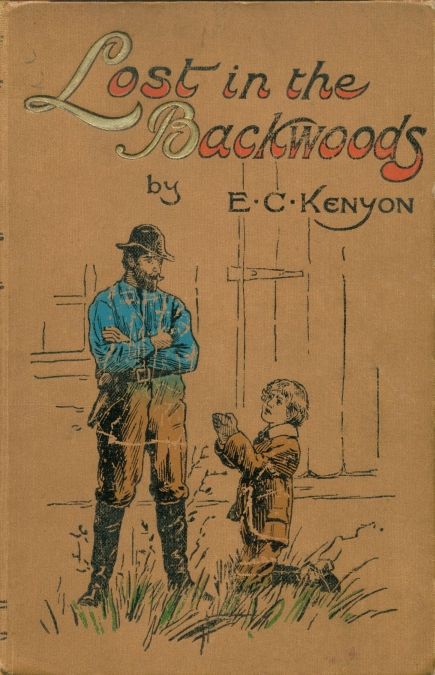
The Project Gutenberg eBook of Lost in the backwoods
Title: Lost in the backwoods
Author: E. C. Kenyon
Illustrator: W. Rainey
Release date: July 21, 2022 [eBook #68584]
Most recently updated: October 18, 2024
Language: English
Original publication: United Kingdom: S. W. Partridge & Co, 1899
Credits: Al Haines
"'God bless you!' he said fervently." p. 62
LOST IN THE BACKWOODS
BY
EDITH C. KENYON
AUTHOR OF "JACK'S HEROISM"; "BRAVE BERTIE," ETC.
ILLUSTRATIONS BY W. RAINEY, R.I.
LONDON
S. W. PARTRIDGE & CO.
8 & 9, PATERNOSTER ROW
FOURTEENTH THOUSAND
CONTENTS.
CHAPTER I.
CHAPTER II.
CHAPTER III.
CHAPTER IV.
CHAPTER V.
CHAPTER VI.
CHAPTER VII.
CHAPTER VIII.
CHAPTER IX.
CHAPTER X.
CHAPTER XI.
CYRIL SPEAKS UP FOR THE INDIANS
CHAPTER XII.
CHAPTER XIII.
CHAPTER XIV.
CHAPTER XV.
CHAPTER XVI.
CHAPTER XVII.
CHAPTER XVIII.
LOST IN THE BACKWOODS.
CHAPTER I.
ATTACKED BY ROBBERS.
"Your money or your life! Quick! Your money or your life!"
Cyril Morton gave a cry of horror and alarm. A masked brigand was pointing a revolver at his father, whose pale face confronted it with unnatural calmness.
Cyril had never passed through such a terrible minute in his whole life as that one during which his father remained silent, instead of replying to his fierce assailant's demand. A short while before the train-boy, passing down the outside passage of the comfortable American train, bearing his tray of chocolate, biscuits, fruit, etc., had waited on them and promised to return in a few minutes with illustrated papers wherewith to beguile the tedium of the journey. The train, which was a very slow one, was going from Menominee northwards. Cyril and his father had come to North America in search of the latter's brother, now long absent from his home. When last heard of Gerald Morton was in Michigan, so to that State they came on the death of Cyril's mother, whose last request was that her husband should go and look up his only brother. Cyril was twelve years old; he was an only child, and his father, in his sorrow, could not bear the thought of leaving him behind in England, so the two travelled together and were "chums," as the boy called it. After a delightful sail from Chicago over the calm grey waters of Lake Michigan they were enjoying their slow journey through immense pine forests, when suddenly a band of robbers galloped up to the train, flung themselves from their horses, and clambered on to it. First they struck down the engine-driver, reversed the engine, and stopped the train. Then they began to search the passengers, demanding of all their money or their life.
On receiving no answer the ruffian who was threatening Mr. Morton repeated his words in a voice of thunder.
"Oh, father," cried Cyril, "give him the money, or he will kill you! Father, please." He screamed the last words in his agony of apprehension.
His attention being diverted by the boy the man glanced aside at him, and in that moment Mr. Morton, with a sudden movement, wrested the pistol from his grasp.
The other instantly snatched at it, and a struggle commenced between the two men for its possession. Backwards and forwards they swayed, now locked in each other's arms, now flung apart. Once the revolver fell upon the soft-cushioned seat, when Cyril instantly caught hold of it, and, watching his opportunity, slipped it back into his father's hand.
Maddened with rage the brigand struck the boy down with his huge fist. Then Cyril lay like a log upon the floor of the carriage, and knew no more.
A few moments and the struggle between the men was ended by the brigand's firing point-blank at Mr. Morton, who fell back on the seat apparently lifeless.
The robber proceeded to rapidly search his victim. Quickly he pocketed a gold watch and chain, a well-filled purse, and also a pocket-book containing notes. Then he stooped over the boy, looking in his pockets. As he did so something in the white upturned face touched even his hard heart.
"He's not unlike my Harry," he muttered, thrusting back the little purse his fingers had just closed on. "No, I'll not take his money. He'll come to, and maybe want it."
Turning away he went on to rob someone else; and presently, with his pockets full of notes and gold, returned to his first victims, still lying where he had left them.
The other outlaws were leaving the train and mounting their horses; they were all in a hurry to get away.
The man who had struck down poor Cyril stood over him now, with a softened look in his hard face as he felt anxiously for the boy's pulse.
"Living!" he exclaimed, when his rough fingers had found it. "Well, he's a plucky little lad. I'll take him with me. His father's dead," he added, glancing at him. "I'll adopt the lad. He shall be my son, instead of poor Harry." So saying he lifted Cyril in his arms, carried him to where he had left his horse, and when he rode off with the others the boy, still unconscious, was on the saddle before him, his curly head drooping against his shoulder.
"The boy was on the saddle before him."
Now it happened that under the double burden the brigand's horse lagged behind the others, and although its master whipped and spurred it cruelly it could not keep up with them.
"Whiterock," cried the captain of the band more than once, "come on. Why do you linger?"
"Coming, sir," answered Whiterock, redoubling his efforts, but in vain.
At last the captain, turning in anger to see why he was disobeyed, perceived the boy, and cried impatiently—
"What have you got there? A lad? Ridiculous! Absurd! Fling him down. Leave him. We want no babies."
Outlaw though he was—strong, desperate too—the brigand dared not disobey his chief. Reluctantly, therefore, he stopped short, sprang off his horse, and lifted the boy down in his arms. Muttering that he had once a son like him he laid Cyril down under a forest tree, and then, turning quickly, remounted his horse and rode rapidly after his captain.
All the horsemen rode away. The sound of their horses' hoofs died out in the distance.
Presently, as evening drew on, a huge grey bear, stealing through the bushes, stood looking down on the unconscious boy. After a few minutes the bear stooped, and almost poked him with his nose.
If Cyril had awoke then, if he had moved one hand, or in any way "shown fight," it would have been all over with him. Unless very hungry, however, these North American bears do not attack human beings if they make no aggressive movement; so Cyril remaining perfectly still the bear, having satisfied his curiosity, moved slowly away.
The shades of night stole over the forest. It became quite dark. The wild beasts sought their prey. All sorts of dangers were on every side; but, quite unconscious still, the boy lay there, a faint stirring of his pulse alone showing that life was still within his slight young frame.
He had no mother at home praying for him, but it might be in the Paradise above she was pleading for her boy, over whom a merciful Providence was watching.
CHAPTER II.
ALONE IN THE FOREST.
About midday Cyril came to himself, opening wondering eyes upon an unknown world. Where was he? What had happened? Where was his father? Why were his limbs when he tried to move them so stiff and cramped? Raising himself with difficulty he leaned upon one elbow, and looked round searchingly.
He was alone in these unknown wilds. Where was his father? Why had he left him?
Suddenly the boy gave a great cry; he remembered all. His father was killed, must have been killed, or he would never have parted from him. He had put the pistol in his father's hand before the robber struck him; he did not know what had happened after that. But he felt convinced that his father was dead, and he lay down again upon the ground, crying as if his heart would break. There was a very tender love between him and his father; since the mother's death they had been all in all to one another. But a new thought came to Cyril by-and-by, and that was that someone must have brought him to the place where he was lying. For there was no railway line to be seen near there; indeed, the trees grew too thickly to admit of such a possibility. Who, then, had brought him away from the train, away from the railway line? Was it, could it possibly have been his father? But if so, where was he now?
Animated by the hope of finding him Cyril struggled to his feet. Then he called as loudly as he could, which was not very loud, for his throat was parched and dry, and he himself felt very faint. "Father! Father!" he cried. "Father, where are you? Father, speak; tell me you are here! Father! Father!"
But there was no answer.
Despairingly the boy turned in first one direction and then another, repeating his cries until he could not utter another word. But all in vain. There was no trace of a human being in any direction. He was alone, quite alone in the forest.
In silence now he wandered up and down, finding some wild raspberries, or what looked like them, and eating them quite ravenously. The soft fruit allayed his thirst, and then he could shout again, which he did repeatedly. At first it had been his intention to remain near the place where he had been lying, that if his father or whoever brought him there returned he might be found. But he lost his way very soon and could not find the place again.
"Father! Father! Help! help!" he cried, pushing his way through the long grass and bushes, and running along narrow tracks in first one direction and then another. "Oh, help, I am perishing! Save me!"
For now a despairing feeling came over him that help would never come, that he would wander up and down there until he died—perhaps killed by some wild beast. He knew there were bears in that part of America, and presently he came across a young one. It did not appear to see him, and he ran away from its neighbourhood as fast as he could. He had no weapon of any kind, and the thought of that made him presently get out his pocket-knife and cut himself a stout stick. Then it was that he discovered that after all he had not been robbed. His purse was still in his pocket. He took it out, opened it, and examined its contents ruefully. One piece of gold, a sovereign, and a good many shillings and sixpences were all there. But of what use was money to him now? How gladly, thankfully, he would give the whole of his money to anyone who would show him the way out of that fearful solitude! However, he was in a place where money availed not. What could he do? He was in despair.
Then he remembered his heavenly Father, and, kneeling down just where he was in the lonely forest, he prayed to Him for help and guidance, and especially that, if his father still lived, they two might speedily find each other.
He felt somewhat comforted when, at length, he rose from his knees, for he knew that he had done the very best thing he could for himself and his dear father by laying all their concerns before God in prayer.
Looking round for more berries he soon found some, ate, and was again refreshed. Then he walked on once more in the hope that he would get to some inhabited place. But he was very tired; and presently, when his foot slipped over a tree-root and he fell heavily to the ground, he did not feel able to rise again. He therefore lay still where he was, and soon fell fast asleep.
Again the shades of night crept over the tall trees of the forest, veiling them and the sleeping boy in darkness. And once again the beasts of prey stole forth in search of food, but did not come near Cyril to harm him, whilst, unconscious of his danger, he slept on.
He was happy now, for he was dreaming of his mother. She looked as sweet as ever and far happier, for the lines of pain and trouble on her face had been all smoothed away. "Cyril, my boy," she said to him, stooping to kiss his brow, "it was brave of you to help your father as you did yesterday. You suffered for it. Yes, but that is all over. Now you must be brave in searching for your father and waiting patiently until God, in His good providence, permits you both to meet again."
"I will, I will, mother," Cyril cried in his dream; and then it ceased, and he lay in heavy, dreamless slumber until he awoke with a consciousness of its being very hot, and that there was a strong smell of something burning.
Starting up and looking round he found that it was morning, and that away to the right of him there was a mighty cloud of smoke mingled with flames, out of which great showers of sparks flew up into the sky. A tremendous roaring as of thunder announced the burning of great forest trees. The noise of it almost drowned the pitiful cries and screams, roars and screeches of wild animals and birds as, in their flight for their lives, the cruel flames caught hold of them and burnt them.
"The forest is on fire!" cried Cyril aloud in terror-stricken accents, "and I, where shall I go? Oh, God," he murmured, "help me!" and set off running fast in the opposite direction from that in which the fire was advancing.
The air had become exceedingly hot. It dried up everything before the fire, so that when the flames came up they caught hold of the great pine trees without a moment's loss. The very ground seemed scorched.
Cyril found the fire gaining upon him. Of what use was it to run? Oh, if he could only come to some open space, or a sheet of water into which he could hasten!
But no. There were no signs of either. Cyril became hotter and hotter. Soon, very soon, the fire would overtake him. He almost felt its hot breath on his cheeks. Wringing his hands he sank down with a loud, despairing cry.
CHAPTER III.
RESCUED.
Now it happened that Whiterock and his companions had been fleeing before the fire for at least an hour, when its direction brought them to the place where Cyril fell.
The boy's wild, despairing cry was unheeded by most of the men, who were only bent on saving their own lives, but on Whiterock's ears it fell with powerful appeal. Swiftly he galloped up, espied the boy, leaped from his horse, flung Cyril upon the saddle, remounted, and once more rode off with him at full speed.
"The boy's wild, despairing cry was unheeded."
The men knew of a large clearing extending for several miles, where lumbermen had felled and carried away the great pines. They rode straight there, and in the course of an hour reached the place.
There was no fear of any fire following them into the clearing, for nothing remained there upon which it could feed. It took another direction, more to the north-west, and the men and boy were safe.
With noisy jests and much jeering at the fears which now were over the company made their way to the deserted camp of the lumberers. This proved to be a big frame-building, run up for the temporary convenience of the men who felled the trees, and then deserted when their work was done and the timber conveyed away. All round the inside of the building were sleeping-bunks, half filled still with dry grass and ferns.
They set to work with alacrity to kindle a fire, make coffee, cook some meat, and spread out their biscuits.
No one took any notice of Cyril, who stood in a corner watching them furtively. What powerful men they were! And how wicked some of them looked! But others seemed quite pleasant and kind. He watched Whiterock closely with very mingled feelings. He would have been most grateful to him for saving his life if it were not for the strong suspicion he had that he was the very man who had attacked his father. At that time he wore a mask. Now his dark-bearded face was uncovered. But there was something in his build and manner, and especially in the tones of his voice, which made Cyril confident that he was his poor father's assailant. How the boy longed to ask him if he had left his father living still! Would he be very angry if he were asked the question?
"Whiterock!" Cyril called timidly to him, stealing nearer as he did so.
The man had constituted himself cook, and was stooping over a battered frying-pan, whereon spluttered great slices of meat. Being much absorbed in his cooking he only noticed Cyril's call by giving him a nod.
Cyril did not return the nod. For just as he was about to do so it occurred to him that if the man were really his poor father's cruel assailant he could return no greeting of his.
Whiterock did not notice the boy's lack of cordiality; he was talking to one of the stewards now about the meat, which had run short. There would not be sufficient to go round. This was a great difficulty which could not be got over by talking.
When at last the men sat and lay down in a sort of circle round the stewards, who helped out the food straight from two central dishes into the men's hands, Cyril was called up by Whiterock and received a share of biscuit only.
"Biscuit is good enough for bairns," said the steward, laughing.
But Whiterock, grumbling, thrust a small piece of meat upon the boy's biscuit. It was his own. But how could Cyril eat it? He pushed it back into the man's hand. Whiterock looked annoyed, and made no further attempt to improve his meal. The men drank their coffee out of little cups belonging to their flasks. Cyril had not one, so would have had to go without if the steward had not kindly lent him his.
After the breakfast all the men but two or three, who remained to look after the horses, collect wood, and so forth, went off on foot to hunt. They returned, late in the afternoon, with an immense quantity of game. The men who had not been hunting were sent, with a couple of horses, to fetch home some of the best parts of the deer which the others had shot.
There was a great feast that evening, and much work afterwards in cutting and hanging up strips of meat to be smoked and dried by the fire during the night. Then the men divided the sleeping-bunks. Cyril shared one with Whiterock.
"There, get in, youngster," said Whiterock. "I'm awful sleepy. Want to say something? No, I can't hear it to-night. To-morrow some time will do. Good-night." He fell asleep, or appeared to do so, almost as he spoke.
Cyril dared not disturb him to inquire about his father's fate. He, too, was very sleepy, and in spite of his anxiety speedily followed his companion's example.
He was awoke suddenly in the night by shouts from the men, and then much loud talking and exclaiming. What was the matter? The men were flying wildly out of their bunks, on all sides, and making for the door. At that moment something soft, smooth, and slippery wound itself round Cyril's neck. With a cry for help he caught hold of Whiterock's hand.
The man sat up and astonished the boy by laughing loudly.
CHAPTER IV.
TEMPTED.
Whiterock flung something from the boy, and, jumping out of the bunk, still laughing loudly, lifted him on to the ground.
"Captain," he called out, "these old bunks here are full of pine-snakes, which have crawled into them for warmth. Fortunately they are quite harmless. Now then, men, they won't hurt you!"
When all the men had returned they declared that it was impossible to sleep any more that night. So more coffee was made, and they all sat and lay about near the fire, talking of their future plans. Cyril began to count the men, but was still so sleepy that he could not quite decide whether their number was nearer twenty than thirty.
For some time no one took any notice of the boy. But at last the Captain did so, and jeered at Whiterock for turning nursemaid.
Then they all began to talk of Cyril, much to his discomfiture.
Presently Whiterock asked him if he would like to remain with them as his adopted son, and in time would become one of the band.
"Ah, like Wolfgang," said the Captain, stroking his long beard. "He was a lad of about your age. We found him. I won't say where, but he grew up amongst us, and for cleverness and pluck there wasn't a man of us all that could beat him. Ah, he would have been captain if he had lived! He was killed in a scuffle with the police. He died fighting nobly."
Cyril had his own opinion about the nobleness of fighting the public officers of law and order. But he felt sorry for Wolfgang. The lad probably knew no better.
"Well, little 'un," said Whiterock, "would you like to stay with us and be my boy?"
"But my father?" said Cyril tremulously, looking appealingly at him.
"Oh, he's dead," said Whiterock hastily. "Now come, boy, don't make a scene."
Cyril turned his back on him. He was struggling with all his might to keep back the tears which would not be suppressed. His father, his dear, kind father, slain by that coarse, ruffianly fellow! Oh, it was too cruel!
"What's the matter?" demanded the Captain.
Whiterock crossed over to him, and said something rather low in his ear.
"Oh!" cried the Captain. "But that's only the fortune of war. Come here, my boy," he added to Cyril.
Cyril went up to him with a pale, resolute face.
"Whiterock saved your life, lad," said the Captain. "You must remember that. There wasn't one of us who would have done so much for you at such a time."
"He took my father's life," replied Cyril, looking up with flashing eyes, the hot blood mounting to his very brow.
"But he saved your life, lad," remonstrated the Captain.
"I know he saved my life," cried Cyril, "and I just wish he hadn't! As he killed my father, I would rather have died than——"
"Be quiet!" thundered the Captain. "Will you stay with us or no?"
"No, a thousand times no!" answered the boy boldly.
"I won't have him," muttered Whiterock sulkily.
"But I will," cried the Captain. "Look here, my lad, I honour you. Yes, I honour you for loving and respecting your father. You're a plucky lad! And if you like to stay with us you shall be my adopted son. Do you hear what I say?"
The men uttered various exclamations, tending to show that what they considered "a piece of rare luck" had come in Cyril's way.
Then they all waited for the boy's answer.
"No, thank you, Captain," he said politely, "I cannot."
"What for, lad? Why not?" demanded the Captain wrathfully.
"Oh, because 'Noblesse oblige!'" replied the boy.
"What do you say?"
Cyril repeated "Noblesse oblige" distinctly, in tones which were heard all over the great room.
"How do you explain those words?" asked the Captain.
"Oh, don't you understand them?" said Cyril, surprised that such a great man as the Captain should be ignorant of their meaning. "My father"—his voice shook a little as he said the name—"told me Noblesse oblige means rank imposes obligations, and that much is expected from one in a good position. You see, Captain, gentlemen can't do mean, dishonourable things. I'm sorry to disappoint you, but you see I come of a race of honourable gentlemen who would scorn to rob and plunder."
The Captain laughed loudly, rudely. "What a fine gentleman we've got here!" said he; "let's look at him." He dragged Cyril forward into the middle of the room. "There, my fine fellow, look around you," cried he. "Do you know several of these men are gentlemen of birth and breeding?"
"Then they've forgotten it," said Cyril calmly.
A murmur of anger went round the room. "Forgotten what?" cried one man.
"Noblesse oblige," replied Cyril.
"Absurd," cried the Captain. "Have you no better reason than that for refusing my offer?"
Cyril was silent.
"Speak out," cried the Captain.
Slowly but bravely Cyril said that there was yet another reason. He could not join them because he was a follower of Christ, who made the law of love, saying, "By this shall all men know that ye are My disciples, if ye have love one to another."
A cry of rage burst from most of the men upon hearing this. But one or two drew rough hands across their faces, as if to hide them for a moment.
CHAPTER V.
CYRIL'S SENTENCE.
"You little prig!" sneered the Captain of the band. But he did not look at Cyril. "Preaching at us!" cried another man indignantly.
"He wants taking down a peg or two," said a third.
"What sinners we must be!" scoffed a fourth.
"Leave him alone," growled one whose heart the boy's brave, noble words had touched. "Let him be."
"Aye, do," said a younger man. But he spoke timidly, looking down on the ground as he did so. "In case—in case," he added, "the youngster may be right."
"Right! Hark at him! Hark at Green!" jeered two or three rough voices.
The Captain looked angrily around at the men, and then at the boy. He felt thoroughly out of temper.
"A good thrashing would do the lad no harm," he muttered.
"Thrashing's too good for him," grumbled Whiterock, all his kind feeling for Cyril having changed to bitter dislike.
"Boy, come here," cried the Captain.
Cyril went up to him. He was very pale now, and trembling. He did not feel at all brave as he clasped his hands nervously together. It was terrible to feel that he stood alone, unarmed, helpless in the midst of all these men.
The Captain looked searchingly at him. "Your name, lad?" he demanded in stern tones.
"Cyril Morton," answered the boy.
"Cyril! A girl's name! Pooh!"
With a sudden change of mood the Captain laughed derisively. He passed his big, rough hand over the boy's soft curly hair and down his slim young figure.
"All the same," he said, "I like you, boy, and believe that we can make a man of you yet. After all, I will repeat my offer. Will you stay and be my son?"
Cyril shook his head. He could not speak at the moment, for the right words would not come. Was he to go through the ordeal again?
"He won't!" cried one of the men indignantly. "Did you ever know such defiance?"
"Speak," demanded the Captain, his hand resting heavily now on Cyril's shoulder as if he would compel his obedience. "Do you still refuse?"
"Yes. I cannot—oh, I cannot accept your offer! I cannot!" cried the boy.
"Very well," shouted the Captain angrily. "You defy us! Here, you, Whiterock, you brought the youngster. Take him outside a bit while we decide what is to be done. Take him away, I say, for ten minutes. Then bring him back to hear his sentence."
Cyril trembled. Would they kill him? Out here in the backwoods they could do whatever they liked. There were no policemen here.
"Come on," said Whiterock, seizing hold of Cyril's collar and dragging him out of the place.
Outside he flung the boy down on the ground at his feet.
"Oh, Whiterock," pleaded Cyril, "though you killed my father—my dear, good father, will you not save me, his son?"
"Oh, Whiterock, will you not save me?"
It was the best plea the boy could have made, for since those words of his to the Captain, and his terrible distress about his poor father, Whiterock had felt something like compunction for what he had done.
"The matter lies in your own hands, Cyril," he said, not unkindly. "You, and only you, can save your life. Accept the Captain's offer—it is a generous one."
"But I can't," said Cyril. "Oh, Whiterock, I can't!"
"Well, come back with me inside."
"One moment," cried poor Cyril. "What will they do to me?"
"You'll hear that soon enough," muttered Whiterock, leading him inside the huge shanty.
"Come here," called the Captain loudly, "and hear our decision."
Cyril stood tremblingly before him.
"It is," cried the man, "that if you do not change your mind by morning and consent to become one of our band, we shall tie you to a bunk and leave you here imprisoned in this camp, with only the snakes for your companions."
A cry of horror escaped from Cyril's lips. Then eagerly, passionately, he pleaded with the Captain to punish him in any other way he liked than that.
But to all and everything he urged the Captain had only one answer, Cyril must accept his offer, and then all would be well with him.
The boy, however, although greatly tempted to dissemble for a while and pretend to comply with the Captain's wishes until they reached a more civilised place where he might gain succour, remained firm.
So did the Captain. At the break of day he and the men breakfasted without giving one morsel of food to the boy. Then they made their preparations for leaving the place, which consisted mainly in packing up the best of the game and deer flesh.
When they were quite ready to start the Captain strode up to Cyril, asking if he had changed his mind.
"No, sir," answered the boy.
Then the Captain made two of his men lay Cyril down in a bunk and tie him to it securely.
The horrified boy, looking round nervously, perceived a snake at the foot of the bunk, and another larger reptile at one side of it.
Was he to be left exposed to their unwelcome embraces? Harmless they might be, but most unpleasant.
Vainly he begged and implored for mercy.
To all and everything he said the Captain's reply was always, "Do you change your mind? Will you be one of us?"
"I cannot! Oh, I cannot!" cried the poor boy every time.
Last of all Whiterock came up, and once more advised him not to throw his life away.
Cyril, however, would not yield.
Then they left him, and going outside mounted their horses and rode off.
There was a great silence in the deserted camp.
Cyril prayed to God for help.
Suddenly he felt a cold, slimy body slipping round his leg and gliding up his waist. He could not reach it with his hands, which were tied to the side of the bunk. Shouting at it to frighten it away was not of any use.
With a piercing scream he gave himself up for lost and knew no more.
CHAPTER VI.
DELIVERANCE.
"Poor little chap!" said a rough but kindly voice, as a young man unwound the snake from Cyril's body and dashed it on the ground. "Pluckier than any of us men after all. Here, my lad, drink this." Whilst speaking he had unfastened Cyril's collar, and was now holding a flask to his lips.
Opening his eyes Cyril looked with a troubled gaze into the man's weather-beaten face. What had happened? Slowly he remembered. It was the young man called Green, who had tried to speak up for him when the others were so angry. What was he doing here?
Green cut away the ropes, and lifting the boy out of the bunk carried him away from the gloomy place altogether into the sunshine outside. Then he laid him down on some long grass, and going to his horse, which was tied to a fence near by, got a packet of food out of his saddle-bag.
The sweet, fresh air revived Cyril; the sunshine warmed him and did him good. In his heart he thanked God for the blessed change.
As Cyril ate and drank the repentant outlaw watched him with hungry eyes. There had been a time once when he was an innocent boy like him. Ah, well! that was long ago, and the good mother, whose pride and joy he had been in those days, had been dead for many years. There was no one to care so much what he did when she had gone, and the tempter enticed him along the downward path of idleness and self-pleasing. He had forgotten his mother's God, and had turned away his mind from all thoughts of Him! That was the beginning and the end of all the evil.
But this boy, Cyril, had done very differently. Alone, unarmed, he had been brave in the most terrible danger, he had resisted the greatest temptation.
The robber sighed deeply.
Cyril, looking up, saw two great tears rolling down the man's face. He turned his head away quickly lest the boy should see them.
Jumping up he threw his arms round the man's neck.
"You have saved my life," he cried, "and now you are in trouble yourself. Yes, I know you are. Is there anything I can do? Will you—will you tell me what is the matter?"
Deeply touched, Green sank down on the grass beside Cyril and told him the whole story of his life, from the time when, as a child, he said his prayers at his mother's knee to the hour when, with his companions, he heard Cyril's outspoken condemnation of their wicked life.
"All night long," he said in conclusion—"all night long I've been thinking, thinking as I never thought before, and I've made up my mind, lad, that I'll try to lead a different life. If I can't earn my bread and cheese in future—well, I'll go without it. And I'll ask God's forgiveness for all my wrong-doing as long as I've breath in me to ask it."
After a pause, during which Green sat pondering, his horse made an impatient movement, which reminded him that they ought to set off.
"But where shall we go?" asked Cyril wonderingly.
Green replied that his father still lived, and happened to be working in a great saw-mill not twenty miles away from where they were. "If we go to him," he said, "I know he will get me work to do."
Then Cyril asked if Green could put him in the way of returning to England to his friends.
Green felt very sorry for him as he listened. But as Cyril had not nearly enough money, and he had very little himself, he did not see how he could possibly assist the boy to return home. However, the first thing was to get him into a place of safety, for the robbers might return when they missed their comrade, or possibly, relenting, they might come back to liberate Cyril.
Mounting his horse, therefore, Green took up Cyril before him on the saddle and rode off.
After proceeding about five miles through the forest, without any greater adventure than the frequent difficulty of finding a path through the dense trees, they unfortunately came out into an open sandy plain, across which they had not gone far before they were perceived by some horsemen who happened to be crossing the plain in another direction.
With wild cries the men turned their horses about and set off after Green and Cyril.
It was a most unequal chase. The doubly-laden horse could not by any chance escape the pursuers, who gained ground every moment.
Encouraging it by word and by every other means in his power Green rode on, but with little hope in his heart.
Nearer and nearer came the pursuers, laughing and shouting as their horses flew over the plain.
"Come, Jack! Jack, old fellow, for pity's sake!" cried Green.
Tossing his head, with flakes of foam flying from his mouth, the horse dashed on.
But still the followers gained a little more.
"Jack, old fellow!" There was something despairing now in Green's appeal to the animal.
Neighing loudly, as if in answer, the horse galloped even faster than before. His hoofs scarcely seemed to touch the ground. It was all Cyril could do to hold on to his friend.
"Stop! stop! stop, or we fire!" cried a stentorian voice.
"Jack!" Green's appeal was almost frantic now.
With a bound the horse responded, plunging forward with greater speed than ever.
A shot rang through the air. Jack swerved heavily to one side; then he rolled over dead.
CHAPTER VII.
A FALSE ALARM.
The good horse Jack was dead, but neither Green nor Cyril were hurt. Fortunately for them the last violent movement of the animal threw them quite clear of its body.
"Cowards!" exclaimed Green, rising, and looking indignantly through a cloud of dust in the direction whence the shot had been fired.
"'Cowards!' exclaimed Green, rising, and looking indignantly."
"Why, Green! Green! They're off!" cried Cyril, who was already on his feet. "They're off!"
"Off! Leaving us!"
Green could scarcely believe his eyes. Instead of coming up to seize them the pursuers were galloping away.
"Oh! Look, look!" Cyril pointed in another direction.
A little company of horsemen had entered the sandy plain, and were riding rapidly towards them.
"They've scared our enemies. Aye, but we'd better be off too," cried Green in alarm.
"But we needn't run away from these men," said Cyril. "They are our friends."
"Friends? Not they! I should have a bad time of it if they caught me," said Green. "You see, they're Government men on the look-out for train-robbers and horse-stealers. Jack was a stolen horse. They'd make short work once they laid hands on me. Come on, lad." He caught hold of Cyril's hand and set off running back towards the forest.
"But, Green, stop. Let us tell them all. You are no outlaw now. You can say you have done with all that sort of thing—that you are repentant!" protested Cyril as they ran.
"That would make no difference. They'd punish me for what I've done already."
Cyril could not help feeling that if he told his story to these new-comers they would be sorry for him, and would befriend him. But he did not like to suggest that he should separate from his companion and wait for them.
Green, however, seemed to be thinking of it "They would not believe even you," he said. "You see, you'd be found in my company, and they would think you were one of us."
Across the boy's mind flashed the copybook precept he had written many a time, "A man is known by the company he keeps." And he remembered he could give no proof that his narrative was true.
"It's impossible to keep this up," panted Green after a while. "I'm dead beat! I can run no further."
The perspiration poured down his red face; he was thoroughly exhausted.
"Nor can I," cried Cyril, who, although more used to running than Green, was not in his usual health. "Let's give up."
They stopped short, and timidly, very timidly, looked round. They were alone. Not a creature—neither horse nor man—had followed them. With the exception of a few birds not a living thing could they see.
"Why, wherever be they?" exclaimed Green.
"Where? Where are they?" echoed Cyril.
There was no answer. Where, indeed, were their pursuers? Had the earth swallowed them?
"Something must have made the new-comers fear to attack them after all," said Green. "They must have been as afraid of the others as t'others was of them! Did you ever know such a thing?"
"And we've been just as bad," said Cyril in a tone of disgust, "for we've been running away from nobody at all!" He sat down dejectedly on a sandhill.
"Three parties all running away from each other, without ever stopping to look round! Well, that was mighty queer," cried Green.
"You were wrong about them being men in pursuit of you and your friends," said Cyril.
"I was indeed. They weren't after us at all. They must have been just quiet, peaceable travellers who heard the firing, and, being alarmed, made off back again as fast as they could!"
"Well, they saved us, anyway," said Cyril.
"Yes, that's true enough."
"But how shall we get on without a horse?"
"Poor Jack!" sighed Green. "Captain gave him to me because I was the means of his getting a whole lot——" he stopped abruptly. "What a rascal I've been!" he reflected.
"I'm ravenously hungry," said Cyril.
"And we've left nearly all our food in the saddlebags. But not quite, I've a little here!" Green got a packet out of his pocket, and, opening it, disclosed some slices of cooked meat.
"Oh, thank you!" Cyril said, gratefully taking his share.
For a few moments they ate in silence, then Green said they must push ahead as fast as possible before night came on.
"But which way shall we take?"
"Oh, we can't be so very far from the saw-mill where my father works, if I could only find the way there," said Green.
However, it turned out that he really did not know where they were—so many turnings had confused him. But they could not remain there, and so set off walking towards the forest. In the shelter of the trees, at least, they would not be so conspicuous if the pursuers again came near. Besides, Green was certain the saw-mill, which he had once been to, was near trees.
In an hour they found themselves again entering the forest, and walking along a broad track made by deer or other large animals. It was dark below the great pine trees, and before long the shades of evening made it still darker.
"Oh, Green, I can walk no further!" said Cyril at length, sinking down at the foot of a tree.
"Well, I think we're both about tired out," rejoined Green, leaning wearily against another tree, and looking down compassionately on the tired boy. "We'll stop here, lad, for the night."
"Yes. But shall we be safe? What about the wild animals?"
"Oh, we must have a fire! There's plenty of dry wood about."
He went forward and began to heap up some broken boughs.
"It won't do to light it here though," he went on. "We might set fire to the forest; everything is so burnt up."
"I'm afraid I can't go any further," said Cyril.
"No, you stay there. I'll just take a look round." He walked off as he spoke, and disappeared amongst the trees.
It was very still after he had gone. The twittering of birds and the occasional snarl of some wild animal, or the breaking of twigs as one stealthily approached, were the only sounds to be heard. At another time Cyril, who was unarmed, might have been nervous had not bodily fatigue overcome every other sensation. As it was, by the time Green returned to him he was fast asleep.
"Poor lad, I won't wake him," said the kindly man, lifting Cyril in his strong arms, and carrying him off as if he were a baby.
When Cyril awoke an hour later he saw a great wood fire burning, and sending up showers of sparks into the still night air. He was lying in an open space at one side of the fire, and Green was stooping down near it, attending to the roasting of a bird.
"Supper's ready, my lad," he was calling. "And a blessing it is I've got some supper for you. Jump up."
"What is it? How did you get it, Green?" asked Cyril eagerly, for all at once he felt uncommonly hungry.
"Never mind," said Green briefly, "you eat it."
He poked it out of the fire, and served it on a smooth flat stone. Then he divided it with his pocket-knife, handing Cyril the best of it with the same useful article.
The two made a good meal, for the food was very welcome. Then they lay down on the ground near the fire and were soon fast asleep.
CHAPTER VIII.
GREEN MEETS HIS FATHER.
It was scarcely light when Cyril was awakened by Green shaking him vigorously.
"Wake up, lad. Wake up!" he cried. "There's something queer near us! Listen."
Cyril sat up, rubbing his eyes, and heard the sound of horses galloping along, and then crashing through the brushwood. He saw strange lights gleaming through the trees, and now shots were fired, and loud and excited voices bewailed the escape of some prey.
"Green," said the boy in a low tone, "are those men after us again?"
"No, no. It's some huntsmen. I see now; they're hunting deer with head-lights."
Even as he spoke one of the lights dashed through the bushes up to them, and Cyril saw, to his amazement, that it was a lighted lantern strapped on to the head of a stout pony. A man with a skin cap on his head rode the pony.
"Hullo!" shouted he, "what's this? What are you fellows doing? Camping out, eh?"
"Of course we are," said Green cautiously. "And who may you be?"
"Oh, we're just a party of men from Ellison's saw-mill——"
"Ellison's saw-mill! That's good hearing!" cried Green. "We're on our way there, but have got lost. How far off are we now?"
"About six miles or so. Where are your horses?"
Green looked embarrassed. Then he said, "We fell in with a rough lot—they shot our horse——"
"Shot your horse? Had you only one?"
Before Green could reply, much to his relief two or three other men came up, who, after asking a few questions, swung themselves from their saddles, and, opening their saddle-bags, began to take out sundry packages.
"We might as well have our breakfast here," said one. "Any objection to our using your fire to boil our kettle, master?"
"None whatever. Make yourselves at home," answered Green heartily.
"Any water hereabouts?" asked the man.
"There's a spring just round those trees, about ten yards off."
"Hurrah! Fetch some, Jem. We'll make coffee. You and the lad will join us, stranger?"
"That's so," replied Green, "and thank you."
In a quarter of an hour the five huntsmen, Cyril, and Green were partaking of a good breakfast, consisting of coffee, tinned meat, and bread.
Cyril learnt from the men's talk that they had been hunting all night and had shot two reindeer, which some of their party had taken home, whilst the others pressed on in search of more. The light of the lanterns fastened to their horses' heads attracted the deer, who, on coming forward to look at it, were shot point-blank by the men.
The boy thought it a very cruel way of entrapping the beautiful creatures, but all the others said it was "fine sport."
Presently the men, who had lingered too long over their breakfast, jumped up, and mounting their horses rode as fast as they could back towards the mill. Very little was said upon the way. One of the men took Cyril up behind him, and he found it difficult enough to hold on to the saddle he bestrode. He had no strength left for talking.
By-and-by they arrived at their destination—a group of houses and outbuildings, and a huge saw-mill, with heaps of timber and roughly-hewn planks.
The master of the mill, who was a tall man, with hair thickly sprinkled with grey, came to the door of his office—a small building at one side of the yard—as they rode up.
"Well, men?" he said laconically.
"We've killed two head of deer, that's all," replied the spokesman of the party, "and we've picked up a man and a boy who were on their way here."
"Dismount," said the master briefly, addressing the strangers.
Green jumped down and took off his skin cap.
"Beg pardon, Mr. Ellison, sir," said he, "but can you tell me, is Josh Davidson, my father, still living here?"
"Yes," replied the master. "You are his son Ben?" he added.
"That's so," said Green, whose real name was Ben Davidson. "Can I see him?"
The master sent for the prodigal's father. Then looking at Ben, he said inquiringly—
"Turned over a new leaf?"
"Yes," Ben nodded. His face was very red, and great tears were in his eyes. The man before whom he stood knew all about him. He knew of the shameful years of robbery and violence; he knew of the father's broken heart.
Suddenly the saw-miller laid his hand on Ben's shoulder.
"Go meet him, lad," he said. "See, he's crossing the yard."
Ben hurried out. The two in the office heard a great glad cry—
"My son! My son! 'He was dead, and is alive again. He was lost, and is found!' Thank God. Oh, thank God!"
"Now," said Mr. Ellison to Cyril, "tell me who you are. Do you belong to that man?"
"No, sir; oh, no!"
"Then how came you to be here with him?"
Cyril looked up into the man's grave, kind face. He wanted to tell him all that had befallen him since the time that he sat by his father's side in the train going northwards from Menominee, but remembered that he must not betray the ex-robber. And although it was evident Mr. Ellison knew something of the latter's wrong-doing, Cyril was not aware how far that knowledge extended.
A shade of sternness crept over Mr. Ellison's face as he noticed the boy's hesitancy.
"Well?" he said impatiently.
Cyril was greatly perplexed. How much could he tell the saw-miller without compromising the man who had saved his life?
CHAPTER IX.
AT THE SAW-MILL.
"It was in a train. It was attacked by rough, cruel men, and one of them killed my father."
Cyril's voice shook as he spoke, and for a moment he paused.
"I fell into the hands of the men, and they were leaving me to die, when Green—I mean Ben Davidson, rescued me."
"Ah! Just so! Well, I won't ask you questions about that. But say, what is your name? Where do you come from?"
"My name is Cyril Morton. My father was an English gentleman, with an estate in Cornwall. We came to this country in search of my uncle, Gerald Morton. Have you ever known him, do you think?"
Cyril asked the question with sudden eagerness. Who was so likely as the great saw-miller to know a sojourner in those parts?
The saw-miller shook his head. "Ours is an immense country," he said. "Unless you have some clue to his whereabouts I'm afraid you won't be likely to find that uncle of yours, my boy."
"Then, if you please," said Cyril, "can you help me to return to my friends in England?"
The saw-miller said nothing. He looked discouragingly at the boy.
"You see," said Cyril, "I've scarcely any money with me. But my father had plenty. When I get back to England I shall just go to Mr. Betts, our lawyer, and get him to send your money back, with interest—that is, if you will be so very kind as to lend me some."
"Just so," said the saw-miller. "But how can a little chap like you travel all those thousands of miles alone? No, no, my boy, it's not so easily done."
"But I must return home," protested Cyril.
"Yes, of course. All in good time. But you must wait here until someone going to Chicago comes this way."
"But——" began Cyril.
"Now, I can't argue with you, boy," said the saw-miller shortly. "You're very welcome to stay here with us until it's convenient to send you along to England. More than that I cannot do for you."
He touched the bell.
"Thank you," said Cyril, "but——"
"Jim, take this youngster to the cook," said Mr. Ellison to his errand-boy, "and tell him to give the lad something to eat and drink."
"Yes, boss. Come along." The last two words were addressed to Cyril, who followed him from the office immediately.
The boy conducted Cyril into a large room in the great house where the master saw-miller lived with such of his men as were unmarried. Then a man wearing a white cap placed a dish of hot meat, bread, and coffee before him, at one end of a very long table.
Just as Cyril was sitting down to the meal Ben and his father entered, and came quickly towards him.
"Here he is, father. Here is the boy whose brave true words spoke a message from heaven to my soul," said Ben.
The old man laid a hard but gentle hand on Cyril's head.
"God bless you!" he said fervently; "God bless you!"
"Thank you," said Cyril in a low tone. He felt very glad to think he had done so much good, but it was a little embarrassing too; so he hastened to speak of other things. "Green—I mean Ben," said he, "aren't you going to have some breakfast? Oh, yes, here comes the cook with another plate."
The man with the white cap laid the plate before Ben, regarding him curiously as he did so.
After he had gone the old man spoke. "Ben," he said, "my son, you've repented; yes, but the consequences of your wrong-doing remain. Your band has done a good deal of mischief in this neighbourhood, and at any moment you may be recognised. You'll have to be disguised in some way."
"I'll shave my beard and whiskers off, and you must cut my hair quite close, father," said Ben. "Then if you'll kindly get me some clothes like yours, you'll see I shall look very different. If any of my old associates ever come this way, it must be quite impossible for them ever to recognise me."
"Aye, my lad. What would that desperate Captain do if he came across you?"
"Shoot me as soon as think of it," replied his son.
Cyril trembled. From what he had seen of the Captain he was sure it would be so. "But these saw-millers are very powerful, Ben, aren't they?" he asked. "They couldn't easily be overcome, could they?"
"Not likely," Ben answered, "if it came to a fair fight."
After the meal was over Ben shaved, and his father cut his hair quite close to his head. Then he dressed in the rough garments worn by the men at the saw-mill. His transformation was so complete that even Cyril did not know him when he returned to the big room.
Then, and not till then, did the old man take him to the master.
A little later in the day, when Cyril had been shown over all "the works," and had seen the different operations whereby great forest trees were sawn into boards, smoothed, planed, and piled up in mighty heaps ready for transportation, he learnt that Mr. Ellison had been very kind to Ben, and had engaged his services, that he might remain there and work with his father. The old man was most pleased and thankful; and his son and he made very much of Cyril, and were never tired of telling him how grateful they were to him for being the means of their present happiness. The boy did not like to disturb and distress them by letting them know of his own bitter disappointment in not being assisted at once to return to England.
Mr. Ellison was very kind to him in other ways. He allowed him to sleep in a tiny room opening into his own bedroom, and at meal times Cyril's plate was always set near the master's.
"He's a little gentleman," said the rough saw-miller; "he shall sit near me."
Sometimes, when "the boss" was resting, he would talk kindly to Cyril, explaining to him all about the wonderful work which went on in the heart of that strange, wild land.
"You would never think, lad," said he, "that houses built in London, York, Sheffield, Liverpool, and so on, in the old country, are floored and partly 'run up' with boards made of our forest pines. Yet it is so; our timber goes to the wood markets of old England."
Then he related graphically how large parties of men, called lumberers, came over to Michigan and Canada just before the long winter and set up great camps, at which they lived a hard, rough life, going out long before light on intensely cold winter mornings to fell the giant pine trees, and returning early in the evenings to eat and sleep heavily until it was again time to go to work. In the winter months when the ground was covered with snow and ice the forest would resound with the blows of the axe, and the trees would lie prone on the ground until they were chained together into rough sleighs and dragged over the frozen snow to the banks of the frozen rivers. There they would lie waiting until the spring, when the ice would melt, and the timber would be slipped into the river and borne by the force of the current on, on, for many miles until it reached its destination.
"Yes," he said, "our timber comes floating down to us on our river. We stop it when it reaches us, and saw it up as you have seen. Afterwards the same river bears it away towards its distant market."
"Then the river is your road, your railway, and everything," said Cyril.
"Yes. And we make the water serve us doubly. It is our carriage or boat, as well as our road or river." And then Mr. Ellison told him of greater wonders still, of timber being formed into gigantic rafts, these "shooting the rapids" and being "tugged" across lakes by steamers.
It was all very wonderful; Cyril was deeply interested. But still he longed to leave that marvellous country to return to his friends and his father's friends in old England.