
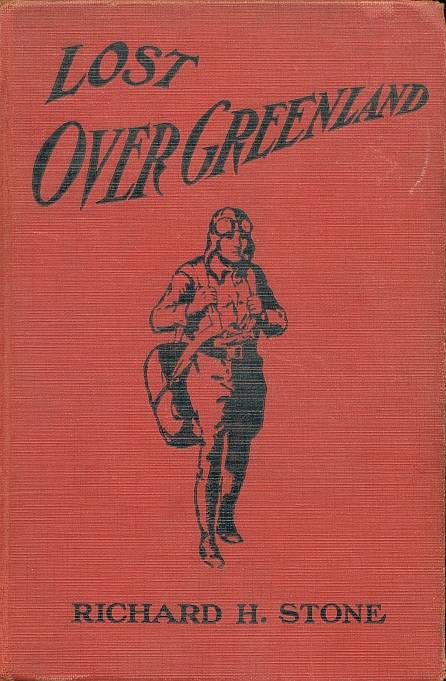
The Project Gutenberg eBook of Lost over Greenland
Title: Lost over Greenland
or, Slim Tyler's search for Dave Boyd
Author: Richard H. Stone
Release date: January 1, 2026 [eBook #77606]
Language: English
Original publication: New York: Cupples & Leon Company, 1930
Credits: Al Haines
"A NEW YORK PAPER!" EXCLAIMED JERRY,
AS HE LOOKED AT THE HEADING.
'Lost Over Greenland.' (See page 118)
SLIM TYLER AIR STORIES
LOST OVER
GREENLAND
OR
Slim Tyler's Search for Dave Boyd
BY
RICHARD H. STONE
Author of "Sky Riders of the Atlantic," "An Air
Cargo of Gold," Etc.
ILLUSTRATED.
NEW YORK
CUPPLES & LEON COMPANY
PUBLISHERS
SLIM TYLER AIR STORIES
By RICHARD H. STONE
12mo. Cloth. Illustrated.
SKY RIDERS OF THE ATLANTIC
OR SLIM TYLER'S FIRST TRIP IN THE CLOUDS
LOST OVER GREENLAND
OR SLIM TYLER'S SEARCH FOR DAVE BOYD
AN AIR CARGO OF GOLD
OR SLIM TYLER, SPECIAL BANK MESSENGER
(Other Volumes in Preparation)
COPYRIGHT, 1930, BY
CUPPLES & LEON COMPANY
LOST OVER GREENLAND
Printed in the U. S. A.
CONTENTS
CHAPTER
I. The Onrushing Train
II. A Bitter Dose
III. The Tramp's Notebook
IV. A Slender Chance
V. The Flight to the Frozen North
VI. Balking a Rascal
VII. A Hazardous Landing
VIII. The Missing Aviators
IX. On the Wing
X. The Howl of the Wolf
XI. The Pack Closes In
XII. A Fearful Dilemma
XIII. Treed
XIV. A Close Call
XV. Singing Arrows
XVI. In Deadly Peril
XVII. At Risk of Life
XVIII. In the Grip of the Storm
XIX. Threatening Doom
XX. The Crash
XXI. Lost
XXII. The Shot
XXIII. A Joyous Reunion
XXIV. At Grips with a Monster
XXV. Down the Slope
XXVI. The Brink of the Abyss
XXVII. Speeding Homeward
XXVIII. Nat Shaley Gets a Jolt
LOST OVER GREENLAND
CHAPTER I
THE ONRUSHING TRAIN
"Go in and win, Slim."
"Good luck to you, old boy!"
"We're rooting for you, Slim Tyler."
A chorus of these and similar good wishes came from a host of throats as Slim Tyler, with an embarrassed grin on his freckled face, made his way toward his plane through the crowd of people on the North Elmwood flying field. The crowd had gathered to witness the take-off on the great refueling endurance flight, in which Slim Tyler was a competitor and which, it was hoped, would establish a new world's record.
The interest in the contest was intense and had attracted spectators from all over the country. Four teams of the most celebrated aviators in America had entered for the prize, and their machines, groomed to the minute and gleaming in the sun, stood quivering on the field, as eager, apparently, to go aloft as were their masters.
As Slim Tyler reached his plane in which Jerry Marbury, his assistant pilot, was already seated, the famous aviator, Dave Boyd, the ace of all the world's flyers, came up to him for a final word.
"Go to it, my boy," said Dave, as he wrung Slim's hand. "I'm backing you to the limit. I've been bragging to everyone that you're the finest airman of your age in America and I'm depending on you to make my boast good."
"I'll do my best, both for your sake and my own," promised Slim. "But it isn't going to be any cinch, considering the fellows I'll be against."
"Righto," agreed Dave Boyd. "But there'll be all the more glory in winning. It wouldn't be any fun if you were fighting against dubs. They'll give you a run for your money, all right. All the same, you're going to lick them. You have the stamina, you have the skill, and, above all, you have the bulldog stick-to-itiveness that's going to count."
"I hope you're a true prophet," said Slim, as he drew on his helmet, adjusted his goggles, and jumped into the plane.
The luck of the draw had placed him last in the order of ascent, and he and Jerry Marbury watched with keen interest as one after another the competing planes were drawn to the head of the runway and soared into the air.
"Those boys know their business," murmured Jerry, as he noted the grace and celerity of the three take-offs.
"They sure do," agreed Slim. "It won't be an easy job to pluck their feathers. But if we don't do it, it won't be for lack of trying."
Generous applause greeted all the pilots as they mounted into the air. But it was nothing compared to the thunderous shout that rose when the Lightning Flash, the plane of Slim Tyler and Jerry Marbury, roared down the runway and darted up into the sky.
"Seems as though they rather like us down there," remarked Slim to Jerry, as he brought the plane to an even keel at an altitude of about fifteen hundred feet.
"Sure does," agreed Jerry. "Of course, it's our home crowd and they want to see us win just as a matter of local pride. Then, too, they know that Dave Boyd is backing us, and anything that Dave wants everybody else in this burg wants."
"That's my own chief reason for wanting to win," declared Slim. "I'd far rather please Dave Boyd that win the two thousand dollars they've hung up as a prize."
"Same here," assented Jerry. "But, oh boy, those two thousand berries look awfully good to me! A thousand apiece for a few days in the air! Not bad, is it?"
"Not to mention the five thousand dollars we'll divide between us if, in addition to beating these fellows, we make a new world's record," added Slim.
Faintly to their ears came the music of the band, which regaled the ears of the spectators with a medley of popular tunes, though without diverting their attention from the four planes that circled about the field in a variety of graceful evolutions, occasionally indulging in stunts that made the spectators gasp.
"Whom do you think we have to beat?" asked Jerry, as he watched the movements of their three rivals.
"All three of them," replied Slim, grinning.
"Of course," rejoined Jerry. "What I mean is, which of these bozos is likely to give us the most trouble?"
"Hard to tell," judged Slim. "They're all good. Ellison and McCarthy in the Comet, Braxton and Deimer in the Scout, Axtell and Wilson in the Speed King. None of them's to be sneezed at. If I were picking any of them, though, I'd fix on Braxton and Deimer as the most dangerous. They won a flight of this kind out in California, you know, and they're veterans."
He pulled the stick and the Lightning Flash darted up to an altitude of three thousand feet. At the same time he reduced his speed from sixty to about fifty miles an hour.
Gradually the crowd below thinned out, although some of the most enthusiastic of the flying fans camped there permanently for the whole duration of the flight. There was always the chance of something sensational happening to one or more of the four competing planes.
Soon the time came for refueling. The supply of gas was running low and the aviators, too, were beginning to feel the pangs of hunger.
Slim gave the preconcerted signal, and their supply plane, manned by Biff Donovan and Tom Ellsworth, rose swiftly from the ground.
"Here comes our flying wagon," murmured Jerry with satisfaction.
"And here's the crucial test of the whole thing," added Slim Tyler as he watched keenly the approaching plane. "I'll tend to the controls while you show me what a perfect contact you can make."
He gradually went lower as the other plane came higher, and the two planes maneuvered until the supply ship was almost directly over the Lightning Flash.
"Let her go, Tom!" shouted and signaled Jerry.
"Here she comes!" called Tom, and a long hose, like a great serpent, came shooting down directly behind the propeller.
Jerry grabbed it deftly before it had time to touch the plane and connected it with the main tank, which immediately began to fill.
"Smart work, Jerry!" exclaimed the young pilot. "Cut her off when we've taken on about seventy gallons."
Jerry Marbury complied and then unscrewed the hose and cast it off.
Aluminum cans, three feet long, containing sandwiches, fruit, and coffee, in addition to a bottle of distilled water, were then swung down to them by Tom Ellsworth.
Jerry received them with marked enthusiasm, which was fully shared by Slim.
"They've sent us plenty, I hope," remarked Slim Tyler.
"They have," declared Jerry, as an avalanche of good things slid from the container that he turned upside down. "If we fail in this flight, it won't be because they've let us starve to death. Sink your teeth into that," and he flipped a lettuce and egg sandwich to his companion, who caught it deftly in his left hand and ate it eagerly. The supply plane slid down in long spirals to the ground, and Jerry, after a copious meal, relieved Slim at the controls so that the latter could follow his example.
They ate with appetite, for it was now nearly night, and in the feverish excitement of the preparations for the flight neither had tasted food since early morning.
The sun went down, dusk deepened into night, and gradually the heavens were studded with stars. The moon would not rise till late, but with the brightly lighted field beneath them and the searchlights that kept sweeping the skies, there was no difficulty in avoiding contact with the rival planes.
Slim had throttled the motor down to about twelve hundred revolutions, and the Lightning Flash maintained a pace which, while it would have been fast for an express train, was slow for an airplane. They were not going anywhere, and it did not matter whether they loafed or sped, as long as they remained aloft.
"We'll work this thing on three-hour spells," decided Slim. "Suppose you get some sleep now, Jerry, and I'll call you three hours from now."
"Suits me all right," acceded Jerry. "Talk about an outdoor sleeping porch! This lies all over that. All the ventilation you want and then some."
He stretched out on his narrow mattress and in a few minutes was fast asleep. At the appointed time Slim Tyler woke him and took his place, and thus they alternated through the night.
A slight haze lay low on the ground when morning broke and shut out the sight of the field. It made flying hazardous, also, and had the rival planes been flying at the same altitude, there would have been great danger of collision.
But it had been previously arranged that in case of bad weather conditions they should fly at different heights, so that the pilots had little worry on that account.
About ten o'clock the haze lifted and the circling planes were bathed in sunlight.
Slim Tyler and Jerry Marbury cast a glance about for their rivals.
"Look at the Scout!" exclaimed Jerry. "She seems to be coming down."
"Wonder what the trouble is," said Slim, with quickened interest.
Braxton could be seen at the controls while Deimer was on the narrow catwalk working desperately to adjust some trouble with the motor.
"Seem to be making heavy weather of it," remarked Jerry. "Something gone wrong with the engine."
Whatever the difficulty was, it seemed unconquerable, for Deimer at last threw up his hands in a gesture of despair, got into his seat, where he sat with drooping head, and Braxton in long spirals brought the plane to the ground. The Scout was definitely out of the race.
Slim Tyler and Jerry Marbury looked at each other, the same thought in the mind of each. The dropping out of one of the contestants marked a step toward their own final triumph. They had only two to beat now, instead of three. They could not help a feeling of elation, but blended with this was a feeling of sympathy for the discomfited aviators. They knew how they would have felt in a similar position.
There were no more casualties on that day. But on the following morning, Ellison and McCarthy in the Comet were forced to quit because of a split in the propeller that had developed during the night.
"Falling like autumn leaves," murmured Jerry. "I can see those two thousand berries coming nearer. We have now only the Speed King to beat and the race is ours."
"They're saying the same thing about us," observed Slim. "Everything seems to be all serene with them so far. Listen to their motors. They're working like a dream."
A little later Slim Tyler himself had a scare. His own motors began to miss.
Jerry's face paled when he heard the ominous knocking.
"Gas giving out?" he asked in alarm.
"No, we have plenty," replied Slim, as he tapped the tank. "It must be that the feed pipe is clogged. Hustle, Jerry, and get it cleared."
Jerry worked like a madman and adjusted the trouble while Slim, with consummate skill, so maneuvered the plane, which for the time was practically motorless, as to keep it from descending.
Even at that, it was dangerously near the ground before the engines resumed their usual hum and Slim Tyler gave her the gun and mounted to a realm of safety.
"Close call that!" exclaimed Jerry, with a gasp of relief as he wiped his streaming brow.
"Sure was," agreed Slim. "It simply shows what an assortment of chances there is in this game."
This was illustrated an hour later when the Speed King was seen to falter and go into a tail spin.
"She's going down!" cried Jerry excitedly. "Here's where we win."
But his excitement was premature, for by a herculean effort the Speed King was brought out of her spin and to a level keel.
"Now where's your two thousand?" chaffed Slim.
"Only postponed a little while," replied Jerry. "Be all the more fun counting it when it comes."
Slim Tyler in his moments of leisure was thinking of far more than two thousand dollars. He was mulling over in his mind the twenty thousand dollars out of which he believed his father had been swindled by the old skinflint, Nat Shaley.
Would he ever get it? Could he ever pin the crime on Shaley and compel him to make restitution?
His last interview with the miserly old lumber dealer had convinced Slim of the man's guilt. But moral certainty was one thing and legal proof was quite another. He had not a shred of real evidence that would stand up for a moment in a court of law.
If the tramp, High Hat Frank, who knew so much about the matter had not died so soon! If——
But what was the use of "ifs?" Slim Tyler put the matter in the back of his mind and devoted himself to the task in hand.
In the afternoon, to vary the scene of action a little, Slim Tyler sailed in a wider circle that carried his plane over the railroad tracks skirting the mountains.
A long whistle came faintly to the ears of the two airmen, and, looking up the tracks, they saw a freight train winding its way down the grade.
Jerry touched Slim's arm.
"Look at the auto coming down that mountain road!" he exclaimed, pointing to the right. "Looks as if the driver had lost control. And that road crosses the railroad tracks!"
"Brakes won't work, I guess," cried Slim in alarm. "Looks as if he were heading for a smashup."
The auto went plunging crazily along, made a wild skid as it approached the roadbed, and turned over on its side on the track, throwing out the driver, who lay stunned across the rails.
"And the train's coming!" cried Slim, with blanched face. "Because of the curve, they won't see him until it's too late to stop. We'll have to go down and save him, contest or not!"
"But the money—" began Jerry, and then added hastily: "All right. I'm with you."
There was an open field near by, and Slim Tyler made the quickest landing of his life. Before the plane stopped, Slim and Jerry had jumped from the cockpit and were racing at full speed toward the wrecked car.
As they neared the track the prostrate man rose and staggered toward them. A shock ran through Slim Tyler as he saw the man's face.
It was the face of Nat Shaley!
CHAPTER II
A BITTER DOSE
Nat Shaley! The worst enemy Slim Tyler had on earth! The man who had cheated him out of his wages! The man who had hounded him on false charges and had had him arrested! The man who, in Slim's belief, had swindled his father out of twenty thousand dollars!
And for the sake of this miserable rascal, Slim had thrown away his chance of winning fame and money and possibly of hanging up a new world's record! And not only his own chance, but that of his loyal friend and companion, Jerry Marbury!
A wave of bitterness swept over Slim Tyler as he looked at the mean, wizened face of the old skinflint.
"So it's you, is it, Nat Shaley?" exclaimed Slim.
"Yes, it's me," snarled Shaley. "Why do you fellers stand here with your mouths open, lookin' so dumb when the train's comin'? Hurry up an' pull that car of mine off the tracks, an' be quick about it."
The indignant response that flew to Slim's lips at the man's brusque order was lost in the grinding of brakes as the freight train rounded the curve and the engineer noted the obstruction on the track.
But the train was heavy and the grade steep, and despite the engineer's utmost efforts the locomotive struck the car and hurled it, a twisted mass of wood and metal, to the side of the tracks.
"There, drat it!" cried Shaley, "they've smashed my car, all because you lazy lummoxes wuz as slow as molasses instead of hustlin'. But somebody'll pay fer this, by gravy!"
"Oh, shut up!" commanded Jerry, stung beyond endurance by the fellow's arrogance. "Who do you think you are, to order us about?"
"You ought to be glad you saved your miserable life," declared Slim. "The old car was a rattletrap, anyway. It ought to have been in the junk heap five years ago."
"What's all this about?" demanded the engineer of the locomotive, who had descended from the cab and approached them, accompanied by his fireman, while the conductor was hurrying from the caboose. "Whose car was that on the track?"
"Mine!" shrieked Nat Shaley. "An' you've got yourself in a pretty mess by smashin' it. I'll sue the company, by heck, an' you'll be lookin' fer another job."
"Cut out that kind of guff," growled the engineer. "What was the car doing on the track?"
"That ain't neither here nor there," retorted Shaley. "You got eyes in your head, ain't you? Why didn't you stop your train when you seed it there?"
"Couldn't stop in time," replied the engineer curtly.
"That's because you don't know your business," snarled Shaley. "You ain't heerd the last of this yet. That car wuz worth twelve hundred dollars, an' your company'll pay every last cent of it. I've got witnesses here," and he pointed to Slim and Jerry.
"Don't call on me," put in Jerry.
"Nor me," added Slim bitterly. "The old car wasn't worth twenty dollars. I've heard you say that you'd had it for fifteen years and it was second hand when you bought it."
"'Tain't so," snarled Shaley vehemently. "You lyin'——"
He stopped abruptly and stepped back as Slim Tyler took a quick step forward.
"Look here, you old rascal," said the young aviator, his eyes blazing, "no man calls me a liar and gets away with it. I won't hit you, because you're too old. But another word like that and I'll take you by the scruff of the neck and shake you till your false teeth drop out."
"Aw, go on," said Shaley sullenly, taking care to keep his distance. "Anyways, I'll make the company pay——"
"How did the car come to get on the tracks?" asked the conductor, who by this time had joined the excited group.
"Because there must have been somethin' wrong in the right of way," replied Shaley. "Part of the rail stickin' out or somethin' that upset it. Why don't your company keep the tracks in order? I wuz joggin' along nice an' peaceable, everything shipshape, an' I struck somethin' at the track that upset the car quick as a wink. Wonder I wuzn't killed. Your company'll have to pay me fer personal damages, as well as fer the car——"
While this farrago of lies was being reeled off, Slim Tyler and Jerry Marbury had been looking at each other in stupefaction.
"You infernal old crook!" Jerry finally burst forth. "The whole thing was your own fault, or the fault of the car. You'd lost control of it, brakes out of order or something, and you were coming down that hill lickety-split."
Shaley glared at him, bursting with rage.
"Well, we can't stay here all day chewing the rag," interrupted the conductor, looking at his watch. "I'll take the names of you two gentlemen," he said, taking out a notebook and doing some hasty scribbling. "As for you," he said to Shaley, "you can put your claim in the regular way, though I don't think you'll get anything. Get into the cab, Jim," he directed the engineer, "and start her going."
A minute or two more and the train was under way.
Slim Tyler had gained his nickname because of his tall, lanky figure. He had been christened Ross Joseph, and was the son of Stillwell and Mary Tyler. Both had now been dead for years. Mr. Tyler had once been possessed of considerable means, but most of it had been swept away in the later years of his life by unfortunate investments.
There was practically nothing left for the orphan lad, and he knocked about, supporting himself as best he could, until he got a job in Nat Shaley's lumberyard at Centerville.
Slim worked early and late, hard and faithfully, but Shaley, whose dislike he had incurred because of an accident that had been wholly Shaley's fault, discharged him abruptly, owing him forty dollars in wages. Shaley offered him twelve dollars in full settlement, but Slim Tyler insisted on getting the forty that were due him. High words took place and Slim declared that he would get square with Shaley for cheating him. The threat was thrown out in the heat of anger and really meant nothing.
But that night Shaley's yards burned, and Slim, friendless and moneyless, realized the deadly significance that would be attached to his threat, which had been overheard by the foreman. In bewilderment and consternation he "hopped" a freight train that same night. In the car where he had ensconced himself he came in contact with a half-drunken tramp who called himself High Hat Frank and who referred to the fire, chuckling tipsily.
In his wanderings Slim Tyler finally brought up at North Elmwood, where he found employment with Carl Stummel, a good-natured old German keeper of a "hot dog" stand. It was a great relief for Slim to have his livelihood provided for, but his chief satisfaction rose from the fact that the hot dog stand directly faced the North Elmwood flying field, one of the great aviation fields of the country.
Slim Tyler, from his earliest boyhood, had been fascinated by the idea of flying. He would have given the world to be an airman. But without money to go to a flying school it seemed that this ambition would never be realized.
It was a great delight, however, to watch the planes circling about and to see the pilots and mechanics at work. He picked up many acquaintances among the aviators, and every spare hour he had he spent on the flying field. He looked with reverence on the famous airmen and especially on Dave Boyd, the most famous aviator in the United States and, for that matter, in the world.
Slim's great chance came when he found in the road, where it had been jolted from an automobile, a satchel containing two thousand dollars in cash. To his delight this proved to belong to Dave Boyd, and Slim hurried to him with the money.
The great aviator was so struck with the boy's honesty that he insisted on giving him a substantial reward, and finding that Slim was interested in flying, he gave him employment in his own hangar. The lad was in the seventh heaven and was learning rapidly all that was to be known about airplanes when one day, just on the eve of a South American flight by Boyd, he found himself confronted on the crowded flying field by Nat Shaley.
The latter clamored instantly for Slim's arrest. In the hue and cry that followed Slim took refuge in the tail of the Shooting Star, the plane that was to carry Boyd and his party to Buenos Aires, Argentina, the goal of the flight. While hiding there, he overheard Shaley say something inadvertently that led him to associate the old miser with his, Slim's, father's lumber deal.
Then, to the lad's surprise and consternation, the Shooting Star rose in the air, and he found himself an unwilling stowaway on the great South American flight.
What thrilling adventures he met with on that voyage, the stern disfavor with which Boyd and his assistants met him when he emerged from his hiding place, the way in which he conquered their respect and admiration by his courage and quick wit in desperate emergencies, his arrest by Shaley on his return and his exoneration; all this is told in the first volume of this series, entitled: "Sky Riders of the Atlantic."
The wrongs he had suffered at the hands of Shaley were in Slim Tyler's mind as he gave vent to his bitter denunciation of the wizened old rascal.
"You'd better look out what you're sayin', you boys had," bristled Shaley. "Them words is actionable at law. You can't go aroun' callin' people names an' not get caught up with, let me tell you."
"Oh, close your face!" exclaimed Jerry, in profound disgust. "Slim knows you're a crook. I know you're a liar. I wish you were younger so that I could take a swing at you. Gosh, Slim," he added as he turned to his comrade, "if I'd known that it was this old rascal in that car I'd never have agreed to come down."
"Well, there's no use crying over spilt milk," said Slim sadly. "We are down, and that's the end of it. Come along and leave this old crab to stew in his own juice. Gee, I hate to face Dave Boyd, but we might as well get the agony over with."
They left Shaley glaring after them malignantly, climbed into the cockpit, and lifted the plane into the air.
"Feel as if I were going to my own funeral," muttered Jerry dejectedly.
"It's a blow right between the eyes," admitted Slim. "But I really don't see what else we could have done. We didn't know that Shaley was going to recover in time to stagger off the tracks. And we would never have forgiven ourselves if, for the sake of money, we'd let a human being be crushed to death, as it seemed likely he would be."
"Of course not," agreed Jerry. "Oh, I'm not beefing because we came down. I'd do the same thing over again under the same circumstances. But I'd rather we'd gone to the help of anyone else in the world than that old miser. And how grateful he was! Thanked us a lot, didn't he? Called us 'lazy lummoxes' because we didn't get that old bunch of junk off the track."
They reached the flying field to find the crowds in a great state of excitement. It was known that the Lightning Flash had come down and all were agog to know the reason.
The Speed King was still gracefully flying over the field, and Jerry looked at it with eyes bleak with disappointment.
"They win," he said bitterly, "and all because a wretched old crook happened to be in this part of the country at the wrong time. This sure has been our unlucky day!"
Slim brought the plane down to a perfect landing, to be surrounded immediately by a clamoring crowd.
Dave Boyd pushed his way to the side of the plane.
"What in thunder made you come down?" he demanded. "Engine trouble?"
In a few words Slim Tyler explained the cause of the disaster. Boyd's disappointment was bitter, but he bore it like the sportsman he was.
"Of course you had to do what you did," he conceded, when Slim had finished. "It's just a bit of awfully bad luck. And the fact that it was Nat Shaley you did it for adds the finishing touch. We've just got to grin and bear it.
"By the way," he added to Slim, as the young aviator and Jerry climbed dispiritedly out of the cockpit, "speaking of Shaley reminds me that a little while ago a trampish-looking man was around here looking for you. Said he'd known High Hat Frank."
Slim pricked up his ears.
"Where is he now?" he asked eagerly.
"Haven't the least idea," replied Boyd. "Probably hanging round somewhere. Probably he'll be hunting you up, now that he knows your plane's come down."
He turned to give directions to have the Lightning Flash drawn into her hangar, and Slim Tyler made his way wearily through the crowd. The reason for his descent had spread like wildfire, and he received many congratulations for having made such a sacrifice for the sake of saving a life that seemed to be in danger.
These, however, failed to cheer him greatly. His heart was sore. He had entered the race with the highest of hopes. He had hoped to write his name on the scroll of fame. His success would have meant not only money, but reputation. His name and the story of his exploit would have been in every newspaper in the United States. It would have been the opening wedge of a great flying career.
But he had lost! And lost for the sake of whom? That was the bitterest drop in his cup of misery. Lost for the sake of his worst enemy, a man who had cheated him, a man who hated him, a man who had not thanked him, a man who would even chuckle when he read the papers and learned the extent of Slim's loss! It was surely the irony of fate.
He made his way across to Stummel's hot dog stand and dropped wearily on a stool.
The old German spotted him at once and was so agitated that he dropped the cup of coffee he was handling.
"Himmel! It vos Shlim!" he cried, as he hurried toward him. "Vy iss it dot you iss not yet oop in der air alretty? Iss it dot you haf a fall gehabt?"
Slim smiled wryly.
"No go, Carl," he replied. "I had to come down."
"Und dot two tausend dollars iss ausgespielt?" asked Carl, in consternation. "It iss geflopt gangen?"
"All gone," assented Slim. "I don't get a red cent."
"Und I haf lost der fife tollers dot I bet on you," continued Carl. "But dot iss nuddings. It iss for you dot I feel badt. Poor Shlim!"
A rough-looking man on an adjoining stool turned about sharply.
"Are you Slim Tyler?" he asked.
CHAPTER III
THE TRAMP'S NOTEBOOK
Slim Tyler nodded cautiously in answer to the stranger's question. He was not impressed by the man's appearance.
"That's what they call me," he replied. "What can I do for you?"
The fellow leered at Slim over his hot dog. His look became sly and calculating.
"Well, now," he said, "it ain't so much what you can do for me, young feller, as what I may be able to do for you."
Slim grinned.
"All right. I never yet shot a fellow for wanting to do me a favor. What's on your mind?"
The last words gained in interest, for it occurred to Slim that this might be the fellow that Dave Boyd had mentioned, the trampish-looking man that had claimed acquaintanceship with High Hat Frank.
Perhaps the tramp noticed his quickened interest and guessed at the cause. At any rate, when he spoke again it was with increased assurance.
"Well, now, I ain't exactly throwin' my favors round reckless like. There's folks might think that this here favor I've got for you was worth spendin' a few bucks to get."
"I supposed you were after money," said Slim. "Tell me what you have for me and how much you want for it."
The look of cunning grew in the eyes of the tramp.
"Yeah, I should tell you!" he jeered. "And after you got my information I'd like to know how much of a chance I'd have of collecting on it."
Slim turned his back on the fellow.
"Keep your information," he said curtly, and added to Carl Stummel: "One hot dog, please, with plenty of mustard."
"Ach!" replied Carl, his eyes twinkling, "you talk like I don't know alretty how you like dem—me who votched you spreadt on der mustard so dick alretty it iss a vender vot you dond burn oudt your insides yet."
"I like plenty of mustard," grinned Slim. "It kills the taste of the dog."
As he accepted the wienie from Carl's stubby fingers he felt a touch on his shoulder. He turned to find the stranger gazing anxiously at him.
"What, you here yet?" asked Slim, with a fine affectation of carelessness and smothering a yawn.
"I knew High Hat Frank," whispered the fellow, his ugly countenance twisted into an expression of amiability. "It will be worth your while to listen to what I have to say. Take it from one who knows."
Slim eyed the man speculatively.
"How much do you want and what have you got?" he asked.
"I have a notebook that once belonged to High Hat Frank," the fellow replied. "I was in a camp with three other guys, gentlemen of the road like me," with a leer. "One day when all the rest had cleared out I found a notebook. It had High Hat Frank's name on it."
"Well," said Slim, "what has that to do with me?"
"It has your name in it, that's what it's got to do with you," was the reply. "And it has other things in it, this notebook has—things you might like to know."
"Let me see it," demanded Slim.
"For a price," replied the tramp. "My name's Dan Mooney and you can see for yourself that I ain't got much of this world's goods. I'm a poor man, I am, and I got to make my money where I can."
"You don't expect me to buy a pig in a poke, do you?" asked Slim.
"You've got to take a chance on that," replied Mooney. "It'll cost you ten dollars in advance to get a squint at it. Maybe it'll be worth a hundred times that to you. I dunno. But you ought to be willing to gamble that much on it."
Slim himself was of the same opinion. He reached into his pocket, pulled out some bills, counted out a five and five ones and shoved them toward the tramp. Mooney seized them eagerly in his dirty fingers and shoved them into an inside pocket of his ragged coat.
"All right," he said. "Now, you being a sport and me being an honest man, I'm giving you a fair return for your money."
He thrust his hand deep into a back pocket and drew out a shabby old notebook which he handed to the young aviator. The book was so filthy with dirt and grease that Slim handled it gingerly by one corner.
"Looks like you vos got schwindled alretty," observed Carl Stummel, who had watched the proceeding with disapproval. "For sooch a book ich vould nicht ten cents geben, to say nuddings oof ten tollers."
"Go take a back seat, grandpa," remarked the tramp, with a lofty wave of his dirty hand. "Believe me when Mr. Tyler here gets a look at the inside sheets of that there little book he'll think he got it dirt cheap. Now give me two wienies with mustard and make it snappy. I got money now and I want service."
The old German's indignant snort was lost on Slim Tyler, as he rose and strolled away, the notebook still held between thumb and forefinger. He wanted to find a secluded spot where he could peruse High Hat Frank's notebook without fear of interruption.
He found such a spot in the yard back of the hot dog stand. He sat down on a tree stump and opened the greasy notebook.
His fingers shook with eagerness.
How much, if anything, had High Hat Frank known of Nat Shaley and his swindling lumber schemes? How much, if anything, had he known of that Oregon deal in which Slim's own father had been involved?
Almost fearfully Slim Tyler leafed the pages of the book.
The first few pages on which his eye fell held little of personal interest for him. They were memoranda of trips made and people encountered by the dead tramp, of private grudges and vows on the part of the writer to even the score with certain persons unknown to Slim.
The lad was becoming increasingly disappointed when a certain notation caught his eye. He read with eagerness the almost illegible writing that lay scrawled across the pages.
"Guess this is worth ten dollars, all right," he muttered to himself.
The paragraph that so interested him began with some decidedly uncomplimentary remarks concerning the character of Nat Shaley, and continued with some generalities relative to an Oregon lumber deal.
These references were vague and had evidently been jotted down only as aids to High Hat Frank's memory, which was probably becoming dimmed by excessive drinking.
Several names, however, were mentioned that Slim felt might serve him as clues. The real name of High Hat Frank himself, Frank Larrapoo, was the first that Slim came across. Two other men, Hugh Garrabrant and Cameron Flood seemed to have been involved in the deal. The man named Flood, it appeared, had a claim amounting to forty thousand dollars.
There was a notation relative to this last fact which made Slim's pulses quicken:
"Flood and Tyl—" here a bit of the paper had crumpled away—"both swindled. Looks like that crook, Shaley, got all the money while they were left holding the bag."
"Tyl—"! It was maddening that just at that point the paper was crumpled. What had originally been on that missing bit. Was it the syllable "er," completing the name "Tyler?" Slim felt sure of it.
This was all in the book that bore on the Oregon transaction, all, as a matter of fact, that had the slightest interest for Slim Tyler.
However, Slim felt that it was a great deal. It was the first written statement he had yet seen in which Nat Shaley had been accused of swindling. And it was the first time that in writing Slim's father's name had been linked with the transaction.
If only the paper had not worn away just there! If, in addition, the full name "Stillwell Tyler" had been there!
High Hat Frank could have made the identification definite. But High Hat Frank was dead. But, even if he were alive, how far would his evidence have weight?
"He was only a tramp," thought Slim. "Who would have taken his word against that of a man like Nat Shaley, who has the power of influence and money behind him?"
Thinking these thoughts, the first fine edge of Slim's enthusiasm was dulled. He figured that as evidence in court High Hat Frank's dirty, grease-soaked notebook would not be worth the paper in it.
"The judge and jury would laugh," he thought, "and so would Nat Shaley. What I need are facts—facts that the crook can't laugh off. But how I'm going to get them—that's another question."
He consulted the notebook again.
"Hugh Garrabrant and Cameron Flood," he said aloud. "I'd like to meet one or both of them. I reckon they might be able to tell me some interesting things about that transaction—things that High Hat Frank neglected to put down in his notebook."
There was the thunderous rumble of an airplane directly overhead.
Slim Tyler looked up absently, but instantly his attention became fixed.
The plane was the Speed King, the last of the four in the contest remaining aloft.
His practiced glance told him at once that the Speed King was in trouble and preparing to descend.
"Lots of good that does me, though, now that Jerry and I are out of it," he said to himself bitterly.
He hurried over to the flying field, thrusting the notebook into his pocket.
The plane was flying low. Its engines barked wearily. It dropped and fluttered like a tired bird.
Slim made his way through the crowd to a place beside the Boyd hangar, where Jerry was in earnest conversation with Henry Cusack, the superintendent of the field, and several of Boyd's mechanics.
Jerry waved to Slim and pointed to the plane.
"One of the engines has passed out altogether," he said. "She's got to come down. That knocks out all their chances of breaking the record."
"Yes," replied Slim. "But they've beaten us just the same in the individual contest."
"And got the two thousand berries that would have been ours if it hadn't been for that confounded Nat Shaley," groaned Jerry.
The plane touched the ground, bounded along for several hundred feet, and came to a standstill.
Slim was about to join the crowd that surged about the Speed King when a familiar voice caught his ear. He glanced back over his shoulder.
Carl Stummel elbowed and pushed his way through the crowd toward him in a state of great excitement.
"Dere he iss, alretty!" cried Carl. "I tell you dot dis Shlim Tyler, dere iss nuddings dot he candt do vunst. Shlim! Vait a minute yet!"
CHAPTER IV
A SLENDER CHANCE
Slim Tyler whirled about, curious to know what had so stirred his good friend.
Carl Stummel's glasses were pushed far up on his forehead. His hair stood up in bushy wisps about his head as though he had grasped it in some extremity of tragic emotion. His eyes were wild and he was panting heavily.
The German was not alone. By the hand he led a man whose girth was as generous as his own. There, however, the resemblance ended. The stranger had a scholarly, sensitive face with near-sighted eyes that peered uncertainly from steel-rimmed spectacles. He appeared not to see Slim until he was almost upon him.
"Dis iss Shlim Tyler," panted Carl to his companion. "Dere is nuddings he candt do alretty. He vill your leetle poy save. Shlim, dis iss Henry Traut."
The newcomer peered up at the tall young aviator. He clutched at Slim's sleeves.
"Ach, yes, I have heard of you," he said. "Can you once save my little boy, I will be your friend for life."
Slim was touched by the pleading in the father's eyes.
"I'll be glad to do anything I can," he said earnestly. "Where is your boy and what's wrong with him?"
Carl broke in to explain.
"Der leetle poy in an accident it iss dot he vos been alretty. He lif in Ernestville, fifty miles from here it iss. He must an oberation haf kevick. He—he——"
Carl was getting so excited that his friend took up the tale.
"My wife has phoned me," he said in husky accents, "that the doctor there says we must get Dr. Aaron Wills, the specialist who lives here, to perform the operation. I understand he is a wonderful surgeon. But he must come at once. Else my baby will die—my little boy, he is only six years old——"
His voice broke and he wrung his hands distractedly.
"Eef you der doctor could get und fly mit him to Ernestville, Shlim," Carl said pleadingly.
"I'll do it," promised Slim.
He made his way through the press of people toward the row of cars parked about the field.
He knew the famous specialist by sight, and remembered having seen him on the field only a few minutes before.
"It would be too good luck to find him there still," Slim thought to himself. "Just the same, it's possible."
When he reached the farther side of the field he caught a glimpse of the surgeon's car about to pull away to the road.
Slim began to run, his long legs covering the ground swiftly.
"Doctor Wills!" he called. "Doctor Wills! Wait a minute!"
The car was already rolling smoothly along the road and Slim's call was unheard.
Slim set his teeth and sprinted. His legs moved like pistons.
The heavy traffic of vehicles along the road decided the race in Slim's favor. He came up with the doctor's car and flung himself upon the running board.
Doctor Wills looked surprised. Perhaps he thought for a fleeting second that he was the victim of a hold-up.
He recognized the young aviator almost instantly, however, and drew up at the side of the road.
"What can I do for you, my boy?" he asked, a smile transforming features that in repose were serious, almost stern. "You scarcely look as though you needed the services of a doctor."
"Not yet, doctor," replied Slim. "Although it's a lucky fellow in my line of work who doesn't need the services of a surgeon to patch him up now and then."
He explained hurriedly the plight of Henry Traut and the six-year-old child, whose life the skill of Dr. Aaron Wills was depended on to save.
Doctor Wills listened intently, his face growing increasingly serious.
"Ernestville is more than fifty miles away," he observed. "If the child is as badly hurt as you say, we probably couldn't get there in time."
Slim smiled confidently.
"We could make it by plane," he declared.
"Ah!" the stern face relaxed again. Slim's youth and enthusiasm possessed a strong appeal for this man of many cares and ceaseless responsibilities. "I see."
He turned his car in the direction of the flying field.
"Get your plane ready," he said. "While you're doing it, I'll call up my office, tell them where I'm going, and leave directions concerning a few matters with my assistant."
They found Henry Traut where Slim had left him. Carl had been forced to go back to his hot dog stand, for on a day like this business was brisk.
Slim introduced the doctor, and the German grasped his hand convulsively.
"It is so good of you, doctor," he said tremulously. "Our little boy, he is all we have. If he should leave us, I too should die."
"I'll do my best," said the doctor, as he and Traut hastily got into the flying togs that Slim handed them.
A hasty word to Jerry from Slim had apprised him of the state of affairs and he had hauled out a speedy plane from the hangar so that in an incredibly short time everything was ready for the flight.
Carl Stummel rushed over again for a parting word with his friend. There were tears in the eyes of the good old fellow as he wrung Traut's hand.
"It vill be alles recht," Carl assured him. "You shoost leave it mit dot Shlim Tyler. He iss vun great poy. He vill get you dere in der jig dime yet."
Slim met the quizzical glance of the famous surgeon and grinned sheepishly.
"Mr. Stummel is an old friend of mine, Doctor," he said. "I'm afraid he has too much confidence in me."
"Any man may count himself fortunate to possess one friend with implicit confidence in his ability," said Dr. Wills gravely. "Besides, I think we're all inclined to share his confidence. Let's see now how quickly you can take us to Ernestville."
"Watch our smoke," said Slim, as he motioned to one of the mechanics to turn the propeller.
The engines sang their song of speed as the plane rushed down the runway and darted upward into the air.
Higher and higher it rose until it was at an elevation of about a thousand feet. Then Slim brought it to an even keel and set its nose in the direction of Ernestville, fifty miles away.
Before Slim's mind rose the vision of a six-year-old child, inert, helpless, dependent for life itself on the speed of the plane and the skill of the surgeon.
"A race with death perhaps," Slim muttered to himself. "But I have a feeling that we'll win."
He gave the plane full throttle and clove the air like a comet. He was racing not for a money prize, not for glory or reputation, but for a life.
He covered the fifty miles in something less than twenty minutes, and came down on a small flying field in the outskirts of Ernestville.
There, through a previous arrangement made over the telephone by Jerry Marbury before the take-off, a car was waiting.
Into this hurried Dr. Wills, followed by Henry Traut and by Slim himself, who had lingered behind just for a moment to give a few directions regarding the plane.
"To my house, quick!" urged Traut.
"No, to the hospital," directed the doctor. "I talked to your doctor before we left North Elmwood and he arranged for the transfer. With the facilities there, a successful outcome to the operation is far more probable than if it were performed at your home. Set your mind at rest. Everything will be done for your child that it is possible to do."
"Ach, Gott!" murmured the stricken father. "I pray that it will be enough."
The car stopped at the hospital, and the doctor hurried up the steps. Henry Traut kept beside him, his fingers twining and intertwining in agonized helplessness.
Slim Tyler brought up the rear, increasingly conscious of being an outsider, yet unwilling to desert the party until he had learned more concerning the fate of the little lad.
Inside the hospital they were greeted by the clean antiseptic odor common to all such institutions.
The great surgeon was met by the nurse in charge, who summoned the head of the hospital, who in turn offered all the facilities of his domain to his distinguished colleague.
Doctor Wills gave a crisp direction and turned toward the stairs. It was evident that he had completely forgotten both the father of his "case" and Slim Tyler, who had been chiefly responsible for bringing him there.
Henry Traut, however, was not willing to be ignored. He followed the surgeon and plucked nervously at his sleeve.
"My boy, I can see him, yes?"
Without pausing in his swift stride, Doctor Wills said over his shoulder:
"Better wait in the reception room with young Tyler. I'll have word sent to you as soon as you can see the boy."
With this small comfort the distracted father was forced to content himself. He walked irresolutely into the waiting room and paced up and down, up and down, his hands behind his back, his glazed stare fixed, his mouth set in a line of pain.
Slim watched him uncomfortably for a few minutes, wondering if he should try to say something comforting, but finally deciding against it.
"How can I say anything consoling when his poor little kid may be dying this minute for all I know? I doubt if he'd even hear me. He has his ears strained for some sound from upstairs."
He turned restlessly to the window and tried to interest his thoughts by the sights of the street.
"The worst fix I ever was in," he muttered to himself. "Who'd think I'd get so cut up about some one else's kid? Wonder what they're doing to the poor little beggar, anyhow."
As though in answer to his question, a soft-footed nurse entered.
"Mr. Traut," she said, "I have come from Doctor Wills. He says that you can see your little boy."
Henry Traut paused in his restless pacing. He regarded the nurse, his face working. He peered at her and gripped her arm with imploring fingers.
"My little boy—my little son," he whispered. "Tell me—will he live?"
The nurse nodded, a smile on her face.
"Doctor Wills says that he is out of danger."
Henry Traut sat down with great suddenness. Slim had the impression that his legs had given out under him. Traut felt in his pocket and drew out a handkerchief, which he applied to his eyes.
"Lieber Gott!" he murmured, "I give thanks."
Slim felt an unaccustomed emotion swelling up in him and turned sharply to the window. He remained there until he was conscious of a presence near him and turned to find the white-garbed nurse beside him.
"Are you Mr. Tyler?" she asked.
Slim admitted his identity.
"I brought Doctor Wills and Mr. Traut here in a plane," he added awkwardly. "I haven't really any business here, but I thought I'd sort of like to hang around until I found out how the little codger was getting along. I—I guess I'll be going now."
"I guess you'll do nothing of the kind," said the nurse smilingly. "Not if I have anything to say about it—or Doctor Wills. You see the little Traut boy has been asking for you—seems he's seen your picture in the papers and heard a lot about your flying—and he won't take no for an answer."
"How does he know I'm here?" asked Slim.
"He heard Doctor Wills speak of you to Doctor Morton the anæsthetist. He must have understood then that you were still downstairs, for you were the first one he asked for when he came out of the ether. You're quite a hero to the little boy, Mr. Tyler."
Slim fidgeted uncomfortably, wondering whether the nurse was laughing at him.
He was ashamed of the suspicion a moment later when very seriously and gently she placed her hand upon his arm.
"You undoubtedly saved the little fellow's life, Mr. Tyler. I heard Doctor Wills say that if he had been half an hour later, he could have done nothing. If you can carry your kindness a little further and come up to see the boy just for a moment. It will keep him from fretting and——"
"I'll be glad to," said Slim promptly. "I'm glad to do anything I can."
The nurse said nothing further, but led the way from the room.
Mr. Traut had already been taken to the room in which his boy lay.
Slim had never been in a hospital before, except on the one occasion when he had visited High Hat Frank. The smell of antiseptics and the rows of narrow beds all had a depressing effect upon him.
"Might as well get used to it, though," he thought. "Here's where I'll come—or to a place like this—after my first crack-up. All the fellows do, sooner or later."
The nurse led him to a room at the far end of the corridor. On the bed lay a little lad, a lad so white and thin that the dark eyes gazing up at Slim seemed enormous in the small face.
Henry Traut had been sitting beside the bed, the child's small hand in his.
Now, at a sign from the nurse, he rose as though to quit the room. He bent over the small figure and the child reached up and patted his face.
As the father retired reluctantly, Slim took his place beside the bed.
"Only a word or two," the nurse whispered. "Then you must go."
The child reached out a brown little hand, and Slim took it with a strange sensation of tenderness. He felt as he had in the waiting room below, a bit choky in the throat.
"You're big flying man," murmured the child. "I saw your picture. You go up in the sky. I like you."
"That's good," said Slim clearing his throat. "I like you, too. And now you're going to hurry up and get well and pretty soon you'll be playing around again."
The little face flushed and the lips moved. Slim bent closer to catch the whisper.
"Will you come again?"
"Sure thing," promised Slim. "When I come again I'll bring you a toy airplane and show you how to fly it."
Slim felt a touch on his arm. It was the nurse.
"Time's up," she whispered.
With difficulty Slim released his hand from the little fellow's grasp. Tears started to the child's eyes, but the nurse soothed him.
Outside in the corridor, it seemed to Slim that he could still feel the pressure of the small fingers. He wanted to go back and reassure him, tell him there was nothing to be frightened about. Gee, it was tough to be flat on your back with all sorts of pains and aches inside of you when you were only six years old!
Doctor Wills emerged from a room where he had been washing after the operation.
"I hear it's all right, Doctor," said Slim.
"Yes," replied the great surgeon. "But it wouldn't have been if you hadn't whisked me here as swiftly as you did. A little while longer and the child would have been beyond help. You've done a good day's work, my boy."
"I'm glad," said Slim simply. "I'll take you back when you're ready, Doctor."
"Thanks," said the doctor. "But I'm going to stay here a few hours to watch developments. I'll have my man bring the car over."
"You surely are not going home to-night, Mr. Tyler," put in Henry Traut. "You must be my guest. My wife would never forgive me if I did not bring you to her so that she can thank you. You must come."
There was really no reason for refusing, and Slim Tyler accompanied his host to the Traut home, where Mrs. Traut, who had been in a state of nervous collapse and was under the care of a trained nurse, received him with joy and gratitude that were beyond all words. They were so insistent on his staying that nearly a week elapsed before they would let him go. Slim yielded the more readily because of his growing attachment to the little fellow, whom he visited daily and who in turn fairly worshipped his deliverer.
The child grew stronger rapidly, and the nurse declared that Slim's visits helped the little lad more than all the medicines.
At last Slim Tyler had to tear himself away. To him who had had so little of home life it was a wrench to go from these kindly people. Yet it was with a thrill of elation that he mounted into the cockpit and felt once more the stick in his hand.
When, after his return flight, he came down on the North Elmwood flying field, Jerry Marbury detached himself from a group and hurried over to him.
"You old stick-in-the-mud!" he called, "where have you been all this time?"
"Didn't Dave Boyd tell you?" asked Slim, in some surprise. "I phoned to him and asked him to pass the word along."
"Dave has been so busy that he's hardly had time to breathe," replied Jerry, "and thereby hangs a tale. Slim, old scout, you and I are out of luck."