
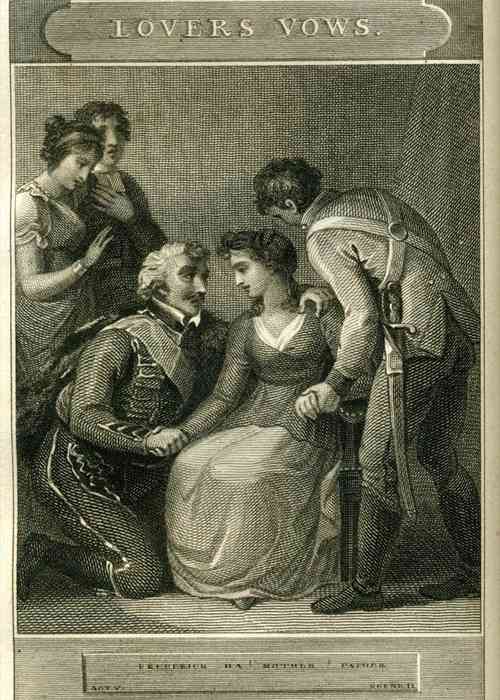
ACT III.
SCENE I.
An open Field.
FREDERICK alone, with a few pieces of money which he turns about in his hands.
FREDERICK.
To return with this trifle for which I have stooped to beg! return to see my
mother dying! I would rather fly to the world’s end. [Looking at the
money.] What can I buy with this? It is hardly enough to pay for the nails
that will be wanted for her coffin. My great anxiety will drive me to
distraction. However, let the consequence of our affliction be what it may, all
will fall upon my father’s head; and may he pant for Heaven’s
forgiveness, as my poor mother —— [At a distance is heard the
firing of a gun, then the cry of Hallo, Hallo—Gamekeepers and Sportsmen
run across the stage—he looks about.] Here they come—a
nobleman, I suppose, or a man of fortune. Yes, yes—and I will once more
beg for my mother.—May Heaven send relief!
Enter the BARON followed slowly by the COUNT. The BARON stops.
BARON.
Quick, quick, Count! Aye, aye, that was a blunder indeed. Don’t you see
the dogs? There they run—they have lost the scent. [Exit Baron
looking after the dogs.
COUNT.
So much the better, Colonel, for I must take a little breath. [He leans on
his gun—Frederick goes up to him with great modesty.]
FREDERICK.
Gentleman, I beg you will bestow from your superfluous wants something to
relieve the pain, and nourish the weak frame, of an expiring woman.
The BARON re-enters.
COUNT.
What police is here! that a nobleman’s amusements should be interrupted
by the attack of vagrants.
FREDERICK.
[to the Baron]. Have pity, noble Sir, and relieve the distress of an
unfortunate son, who supplicates for his dying mother.
BARON.
[taking out his purse]. I think, young soldier, it would be better if
you were with your regiment on duty, instead of begging.
FREDERICK.
I would with all my heart: but at this present moment my sorrows are too
great.—[Baron gives something.] I entreat your pardon. What you
have been so good as to give me is not enough.
BARON.
[surprised]. Not enough!
FREDERICK.
No, it is not enough.
COUNT.
The most singular beggar I ever met in all my travels.
FREDERICK.
If you have a charitable heart, give me one dollar.
BARON.
This is the first time I was ever dictated by a beggar what to give him.
FREDERICK.
With one dollar you will save a distracted man.
BARON.
I don’t choose to give any more. Count, go on.
[Exit Count—as the Baron follows, Frederick seizes him by the breast and draws his sword.]
FREDERICK.
Your purse, or your life.
BARON.
[calling]. Here! here! seize and secure him.
[Some of the Gamekeepers run on, lay hold of Frederick, and disarm him.]
FREDERICK.
What have I done!
BARON.
Take him to the castle, and confine him in one of the towers. I shall follow
you immediately.
FREDERICK.
One favour I have to beg, one favour only.—I know that I am guilty, and
am ready to receive the punishment my crime deserves. But I have a mother, who
is expiring for want—pity her, if you cannot pity me—bestow on her
relief. If you will send to yonder hut, you will find that I do not impose on
you a falsehood. For her it was I drew my sword—for her I am ready to
die.
BARON.
Take him away, and imprison him where I told you.
FREDERICK.
[as he is forced off by the keepers]. Woe to that man to whom I owe my
birth! [Exit.
BARON.
[calls another Keeper]. Here, Frank, run directly to yonder hamlet,
inquire in the first, second, and third cottage for a poor sick woman—and
if you really find such a person, give her this purse. [Exit
Gamekeeper.]
BARON.
A most extraordinary event!—and what a well-looking youth! something in
his countenance and address which struck me inconceivably!—If it is true
that he begged for his mother—But if he did——for the attempt
upon my life, he must die. Vice is never half so dangerous, as when it assumes
the garb of morality. [Exit.]
SCENE II.
A room in the Castle.
AMELIA.
[alone.] Why am I so uneasy; so peevish; who has offended me? I did not
mean to come into this room. In the garden I intended to go [going, turns
back]. No, I will not—yes, I will—just go, and look if my
auriculas are still in blossom; and if the apple tree is grown which Mr. Anhalt
planted.—I feel very low-spirited—something must be the
matter.—Why do I cry?—Am I not well?
Enter Mr. ANHALT.
Ah! good morning, my dear Sir—Mr. Anhalt, I meant to say—I beg pardon.
MR. ANHALT.
Never mind, Miss Wildenhaim—I don’t dislike to hear you call me as
you did.
AMELIA.
In earnest?
MR. ANHALT.
Really. You have been crying. May I know the reason? The loss of your mother,
still?—
AMELIA.
No—I have left off crying for her.
MR. ANHALT.
I beg pardon if I have come at an improper hour; but I wait upon you by the
commands of your father.
AMELIA.
You are welcome at all hours. My father has more than once told me that he who
forms my mind I should always consider as my greatest benefactor. [looking
down] And my heart tells me the same.
MR. ANHALT.
I think myself amply rewarded by the good opinion you have of me.
AMELIA.
When I remember what trouble I have sometimes given you, I cannot be too
grateful.
MR. ANHALT.
[to himself] Oh! Heavens!—[to Amelia]. I—I come from
your father with a commission.—If you please, we will sit down. [He
places chairs, and they sit.] Count Cassel is arrived.
AMELIA.
Yes, I know.
MR. ANHALT.
And do you know for what reason?
AMELIA.
He wishes to marry me.
MR. ANHALT.
Does he? [hastily] But believe me, the Baron will not persuade
you—No, I am sure he will not.
AMELIA.
I know that.
MR. ANHALT.
He wishes that I should ascertain whether you have an inclination
——
AMELIA.
For the Count, or for matrimony do you mean?
MR. ANHALT.
For matrimony.
AMELIA.
All things that I don’t know, and don’t understand, are quite
indifferent to me.
MR. ANHALT.
For that very reason I am sent to you to explain the good and the bad of which
matrimony is composed.
AMELIA.
Then I beg first to be acquainted with the good.
MR. ANHALT.
When two sympathetic hearts meet in the marriage state, matrimony may be called
a happy life. When such a wedded pair find thorns in their path, each will be
eager, for the sake of the other, to tear them from the root. Where they have
to mount hills, or wind a labyrinth, the most experienced will lead the way,
and be a guide to his companion. Patience and love will accompany them in their
journey, while melancholy and discord they leave far behind.—Hand in hand
they pass on from morning till evening, through their summer’s day, till
the night of age draws on, and the sleep of death overtakes the one. The other,
weeping and mourning, yet looks forward to the bright region where he shall
meet his still surviving partner, among trees and flowers which themselves have
planted, in fields of eternal verdure.
AMELIA.
You may tell my father—I’ll marry. [Rises.]
MR. ANHALT.
[rising]. This picture is pleasing; but I must beg you not to forget
that there is another on the same subject.—When convenience, and fair
appearance joined to folly and ill-humour, forge the fetters of matrimony, they
gall with their weight the married pair. Discontented with each other—at
variance in opinions—their mutual aversion increases with the years they
live together. They contend most, where they should most unite; torment, where
they should most soothe. In this rugged way, choaked with the weeds of
suspicion, jealousy, anger, and hatred, they take their daily journey, till one
of these also sleep in death. The other then lifts up his dejected head,
and calls out in acclamations of joy—Oh, liberty! dear liberty!
AMELIA.
I will not marry.
MR. ANHALT.
You mean to say, you will not fall in love.
AMELIA.
Oh no! [ashamed] I am in love.
MR. ANHALT.
Are in love! [starting] And with the Count?
AMELIA.
I wish I was.
MR. ANHALT.
Why so?
AMELIA.
Because he would, perhaps, love me again.
MR. ANHALT.
[warmly]. Who is there that would not?
AMELIA.
Would you?
MR. ANHALT.
I—I—me—I—I am out of the question.
AMELIA.
No; you are the very person to whom I have put the question.
MR. ANHALT.
What do you mean?
AMELIA.
I am glad you don’t understand me. I was afraid I had spoken too plain.
[in confusion].
MR. ANHALT.
Understand you!—As to that—I am not dull.
AMELIA.
I know you are not—And as you have for a long time instructed me, why
should not I now begin to teach you?
MR. ANHALT.
Teach me what?
AMELIA.
Whatever I know, and you don’t.
MR. ANHALT.
There are some things I had rather never know.
AMELIA.
So you may remember I said when you began to teach me mathematics. I said I had
rather not know it—But now I have learnt it gives me a great deal of
pleasure—and [hesitating] perhaps, who can tell, but that I might
teach something as pleasant to you, as resolving a problem is to me.
MR. ANHALT.
Woman herself is a problem.
AMELIA.
And I’ll teach you to make her out.
MR. ANHALT.
You teach?
AMELIA.
Why not? none but a woman can teach the science of herself: and though I own I
am very young, a young woman may be as agreeable for a tutoress as an old
one.—I am sure I always learnt faster from you than from the old
clergyman who taught me before you came.
MR. ANHALT.
This is nothing to the subject.
AMELIA.
What is the subject?
MR. ANHALT.
—— Love.
AMELIA.
[going up to him]. Come, then, teach it me—teach it me as you
taught me geography, languages, and other important things.
MR. ANHALT.
[turning from her] Pshaw!
AMELIA.
Ah! you won’t—You know you have already taught me that, and you
won’t begin again.
MR. ANHALT.
You misconstrue—you misconceive every thing I say or do. The subject I
came to you upon was marriage.
AMELIA.
A very proper subject from the man who has taught me love, and I accept the
proposal [curtsying].
MR. ANHALT.
Again you misconceive and confound me.
AMELIA.
Ay, I see how it is—You have no inclination to experience with me
“the good part of matrimony:” I am not the female with whom you
would like to go “hand in hand up hills, and through
labyrinths”—with whom you would like to “root up thorns; and
with whom you would delight to plant lilies and roses.” No, you had
rather call out, “O liberty, dear liberty.”
MR. ANHALT.
Why do you force from me, what it is villanous to own?—I love you more
than life—Oh, Amelia! had we lived in those golden times, which the
poet’s picture, no one but you——But as the world is changed,
your birth and fortune make our union impossible—To preserve the
character, and more the feelings of an honest man, I would not marry you
without the consent of your father—And could I, dare I propose it to him.
AMELIA.
He has commanded me never to conceal or disguise the truth. I will propose it
to him. The subject of the Count will force me to speak plainly, and this will
be the most proper time, while he can compare the merit of you both.
MR. ANHALT.
I conjure you not to think of exposing yourself and me to his resentment.
AMELIA.
It is my father’s will that I should marry—It is my father’s
wish to see me happy—If then you love me as you say, I will marry; and
will be happy—but only with you.—I will tell him this.—At
first he will start; then grow angry; then be in a passion—In his passion
he will call me “undutiful:” but he will soon recollect himself,
and resume his usual smiles, saying “Well, well, if he love you, and you
love him, in the name of heaven, let it be.” Then I shall hug him round
the neck, kiss his hands, run away from him, and fly to you; it will soon be
known that I am your bride, the whole village will come to wish me joy, and
heaven’s blessing will follow.
Enter Verdun, the BUTLER.
AMELIA.
[discontented]. Ah! is it you?
BUTLER.
Without vanity, I have taken the liberty to enter this apartment the moment the
good news reached my ears.
AMELIA.
What news?
BUTLER.
Pardon an old servant, your father’s old butler, gracious lady, who has
had the honour to carry the baron in his arms—and afterwards with humble
submission to receive many a box o’ the ear from you—if he thinks
it his duty to make his congratulations with due reverence on this happy day,
and to join with the muses in harmonious tunes on the lyre.
AMELIA.
Oh! my good butler, I am not in a humour to listen to the muses, and your lyre.
BUTLER.
There has never been a birth-day, nor wedding-day, nor christening-day,
celebrated in your family, in which I have not joined with the muses in full
chorus.—In forty-six years, three hundred and ninety-seven
congratulations on different occasions have dropped from my pen. To-day, the
three hundred and ninety-eighth is coming forth;—for heaven has protected
our noble master, who has been in great danger.
AMELIA.
Danger! My father in danger! What do you mean?
BUTLER.
One of the gamekeepers has returned to inform the whole castle of a base and
knavish trick, of which the world will talk, and my poetry hand down to
posterity.
AMELIA.
What, what is all this?
BUTLER.
The baron, my lord and master, in company with the strange Count, had not been
gone a mile beyond the lawn, when one of them ——
AMELIA.
What happened? Speak for heaven’s sake.
BUTLER.
My verse shall tell you.
AMELIA.
No, no; tell us in prose.
MR. ANHALT.
Yes, in prose.
BUTLER.
Ah, you have neither of you ever been in love, or you would prefer poetry to
prose. But excuse [pulls out a paper] the haste in which it was written.
I heard the news in the fields—always have paper and a pencil about me,
and composed the whole forty lines crossing the meadows and the park in my way
home. [reads.]
Oh Muse, ascend the forked mount.
And lofty strains prepare,
About a Baron and a Count,
Who went to hunt the hare.
The hare she ran with utmost speed,
And sad, and anxious looks,
Because the furious hounds indeed,
Were near to her, gadzooks.
At length, the Count and Baron bold
Their footsteps homeward bended;
For why, because, as you were told,
The hunting it was ended.
Before them strait a youth appears,
Who made a piteous pother,
And told a tale with many tears,
About his dying mother.
The youth was in severe distress,
And seem’d as he had spent all,
He look’d a soldier by his dress;
For that was regimental.
The Baron’s heart was full of ruth,
While from his eye fell brine o!
And soon he gave the mournful youth
A little ready rino.
He gave a shilling as I live,
Which, sure, was mighty well;
But to some people if you give
An inch—they’ll take an ell.
The youth then drew his martial knife,
And seiz’d the Baron’s collar,
He swore he’d have the Baron’s life,
Or else another dollar.
Then did the Baron in a fume,
Soon raise a mighty din,
Whereon came butler, huntsman, groom,
And eke the whipper-in.
Maugre this young man’s warlike coat,
They bore him off to prison;
And held so strongly by his throat,
They almost stopt his whizzen.
Soon may a neckcloth, call’d a rope,
Of robbing cure this elf;
If so I’ll write, without a trope,
His dying speech myself.
And had the Baron chanc’d to die,
Oh! grief to all the nation,
I must have made an elegy,
And not this fine narration.
MORAL.
Henceforth let those who all have spent,
And would by begging live,
Take warning here, and be content,
With what folks chuse to give.
AMELIA.
Your muse, Mr. Butler, is in a very inventive humour this morning.
MR. ANHALT.
And your tale too improbable, even for fiction.
BUTLER.
Improbable! It’s a real fact.
AMELIA.
What, a robber in our grounds, at noon-day? Very likely indeed!
BUTLER.
I don’t say it was likely—I only say it is true.
MR. ANHALT.
No, no, Mr. Verdun, we find no fault with your poetry; but don’t attempt
to impose it upon us for truth.
AMELIA.
Poets are allowed to speak falsehood, and we forgive yours.
BUTLER.
I won’t be forgiven, for I speak truth—And here the robber comes,
in custody, to prove my words. [Goes off, repeating] “I’ll
write his dying speech myself.”
AMELIA.
Look! as I live, so he does—They come nearer; he’s a young man, and
has something interesting in his figure. An honest countenance, with grief and
sorrow in his face. No, he is no robber—I pity him! Oh! look how the
keepers drag him unmercifully into the tower—Now they lock it—Oh!
how that poor, unfortunate man must feel!
MR. ANHALT.
[aside]. Hardly worse than I do.
Enter the BARON.
AMELIA.
[runs up to him]. A thousand congratulations, my dear papa.
BARON.
For Heaven’s sake spare me your congratulations. The old Butler, in
coming up stairs, has already overwhelmed me with them.
MR. ANHALT.
Then, it is true, my Lord? I could hardly believe the old man.
AMELIA.
And the young prisoner, with all his honest looks, is a robber?
BARON.
He is; but I verily believe for the first and last time. A most extraordinary
event, Mr. Anhalt This young man begged; then drew his sword upon me; but he
trembled so, when he seized me by the breast, a child might have overpowered
him. I almost wish he had made his escape—this adventure may cost him his
life, and I might have preserved it with one dollar: but, now, to save him
would set a bad example.
AMELIA.
Oh no! my lord, have pity on him! Plead for him, Mr. Anhalt!
BARON.
Amelia, have you had any conversation with Mr. Anhalt?
AMELIA.
Yes, my Lord.
BARON.
Respecting matrimony?
AMELIA.
Yes; and I have told him ——
MR. ANHALT.
[very hastily]. According to your commands, Baron ——
AMELIA.
But he has conjured me ——
MR. ANHALT.
I have endeavoured, my Lord, to find out ——
AMELIA.
Yet, I am sure, dear papa, your affection for me ——
MR. ANHALT.
You wish to say something to me in your closet, my Lord?
BARON.
What the devil is all this conversation? You will not let one another
speak—I don’t understand either of you.
AMELIA.
Dear father, have you not promised you will not thwart my affections when I
marry, but suffer me to follow their dictates.
BARON.
Certainly.
AMELIA.
Do you hear, Mr. Anhalt?
MR. ANHALT.
I beg pardon—I have a person who is waiting for me—I am obliged to
retire. [Exit in confusion.
BARON.
[calls after him]. I shall expect you in my closet. I am going there
immediately. [Retiring towards the opposite door.]
AMELIA.
Pray, my Lord, stop a few minutes longer; I have something of great importance
to say to you.
BARON.
Something of importance! to plead for the young man, I suppose! But
that’s a subject I must not listen to. [Exit.
AMELIA.
I wish to plead for two young men—For one, that he may be let out of
prison: for the other, that he may be made a prisoner for life. [Looks
out.] The tower is still locked. How dismal it must be to be shut up in
such a place; and perhaps—[Calls] Butler! Butler! Come this way. I
wish to speak to you. This young soldier has risked his life for his mother,
and that accounts for the interest I take in his misfortunes.
Enter the BUTLER.
Pray, have you carried anything to the prisoner to eat?
BUTLER.
Yes.
AMELIA.
What was it?
BUTLER.
Some fine black bread; and water as clear as crystal.
AMELIA.
Are you not ashamed! Even my father pities him. Go directly down to the
kitchen, and desire the cook to give you something good and comfortable; and
then go into the cellar for a bottle of wine.
BUTLER.
Good and comfortable indeed!
AMELIA.
And carry both to the tower.
BUTLER.
I am willing at any time, dear Lady, to obey your orders; but, on this
occasion, the prisoner’s food must remain bread and water—It is the
Baron’s particular command.
AMELIA.
Ah! My father was in the height of passion when he gave it.
BUTLER.
Whatsoever his passion might be, it is the duty of a true, and honest dependent
to obey his Lord’s mandates. I will not suffer a servant in this house,
nor will I, myself, give the young man any thing except bread and
water—But I’ll tell you what I’ll do—I’ll read my
verses to him.
AMELIA.
Give me the key of the cellar—I’ll go myself.
BUTLER.
[gives the key]. And there’s my verses—[taking them from
his pocket] Carry them with you, they may comfort him as much as the wine.
[She throws them down. [Exit Amelia.
BUTLER.
[in amazement]. Not take them! Refuse to take them—[he lifts
them from the floor with the utmost respect]—
“I must have made an elegy,
And not this fine narration.” [Exit.