
ACT V.
SCENE I.
Inside of the Cottage (as in Act II).
AGATHA, COTTAGER, and his WIFE discovered.
AGATHA.
Pray look and see if he is coming.
COTTAGER.
It is of no use. I have been in the road; have looked up and down; but neither
see nor hear any thing of him.
WIFE.
Have a little patience.
AGATHA.
I wish you would step out once more—I think he cannot be far off.
COTTAGER.
I will; I will go. [Exit.
WIFE.
If your son knew what heaven had sent you, he would be here very soon.
AGATHA.
I feel so anxious——
WIFE.
But why? I should think a purse of gold, such as you have received, would make
any body easy.
AGATHA.
Where can he be so long? He has been gone four hours. Some ill must have
befallen him.
WIFE.
It is still broad day-light—don’t think of any danger.—This
evening we must all be merry. I’ll prepare the supper. What a good
gentleman our Baron must be! I am sorry I ever spoke a word against him.
AGATHA.
How did he know I was here?
WIFE.
Heaven only can tell. The servant that brought the money was very secret.
AGATHA.
[to herself]. I am astonished! I wonder! Oh! surely he has been
informed—Why else should he have sent so much money?
Re-enter Cottager.
AGATHA.
Well!—not yet!
COTTAGER.
I might look till I am blind for him—but I saw our new Rector coming
along the road; he calls in sometimes. May be, he will this evening.
WIFE.
He is a very good gentleman; pays great attention to his parishioners; and
where he can assist the poor, he is always ready.
Enter Mr. ANHALT.
MR. ANHALT.
Good evening, friends.
BOTH.
Thank you, reverend Sir.
[They both run to fetch him a chair].
MR. ANHALT.
I thank you, good people—I see you have a stranger here.
COTTAGER.
Yes, your Reverence; it is a poor sick woman, whom I took in doors.
MR. ANHALT.
You will be rewarded for it. [to Agatha.] May I beg leave to ask your
name?
AGATHA.
Ah! If we were alone——
MR. ANHALT.
Good neighbours, will you leave us alone for a few minutes? I have something to
say to this poor woman.
COTTAGER.
Wife, do you hear? Come along with me. [Exeunt Cottager and his
Wife.]
MR. ANHALT.
Now——
AGATHA.
Before I tell you who I am, what I am, and what I was——I must beg
to ask—Are you of this country?
MR. ANHALT.
No—I was born in Alsace.
AGATHA.
Did you know the late rector personally, whom you have succeeded?
MR. ANHALT.
No.
AGATHA.
Then you are not acquainted with my narrative?
MR. ANHALT.
Should I find you to be the person whom I have long been in search of, your
history is not altogether unknown to me.
AGATHA.
“That you have been in search of!” Who gave you such a commission?
MR. ANHALT.
A man, who, if it so prove, is much concerned for your misfortunes.
AGATHA.
How? Oh, Sir! tell me quickly—Whom do you think to find in me?
MR. ANHALT.
Agatha Friburg.
AGATHA.
Yes, I am that unfortunate woman; and the man who pretends to take concern in
my misfortunes is——Baron Wildenhaim——he who betrayed
me, abandoned me and my child, and killed my parents.—He would now repair
our sufferings with this purse of gold. [Takes out the purse.] Whatever
may be your errand, Sir, whether to humble, or to protect me, it is alike
indifferent. I therefore request you to take this money to him who sent it.
Tell him, my honour has never been saleable. Tell him, destitute as I am, even
indigence will not tempt me to accept charity from my seducer. He despised my
heart—I despise his gold.—He has trampled on me—I trample on
his representative. [Throws the purse on the ground.]
MR. ANHALT.
Be patient—I give you my word, that when the Baron sent this present to
an unfortunate woman, for whom her son had supplicated, he did not know that
woman was Agatha.
AGATHA.
My son? what of my son?
MR. ANHALT.
Do not be alarmed—The Baron met with an affectionate son, who begged for
his sick mother, and it affected him.
AGATHA.
Begged of the Baron! of his father!
MR. ANHALT.
Yes; but they did not know each other; and the mother received the present on
the son’s account.
AGATHA.
Did not know each other? Where is my son?
MR. ANHALT.
At the Castle.
AGATHA.
And still unknown?
MR. ANHALT.
Now he is known—an explanation has taken place;—and I am sent here
by the Baron, not to a stranger, but to Agatha Friburg—not with gold! his
commission was—“do what your heart directs you.”
AGATHA.
How is my Frederick? How did the Baron receive him?
MR. ANHALT.
I left him just in the moment the discovery was made. By this time your son is,
perhaps, in the arms of his father.
AGATHA.
Oh! is it possible that a man, who has been twenty years deaf to the voice of
nature, should change so suddenly?
MR. ANHALT.
I do not mean to justify the Baron, but—he has loved you—and fear
of his noble kindred alone caused his breach of faith to you.
AGATHA.
But to desert me wholly and wed another—
MR. ANHALT.
War called him away—Wounded in the field, he was taken to the adjacent
seat of a nobleman, whose only daughter, by anxious attention to his recovery,
won his gratitude; and, influenced by the will of his worldly friends, he
married. But no sooner was I received into the family, and admitted to his
confidence, than he related to me your story; and at times would exclaim in
anguish—“The proud imperious Baroness avenges the wrongs of my
deserted Agatha.” Again, when he presented me this living, and I left
France to take possession of it, his last words before we parted,
were—“The moment you arrive at Wildenhaim, make all enquiries to
find out my poor Agatha.” Every letter from him contained “Still,
still, no tidings of my Agatha.” And fate ordained it should be so, till
this fortunate day.
AGATHA.
What you have said has made my heart overflow—where will this end?
MR. ANHALT.
I know not yet the Baron’s intentions: but your sufferings demand
immediate remedy: and one way only is left—Come with me to the castle. Do
not start—you shall be concealed in my apartments till you are called
for.
AGATHA.
I go to the Baron’s?—No.
MR. ANHALT.
Go for the sake of your son—reflect, that his fortunes may depend upon
your presence.
AGATHA.
And he is the only branch on which my hope still blossoms: the rest are
withered.—I will forget my wrongs as a woman, if the Baron will atone to
the mother—he shall have the woman’s pardon, if he will merit the
mother’s thanks—[after a struggle]—I will go to
the castle—for the sake of my Frederick, go even to his father. But where
are my good host and hostess, that I may take leave, and thank them for their
kindness?
MR. ANHALT.
[taking up the purse which Agatha had thrown down]. Here, good friend! Good
woman!
Enter the COTTAGER and his WIFE.
WIFE.
Yes, yes, here I am.
MR. ANHALT.
Good people, I will take your guest with me. You have acted an honest part, and
therefore receive this reward for your trouble. [He offers the purse to
the Cottager, who puts it by, and turns away].
MR. ANHALT.
[to the Wife]. Do you take it.
WIFE.
I always obey my pastor. [taking it].
AGATHA.
Good bye. [shaking hands with the Cottagers.] For your hospitality to
me, may ye enjoy continued happiness.
COTTAGER.
Fare you well—fare you well.
WIFE.
If you find friends and get health, we won’t trouble you to call on us
again: but if you should fall sick or be in poverty, we shall take it very
unkind if we don’t see you.
[Exeunt Agatha and Anhalt on one side, Cottager and his Wife on the other].
SCENE II.
A Room in the Castle.
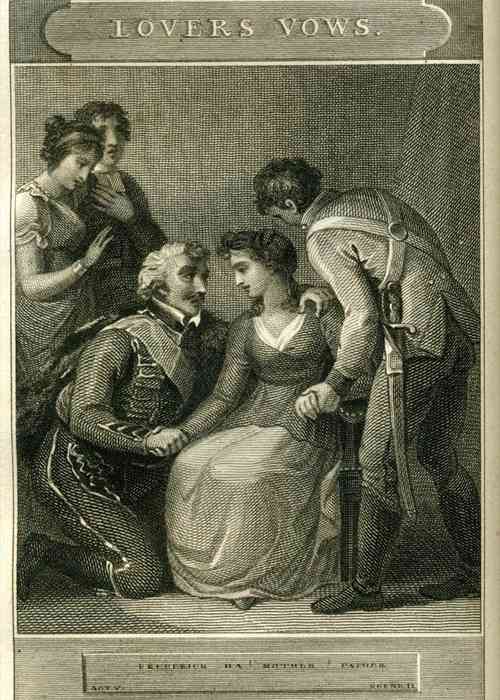
BARON sitting upon a sopha.—FREDERICK standing near him, with one hand pressed between his—the Baron rises.
BARON.
Been in battle too!—I am glad to hear it. You have known hard services,
but now they are over, and joy and happiness will succeed.—The reproach
of your birth shall be removed, for I will acknowledge you my son, and heir to
my estate.
FREDERICK.
And my mother——
BARON.
She shall live in peace and affluence. Do you think I would leave your mother
unprovided, unprotected? No! About a mile from this castle I have an estate
called Weldendorf—there she shall live, and call her own whatever it
produces. There she shall reign, and be sole mistress of the little paradise.
There her past sufferings shall be changed to peace and tranquility. On a
summer’s morning, we, my son, will ride to visit her; pass a day, a week
with her; and in this social intercourse time will glide pleasantly.
FREDERICK.
And, pray, my Lord—under what name is my mother to live then?
BARON.
[confused]. How?
FREDERICK.
In what capacity?—As your domestic—or as——
BARON.
That we will settle afterwards.
FREDERICK.
Will you allow me, Sir, to leave the room a little while, that you may have
leisure to consider now?
BARON.
I do not know how to explain myself in respect to your mother more than I have
done already.
FREDERICK.
My fate, whatever it may be, shall never part me from her. This is my firm
resolution, upon which I call Heaven to witness! My Lord, it must be Frederick
of Wildenhaim, and Agatha of Wildenhaim—or Agatha Friburg, and Frederick
Friburg. [Exit.
BARON.
Young man! Frederick!—[calling after him.] Hasty indeed! would
make conditions with his father. No, no, that must not be. I just now thought
how well I had arranged my plans—had relieved my heart of every burden,
when, a second time, he throws a mountain upon it. Stop, friend conscience, why
do you take his part?—For twenty years thus you have used me, and been my
torture.
Enter Mr. ANHALT.
Ah! Anhalt, I am glad you are come. My conscience and myself are at variance.
MR. ANHALT.
Your conscience is in the right.
BARON.
You don’t know yet what the quarrel is.
MR. ANHALT.
Conscience is always right—because it never speaks unless it is
so.
BARON.
Ay, a man of your order can more easily attend to its whispers, than an old
warrior. The sound of cannon has made him hard of hearing.—I have found
my son again, Mr. Anhalt, a fine, brave young man—I mean to make him my
heir—Am I in the right?
MR. ANHALT.
Perfectly.
BARON.
And his mother shall live in happiness—My estate, Weldendorf, shall be
hers—I’ll give it to her, and she shall make it her residence.
Don’t I do right?
MR. ANHALT.
No.
BARON.
[surprized]. No? And what else should I do?
MR. ANHALT.
[forcibly]. Marry her.
BARON.
[starting]. I marry her!
MR. ANHALT.
Baron Wildenhaim is a man who will not act inconsistently.—As this is my
opinion, I expect your reasons, if you do not.
BARON.
Would you have me marry a beggar?
MR. ANHALT.
[after a pause]. Is that your only objection?
BARON.
[confused]. I have more—many more.
MR. ANHALT.
May I beg to know them likewise?
BARON.
My birth!
MR. ANHALT.
Go on.
BARON.
My relations would despise me.
MR. ANHALT.
Go on.
BARON.
[in anger]. ’Sdeath! are not these reasons enough?—I know no
other.
MR. ANHALT.
Now, then, it is my turn to state mine for the advice I have given you. But
first, I must presume to ask a few questions.—Did Agatha, through artful
insinuation, gain your affection? or did she give you cause to suppose her
inconstant?
BARON.
Neither—but for me, she was always virtuous and good.
MR. ANHALT.
Did it cost you trouble and earnest entreaty to make her otherwise?
BARON.
[angrily]. Yes.
MR. ANHALT.
You pledged your honour?
BARON.
[confused]. Yes.
MR. ANHALT.
Called God to witness?
BARON.
[more confused]. Yes.
MR. ANHALT.
The witness you called at that time was the Being who sees you now. What you
gave in pledge was your honour, which you must redeem. Therefore thank Heaven
that it is in your power to redeem it. By marrying Agatha the
ransom’s made: and she brings a dower greater than any princess can
bestow—peace to your conscience. If you then esteem the value of this
portion, you will not hesitate a moment to exclaim,—Friends, wish me joy,
I will marry Agatha.
[Baron, in great agitation, walks backwards and forwards, then takes Anhalt by the hand.]
BARON.
“Friend, wish me joy—I will marry Agatha.”
MR. ANHALT.
I do wish you joy.
BARON.
Where is she?
MR. ANHALT.
In the castle—in my apartments here—I conducted her through the
garden, to avoid curiosity.
BARON.
Well, then, this is the wedding-day. This very evening you shall give us your
blessing.
MR. ANHALT.
Not so soon, not so private. The whole village was witness of Agatha’s
shame—the whole village must be witness of Agatha’s re-established
honour. Do you consent to this?
BARON.
I do.
MR. ANHALT.
Now the quarrel is decided. Now is your conscience quiet?
BARON.
As quiet as an infant’s. I only wish the first interview was over.
MR. ANHALT.
Compose yourself. Agatha’s heart is to be your judge.
Enter AMELIA.
BARON.
Amelia, you have a brother.
AMELIA.
I have just heard so, my Lord; and rejoice to find the news confirmed by you.
BARON.
I know, my dear Amelia, I can repay you for the loss of Count Cassel; but what
return can I make to you for the loss of half your fortune?
AMELIA.
My brother’s love will be ample recompense.
BARON.
I will reward you better. Mr. Anhalt, the battle I have just fought, I owe to
myself: the victory I gained, I owe to you. A man of your principles, at once a
teacher and an example of virtue, exalts his rank in life to a level with the
noblest family—and I shall be proud to receive you as my son.
MR. ANHALT.
[falling on his knees, and taking the Baron’s hand]. My
Lord, you overwhelm me with confusion, as well as with joy.
BARON.
My obligations to you are infinite—Amelia shall pay the debt. [Gives
her to him.]
AMELIA.
Oh, my dear father! [embracing the Baron] what blessings have you
bestowed on me in one day. [to Anhalt.] I will be your scholar still,
and use more diligence than ever to please my master.
MR. ANHALT.
His present happiness admits of no addition.
BARON.
Nor does mine—And yet there is another task to perform that will require
more fortitude, more courage, than this has done! A trial
that!—[bursts into tears]—I cannot prevent them—Let
me—let me—A few minutes will bring me to myself—Where is
Agatha?
MR. ANHALT.
I will go, and fetch her. [Exit Anhalt at an upper entrance.]
BARON.
Stop! Let me first recover a little. [Walks up and down, sighing
bitterly—looks at the door through which Anhalt left the
room.] That door she will come from—That was once the dressing-room
of my mother—From that door I have seen her come many times—have
been delighted with her lovely smiles—How shall I now behold her altered
looks! Frederick must be my mediator.—Where is he? Where is my
son?—Now I am ready—my heart is prepared to receive
her—Haste! haste! Bring her in.
[He looks stedfastly at the door—Anhalt leads on Agatha—The Baron runs and clasps her in his arms—Supported by him, she sinks on a chair which Amelia places in the middle of the stage—The Baron kneels by her side, holding her hand.]
BARON.
Agatha, Agatha, do you know this voice?
AGATHA.
Wildenhaim.
BARON.
Can you forgive me?
AGATHA.
I forgive you. [embracing him].
FREDERICK.
[as he enters]. I hear the voice of my mother!—Ha! mother! father!
[Frederick throws himself on his knees by the other side of his mother—She clasps him in her arms.—Amelia is placed on the side of her father attentively viewing Agatha—Anhalt stands on the side of Frederick with his hands gratefully raised to Heaven.]——The curtain slowly drops.
END.