
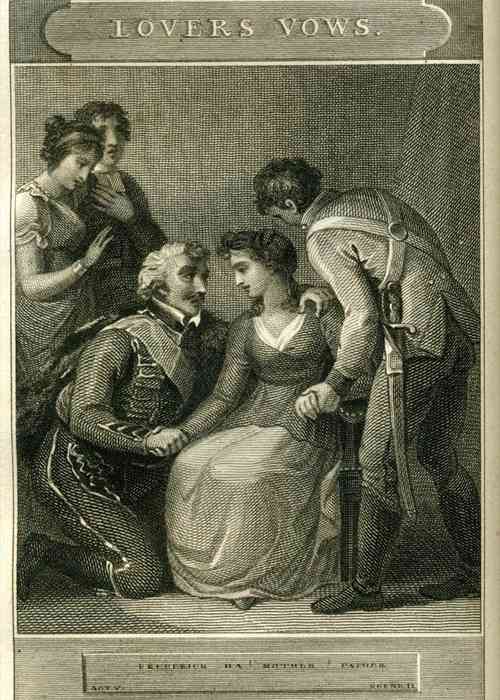
ACT I.
SCENE I.
A high road, a town at a distance—A small inn on one side of the road—A cottage on the other.
The LANDLORD of the inn leads AGATHA by the hand out of his house.
LANDLORD.
No, no! no room for you any longer—It is the fair to-day in the next
village; as great a fair as any in the German dominions. The country people
with their wives and children take up every corner we have.
AGATHA.
You will turn a poor sick woman out of doors who has spent her last farthing in
your house.
LANDLORD.
For that very reason; because she has spent her last farthing.
AGATHA.
I can work.
LANDLORD.
You can hardly move your hands.
AGATHA.
My strength will come again.
LANDLORD.
Then you may come again.
AGATHA.
What am I to do? Where shall I go?
LANDLORD.
It is fine weather—you may go any where.
AGATHA.
Who will give me a morsel of bread to satisfy my hunger?
LANDLORD.
Sick people eat but little.
AGATHA.
Hard, unfeeling man, have pity.
LANDLORD.
When times are hard, pity is too expensive for a poor man. Ask alms of the
different people that go by.
AGATHA.
Beg! I would rather starve.
LANDLORD.
You may beg and starve too. What a fine lady you are! Many an honest woman has
been obliged to beg. Why should not you? [Agatha sits down upon a large
stone under a tree.] For instance, here comes somebody; and I will teach
you how to begin. [A Countryman, with working tools, crosses the road.]
Good day, neighbour Nicholas.
COUNTRYMAN
Good day. [Stops.]
LANDLORD.
Won’t you give a trifle to this poor woman? [Countryman takes no
notice, but walks off.] That would not do—the poor man has nothing
himself but what he gets by hard labour. Here comes a rich farmer; perhaps he
will give you something.
Enter FARMER.
LANDLORD.
Good morning to you, Sir. Under yon tree sits a poor woman in distress, who is
in need of your charity.
FARMER.
Is she not ashamed of herself? Why don’t she work?
LANDLORD.
She has had a fever.—If you would but pay for one dinner—
FARMER.
The harvest has been indifferent, and my cattle and sheep have suffered
distemper. [Exit.
LANDLORD.
My fat, smiling face was not made for begging: you’ll have more luck with
your thin, sour one—so, I’ll leave you to yourself. [Exit.
[Agatha rises and comes forward.]
AGATHA.
Oh Providence! thou hast till this hour protected me, and hast given me
fortitude not to despair. Receive my humble thanks, and restore me to health,
for the sake of my poor son, the innocent cause of my sufferings, and yet my
only comfort. [kneeling] Oh, grant that I may see him once more! See him
improved in strength of mind and body; and that by thy gracious mercy he may
never be visited with afflictions great as mine. [After a pause] Protect
his father too, merciful Providence, and pardon his crime of perjury to me!
Here, in the face of heaven (supposing my end approaching, and that I can but a
few days longer struggle with want and sorrow), here, I solemnly forgive my
seducer for all the ills, the accumulated evils which his allurements, his
deceit, and cruelty, have for twenty years past drawn upon me.
Enter a COUNTRY GIRL with a basket.
AGATHA.
[near fainting]. My dear child, if you could spare me a trifle—
GIRL.
I have not a farthing in the world—But I am going to market to sell my
eggs, and as I come back I’ll give you three-pence—And I’ll
be back as soon as ever I can. [Exit.
AGATHA.
There was a time when I was as happy as this country girl, and as willing to
assist the poor in distress. [Retires to the tree and sits down.]
Enter FREDERICK—He is dressed in a German soldier’s uniform, has a knapsack on his shoulders, appears in high spirits, and stops at the door of the inn.
FREDERICK.
Halt! Stand at ease! It is a very hot day—A draught of good wine will not
be amiss. But first let me consult my purse. [Takes out a couple of pieces
of money, which he turns about in his hand.] This will do for a
breakfast—the other remains for my dinner; and in the evening I shall be
home. [Calls out] Ha! Halloo! Landlord! [Takes notice of Agatha,
who is leaning against the tree.] Who is that? A poor sick woman! She
don’t beg; but her appearance makes me think she is in want. Must one
always wait to give till one is asked? Shall I go without my breakfast now, or
lose my dinner? The first I think is best. Ay, I don’t want a breakfast,
for dinner time will soon be here. To do good satisfies both hunger and thirst.
[Going towards her with the money in his hand.] Take this, good woman.
[She stretches her hand for the gift, looks steadfastly at him, and cries out with astonishment and joy.]
AGATHA.
Frederick!
FREDERICK.
Mother! [With astonishment and grief.] Mother! For God’s sake what
is this! How is this! And why do I find my mother thus? Speak!
AGATHA.
I cannot speak, dear son! [Rising and embracing him.] My dear Frederick!
The joy is too great—I was not prepared—
FREDERICK.
Dear mother, compose yourself: [leans her head against his breast] now,
then, be comforted. How she trembles! She is fainting.
AGATHA.
I am so weak, and my head so giddy—I had nothing to eat all yesterday.
FREDERICK.
Good heavens! Here is my little money, take it all! Oh mother! mother! [Runs
to the inn]. Landlord! Landlord! [knocking violently at the door.]
LANDLORD.
What is the matter?
FREDERICK.
A bottle of wine—quick, quick!
LANDLORD.
[surprised]. A bottle of wine! For who?
FREDERICK.
For me. Why do you ask? Why don’t you make haste?
LANDLORD.
Well, well, Mr. soldier: but can you pay for it?
FREDERICK.
Here is money—make haste, or I’ll break every window in your house.
LANDLORD.
Patience! Patience! [goes off.
FREDERICK.
[to Agatha]. You were hungry yesterday when I sat down to a comfortable
dinner. You were hungry when I partook of a good supper. Oh! Why is so much
bitter mixed with the joy of my return?
AGATHA.
Be patient, my dear Frederick. Since I see you, I am well. But I have
been very ill: so ill, that I despaired of ever beholding you again.
FREDERICK.
Ill, and I was not with you? I will, now, never leave you more. Look, mother,
how tall and strong I am grown. These arms can now afford you support. They
can, and shall, procure you subsistence.
[Landlord coming out of the house with a small pitcher.]
LANDLORD.
Here is wine—a most delicious nectar. [Aside.] It is only Rhenish;
but it will pass for the best old Hock.
FREDERICK.
[impatiently snatching the pitcher]. Give it me.
LANDLORD.
No, no—the money first. One shilling and two-pence, if you please.
[Frederick gives him money.]
FREDERICK.
This is all I have.—Here, here, mother.
[While she drinks Landlord counts the money.]
LANDLORD.
Three halfpence too short! However, one must be charitable. [Exit
Landlord.
AGATHA.
I thank you, my dear Frederick—Wine revives me—Wine from the hand
of my son gives me almost a new life.
FREDERICK.
Don’t speak too much, mother.—Take your time.
AGATHA.
Tell me, dear child, how you have passed the five years since you left me.
FREDERICK.
Both good and bad, mother. To day plenty—to-morrow not so much—And
sometimes nothing at all.
AGATHA.
You have not written to me this long while.
FREDERICK.
Dear mother, consider the great distance I was from you!—And then, in the
time of war, how often letters miscarry.—Besides——
AGATHA.
No matter now I see you. But have you obtained your discharge?
FREDERICK.
Oh, no, mother—I have leave of absence only for two months; and that for
a particular reason. But I will not quit you so soon, now I find you are in
want of my assistance.
AGATHA.
No, no, Frederick; your visit will make me so well, that I shall in a very
short time recover strength to work again; and you must return to your regiment
when your furlough is expired. But you told me leave of absence was granted you
for a particular reason.—What reason?
FREDERICK.
When I left you five years ago, you gave me every thing you could afford, and
all you thought would be necessary for me. But one trifle you forgot, which
was, the certificate of my birth from the church-book.—You know in this
country there is nothing to be done without it. At the time of parting from
you, I little thought it could be of that consequence to me which I have since
found it would have been. Once I became tired of a soldier’s life, and in
the hope I should obtain my discharge, offered myself to a master to learn a
profession; but his question was, “Where is your certificate from the
church-book of the parish in which you were born?” It vexed me that I had
not it to produce, for my comrades laughed at my disappointment. My captain
behaved kinder, for he gave me leave to come home to fetch it—and you
see, mother, here I am.
[During his speech Agatha is confused and agitated.
AGATHA.
So, you are come for the purpose of fetching your certificate from the
church-book.
FREDERICK.
Yes, mother.
AGATHA.
Oh! oh!
FREDERICK.
What is the matter? [She bursts into tears.] For heaven’s sake,
mother, tell me what’s the matter?
AGATHA.
You have no certificate.
FREDERICK.
No!
AGATHA.
No.—The laws of Germany excluded you from being registered at your
birth—for—you are a natural son!
FREDERICK.
[starts—after a pause]. So!—And who is my father?
AGATHA.
Oh Frederick, your wild looks are daggers to my heart. Another time.
FREDERICK.
[endeavouring to conceal his emotion]. No, no—I am still your
son—and you are still my mother. Only tell me, who is my father?
AGATHA.
When we parted five years ago, you were too young to be intrusted with a secret
of so much importance.—But the time is come when I can, in confidence,
open my heart, and unload that burthen with which it has been long oppressed.
And yet, to reveal my errors to my child, and sue for his mild judgment on my
conduct——
FREDERICK.
You have nothing to sue for; only explain this mystery.
AGATHA.
I will, I will. But—my tongue is locked with remorse and shame. You must
not look at me.
FREDERICK.
Not look at you! Cursed be that son who could find his mother guilty, although
the world should call her so.
AGATHA.
Then listen to me, and take notice of that village, [pointing] of that
castle, and of that church. In that village I was born—in that church I
was baptized. My parents were poor, but reputable farmers.—The lady of
that castle and estate requested them to let me live with her, and she would
provide for me through life. They resigned me; and at the age of fourteen I
went to my patroness. She took pleasure to instruct me in all kinds of female
literature and accomplishments, and three happy years had passed under
protection, when her only son, who was an officer in the Saxon service,
obtained permission to come home. I had never seen him before—he was a
handsome young man—in my eyes a prodigy; for he talked of love, and
promised me marriage. He was the first man who had ever spoken to me on such a
subject.—His flattery made me vain, and his repeated
vows—Don’t look at me, dear Frederick!—I can say no more.
[Frederick with his eyes cast down, takes her hand, and puts it to his
heart.] Oh! oh! my son! I was intoxicated by the fervent caresses of a
young, inexperienced, capricious man, and did not recover from the delirium
till it was too late.
FREDERICK.
[after a pause]. Go on.—Let me know more of my father.
AGATHA.
When the time drew near that I could no longer conceal my guilt and shame, my
seducer prevailed upon me not to expose him to the resentment of his mother. He
renewed his former promises of marriage at her death;—on which relying, I
gave him my word to be secret—and I have to this hour buried his name
deep in my heart.
FREDERICK.
Proceed, proceed! give me full information—I will have courage to hear it
all. [Greatly agitated.]
AGATHA.
His leave of absence expired, he returned to his regiment, depending on my
promise, and well assured of my esteem. As soon as my situation became known, I
was questioned, and received many severe reproaches: but I refused to confess
who was my undoer; and for that obstinacy was turned from the castle.—I
went to my parents; but their door was shut against me. My mother, indeed, wept
as she bade me quit her sight for ever; but my father wished increased
affliction might befall me.
FREDERICK.
[weeping]. Be quick with your narrative, or you’ll break my heart.
AGATHA.
I now sought protection from the old clergyman of the parish. He received me
with compassion. On my knees I begged forgiveness for the scandal I had caused
to his parishioners; promised amendment; and he said he did not doubt me.
Through his recommendation I went to town; and hid in humble lodgings, procured
the means of subsistence by teaching to the neighbouring children what I had
learnt under the tuition of my benefactress.—To instruct you, my
Frederick, was my care and delight; and in return for your filial love I would
not thwart your wishes when they led to a soldier’s life: but I saw you
go from me with an aching heart. Soon after, my health declined, I was
compelled to give up my employment, and, by degrees, became the object you now
see me. But, let me add, before I close my calamitous story, that—when I
left the good old clergyman, taking along with me his kind advice and his
blessing, I left him with a firm determination to fulfil the vow I had made of
repentance and amendment. I have fulfilled it—and now, Frederick,
you may look at me again. [He embraces her.]
FREDERICK.
But my father all this time? [mournfully] I apprehend he died.
AGATHA.
No—he married.
FREDERICK.
Married!
AGATHA.
A woman of virtue—of noble birth and immense fortune. Yet, [weeps]
I had written to him many times; had described your infant innocence and wants;
had glanced obliquely at former promises—
FREDERICK.
[rapidly]. No answer to these letters?
AGATHA.
Not a word.—But in time of war, you know, letters miscarry.
FREDERICK.
Nor did he ever return to this estate?
AGATHA.
No—since the death of his mother this castle has only been inhabited by
servants—for he settled as far off as Alsace, upon the estate of his
wife.
FREDERICK.
I will carry you in my arms to Alsace. No—why should I ever know my
father, if he is a villain! My heart is satisfied with a
mother.—No—I will not go to him. I will not disturb his
peace—I leave that task to his conscience. What say you, mother,
can’t we do without him? [Struggling between tears and his pride.]
We don’t want him. I will write directly to my captain. Let the
consequence be what it will, leave you again I cannot. Should I be able to get
my discharge, I will work all day at the plough, and all the night with my pen.
It will do, mother, it will do! Heaven’s goodness will assist me—it
will prosper the endeavours of a dutiful son for the sake of a helpless mother.
AGATHA.
[presses him to her breast]. Where could be found such another son?
FREDERICK.
But tell me my father’s name, that I may know how to shun him.
AGATHA.
Baron Wildenhaim.
FREDERICK.
Baron Wildenhaim! I shall never forget it.—Oh! you are near fainting.
Your eyes are cast down. What’s the matter? Speak, mother!
AGATHA.
Nothing particular.—Only fatigued with talking. I wish to take a little
rest.
FREDERICK.
I did not consider that we have been all this time in the open road. [Goes
to the Inn, and knocks at the door.] Here, Landlord!
LANDLORD re-enters.
LANDLORD.
Well, what is the matter now?
FREDERICK.
Make haste, and get a bed ready for this good woman.
LANDLORD.
[with a sneer]. A bed for this good woman! ha, ha ha! She slept last
night in that pent-house; so she may to-night. [Exit, shutting the door.
FREDERICK.
You are an infamous—[goes back to his mother] Oh! my poor
mother—[runs to the Cottage at a little distance, and knocks]. Ha!
halloo! Who is there?
Enter COTTAGER.
COTTAGER.
Good day, young soldier.—What is it you want?
FREDERICK.
Good friend, look at that poor woman. She is perishing in the public road! It
is my mother.—Will you give her a small corner in your hut? I beg for
mercy’s sake—Heaven will reward you.
COTTAGER.
Can’t you speak quietly? I understand you very well. [Calls at the
door of the hut.] Wife, shake up our bed—here’s a poor sick
woman wants it. [Enter WIFE]. Why could not you say all this in fewer
words? Why such a long preamble? Why for mercy’s sake, and heaven’s
reward? Why talk about reward for such trifles as these? Come, let us lead her
in; and welcome she shall be to a bed, as good as I can give her; and our
homely fare.
FREDERICK.
Ten thousand thanks, and blessings on you!
WIFE.
Thanks and blessings! here’s a piece of work indeed about nothing! Good
sick lady, lean on my shoulder. [To Frederick] Thanks and reward indeed!
Do you think husband and I have lived to these years, and don’t know our
duty? Lean on my shoulder. [Exeunt into the Cottage.