
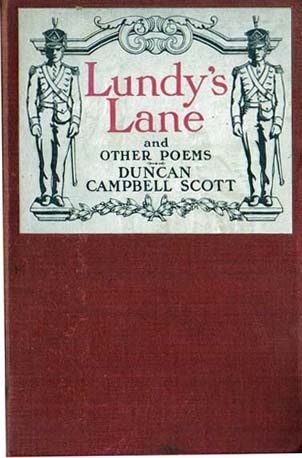
The Project Gutenberg eBook of Lundy's Lane, and Other Poems
Title: Lundy's Lane, and Other Poems
Author: Duncan Campbell Scott
Release date: September 22, 2007 [eBook #22717]
Most recently updated: January 3, 2021
Language: English
Credits: Produced by Marilynda Fraser-Cunliffe and the Online
Distributed Proofreading Team at https://www.pgdp.net
Lundy's Lane
and Other Poems
By
Duncan Campbell Scott
Author of "The Magic House," "In the Village of Viger," etc., etc.
McClelland, Goodchild & Stewart
Publishers
:: :: :: ::
Toronto
Copyright, 1916,
By GEORGE H. DORAN COMPANY
Printed in the United States of America
To the Memory of My Daughter
ELIZABETH DUNCAN SCOTT
1895-1907
CONTENTS
- THE BATTLE OF LUNDY'S LANE13
- VIA BOREALIS—
-
LYRICS, SONGS AND SONNETS—
- Meditation at Perugia49
- At William MacLennan's Grave. Near Florence53
- The Wood-Spring to the Poet56
- The November Pansy63
- The Height of Land68
- New Year's Night, 191677
- Fragment of an Ode to Canada79
- Fantasia84
- The Lover to His Lass86
- The Ghost's Story90
- Night92
- The Apparition94
- At Sea96
- Madonna with Two Angels98
- Mid-August100
- Mist and Frost105
- The Beggar and the Angel110
- Improvisation on an Old Song117
- O Turn Once More121
- At the Gill-Nets124
- A Love Song126
- Three Songs:
- The Sailor's Sweetheart131
- Feuilles d'Automne133
- To the Heroic Soul:
- Retrospect138
- Frost Magic:
- In Snow-Time142
- To a Canadian Lad Killed in the War143
- THE CLOSED DOOR—
- LINES IN MEMORY OF EDMUND MORRIS179
THE BATTLE OF LUNDY'S LANE
THE BATTLE OF LUNDY'S LANE
Rufus Gale speaks—1852
Yes,—in the Lincoln Militia,—in the war of eighteen-twelve;
Many's the day I've had since then to dig and delve—
But those are the years I remember as the brightest years of all,
When we left the plow in the furrow to follow the bugle's call.
Why, even our son Abner wanted to fight with the men!
"Don't you go, d'ye hear, sir!"—I was angry with him then.
"Stay with your mother!" I said, and he looked so old and grim—
He was just sixteen that April—I couldn't believe it was him;
But I didn't think—I was off—and we met the foe again,
Five thousand strong and ready, at the hill by Lundy's Lane.
There as the night came on we fought them from six to nine,
Whenever they broke our line we broke their line,
They took our guns and we won them again, and around the levels
Where the hill sloped up—with the Eighty-ninth,—we fought like devils
Around the flag;—and on they came and we drove them back,
Until with its very fierceness the fight grew slack.
It was then about nine and dark as a miser's pocket,
When up came Hercules Scott's brigade swift as a rocket,
And charged,—and the flashes sprang in the dark like a lion's eyes;
The night was full of fire—groans, and cheers, and cries;
Then through the sound and the fury another sound broke in—
The roar of a great old duck-gun shattered the rest of the din;
It took two minutes to charge it and another to set it free.
Every time I heard it an angel spoke to me;
Yes, the minute I heard it I felt the strangest tide
Flow in my veins like lightning, as if, there, by my side,
Was the very spirit of Valor. But 'twas dark—you couldn't see—
And the one who was firing the duck-gun fell against me
And slid down to the clover, and lay there still;
Something went through me—piercing—with a strange, swift thrill;
The noise fell away into silence, and I heard as clear as thunder
The long, slow roar of Niagara: O the wonder
Of that deep sound. But again the battle broke
And the foe, driven before us desperately—stroke upon stroke,
Left the field to his master, and sullenly down the road
Sounded the boom of his guns, trailing the heavy load
Of his wounded men and his shattered flags, sullen and slow,
Setting fire in his rage to Bridgewater mills and the glow
Flared in the distant forest. We rested as we could,
And for a while I slept in the dark of a maple wood:
But when the clouds in the east were red all over,
I came back there to the place we made the stand in the clover;
For my heart was heavy then with a strange deep pain,
As I thought of the glorious fight, and again and again
I remembered the valiant spirit and the piercing thrill;
But I knew it all when I reached the top of the hill,—
For there, there with the blood on his dear, brave head,
There on the hill in the clover lay our Abner—dead!—
No—thank you—no, I don't need it; I'm solid as granite rock,
But every time that I tell it I feel the old, cold shock,
I'm eighty-one my next birthday—do you breed such fellows now?
There he lay with the dawn cooling his broad fair brow,
That was no dawn for him; and there was the old duck-gun
That many and many's the time,—just for the fun,
We together, alone, would take to the hickory rise,
And bring home more wild pigeons than ever you saw with your eyes.
Up with Hercules Scott's brigade, just as it came on night—
He was the angel beside me in the thickest of the fight—
Wrote a note to his mother—He said, "I've got to go;
Mother what would home be under the heel of the foe!"
Oh! she never slept a wink, she would rise and walk the floor;
She'd say this over and over, "I knew it all before!"
I'd try to speak of the glory to give her a little joy.
"What is the glory to me when I want my boy, my boy!"
She'd say, and she'd wring her hands; her hair grew white as snow—
And I'd argue with her up and down, to and fro,
Of how she had mothered a hero, and his was a glorious fate,
Better than years of grubbing to gather an estate.
Sometimes I'd put it this way: "If God was to say to me now
'Take him back as he once was helping you with the plow,'
I'd say, 'No, God, thank You kindly; 'twas You that he obeyed;
You told him to fight and he fought, and he wasn't afraid;
You wanted to prove him in battle, You sent him to Lundy's Lane,
'Tis well!" But she only would answer over and over again,
"Give me back my Abner—give me back my son!"
It was so all through the winter until the spring had begun,
And the crocus was up in the dooryard, and the drift by the fence was thinned,
And the sap drip-dropped from the branches wounded by the wind,
And the whole earth smelled like a flower,—then she came to me one night—
"Rufus!" she said, with a sob in her throat,—"Rufus, you're right."
I hadn't cried till then, not a tear—but then I was torn in two—
There, it's all right—my eyes don't see as they used to do!
But O the joy of that battle—it was worth the whole of life,
You felt immortal in action with the rapture of the strife,
There in the dark by the river, with the flashes of fire before,
Running and crashing along, there in the dark, and the roar
Of the guns, and the shrilling cheers, and the knowledge that filled your heart
That there was a victory making and you must do your part,
But—there's his grave in the orchard where the headstone glimmers white:
We could see it, we thought, from our window even on the darkest night;
It is set there for a sign that what one lad could do
Would be done by a hundred hundred lads whose hearts were stout and true.
And when in the time of trial you hear the recreant say,
Shooting his coward lips at us, "You shall have had your day:
For all your state and glory shall pass like a cloudy wrack,
And here some other flag shall fly where flew the Union Jack,"—
Why tell him a hundred thousand men would spring from these sleepy farms,
To tie that flag in its ancient place with the sinews of their arms;
And if they doubt you and put you to scorn, why you can make it plain,
With the tale of the gallant Lincoln men and the fight at Lundy's Lane.=
1908.
VIA BOREALIS
TO
Pelham Edgar
SPRING ON MATTAGAMI
Far in the east the rain-clouds sweep and harry,
Down the long haggard hills, formless and low,
Far in the west the shell-tints meet and marry,
Piled gray and tender blue and roseate snow;
East—like a fiend, the bolt-breasted, streaming
Storm strikes the world with lightning and with hail;
West—like the thought of a seraph that is dreaming,
Venus leads the young moon down the vale.
Through the lake furrow between the gloom and bright'ning
Firm runs our long canoe with a whistling rush,
While Potàn the wise and the cunning Silver Lightning
Break with their slender blades the long clear hush;
Soon shall I pitch my tent amid the birches,
Wise Potàn shall gather boughs of balsam fir,
While for bark and dry wood Silver Lightning searches;
Soon the smoke shall hang and lapse in the moist air.
Soon shall I sleep—if I may not remember
One who lives far away where the storm-cloud went;
May it part and starshine burn in many a quiet ember,
Over her towered city crowned with large content;
Dear God, let me sleep, here where deep peace is,
Let me own a dreamless sleep once for all the years,
Let me know a quiet mind and what heart ease is,
Lost to light and life and hope, to longing and to tears.
Here in the solitude less her memory presses,
Yet I see her lingering where the birches shine,
All the dark cedars are sleep-laden like her tresses,
The gold-moted wood-pools pellucid as her eyen;
Memories and ghost-forms of the days departed
People all the forest lone in the dead of night;
While Potàn and Silver Lightning sleep, the happy-hearted,
Troop they from their fastnesses upon my sight.
Once when the tide came straining from the Lido,
In a sea of flame our gondola flickered like a sword,
Venice lay abroad builded like beauty's credo,
Smouldering like a gorget on the breast of the Lord:
Did she mourn for fame foredoomed or passion shattered
That with a sudden impulse she gathered at my side?
But when I spoke the ancient fates were flattered,
Chill there crept between us the imperceptible tide.
Once I well remember in her twilight garden,
She pulled a half-blown rose, I thought it meant for me,
But poising in the act, and with half a sigh for pardon,
She hid it in her bosom where none may dare to see:
Had she a subtle meaning?—would to God I knew it,
Where'er I am I always feel the rose leaves nestling there,
If I might know her mind and the thought which then flashed through it,
My soul might look to heaven not commissioned to despair.
Though she denied at parting the gift that I besought her,
Just a bit of ribbon or a strand of her hair;
Though she would not keep the token that I brought her,
Proud she stood and calm and marvellously fair;
Yet I saw her spirit—truth cannot dissemble—
Saw her pure as gold, staunch and keen and brave,
For she knows my worth and her heart was all atremble,
Lest her will should weaken and make her heart a slave.
If she could be here where all the world is eager
For dear love with the primal Eden sway,
Where the blood is fire and no pulse is thin or meagre,
All the heart of all the world beats one way!
There is the land of fraud and fame and fashion,
Joy is but a gaud and withers in an hour,
Here is the land of quintessential passion,
Where in a wild throb Spring wells up with power.
She would hear the partridge drumming in the distance,
Rolling out his mimic thunder in the sultry noons;
Hear beyond the silver reach in ringing wild persistence
Reel remote the ululating laughter of the loons;
See the shy moose fawn nestling by its mother,
In a cool marsh pool where the sedges meet;
Rest by a moss-mound where the twin-flowers smother
With a drowse of orient perfume drenched in light and heat:
She would see the dawn rise behind the smoky mountain,
In a jet of colour curving up to break,
While like spray from the iridescent fountain,
Opal fires weave over all the oval of the lake:
She would see like fireflies the stars alight and spangle
All the heaven meadows thick with growing dusk,
Feel the gipsy airs that gather up and tangle
The woodsy odours in a maze of myrrh and musk:
There in the forest all the birds are nesting,
Tells the hermit thrush the song he cannot tell,
While the white-throat sparrow never resting,
Even in the deepest night rings his crystal bell:
O, she would love me then with a wild elation,
Then she must love me and leave her lonely state,
Give me love yet keep her soul's imperial reservation,
Large as her deep nature and fathomless as fate:
Then, if she would lie beside me in the even,
On my deep couch heaped of balsam fir,
Fragrant with sleep as nothing under heaven,
Let the past and future mingle in one blur;
While all the stars were watchful and thereunder
Earth breathed not but took their silent light,
All life withdrew and wrapt in a wild wonder
Peace fell tranquil on the odorous night:
She would let me steal,—not consenting or denying—
One strong arm beneath her dusky hair,
She would let me bare, not resisting or complying,
One sweet breast so sweet and firm and fair;
Then with the quick sob of passion's shy endeavour,
She would gather close and shudder and swoon away,
She would be mine for ever and for ever,
Mine for all time and beyond the judgment day.
Vain is the dream, and deep with all derision—
Fate is stern and hard—fair and false and vain—
But what would life be worth without the vision,
Dark with sordid passion, pale with wringing pain?
What I dream is mine, mine beyond all cavil,
Pure and fair and sweet, and mine for evermore,
And when I will my life I may unravel,
And find my passion dream deep at the red core.
Venus sinks first lost in ruby splendour,
Stars like wood-daffodils grow golden in the night,
Far, far above, in a space entranced and tender,
Floats the growing moon pale with virgin light.
Vaster than the world or life or death my trust is
Based in the unseen and towering far above;
Hold me, O Law, that deeper lies than Justice,
Guide me, O Light, that stronger burns than Love.
AN IMPROMPTU
Here in the pungent gloom
Where the tamarac roses glow
And the balsam burns its perfume,
A vireo turns his slow
Cadence, as if he gloated
Over the last phrase he floated;
Each one he moulds and mellows
Matching it with its fellows:
So have you noted
How the oboe croons,
The canary-throated,
In the gloom of the violoncellos
And bassoons.
But afar in the thickset forest
I hear a sound go free,
Crashing the stately neighbours
The pine and the cedar tree,
Horns and harps and tabors,
Drumming and harping and horning
In savage minstrelsy—
It wakes in my soul a warning
Of the wind of destiny.
My life is soaring and swinging
In triple walls of quiet,
In my heart there is rippling and ringing
A song with melodious riot,
When a fateful thing comes nigh it
A hush falls, and then
I hear in the thickset world
The wind of destiny hurled
On the lives of men.
THE HALF-BREED GIRL
She is free of the trap and the paddle,
The portage and the trail,
But something behind her savage life
Shines like a fragile veil.
Her dreams are undiscovered,
Shadows trouble her breast,
When the time for resting cometh
Then least is she at rest.
Oft in the morns of winter,
When she visits the rabbit snares,
An appearance floats in the crystal air
Beyond the balsam firs.
Oft in the summer mornings
When she strips the nets of fish,
The smell of the dripping net-twine
Gives to her heart a wish.
But she cannot learn the meaning
Of the shadows in her soul,
The lights that break and gather,
The clouds that part and roll,
The reek of rock-built cities,
Where her fathers dwelt of yore,
The gleam of loch and shealing,
The mist on the moor,
Frail traces of kindred kindness,
Of feud by hill and strand,
The heritage of an age-long life
In a legendary land.
She wakes in the stifling wigwam,
Where the air is heavy and wild,
She fears for something or nothing
With the heart of a frightened child.
She sees the stars turn slowly
Past the tangle of the poles,
Through the smoke of the dying embers,
Like the eyes of dead souls.
Her heart is shaken with longing
For the strange, still years,
For what she knows and knows not,
For the wells of ancient tears.
A voice calls from the rapids,
Deep, careless and free,
A voice that is larger than her life
Or than her death shall be.
She covers her face with her blanket,
Her fierce soul hates her breath,
As it cries with a sudden passion
For life or death.
NIGHT BURIAL IN THE FOREST
Lay him down where the fern is thick and fair.
Fain was he for life, here lies he low:
With the blood washed clean from his brow and his beautiful hair,
Lay him here in the dell where the orchids grow.
Let the birch-bark torches roar in the gloom,
And the trees crowd up in a quiet startled ring
So lone is the land that in this lonely room
Never before has breathed a human thing.
Cover him well in his canvas shroud, and the moss
Part and heap again on his quiet breast,
What recks he now of gain, or love, or loss
Who for love gained rest?
While she who caused it all hides her insolent eyes
Or braids her hair with the ribbons of lust and of lies,
And he who did the deed fares out like a hunted beast
To lurk where the musk-ox tramples the barren ground
Where the stroke of his coward heart is the only sound.
Haunting the tamarac shade,
Hear them up-thronging
Memories foredoomed
Of strife and of longing:
Haggard or bright
By the tamaracs and birches,
Where the red torch light
Trembles and searches,
The wilderness teems
With inscrutable eyes
Of ghosts that are dreams
Commingled with memories.
Leave him here in his secret ferny tomb,
Withdraw the little light from the ocean of gloom,
He who feared nought will fear aught never,
Left alone in the forest forever and ever.
Then, as we fare on our way to the shore
Sudden the torches cease to roar:
For cleaving the darkness remote and still
Comes a wind with a rushing, harp-like thrill,
The sound of wings hurled and furled and unfurled,
The wings of the Angel who gathers the souls from the wastes of the world.
DREAM VOYAGEURS
To ports of balm through isles of musk
The gentle airs are leading us;
To curtained calm and tents of dusk,
The wood-wild things unheeding us
Will share their hoards of hardihood,
Cool dew and roots of fern for food,
Frail berries full of the sun's blood.
To planets bland with dales of dream
A tranquil life is leading us,
We shall land from the languid stream,
The musing shades, unheeding us,
Will share their veils of angelhood,
Thoughts that are tranced with mystic food,
Still broodings tinct with a seraph's blood.
SONG
Creep into my heart, creep in, creep in,
Afar from the fret, the toil and the din,
Where the spring of love forever flows,
As clear as light and as sweet as the rose;
(Creep into my heart),
Where the dreams never wilt but their tints refine,
Rooted in beautiful thoughts of thine;
Where morn falls cool on the soul, like sleep,
And the nights are tranquil and tranced and deep;
Where the fairest thing of all the fair
Thou art, who hast somehow crept in there,
Deep into my heart,
Deep into my heart.
ECSTASY
The shore-lark soars to his topmost flight,
Sings at the height where morning springs,
What though his voice be lost in the light,
The light comes dropping from his wings.
Mount, my soul, and sing at the height
Of thy clear flight in the light and the air,
Heard or unheard in the night in the light
Sing there! Sing there!
LYRICS, SONGS AND SONNETS
MEDITATION AT PERUGIA
The sunset colours mingle in the sky,
And over all the Umbrian valleys flow;
Trevi is touched with wonder, and the glow
Finds high Perugia crimson with renown;
Spello is bright;
And, ah! St. Francis, thy deep-treasured town,
Enshrined Assisi, fully fronts the light.
This valley knew thee many a year ago;
Thy shrine was built by simpleness of heart;
And from the wound called life thou drew'st the smart:
Unquiet kings came to thee and the sad poor—
Thou gavest them peace;
Far as the Sultan and the Iberian shore
Thy faith and abnegation gave release.
Deeper our faith, but not so sweet as thine;
Wider our view, but not so sanely sure;
For we are troubled by the witching lure
Of Science, with her lightning on the mist;
Science that clears,
Yet never quite discloses what she wist,
And leaves us half with doubts and half with fears.
We act her dreams that shadow forth the truth,
That somehow here the very nerves of God
Thrill the old fires, the rocks, the primal sod;
We throw our speech upon the open air,
And it is caught
Far down the world, to sing and murmur there;
Our common words are with deep wonder fraught.
Shall not the subtle spirit of man contrive
To charm the tremulous ether of the soul,
Wherein it breathes?—until, from pole to pole,
Those who are kin shall speak, as face to face,
From star to star,
Even from earth to the most secret place,
Where God and the supreme archangels are.
Shall we not prove, what thou hast faintly taught,
That all the powers of earth and air are one,
That one deep law persists from mole to sun?
Shall we not search the heart of God and find
That law empearled,
Until all things that are in matter and mind
Throb with the secret that began the world?
Yea, we have journeyed since thou trod'st the road,
Yet still we keep the foreappointed quest;
While the last sunset smoulders in the West,
Still the great faith with the undying hope
Upsprings and flows,
While dim Assisi fades on the wide slope
And the deep Umbrian valleys fill with rose.
AT WILLIAM MACLENNAN'S GRAVE
Here where the cypress tall
Shadows the stucco wall,
Bronze and deep,
Where the chrysanthemums blow,
And the roses—blood and snow—
He lies asleep.
Florence dreameth afar;
Memories of foray and war,
Murmur still;
The Certosa crowns with a cold
Cloud of snow and gold
The olive hill.
What has he now for the streams
Born sweet and deep with dreams
From the cedar meres?
Only the Arno's flow,
Turbid, and weary, and slow
With wrath and tears.
What has he now for the song
Of the boatmen, joyous and long,
Where the rapids shine?
Only the sound of toil,
Where the peasants press the soil
For the oil and wine.
Spirit-fellow in sooth
With bold La Salle and Duluth,
And La Vérandrye,—
Nothing he has but rest,
Deep in his cypress nest
With memory.
Hearts of steel and of fire,
Why do ye love and aspire,
When follows
Death—all your passionate deeds,
Garnered with rust and with weeds
In the hollows?
God that hardened the steel,
Bid the flame leap and reel,
Gave us unrest;
We act in the dusk afar,
In a star beyond your star,
His behest.
"We leave you dreams and names
Still we are iron and flames,
Biting and bright;
Into some virgin world,
Champions, we are hurled,
Of venture and fight."
Here where the shadows fall,
From the cypress by the wall,
Where the roses are—
Here is a dream and a name,
There, like a rose of flame,
Rises—a star.
THE WOOD-SPRING TO THE POET
Dawn-cool, dew-cool
Gleams the surface of my pool
Bird haunted, fern enchanted,
Where but tempered spirits rule;
Stars do not trace their mystic lines
In my confines;
I take a double night within my breast
A night of darkened heavens, a night of leaves,
And in the two-fold dark I hear the owl
Puff at his velvet horn
And the wolves howl.
Even daylight comes with a touch of gold
Not overbold,
And shows dwarf-cornel and the twin-flowers,
Below the balsam bowers,
Their tints enamelled in my dew-drop shield.
Too small even for a thirsty fawn
To quench upon,
I hold my crystal at one level
There where you see the liquid bevel
Break in silver and go free
Singing to its destiny.
Give, Poet, give!
Thus only shalt thou live.
Give! for 'tis thy joyous doom
To charm, to comfort, to illume.
Speak to the maiden and the child
With accents deep and mild,
Tell them of the world so wide
In words of wonder and pure pride,
Touched with the rapture of surprise
That dwells in a child angel's eyes,
Awed with the strangeness of new-birth,
When the flaming seraph sent
To lead him into Paradise,
Calls his name with the mother's voice
He has just ceased to hear on earth.
Give to the youth his heart's content,
But power with prudence blent,
Thicken his sinews with love,
With courage his heart prove,
Till over his spirit shall roll
The vast wave of control.
In the cages and dens of strife,
Where men draw breath
Thick with a curse at the dear thing called life,
Give them courage to bear,
Strength to aspire and dare;
Give them hopes rooted in stone,
That the loveliest flowers take on,
Bind on their brows with a gesture free
The palm green bays of liberty.
Give to the mothers of men
The knowledge of joy in pain,
Give them the sense of reward
That grew in the breast of the Lord
On the dawn of the seventh morn;
For 'tis they who re-create the world
Whenever a child is born.
Give, Poet, give!
Give them songs that charm and fill
The soul with an alluring pleasure,
Prelusive to a deeper thrill,
A richer tone, a fuller measure;
Like voices, veiled with hidden treasure,
Of angels on a windy morning,
That first far off, then all together,
Come with a glorious clarion calling;
And when they swoon beneath the spell
Recapture them to hear the echoes
Falling—falling—falling.
To those stoned for the truth
Give ruth;
Give manna for the mourner's mouth
Sovereign as air;
For his heart's drouth
A prayer.
Give to dead souls that mock at life
Aweary of their cankered hearts,
Weary of sleep and weary of strife,
Weary of markets and of arts,—
Helve them a song of life,
Two-edged with joyous life,
Tempered trusty with life,
Proud pointed with wild life,
Plunge it as lightning plunges,
Stab them to life!
Give to those who grieve in secret,
Those who bear the sorrows of earth,
The deep unappeasable longings
Which beset them with throngings and throngings,
(As, on a windless night,
Through the fold of a dark mantle furled,
Gleams on our world, world after unknown world)
Give them peace,
Wide as the veil that hides God's face,
The pure plenitude of space,
In which our universe is but a glittering crease,—
Give them such peace.
Give, Poet, give!
Thus only shalt thou live:
Give as we give who are hidden
In myriad dimples of rock and fern;
Give as we give unbidden
To tarn and rillet and burn,
Where the lake dreams,
Where the fall is hurled,
Striving to sweeten
The oceans of the world.
Should my song for a moment cease,
Silence fall in the woodland peace;
Should I wilfully check the flow
Bubbling and dancing up from below;
Say to my heart be still—be still,
Let the murmur die with the rill;
Then should the glittering, grey sea-things
Sigh as they wallow the under springs;
Where the deep brine-pools used to lie
Deserts vast would stare at the sky,
And even thy rich heart
(O Poet, Poet!)
Even thy rich heart run dry.
THE NOVEMBER PANSY
This is not June,—by Autumn's stratagem
Thou hast been ambushed in the chilly air;
Upon thy fragile crest virginal fair
The rime has clustered in a diadem;
The early frost
Has nipped thy roots and tried thy tender stem,
Seared thy gold petals, all thy charm is lost.
Thyself the only sunshine: in obeying
The law that bids thee blossom in the world
Thy little flag of courage is unfurled;
Inherent pansy-memories are saying
That there is sun,
That there is dew and colour and warmth repaying
The rain, the starlight when the light is done.
These are the gaunt forms of the hollyhocks
That shower the seeds from out their withered purses;
Here were the pinks; there the nasturtium nurses
The last of colour in her gaudy smocks;
The ruins yonder
Show but a vestige of the flaming phlox;
The poppies on their faded glory ponder.
Here visited the vagrant humming-bird,
The nebulous darting green, the ruby-throated;
The warm fans of the butterfly here floated;
Those two nests reared the robins, and the third
Was left forlorn
Muffled in lilacs, whence the perfume stirred
The tremulous eyelids of the dewy morn.
Thy sisters of the early summer-time
Were masquers in this carnival of pleasure;
Each in her turn unrolled her golden treasure,
And thou hast but the ashes of the prime;
'Tis life's own malice
That brings the peasant of a race sublime
To feed her flock around her ruined palace.
Yet for withstanding thus the autumn's dart
Some deeper pansy-insight will atone;
It comes to souls neglected and alone,
Something that prodigals in pleasure's mart
Lose in the whirl;
The peasant child will have a purer heart
Than the vain favourite of the vanished earl.
And far above this tragic world of ours
There is a world of a diviner fashion,
A mystic world, a world of dreams and passion
That each aspiring thing creates and dowers
With its own light;
Where even the frail spirits of trees and flowers
Pause, and reach out, and pass from height to height.
Here will we claim for thee another fief,
An upland where a glamour haunts the meadows,
Snow peaks arise enrobed in rosy shadows,
Fairer the under slopes with vine and sheaf
And shimmering lea;
The paradise of a simple old belief,
That flourished in the Islands of the Sea.
A snow-cool cistern in the fairy hills
Shall feed thy roots with moisture clear as dew;
A ferny shield to temper the warm blue
That heaven is; a thrush that thrills
To answer his mate,
And when above the ferns the shadow fills,
Fireflies to render darkness consolate.
Here muse and brood, moulding thy seed and die
And re-create thy form a thousand fold,
Mellowing thy petals to more lucent gold,
Till they expand, tissues of amber sky;
Till the full hour,
And the full light and the fulfilling eye
Shall find amid the ferns the perfect flower.